Nevada: Sharing the road — Part 1 Practice Test
Questions in this part include: “In a crash between a commercial vehicle and a small car, who is much more likely to be killed or injured?”
Independent educational site · not affiliated with any government agency or DMV
Ready? Test yourself
- Instant feedback with an explanation
- Every answer cites its source in the manual
- Your best score is saved on this device
- Keyboard: press 1 to 4 to answer and Enter for the next question
Questions are original and based on the official manual "Nevada Driver's Handbook" (March 2024 (DMV 700)), Nevada Department of Motor Vehicles.
All 17 questions in this practice test
Take the test above first, then use this list to study. Tap “Show answer” to see the correct answer and explanation.
Show the questions and answersHide the questions
-
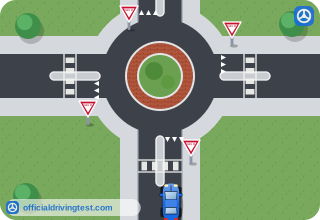
Which vehicles are permitted to use the truck apron around the center island of a roundabout?
- Passenger cars in a hurry
- Any vehicle that cannot find a gap in traffic
- Only vehicles carrying hazardous materials
- Large commercial trucks and trailers
Show answer
Correct answer: Large commercial trucks and trailers
Large commercial trucks and trailers may use the truck apron to negotiate the tight turning radius, while cars should not use it.
Source: Nevada Driver's Handbook (March 2024 (DMV 700)), page 44 · Open this page in the manual (Manual page 44)
-
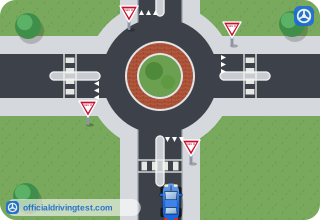
When a large commercial truck uses the raised truck apron of a roundabout, which wheels usually drive on it?
- Usually just the rear wheels
- All of the wheels
- Only the front wheels
- Only the wheels on the trailer's left side
Show answer
Correct answer: Usually just the rear wheels
The handbook says trucks usually drive with just the rear wheels on the raised pavement of the truck apron.
Source: Nevada Driver's Handbook (March 2024 (DMV 700)), page 44 · Open this page in the manual (Manual page 44)
-
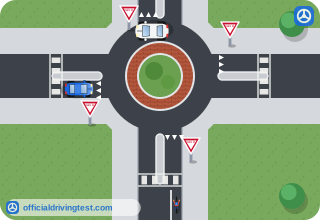
A bicyclist is unsure about using a roundabout. What does the handbook say to do?
- Ride on the truck apron
- Ride against the flow of traffic around the central island
- Dismount and walk the bike in the designated crosswalks
- Ride through the roundabout in the center of the lane without signaling
Show answer
Correct answer: Dismount and walk the bike in the designated crosswalks
A bicyclist who is unsure about using the roundabout should dismount and walk the bike in the designated crosswalks.
Source: Nevada Driver's Handbook (March 2024 (DMV 700)), page 44 · Open this page in the manual (Manual page 44)
-
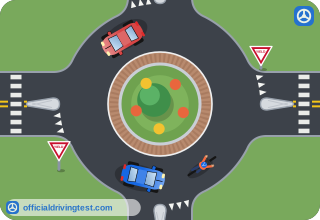
Why should a bicyclist ride at the speed of traffic in a roundabout?
- To be able to use the truck apron
- To discourage cars from wanting to pass
- To avoid having to yield when entering
- To be exempt from using hand signals
Show answer
Correct answer: To discourage cars from wanting to pass
Riding at the speed of traffic in the roundabout discourages cars from wanting to pass.
Source: Nevada Driver's Handbook (March 2024 (DMV 700)), page 44 · Open this page in the manual (Manual page 44)
-
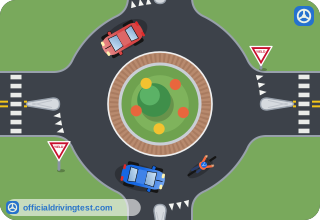
How should a bicyclist signal when exiting a roundabout?
- With a horn only
- No signal is needed in a roundabout
- With a flashing light on the center island
- With hand signals
Show answer
Correct answer: With hand signals
Bicyclists should use hand signals when exiting the roundabout.
Source: Nevada Driver's Handbook (March 2024 (DMV 700)), page 44 · Open this page in the manual (Manual page 44)
-
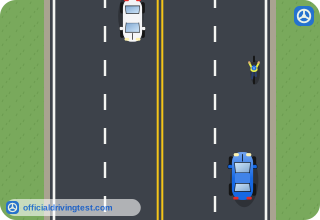
When passing a cyclist on a road with more than one lane in your direction, and moving over is reasonably safe, what must a motorist do?
- Move into the lane to the left
- Pass on the right side of the bicycle
- Stay in your lane and sound the horn
- Slow down and follow the cyclist until the road ends
Show answer
Correct answer: Move into the lane to the left
A motorist passing a cyclist must move into the lane to the left when more than one lane for traffic in the same direction exists and doing so is reasonably safe.
Source: Nevada Driver's Handbook (March 2024 (DMV 700)), page 48 · Open this page in the manual (Manual page 48)
-
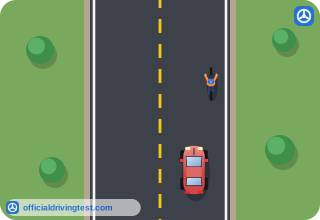
If there is no adjacent lane, what is the minimum distance a motorist must leave when passing a bicycle?
- One foot
- Two feet
- Three feet
- Five feet
Show answer
Correct answer: Three feet
When no adjacent lane exists, the motorist passes to the left of the bicycle at a safe distance, which must be at least three feet.
Source: Nevada Driver's Handbook (March 2024 (DMV 700)), page 48 · Open this page in the manual (Manual page 48)
-
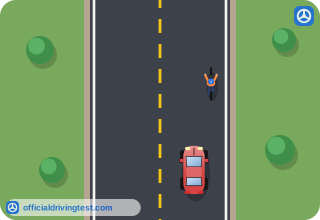
After passing a bicycle, when may the motorist move back to the right?
- When the cyclist has moved into the bicycle lane
- When the vehicle is safely clear of the bicycle
- After signaling for at least three seconds
- After driving at least 200 feet past the cyclist
Show answer
Correct answer: When the vehicle is safely clear of the bicycle
The motorist may not move back to the right until the vehicle is safely clear of the bicycle.
Source: Nevada Driver's Handbook (March 2024 (DMV 700)), page 48 · Open this page in the manual (Manual page 48)
-
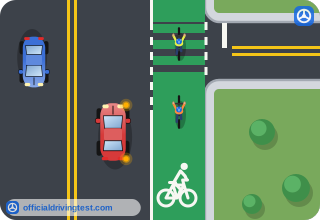
While passing a cyclist, what does the handbook say about traveling in a marked bicycle lane?
- It is allowed if you signal first
- It is allowed for up to 200 feet
- It is allowed at a low speed
- It is prohibited
Show answer
Correct answer: It is prohibited
The handbook states that traveling in a marked bicycle lane is prohibited when passing a cyclist.
Source: Nevada Driver's Handbook (March 2024 (DMV 700)), page 48 · Open this page in the manual (Manual page 48)
-
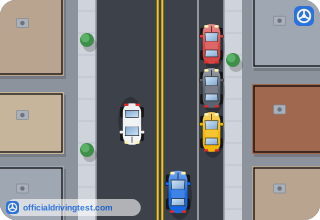
When driving past parked vehicles, which of these is a sign that a vehicle may be pulling out in front of you?
- The vehicle's hood is raised
- Its tires are turned toward the curb
- Its windows are covered with frost
- Exhaust is coming from the tailpipe
Show answer
Correct answer: Exhaust is coming from the tailpipe
The handbook lists exhaust coming from the tailpipe, along with a turn signal, white backup lights or red brake lights, as a sign that a parked vehicle may be pulling out.
Source: Nevada Driver's Handbook (March 2024 (DMV 700)), page 48 · Open this page in the manual (Manual page 48)
-
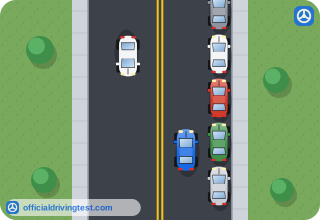
When driving past parked vehicles, who should you watch for trying to cross between the parked cars?
- Only pedestrians in marked crosswalks
- Pedestrians, bicyclists or skateboarders
- Only drivers entering from side streets
- Police officers directing traffic
Show answer
Correct answer: Pedestrians, bicyclists or skateboarders
The handbook tells drivers to watch for pedestrians, bicyclists or skateboarders trying to cross between parked cars.
Source: Nevada Driver's Handbook (March 2024 (DMV 700)), page 48 · Open this page in the manual (Manual page 48)
-
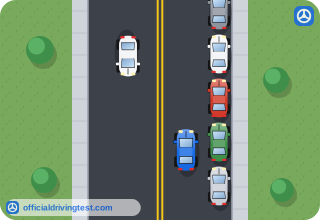
When driving past parked vehicles, what should you also watch for in front of or beside you?
- Vehicle doors opening
- Parked vehicles' mirrors folding in
- Parking meters running out of time
- Parked vehicles rolling backward
Show answer
Correct answer: Vehicle doors opening
The handbook says to watch for vehicle doors opening in front of or beside you when passing parked vehicles.
Source: Nevada Driver's Handbook (March 2024 (DMV 700)), page 48 · Open this page in the manual (Manual page 48)
-
Compared with a car, what do large commercial vehicles need in order to slow down or stop?
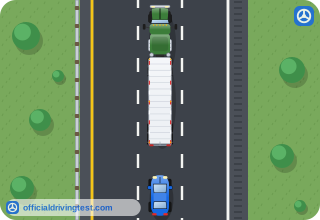
- More time and space
- The same time and space when the brakes are in good repair
- Less time but more space
- Less space but more time
Show answer
Correct answer: More time and space
The handbook says large commercial vehicles take more time and space to slow down or stop.
Source: Nevada Driver's Handbook (March 2024 (DMV 700)), page 62 · Open this page in the manual (Manual page 62)
-
How do the blind spots of large commercial vehicles compare with those of smaller vehicles?
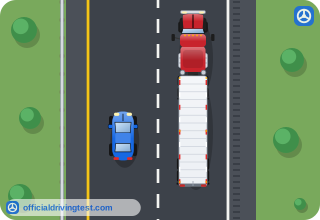
- They are about the same size
- They are smaller, because the driver sits higher
- They are much larger
- They are larger only on the left side
Show answer
Correct answer: They are much larger
The handbook states that large commercial vehicles have much larger blind spots than smaller vehicles.
Source: Nevada Driver's Handbook (March 2024 (DMV 700)), page 62 · Open this page in the manual (Manual page 62)
-
In a crash between a commercial vehicle and a small car, who is much more likely to be killed or injured?
- The driver of the commercial vehicle
- Both are equally likely to be hurt
- Only people outside the vehicles
- The people in the car
Show answer
Correct answer: The people in the car
The handbook says the people in cars are much more likely to be killed or injured than the driver of the commercial vehicle.
Source: Nevada Driver's Handbook (March 2024 (DMV 700)), page 62 · Open this page in the manual (Manual page 62)
-
What is a "no-zone" around a large commercial truck or bus?
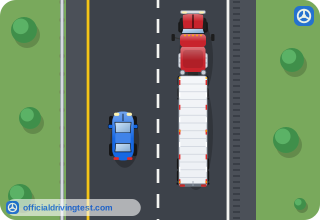
- The area where passing is prohibited
- The area the truck's headlights light up
- A lane used only by trucks and buses
- The area where cars disappear into blind spots
Show answer
Correct answer: The area where cars disappear into blind spots
The no-zone is the area around large trucks or buses where cars disappear into blind spots.
Source: Nevada Driver's Handbook (March 2024 (DMV 700)), page 62 · Open this page in the manual (Manual page 62)
-
Why is the right-side blind spot of a truck or bus described as doubly dangerous?
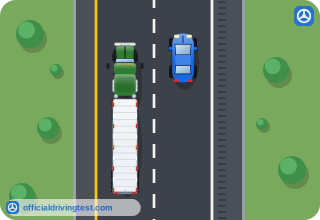
- Trucks and buses brake harder on the right
- Trucks and buses make wide right turns
- Truck drivers cannot use a right mirror
- Trucks and buses stay in the right lane
Show answer
Correct answer: Trucks and buses make wide right turns
The right-side blind spot is doubly dangerous because trucks and buses make wide right turns.
Source: Nevada Driver's Handbook (March 2024 (DMV 700)), page 62 · Open this page in the manual (Manual page 62)