Nevada: Sharing the road — Part 3 Practice Test
Questions in this part include: “What is the maximum horsepower of a moped, as Nevada defines it?” · “Who is required to wear a helmet on a moped in Nevada?”
Independent educational site · not affiliated with any government agency or DMV
Ready? Test yourself
- Instant feedback with an explanation
- Every answer cites its source in the manual
- Your best score is saved on this device
- Keyboard: press 1 to 4 to answer and Enter for the next question
Questions are original and based on the official manual "Nevada Driver's Handbook" (March 2024 (DMV 700)), Nevada Department of Motor Vehicles.
All 16 questions in this practice test
Take the test above first, then use this list to study. Tap “Show answer” to see the correct answer and explanation.
Show the questions and answersHide the questions
-
What should you do if you are coming up behind a motorcycle?
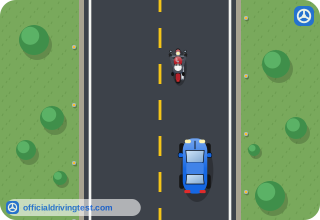
- Slow down sooner than usual and leave plenty of space
- Move up close behind so that the rider can see you
- Stay in position and honk to warn the rider ahead
- Slow down later than you would for another vehicle
Show answer
Correct answer: Slow down sooner than usual and leave plenty of space
The handbook says to slow down sooner than you would for another vehicle and leave plenty of space behind a motorcycle.
Source: Nevada Driver's Handbook (March 2024 (DMV 700)), page 63 · Open this page in the manual (Manual page 63)
-
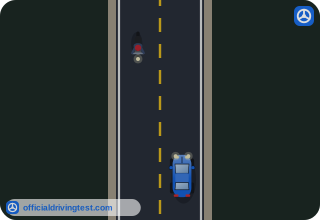
What should you do with your headlights when approaching a motorcycle?
- Leave the high beams on
- Turn them off
- Dim them
- Flash them repeatedly
Show answer
Correct answer: Dim them
The handbook says to always dim your headlights when approaching a motorcycle.
Source: Nevada Driver's Handbook (March 2024 (DMV 700)), page 64 · Open this page in the manual (Manual page 64)
-
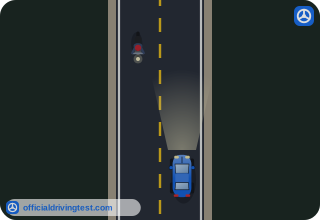
Why are high beams especially dangerous to a motorcyclist?
- Motorcycle headlights are weaker than car headlights
- Motorcycles do not have mirrors to block the glare
- Riders steer by balance, so being blinded is more dangerous
- Motorcycles cannot stop as quickly as large trucks
Show answer
Correct answer: Riders steer by balance, so being blinded is more dangerous
Because motorcyclists use their balance to steer, the blinding effect of high beams can be far more dangerous to them than to drivers of cars or large trucks.
Source: Nevada Driver's Handbook (March 2024 (DMV 700)), page 64 · Open this page in the manual (Manual page 64)
-
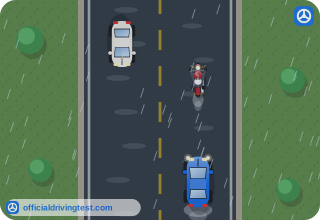
What should you allow around a motorcycle when it is raining or the road is slippery?
- Even more following distance
- The same following distance as in dry weather
- Less following distance, so the rider sees you
- A position directly beside the motorcycle
Show answer
Correct answer: Even more following distance
The handbook says to allow even more following distance behind motorcyclists when it is raining or the road is slippery.
Source: Nevada Driver's Handbook (March 2024 (DMV 700)), page 64 · Open this page in the manual (Manual page 64)
-
What is the maximum horsepower of a moped, as Nevada defines it?
- One brake horsepower
- Two brake horsepower
- Five brake horsepower
- Ten brake horsepower
Show answer
Correct answer: Two brake horsepower
Nevada defines mopeds partly by a maximum of two brake horsepower.
Source: Nevada Driver's Handbook (March 2024 (DMV 700)), page 64 · Open this page in the manual (Manual page 64)
-
What is the maximum speed of a moped on a flat or near-flat surface, as Nevada defines it?
- 20 miles per hour
- 30 miles per hour
- 40 miles per hour
- 45 miles per hour
Show answer
Correct answer: 30 miles per hour
Nevada defines mopeds partly by a 30 miles per hour maximum speed on a flat or near-flat surface.
Source: Nevada Driver's Handbook (March 2024 (DMV 700)), page 64 · Open this page in the manual (Manual page 64)
-
Where must moped operators remain on a road, unless an exception applies?
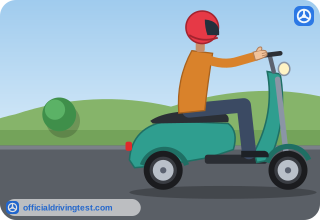
- In the left-hand lane
- In the center of the road
- On the shoulder
- In the extreme right-hand lane
Show answer
Correct answer: In the extreme right-hand lane
Moped operators must remain in the extreme right-hand lane of any road unless an exception applies.
Source: Nevada Driver's Handbook (March 2024 (DMV 700)), page 64 · Open this page in the manual (Manual page 64)
-
In which situation may a moped operator leave the extreme right-hand lane?
- When the moped is slower than other traffic
- When it is raining
- When directed by a police officer
- When passing a parked vehicle
Show answer
Correct answer: When directed by a police officer
The handbook lists exceptions, including when a police officer directs the moped operator.
Source: Nevada Driver's Handbook (March 2024 (DMV 700)), page 64 · Open this page in the manual (Manual page 64)
-
A moped operator preparing to make a left turn may leave the extreme right-hand lane. Within what distance from entering the lane must the turn be made?
- One-quarter mile
- One-eighth mile
- One-half mile
- One mile
Show answer
Correct answer: One-quarter mile
The handbook says the left turn must be made within one-quarter mile from entering the lane.
Source: Nevada Driver's Handbook (March 2024 (DMV 700)), page 64 · Open this page in the manual (Manual page 64)
-
Who is required to wear a helmet on a moped in Nevada?
- Operators only
- Passengers only
- Operators and passengers
- Only operators under 18
Show answer
Correct answer: Operators and passengers
The handbook says moped operators and passengers are required to wear helmets in Nevada.
Source: Nevada Driver's Handbook (March 2024 (DMV 700)), page 64 · Open this page in the manual (Manual page 64)
-
When must you stop for a school bus?
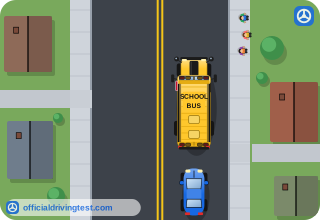
- Only when it shows flashing yellow lights on the road
- When it loads or unloads students with flashing red lights
- Only when children are crossing in front of the bus
- Only when a police officer directs you to stop
Show answer
Correct answer: When it loads or unloads students with flashing red lights
You are required to stop for school buses that are loading or unloading students and displaying a flashing red signal.
Source: Nevada Driver's Handbook (March 2024 (DMV 700)), page 64 · Open this page in the manual (Manual page 64)
-
When may you proceed past a school bus that has stopped with flashing red lights?
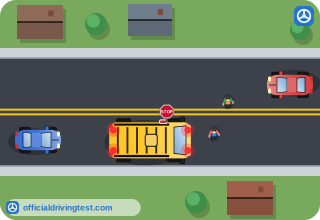
- As soon as the last child is out of the traffic lane
- After you have waited a full thirty seconds or more
- When the bus begins to pull away from the stop
- After the bus driver has turned off the flashing red lights
Show answer
Correct answer: After the bus driver has turned off the flashing red lights
You may not overtake or proceed past the school bus until the bus driver has turned off the flashing red lights.
Source: Nevada Driver's Handbook (March 2024 (DMV 700)), page 64 · Open this page in the manual (Manual page 64)
-
On a divided highway, when are you required to stop for a school bus with flashing red lights?
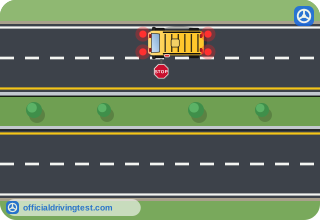
- Never, because of the median between the roadways
- Only when traveling opposite to the bus's direction
- Only when children are actually crossing the road
- Only when traveling in the same direction as the bus
Show answer
Correct answer: Only when traveling in the same direction as the bus
On divided highways, you are only required to stop when you are traveling in the same direction as the school bus.
Source: Nevada Driver's Handbook (March 2024 (DMV 700)), page 64 · Open this page in the manual (Manual page 64)
-
What happens when a school bus driver reports a violation to the school district and the Department of Motor Vehicles?
- The driver's license is canceled at once
- The registered owner is sent a warning letter
- The owner must appear in court within 30 days
- The registration is canceled
Show answer
Correct answer: The registered owner is sent a warning letter
The registered owner of the vehicle is sent a warning letter explaining the seriousness of the violation.
Source: Nevada Driver's Handbook (March 2024 (DMV 700)), page 64 · Open this page in the manual (Manual page 64)
-
Which rules must cyclists obey?
- The same rules and regulations as other vehicles
- Only the rules for pedestrians
- Only the rules posted on bicycle paths
- None, because bicycles are not motor vehicles
Show answer
Correct answer: The same rules and regulations as other vehicles
The handbook says cyclists must obey the same rules and regulations as other types of vehicles.
Source: Nevada Driver's Handbook (March 2024 (DMV 700)), page 65 · Open this page in the manual (Manual page 65)
-
Who is responsible for the safe interaction between bicyclists and motorists?
- Only the motorist
- Only the bicyclist
- Both parties
- Only a police officer
Show answer
Correct answer: Both parties
The handbook says the safe interaction between bicyclists and motorists is the responsibility of both parties.
Source: Nevada Driver's Handbook (March 2024 (DMV 700)), page 65 · Open this page in the manual (Manual page 65)