Montana: Sharing the road — Part 3 Practice Test
Questions in this part include: “What does it mean when a bicyclist is "doored"?” · “When a bicycle is used at nighttime, what must both of its tires be equipped with?”
Independent educational site · not affiliated with any government agency or DMV
Ready? Test yourself
- Instant feedback with an explanation
- Every answer cites its source in the manual
- Your best score is saved on this device
- Keyboard: press 1 to 4 to answer and Enter for the next question
Questions are original and based on the official manual "Montana Driver Manual" (Revised April 2024), Montana Department of Justice, Motor Vehicle Division.
All 18 questions in this practice test
Take the test above first, then use this list to study. Tap “Show answer” to see the correct answer and explanation.
Show the questions and answersHide the questions
-
A bicyclist riding slower than traffic wants to overtake and pass another vehicle going in the same direction. Under Montana law, may the bicyclist leave the right side of the roadway to do so?
- No; a bicyclist must stay at the right side at all times
- Only after getting off and walking the bicycle past it
- Yes; passing a vehicle going the same way is an exception
- Only on a road with two or more lanes in each direction
Show answer
Correct answer: Yes; passing a vehicle going the same way is an exception
Overtaking and passing another vehicle proceeding in the same direction is one of the exceptions to the rule that a slower bicyclist must ride as near to the right side as practicable.
Source: Montana Driver Manual (Revised April 2024), page 43
-
What does it mean when a bicyclist is "doored"?
- Someone in a parked car opens a door without checking for cyclists
- A bicyclist rides through an open gate and onto the roadway
- A driver opens a car door to signal a turn to a bicyclist
- A bicyclist is squeezed between two moving vehicles in a lane
Show answer
Correct answer: Someone in a parked car opens a door without checking for cyclists
Being "doored" describes a situation when a person in a parked vehicle suddenly opens the car door without checking for bicyclists approaching from behind.
Source: Montana Driver Manual (Revised April 2024), page 43
-
Most bicycles are not equipped with mirrors. What should you assume when you approach a bicyclist from behind?
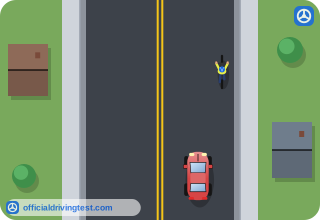
- The bicyclist has seen you and will move to the shoulder
- The bicyclist will hear your engine and stop to let you by
- The bicyclist will look back before changing position
- The bicyclist does not hear or see your vehicle
Show answer
Correct answer: The bicyclist does not hear or see your vehicle
Because most bicycles have no mirrors, bicyclists are often not aware of a motorist behind them. Assume the bicyclist does not hear or see you.
Source: Montana Driver Manual (Revised April 2024), page 43
-
A bicycle is traveling in your lane and you need to make a right turn. What should you always make sure of before turning?
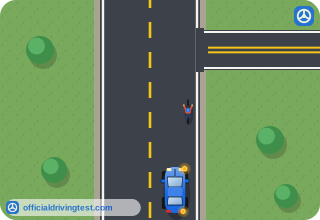
- The bicyclist is right beside your right front door
- The bicyclist has stopped to let you turn, or has passed you
- The bicyclist has a working light on the front
- The bicyclist has moved onto the sidewalk ahead of you
Show answer
Correct answer: The bicyclist has stopped to let you turn, or has passed you
Always check that the bicyclist has either stopped to let you turn, or allow the bicyclist to pass you before making the turn.
Source: Montana Driver Manual (Revised April 2024), page 44
-
According to the manual, on which side should a bicycle pass a motor vehicle?
- On the right
- On the left
- On the sidewalk
- Never; it may not pass
Show answer
Correct answer: On the left
Bicycles should pass on the left, although this is often overlooked because bicyclists feel comfortable passing on the right.
Source: Montana Driver Manual (Revised April 2024), page 44
-
Which statement about bicycles and lights during daytime travel is true?
- Bicycles must show a white front light at all times
- Bicycles must show a red rear light at all times
- Bicycles need daytime lights only on a highway
- Bicycles are not required to have lights in the daytime
Show answer
Correct answer: Bicycles are not required to have lights in the daytime
Bicycles are less visible and, unlike motorcycles, are not required to have lights during daytime travel.
Source: Montana Driver Manual (Revised April 2024), page 44
-
Why does the manual advise extra caution when you encounter youngsters on bikes?
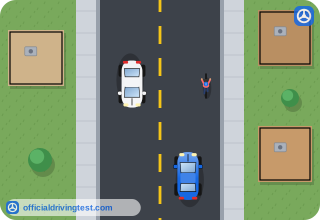
- Many have had no bike safety course and don't know many road rules
- They must ride on the sidewalk and often leave it suddenly
- They are allowed to ride on either side of the road
- They have the right-of-way over every motor vehicle
Show answer
Correct answer: Many have had no bike safety course and don't know many road rules
Many bicyclists are under 15 and have not taken a bicycle safety course or the Montana motor vehicle test, so they are unaware of many rules of the road.
Source: Montana Driver Manual (Revised April 2024), page 44
-
When a bicycle is used at nighttime, what front light does Montana law require?
- A white light visible for at least 100 feet
- A red light visible for at least 500 feet
- A white light visible for at least 500 feet
- An amber light visible for at least 1,000 feet
Show answer
Correct answer: A white light visible for at least 500 feet
Montana law requires a bicycle used at nighttime to have a front light that emits white light visible for at least 500 feet to the front.
Source: Montana Driver Manual (Revised April 2024), page 44
-
Which rear equipment does Montana law require on a bicycle?
- A red rear light visible from 500 feet
- A rear-view mirror on the handlebar
- A fluorescent orange flag on a pole
- Rear-facing reflectors
Show answer
Correct answer: Rear-facing reflectors
Rear-facing reflectors are required. A red light visible from 500 feet to the rear may be used in addition to them.
Source: Montana Driver Manual (Revised April 2024), page 44
-
When a bicycle is used at nighttime, what must both of its tires be equipped with?
- Studded treads for better grip on the pavement
- Retro-reflective sidewalls or spoke-mounted reflectors
- Fluorescent orange tape around each wheel rim
- Small lights mounted on the hub of each wheel
Show answer
Correct answer: Retro-reflective sidewalls or spoke-mounted reflectors
At nighttime, both tires of a bicycle must have retro-reflective sidewalls or reflectors mounted on the spokes of each wheel.
Source: Montana Driver Manual (Revised April 2024), page 44
-
How close to the inside of the rim must spoke-mounted bicycle reflectors be?
- Within 25 mm (1 inch)
- Within 152 mm (6 inches)
- Within 76 mm (3 inches)
- Within 305 mm (12 inches)
Show answer
Correct answer: Within 76 mm (3 inches)
Spoke-mounted reflectors must be within 76 mm (3 inches) of the inside of the rim and visible on each side of the wheel.
Source: Montana Driver Manual (Revised April 2024), page 44
-
What color must the reflectors on the front wheel of a bicycle be?
- Essentially colorless or amber
- Essentially red or blue
- Fluorescent green or bright blue
- Red only, never amber
Show answer
Correct answer: Essentially colorless or amber
The reflectors on the front wheel of a bicycle must be essentially colorless or amber.
Source: Montana Driver Manual (Revised April 2024), page 44
-
What color must the reflectors on the rear wheel of a bicycle be?
- Amber or red
- Green or blue
- Blue or white
- Green only
Show answer
Correct answer: Amber or red
The reflectors on the rear wheel of a bicycle must be amber or red.
Source: Montana Driver Manual (Revised April 2024), page 44
-
What kind of brake does Montana law require on a bicycle?
- One that works on the front wheel only, like a hand brake
- One that can stop the bicycle within 10 feet at any speed
- One that can make the wheels skid on dry, level, clean pavement
- One that locks the pedals when the rider stops pedaling
Show answer
Correct answer: One that can make the wheels skid on dry, level, clean pavement
Montana law requires a bicycle brake that will enable the operator to make the wheels skid on dry, level, clean pavement.
Source: Montana Driver Manual (Revised April 2024), page 44
-
The manual encourages every bicyclist to add a fluorescent orange flag. How high above the roadway should it be when the bicycle is standing upright?
- At least 2 feet
- At least 6 feet
- At least 3 feet
- At least 10 feet
Show answer
Correct answer: At least 6 feet
Every bicyclist is encouraged to equip the bicycle with a fluorescent orange flag, clearly visible from the rear and suspended at least 6 feet above the roadway.
Source: Montana Driver Manual (Revised April 2024), page 44
-
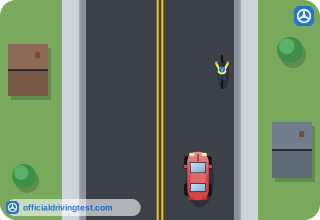
According to the manual, what is one of the major causes of vehicle/bicycle crashes?
- Most bicyclists ride against traffic
- Most bicycles have no working brakes
- Most motorists drive too slowly
- Most motorists do not see the bicyclist
Show answer
Correct answer: Most motorists do not see the bicyclist
One of the major causes of vehicle/bicycle crashes is that most motorists do not see the bicyclist.
Source: Montana Driver Manual (Revised April 2024), page 44
-
When does the manual tell drivers to pay extra attention for bicycles?
- Only on rural roads where the speed limit is 65 mph or more
- Only in school zones on days when school is in session
- As you enter streets, cross bikeways or sidewalks, and make turns
- Only after dark, when bicycles must show lights
Show answer
Correct answer: As you enter streets, cross bikeways or sidewalks, and make turns
Think of a bicycle as you do a vehicle, and pay extra attention as you enter streets, cross bikeways or sidewalks, and when you make turns.
Source: Montana Driver Manual (Revised April 2024), page 44
-
The manual tells drivers to watch for children on bicycles who may dart out from where?
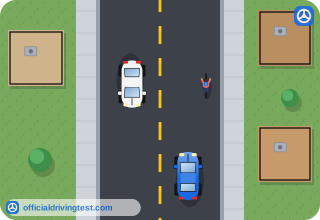
- Between parked cars or hedges
- Only from marked bike lanes
- Only from school bus stops
- Only from marked crosswalks
Show answer
Correct answer: Between parked cars or hedges
Watch for children on bicycles who may dart out between parked cars or hedges; bicyclists are very vulnerable.
Source: Montana Driver Manual (Revised April 2024), page 44