Montana: Sharing the road — Part 5 Practice Test
Questions in this part include: “On a two-lane road, what does keeping space between you and oncoming vehicles mean?” · “As a general rule, how many vehicles should you pass at a time?”
Independent educational site · not affiliated with any government agency or DMV
Ready? Test yourself
- Instant feedback with an explanation
- Every answer cites its source in the manual
- Your best score is saved on this device
- Keyboard: press 1 to 4 to answer and Enter for the next question
Questions are original and based on the official manual "Montana Driver Manual" (Revised April 2024), Montana Department of Justice, Motor Vehicle Division.
All 18 questions in this practice test
Take the test above first, then use this list to study. Tap “Show answer” to see the correct answer and explanation.
Show the questions and answersHide the questions
-
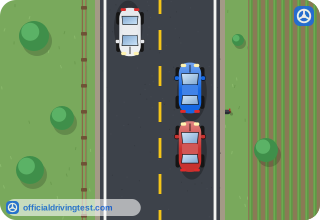
You are being tailgated and there is no right lane. What should you do?
- Brake hard right away so the driver must go around
- Speed up until the driver falls behind
- Stop in your lane so the driver can pass
- Wait until the way is clear, then reduce speed slowly
Show answer
Correct answer: Wait until the way is clear, then reduce speed slowly
With no right lane, you wait until the way is clear and then reduce speed slowly, which encourages the tailgater to drive around you.
Source: Montana Driver Manual (Revised April 2024), page 65
-
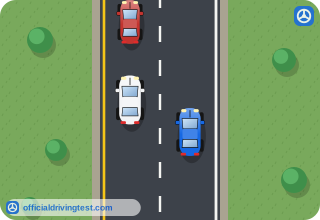
How can you avoid driving next to other vehicles on a multi-lane road?
- Stay beside the other vehicle and match its speed
- Move to the center line and keep your speed
- Move ahead or drop to the back of the other vehicle
- Flash your headlights so the other driver sees you
Show answer
Correct answer: Move ahead or drop to the back of the other vehicle
Someone driving next to you may crowd your lane or pull into you, so you move ahead or drop to the back of the other vehicle.
Source: Montana Driver Manual (Revised April 2024), page 65
-
On a two-lane road, what does keeping space between you and oncoming vehicles mean?
- Driving on the right edge of the road
- Not crowding the center line
- Staying very close to parked vehicles
- Driving on the shoulder
Show answer
Correct answer: Not crowding the center line
On a two-lane road, keeping as much space as you can from oncoming vehicles means not crowding the center line.
Source: Montana Driver Manual (Revised April 2024), page 65
-
In general, where in your lane is it safest to drive?
- Near the right edge of your lane
- Near the left edge of your lane
- On the line next to the shoulder
- In the center of your lane
Show answer
Correct answer: In the center of your lane
In general, it is safest to drive in the center of your lane.
Source: Montana Driver Manual (Revised April 2024), page 65
-
Vehicles are entering a roadway that has two or more lanes, and no one is next to you. What should you do?
- Move over a lane to make room for them
- Speed up so you pass the entrance before they enter
- Stay in your lane and flash your headlights
- Move to the shoulder and stop
Show answer
Correct answer: Move over a lane to make room for them
You make room for vehicles entering a roadway with two or more lanes by moving over a lane if there is no one next to you.
Source: Montana Driver Manual (Revised April 2024), page 65
-
Why should you keep extra space between your vehicle and parked vehicles?
- Parked vehicles have the right-of-way when you pass them
- Parked vehicles are required to keep their lights off
- Someone could step out from between parked vehicles
- Parked vehicles may block the lane markings from your view
Show answer
Correct answer: Someone could step out from between parked vehicles
Someone could step out from a parked vehicle or from between vehicles, or a parked vehicle could pull out.
Source: Montana Driver Manual (Revised April 2024), page 65
-
What is the “Split the Difference Rule”?
- Steer a middle course between two hazards on the road
- Drive halfway between the speed limit and the speed of traffic
- Share a lane equally with a bicyclist or pedestrian
- Divide your following distance equally between two vehicles
Show answer
Correct answer: Steer a middle course between two hazards on the road
The “Split the Difference Rule” means splitting the difference between two hazards, for example steering a middle course between oncoming and parked vehicles.
Source: Montana Driver Manual (Revised April 2024), page 66
-
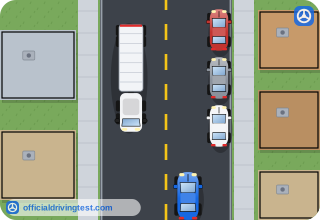
A tractor-trailer is approaching on one side and parked vehicles are on the other. Where should you leave a little more room?
- On the side where the parked vehicles are
- Equally on both sides, with no change
- On the side that the truck will pass
- Toward the center line so the truck can see you
Show answer
Correct answer: On the side that the truck will pass
If one hazard is more dangerous, you leave a little more space on that side; for an oncoming tractor-trailer, that is the side the truck will pass.
Source: Montana Driver Manual (Revised April 2024), page 66
-
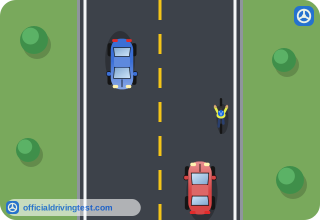
You are overtaking a bicycle and an oncoming vehicle is approaching. What should you do?
- Speed up and pass the bicycle before the oncoming vehicle arrives
- Slow down and let the vehicle pass first, then give the bicycle extra room
- Stay beside the bicycle and match its speed until the road is clear
- Pass the bicycle at once, staying close to the center line of the road
Show answer
Correct answer: Slow down and let the vehicle pass first, then give the bicycle extra room
Take hazards one at a time: slow down and let the oncoming vehicle pass first so you can give extra room to the bicycle.
Source: Montana Driver Manual (Revised April 2024), page 66
-
As a general rule, how many vehicles should you pass at a time?
- Two
- One
- Three
- As many as the road allows
Show answer
Correct answer: One
As a general rule, you only pass one vehicle at a time, because you should not count on having enough time to pass several cars at once.
Source: Montana Driver Manual (Revised April 2024), page 66
-
At a speed of 55 mph, about how long do you need to pass?
- About 4 seconds
- About 6 seconds
- About 20 seconds
- About 10 seconds
Show answer
Correct answer: About 10 seconds
At 55 mph you need about 10 seconds to pass, which means a 10 second gap in oncoming traffic and sight distance.
Source: Montana Driver Manual (Revised April 2024), page 66
-
At 55 mph, how much space do you need to pass safely, counting an oncoming vehicle?
- Over 1600 feet, or about one-third of a mile
- About 400 feet, or one-twelfth of a mile
- About 1,000 feet, or one-fifth of a mile
- About 2,500 feet, or one-half of a mile
Show answer
Correct answer: Over 1600 feet, or about one-third of a mile
You and an oncoming vehicle each travel over 800 feet in 10 seconds, so you need over 1600 feet, or about one-third of a mile, to pass safely.
Source: Montana Driver Manual (Revised April 2024), page 67
-
How does an oncoming vehicle that is far enough away generally appear when you judge its speed?
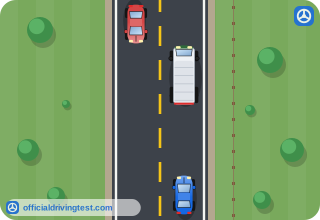
- To be coming faster than it really is
- To be slowing down
- To be standing still
- To be changing lanes
Show answer
Correct answer: To be standing still
A vehicle that is far enough away generally appears to be standing still, so oncoming vehicles do not seem to be coming as fast as they really are.
Source: Montana Driver Manual (Revised April 2024), page 67
-
You are not sure whether there is enough space to pass an oncoming vehicle. What should you do?
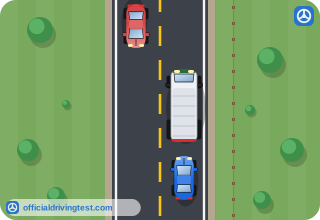
- Pass quickly before the vehicle gets closer
- Wait to pass until you are sure there is enough space
- Start to pass and turn back if the vehicle comes too close
- Pass only if you can still see the vehicle moving closer
Show answer
Correct answer: Wait to pass until you are sure there is enough space
If you are not sure, you wait to pass until you are sure that there is enough space.
Source: Montana Driver Manual (Revised April 2024), page 67
-
Your view is blocked by a curve or a hill. What should you assume?
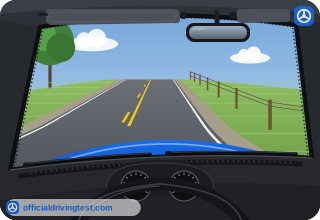
- That an oncoming vehicle is just out of your sight
- That the road ahead is clear for passing
- That oncoming drivers will slow down for you
- That you have the right-of-way over oncoming traffic
Show answer
Correct answer: That an oncoming vehicle is just out of your sight
Anytime your view is blocked by a curve or a hill, you should assume there is an oncoming vehicle just out of your sight and treat the curve or hill like an oncoming vehicle.
Source: Montana Driver Manual (Revised April 2024), page 67
-
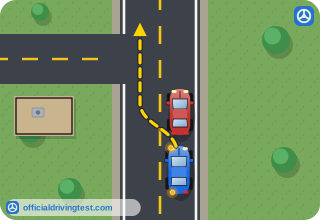
Why is it dangerous to pass where a vehicle is likely to enter or cross the road, such as at an intersection?
- Road markings do not show where you may return to your lane
- Drivers there are not allowed to slow down for passing vehicles
- The vehicle you pass can block your view of people, vehicles or trains
- Traffic signals cannot be seen from the oncoming lane
Show answer
Correct answer: The vehicle you pass can block your view of people, vehicles or trains
While you are passing, the vehicle you are passing can block your view of people, vehicles or trains.
Source: Montana Driver Manual (Revised April 2024), page 67
-
Before you pass, what should you look ahead for?
- Only the vehicles that are in front of the vehicle you are passing
- Conditions and traffic that may push other vehicles into your lane
- Road signs that show the posted speed limit for passing
- Places where the road shoulder is wide enough to drive on
Show answer
Correct answer: Conditions and traffic that may push other vehicles into your lane
Before you pass, you look ahead for road conditions and traffic that may cause other vehicles to move into your lane.
Source: Montana Driver Manual (Revised April 2024), page 67
-
What must you have before you pass?
- A driver ahead who has agreed to make room for you
- A signal from the driver you are passing
- A clear view of the next intersection
- Enough space to return to the driving lane
Show answer
Correct answer: Enough space to return to the driving lane
You do not pass unless you have enough space to return to the driving lane, and you do not count on other drivers to make room for you.
Source: Montana Driver Manual (Revised April 2024), page 67