Montana: Sharing the road
School buses, bicycles and their equipment, motorcycles, large trucks, slow-moving vehicles and passing safely on two-lane roads. Split into 6 shorter tests so you're not stuck in one long quiz.
Independent educational site · not affiliated with any government agency or DMV
Choose a part
Sharing the road — Part 1
Questions in this part include: “Which slow-moving vehicle is not required to display the slow-moving emblem?”
StartSharing the road — Part 2
Questions in this part include: “How far to the right are bicyclists required by law to ride?”
StartSharing the road — Part 3
Questions in this part include: “What does it mean when a bicyclist is "doored"?”
StartSharing the road — Part 4
Questions in this part include: “Which road users does the manual say are harder to see than cars and trucks?”
StartSharing the road — Part 5
Questions in this part include: “On a two-lane road, what does keeping space between you and oncoming vehicles mean?”
StartSharing the road — Part 6
Questions in this part include: “After passing a vehicle, when is it safe to return to the driving lane?”
StartAll 109 Sharing the road questions with answers
Choose a part above to take a practice test, or study every question and answer here.
Show the questions and answersHide the questions
-
A slow-moving vehicle normally operating at or under what speed must display an emblem on its rear?
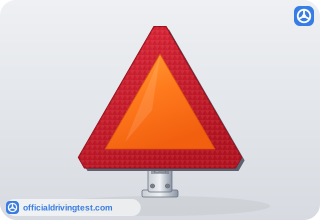
- 25 miles per hour
- 15 miles per hour
- 35 miles per hour
- 45 miles per hour
Show answer
Correct answer: 25 miles per hour
The manual says slow-moving vehicles normally operating at or under 25 miles per hour must display an emblem on the rear.
Source: Montana Driver Manual (Revised April 2024), page 18
-
Which slow-moving vehicle is not required to display the slow-moving emblem?
- Road machinery driving on the highway to a job site
- An animal-drawn vehicle on a two-lane highway
- Machinery doing actual road work, guarded by a flagger
- A farm tractor moved on a two-lane highway
Show answer
Correct answer: Machinery doing actual road work, guarded by a flagger
The manual exempts road construction or maintenance machinery engaged in actual work and guarded by a flagger or warning signs.
Source: Montana Driver Manual (Revised April 2024), page 18
-
What are the base and height of the slow-moving vehicle triangle emblem?
- 8 inches and 8 inches
- 14 inches and 14 inches
- 10 inches and 14 inches
- 20 inches and 20 inches
Show answer
Correct answer: 14 inches and 14 inches
The manual says the emblem is a triangle with a base of 14 inches and a height of 14 inches.
Source: Montana Driver Manual (Revised April 2024), page 18
-
At what height above the roadway must the slow-moving vehicle emblem be mounted in the center of the rear of the vehicle?
- One to two feet
- Five to seven feet
- Seven to nine feet
- Three to five feet
Show answer
Correct answer: Three to five feet
The manual says the emblem is mounted in the center of the rear at a height of three to five feet above the roadway.
Source: Montana Driver Manual (Revised April 2024), page 18
-
How wide are the reflective red stripes in the border of the slow-moving vehicle emblem?
- One and one-quarter inches
- Two and one-half inches
- Three and one-quarter inches
- One and three-quarters inches
Show answer
Correct answer: One and three-quarters inches
The manual says the border has reflective red stripes one and three-quarters inches wide.
Source: Montana Driver Manual (Revised April 2024), page 18
-
When traffic is held up behind a slow-moving vehicle on a two-lane highway, what must the slow-moving vehicle do?
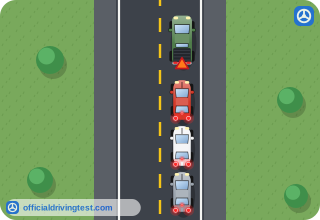
- Speed up to the posted speed limit
- Pull over at the first safe opportunity
- Stop immediately in the travel lane
- Move to the center of the roadway
Show answer
Correct answer: Pull over at the first safe opportunity
The manual says it must, at the first safe opportunity with sufficient room for turnout, pull over to allow other vehicles to pass.
Source: Montana Driver Manual (Revised April 2024), page 18
-
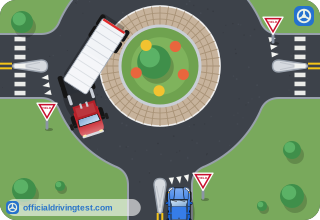
At a single-lane roundabout, what should the driver of a smaller vehicle do while a large truck completes its travel through?
- Pass the truck on the left side
- Drive right beside the truck
- Move up onto the truck apron
- Drop back behind the larger truck
Show answer
Correct answer: Drop back behind the larger truck
The rear wheels of a large vehicle will cross over the truck apron, so the driver of the smaller vehicle should drop back behind the truck.
Source: Montana Driver Manual (Revised April 2024), page 32
-
What is the truck apron in a single-lane roundabout?
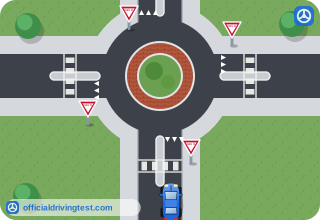
- A sloped, flat curb on the center island that rear wheels of large vehicles cross
- A painted lane where trucks wait for a gap before entering the roundabout
- A raised island in the crosswalk where pedestrians may stand and wait
- A ramp that lets large vehicles leave the circle without making a turn
Show answer
Correct answer: A sloped, flat curb on the center island that rear wheels of large vehicles cross
The center island of a single-lane roundabout has a gradually sloped and flat curb called a truck apron, which the rear wheels of a large vehicle will cross over.
Source: Montana Driver Manual (Revised April 2024), page 32
-
At a roundabout, what are bicyclists encouraged to do?
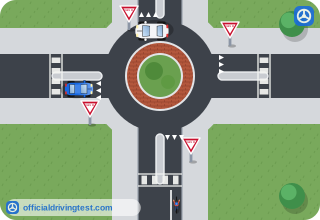
- Ride on the sidewalks and cross at the crosswalks without dismounting
- Ride on the truck apron so that they stay well clear of the cars
- Stay to the left of the center island and ride against the flow
- Walk their bicycles on the sidewalks and use the pedestrian crosswalks
Show answer
Correct answer: Walk their bicycles on the sidewalks and use the pedestrian crosswalks
Bicyclists are encouraged to walk their bicycles on the sidewalks and use the pedestrian crosswalks.
Source: Montana Driver Manual (Revised April 2024), page 32
-
What rules apply to a bicyclist who rides on the circulatory roadway of a roundabout?
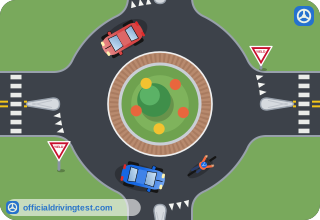
- The same traffic rules as motorized vehicles
- Pedestrian rules only
- No rules, since bicycles are not vehicles
- Rules that apply only on the sidewalk
Show answer
Correct answer: The same traffic rules as motorized vehicles
A bicyclist who is comfortable riding in traffic may ride on the circulatory roadway like a car, obeying the same traffic rules as motorized vehicles.
Source: Montana Driver Manual (Revised April 2024), page 32
-
When you meet or pass a school bus stopped with its red lights flashing, at least how far from the bus must you stop?
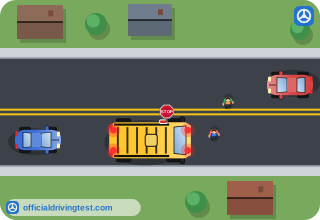
- 30 feet
- 10 feet
- 15 feet
- 50 feet
Show answer
Correct answer: 30 feet
Upon meeting or passing from either direction a school bus stopped with its red lights flashing, you must stop at least 30 feet from the bus.
Source: Montana Driver Manual (Revised April 2024), page 40
-
How long must you stay stopped for a school bus that has its red lights flashing?
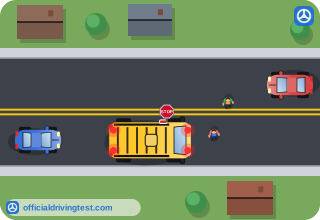
- When the red lights are turned off
- For at least one full minute
- Until the bus driver waves you on
- Until the stop arm starts to fold
Show answer
Correct answer: When the red lights are turned off
A driver stopped for a school bus with its red lights flashing cannot proceed until the red lights are turned off.
Source: Montana Driver Manual (Revised April 2024), page 40
-
On a two-lane road, a school bus is stopped with its red lights flashing. Which drivers must stop?
- Only drivers behind the bus
- Only drivers meeting the bus
- Drivers coming from either direction
- Only drivers in the lane of the bus
Show answer
Correct answer: Drivers coming from either direction
Upon meeting or passing from either direction any school bus stopped with its red lights flashing, a driver must stop.
Source: Montana Driver Manual (Revised April 2024), page 40
-
What must you do when a school bus ahead is slowing down to stop, or is showing a yellow flashing light?
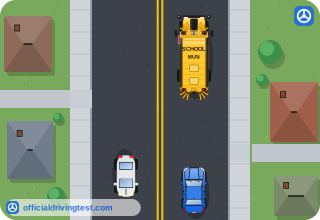
- Speed up to pass before it stops
- Slow down and proceed carefully
- Stop until the yellow lights go off
- Keep your speed and sound your horn
Show answer
Correct answer: Slow down and proceed carefully
If a bus is slowing down to stop to load passengers, or is displaying a yellow flashing light, you must slow down and proceed carefully, because children may be in the road.
Source: Montana Driver Manual (Revised April 2024), page 40
-
In which case does the manual say you do not need to stop for a school bus that has stopped?
- You are behind the bus on a two-lane road
- You are meeting it on a two-lane road
- No children are visible near the bus
- The bus is on a different road
Show answer
Correct answer: The bus is on a different road
You do not need to stop if meeting or passing a school bus that is on a different road.
Source: Montana Driver Manual (Revised April 2024), page 40
-
You do not need to stop for a school bus stopped in an adjacent loading zone when what is true?
- The bus is parked on your side of the road
- The bus door is still closed
- Pedestrians are not allowed to cross the road
- You are traveling below 25 mph
Show answer
Correct answer: Pedestrians are not allowed to cross the road
You do not need to stop for a school bus stopped in an adjacent loading zone where pedestrians are not allowed to cross the road.
Source: Montana Driver Manual (Revised April 2024), page 40
-
When does the manual say to slow down and watch for children when driving past a school?
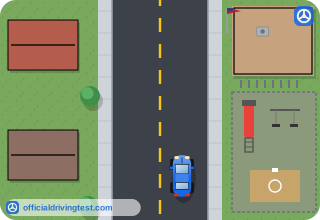
- Day and night
- Only on school days
- Only during school hours
- Only when a sign flashes
Show answer
Correct answer: Day and night
When driving past a school, slow down and watch for children day and night, because kids go back to use the playground at all hours.
Source: Montana Driver Manual (Revised April 2024), page 41
-
Under Montana law, how are bicycles treated?
- As vehicles under the same traffic laws
- As pedestrians whenever they ride on the road
- As toys that no traffic laws apply to
- As motor vehicles that need a license
Show answer
Correct answer: As vehicles under the same traffic laws
Under Montana law, bicycles are considered vehicles and are governed by the same traffic laws that reasonably apply to their operation.
Source: Montana Driver Manual (Revised April 2024), page 42
-
What does the manual say motorists should realize about bicycles and mopeds?
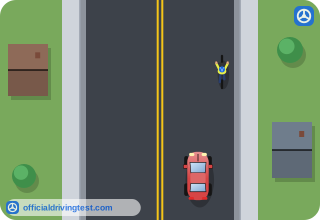
- They travel as fast as cars in town
- They never use rural roadways
- They must ride on the sidewalk
- They travel slower, so adjust when passing
Show answer
Correct answer: They travel slower, so adjust when passing
Bicycles and mopeds travel at a slower speed, so motorists should make the appropriate adjustments when passing or sharing the roadway with them.
Source: Montana Driver Manual (Revised April 2024), page 42
-
You approach a cyclist from behind on a high-speed, two-lane roadway. According to the manual, what is the safest way to pass?
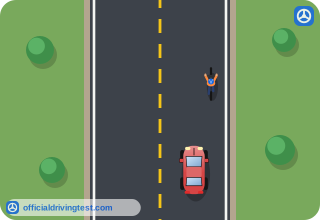
- Treat the cyclist like any other slow-moving vehicle, such as a farm tractor
- Stay in your lane and pass close beside the cyclist without slowing down
- Use the paved shoulder on the right to pass the cyclist more quickly
- Speed up and pass before the cyclist has time to change position
Show answer
Correct answer: Treat the cyclist like any other slow-moving vehicle, such as a farm tractor
The manual says the safest way to pass a cyclist on a high-speed, two-lane roadway is to view the cyclist as any other legitimate slow-moving vehicle, such as a farm tractor.
Source: Montana Driver Manual (Revised April 2024), page 43
-
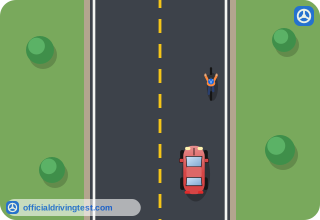
You are passing a cyclist on a high-speed, two-lane roadway and there is no oncoming traffic. How much distance does the manual recommend leaving between the cyclist and your vehicle?
- One foot
- Two feet
- Five feet
- Three feet
Show answer
Correct answer: Five feet
With no oncoming traffic, the manual recommends giving the cyclist a five-foot distance between them and your motor vehicle.
Source: Montana Driver Manual (Revised April 2024), page 43
-
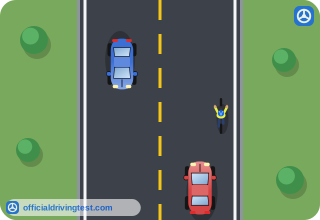
You approach a cyclist from behind on a high-speed, two-lane roadway and there is oncoming traffic. What should you do?
- Pass quickly before the oncoming traffic gets near you
- Slow to the speed of the cyclist and wait until it is safe to pass
- Pass within your own lane, keeping close to the cyclist
- Move onto the shoulder and pass the cyclist on the right
Show answer
Correct answer: Slow to the speed of the cyclist and wait until it is safe to pass
If there is oncoming traffic, slow to the speed of the cyclist and wait for it to be safe to pass.
Source: Montana Driver Manual (Revised April 2024), page 43
-
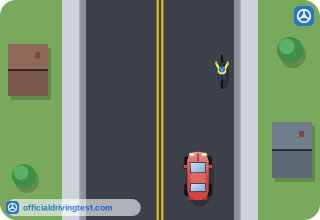
What should you assume when you need to pass a cyclist on the road?
- The cyclist rides on the shoulder, so you can pass within your lane
- The cyclist will move onto the shoulder as soon as you get close
- The cyclist will speed up so that you can pass more quickly
- You will need to wait for a safe time to leave your lane to pass
Show answer
Correct answer: You will need to wait for a safe time to leave your lane to pass
Do not assume a cyclist is riding on the shoulder. Assume that to pass safely you will need to wait for a safe time to leave your driving lane.
Source: Montana Driver Manual (Revised April 2024), page 43
-
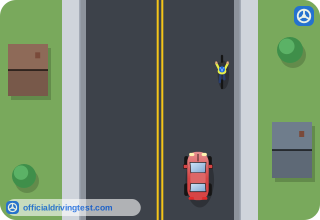
Why does the manual warn drivers not to assume a cyclist is riding alone?
- Cyclists must by law ride in groups of two or more on highways
- Cyclists riding in groups must always use the paved shoulder
- Cyclists often travel in single-file groups that take more time to pass
- Cyclists in groups must use bike paths, never the roadway
Show answer
Correct answer: Cyclists often travel in single-file groups that take more time to pass
Cyclists often travel in groups and ride in a single-file line, so it takes more time to pass all of them safely.
Source: Montana Driver Manual (Revised April 2024), page 43
-
How far to the right are bicyclists required by law to ride?
- As far to the right as practical
- Always on the shoulder of the road
- Always in the center of the lane
- Within 3 feet of the center line
Show answer
Correct answer: As far to the right as practical
Bicyclists must by law ride as far to the right as practical, which does not mean they are always on the shoulder.
Source: Montana Driver Manual (Revised April 2024), page 43
-
Many bicyclists ride approximately how far into the lane to discourage drivers from a dangerous in-lane pass?
- 2-6 inches
- 36-48 inches
- 6-8 feet
- 18-24 inches
Show answer
Correct answer: 18-24 inches
Many bicyclists ride further into the lane, approximately 18-24 inches, to discourage motorists from attempting a dangerous in-lane pass.
Source: Montana Driver Manual (Revised April 2024), page 43
-
By following shared lane markings (sharrows), what can cyclists avoid?
- Having to obey the traffic signals and stop signs on the road
- Being hit by an opening car door or squeezed in a narrow lane
- Having to signal before they turn at an intersection ahead
- Having to ride in single file on a busy, narrow roadway
Show answer
Correct answer: Being hit by an opening car door or squeezed in a narrow lane
By following the markings of two arrows over a bicycle, cyclists can avoid being hit by the open door of a parked vehicle or getting squeezed next to a motor vehicle in a narrow lane.
Source: Montana Driver Manual (Revised April 2024), page 43
-
What must you do when you see a shared lane marking (two arrows over a bicycle) in your lane?
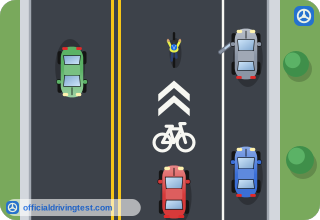
- Leave the lane, because it is reserved for bicycles only
- Stop and wait until no bicyclist is left in the lane
- Use the lane only to turn right at the next intersection
- Look out for bicyclists and leave them enough space when passing
Show answer
Correct answer: Look out for bicyclists and leave them enough space when passing
When you see a shared lane marking, you must look out for bicyclists and make sure you leave them enough space when passing.
Source: Montana Driver Manual (Revised April 2024), page 43
-
Under Montana law, what rights must motorists grant to people operating bicycles?
- Fewer rights, since bicycles are not considered vehicles
- Rights only while the bicyclist rides in a bicycle lane
- The same rights as any vehicle legitimately on the road
- Greater rights than any other vehicle in every situation
Show answer
Correct answer: The same rights as any vehicle legitimately on the road
Montana law says motorists must grant people operating bicycles the same rights as the operators of any vehicle legitimately using Montana roadways.
Source: Montana Driver Manual (Revised April 2024), page 43
-
Under Montana law, which of these may a motorist NOT do to a person lawfully riding a bicycle?
- Slow to the bicyclist's speed and wait to pass
- Pass when it can be done without endangering anyone
- Give the bicyclist the same rights as other vehicles
- Intentionally interfere with the bicyclist's movement
Show answer
Correct answer: Intentionally interfere with the bicyclist's movement
Montana law says motorists may not intentionally interfere with the movement of a person lawfully riding a bicycle.
Source: Montana Driver Manual (Revised April 2024), page 43
-
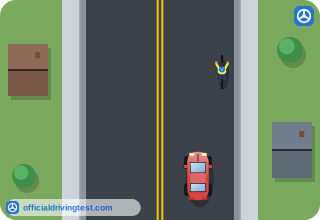
Under Montana law, when may a motorist overtake and pass a person riding a bicycle?
- Whenever the bicyclist is riding slower than the speed limit
- Only when it won't endanger the rider or people in nearby vehicles
- Only after the bicyclist has moved fully onto the shoulder
- Whenever the road has two or more lanes in each direction
Show answer
Correct answer: Only when it won't endanger the rider or people in nearby vehicles
Motorists may not overtake and pass a person riding a bicycle unless it can be done without endangering the bicyclist or those in any nearby motor vehicle.
Source: Montana Driver Manual (Revised April 2024), page 43
-
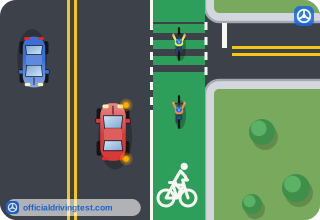
A person is riding a bicycle within a designated bicycle lane. Under Montana law, who must yield the right-of-way?
- The bicyclist
- Whoever arrives first
- The motorist
- Neither one
Show answer
Correct answer: The motorist
Montana law says motorists must yield the right-of-way to a person riding a bicycle within a designated bicycle lane.
Source: Montana Driver Manual (Revised April 2024), page 43
-
Unless one of the law's exceptions applies, how must people riding bicycles on a roadway ride?
- In single file
- Two abreast
- Three abreast
- In a group
Show answer
Correct answer: In single file
Individuals riding bicycles on a roadway must ride in single file, except in the cases the law lists.
Source: Montana Driver Manual (Revised April 2024), page 43
-
On which of these may people riding bicycles ride two abreast?
- A paved shoulder or a parking lane
- A narrow lane on a two-lane highway
- Any lane, if no vehicle is behind them
- A lane next to the center line at night
Show answer
Correct answer: A paved shoulder or a parking lane
Bicyclists riding on a paved shoulder or on a parking lane may ride two abreast.
Source: Montana Driver Manual (Revised April 2024), page 43
-
Bicyclists are riding within a single lane of a roadway with at least two lanes in each direction. When may they ride two abreast?
- Only when no motor vehicle is in sight behind them
- Only in daylight hours on a dry road surface
- If they impede traffic no more than riding single file would
- Never; they must always ride single file there
Show answer
Correct answer: If they impede traffic no more than riding single file would
On a laned roadway with at least two lanes in each direction, bicyclists may ride two abreast in a single lane if they do not impede the normal and reasonable movement of traffic more than they would by riding single file.
Source: Montana Driver Manual (Revised April 2024), page 43
-
A bicyclist is riding slower than the normal speed of traffic. When may the bicyclist move away from the right side of the roadway?
- Whenever the road is wet from rain
- When preparing to turn left at an intersection
- When riding at night on a road with no shoulder
- When the posted speed limit is above 45 mph
Show answer
Correct answer: When preparing to turn left at an intersection
A bicyclist slower than traffic must ride as near to the right side as practicable, except when preparing for a left turn at an intersection or into a private road or driveway, among other listed cases.
Source: Montana Driver Manual (Revised April 2024), page 43
-
Which of these does Montana law list as a condition that lets a slower bicyclist move away from the right side of the roadway?
- A posted speed limit above 45 miles per hour on the road
- A wish to ride beside another bicyclist for company
- Traffic in the lane moving faster than the bicyclist
- A lane too narrow for a bicycle and a vehicle to share safely
Show answer
Correct answer: A lane too narrow for a bicycle and a vehicle to share safely
A bicyclist may leave the right side when necessary to avoid an unsafe condition, such as a lane too narrow for a bicycle and another vehicle to travel safely side-by-side.
Source: Montana Driver Manual (Revised April 2024), page 43
-
A bicyclist riding slower than traffic wants to overtake and pass another vehicle going in the same direction. Under Montana law, may the bicyclist leave the right side of the roadway to do so?
- No; a bicyclist must stay at the right side at all times
- Only after getting off and walking the bicycle past it
- Yes; passing a vehicle going the same way is an exception
- Only on a road with two or more lanes in each direction
Show answer
Correct answer: Yes; passing a vehicle going the same way is an exception
Overtaking and passing another vehicle proceeding in the same direction is one of the exceptions to the rule that a slower bicyclist must ride as near to the right side as practicable.
Source: Montana Driver Manual (Revised April 2024), page 43
-
What does it mean when a bicyclist is "doored"?
- Someone in a parked car opens a door without checking for cyclists
- A bicyclist rides through an open gate and onto the roadway
- A driver opens a car door to signal a turn to a bicyclist
- A bicyclist is squeezed between two moving vehicles in a lane
Show answer
Correct answer: Someone in a parked car opens a door without checking for cyclists
Being "doored" describes a situation when a person in a parked vehicle suddenly opens the car door without checking for bicyclists approaching from behind.
Source: Montana Driver Manual (Revised April 2024), page 43
-
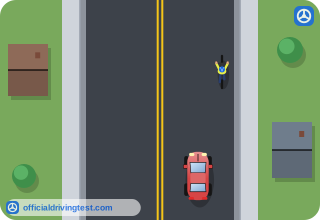
Most bicycles are not equipped with mirrors. What should you assume when you approach a bicyclist from behind?
- The bicyclist has seen you and will move to the shoulder
- The bicyclist will hear your engine and stop to let you by
- The bicyclist will look back before changing position
- The bicyclist does not hear or see your vehicle
Show answer
Correct answer: The bicyclist does not hear or see your vehicle
Because most bicycles have no mirrors, bicyclists are often not aware of a motorist behind them. Assume the bicyclist does not hear or see you.
Source: Montana Driver Manual (Revised April 2024), page 43
-
A bicycle is traveling in your lane and you need to make a right turn. What should you always make sure of before turning?
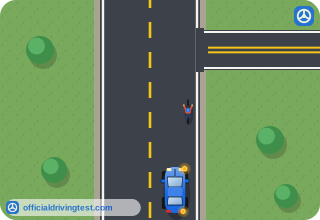
- The bicyclist is right beside your right front door
- The bicyclist has stopped to let you turn, or has passed you
- The bicyclist has a working light on the front
- The bicyclist has moved onto the sidewalk ahead of you
Show answer
Correct answer: The bicyclist has stopped to let you turn, or has passed you
Always check that the bicyclist has either stopped to let you turn, or allow the bicyclist to pass you before making the turn.
Source: Montana Driver Manual (Revised April 2024), page 44
-
According to the manual, on which side should a bicycle pass a motor vehicle?
- On the right
- On the left
- On the sidewalk
- Never; it may not pass
Show answer
Correct answer: On the left
Bicycles should pass on the left, although this is often overlooked because bicyclists feel comfortable passing on the right.
Source: Montana Driver Manual (Revised April 2024), page 44
-
Which statement about bicycles and lights during daytime travel is true?
- Bicycles must show a white front light at all times
- Bicycles must show a red rear light at all times
- Bicycles need daytime lights only on a highway
- Bicycles are not required to have lights in the daytime
Show answer
Correct answer: Bicycles are not required to have lights in the daytime
Bicycles are less visible and, unlike motorcycles, are not required to have lights during daytime travel.
Source: Montana Driver Manual (Revised April 2024), page 44
-
Why does the manual advise extra caution when you encounter youngsters on bikes?
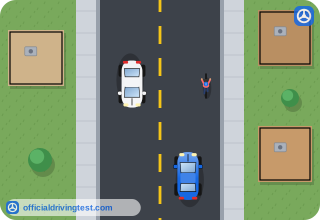
- Many have had no bike safety course and don't know many road rules
- They must ride on the sidewalk and often leave it suddenly
- They are allowed to ride on either side of the road
- They have the right-of-way over every motor vehicle
Show answer
Correct answer: Many have had no bike safety course and don't know many road rules
Many bicyclists are under 15 and have not taken a bicycle safety course or the Montana motor vehicle test, so they are unaware of many rules of the road.
Source: Montana Driver Manual (Revised April 2024), page 44
-
When a bicycle is used at nighttime, what front light does Montana law require?
- A white light visible for at least 100 feet
- A red light visible for at least 500 feet
- A white light visible for at least 500 feet
- An amber light visible for at least 1,000 feet
Show answer
Correct answer: A white light visible for at least 500 feet
Montana law requires a bicycle used at nighttime to have a front light that emits white light visible for at least 500 feet to the front.
Source: Montana Driver Manual (Revised April 2024), page 44
-
Which rear equipment does Montana law require on a bicycle?
- A red rear light visible from 500 feet
- A rear-view mirror on the handlebar
- A fluorescent orange flag on a pole
- Rear-facing reflectors
Show answer
Correct answer: Rear-facing reflectors
Rear-facing reflectors are required. A red light visible from 500 feet to the rear may be used in addition to them.
Source: Montana Driver Manual (Revised April 2024), page 44
-
When a bicycle is used at nighttime, what must both of its tires be equipped with?
- Studded treads for better grip on the pavement
- Retro-reflective sidewalls or spoke-mounted reflectors
- Fluorescent orange tape around each wheel rim
- Small lights mounted on the hub of each wheel
Show answer
Correct answer: Retro-reflective sidewalls or spoke-mounted reflectors
At nighttime, both tires of a bicycle must have retro-reflective sidewalls or reflectors mounted on the spokes of each wheel.
Source: Montana Driver Manual (Revised April 2024), page 44
-
How close to the inside of the rim must spoke-mounted bicycle reflectors be?
- Within 25 mm (1 inch)
- Within 152 mm (6 inches)
- Within 76 mm (3 inches)
- Within 305 mm (12 inches)
Show answer
Correct answer: Within 76 mm (3 inches)
Spoke-mounted reflectors must be within 76 mm (3 inches) of the inside of the rim and visible on each side of the wheel.
Source: Montana Driver Manual (Revised April 2024), page 44
-
What color must the reflectors on the front wheel of a bicycle be?
- Essentially colorless or amber
- Essentially red or blue
- Fluorescent green or bright blue
- Red only, never amber
Show answer
Correct answer: Essentially colorless or amber
The reflectors on the front wheel of a bicycle must be essentially colorless or amber.
Source: Montana Driver Manual (Revised April 2024), page 44
-
What color must the reflectors on the rear wheel of a bicycle be?
- Amber or red
- Green or blue
- Blue or white
- Green only
Show answer
Correct answer: Amber or red
The reflectors on the rear wheel of a bicycle must be amber or red.
Source: Montana Driver Manual (Revised April 2024), page 44
-
What kind of brake does Montana law require on a bicycle?
- One that works on the front wheel only, like a hand brake
- One that can stop the bicycle within 10 feet at any speed
- One that can make the wheels skid on dry, level, clean pavement
- One that locks the pedals when the rider stops pedaling
Show answer
Correct answer: One that can make the wheels skid on dry, level, clean pavement
Montana law requires a bicycle brake that will enable the operator to make the wheels skid on dry, level, clean pavement.
Source: Montana Driver Manual (Revised April 2024), page 44
-
The manual encourages every bicyclist to add a fluorescent orange flag. How high above the roadway should it be when the bicycle is standing upright?
- At least 2 feet
- At least 6 feet
- At least 3 feet
- At least 10 feet
Show answer
Correct answer: At least 6 feet
Every bicyclist is encouraged to equip the bicycle with a fluorescent orange flag, clearly visible from the rear and suspended at least 6 feet above the roadway.
Source: Montana Driver Manual (Revised April 2024), page 44
-
According to the manual, what is one of the major causes of vehicle/bicycle crashes?
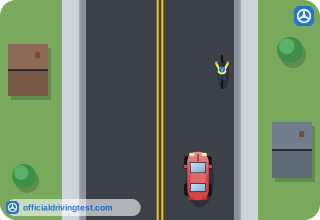
- Most bicyclists ride against traffic
- Most bicycles have no working brakes
- Most motorists drive too slowly
- Most motorists do not see the bicyclist
Show answer
Correct answer: Most motorists do not see the bicyclist
One of the major causes of vehicle/bicycle crashes is that most motorists do not see the bicyclist.
Source: Montana Driver Manual (Revised April 2024), page 44
-
When does the manual tell drivers to pay extra attention for bicycles?
- Only on rural roads where the speed limit is 65 mph or more
- Only in school zones on days when school is in session
- As you enter streets, cross bikeways or sidewalks, and make turns
- Only after dark, when bicycles must show lights
Show answer
Correct answer: As you enter streets, cross bikeways or sidewalks, and make turns
Think of a bicycle as you do a vehicle, and pay extra attention as you enter streets, cross bikeways or sidewalks, and when you make turns.
Source: Montana Driver Manual (Revised April 2024), page 44
-
The manual tells drivers to watch for children on bicycles who may dart out from where?
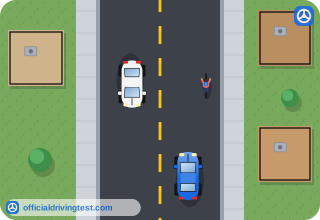
- Between parked cars or hedges
- Only from marked bike lanes
- Only from school bus stops
- Only from marked crosswalks
Show answer
Correct answer: Between parked cars or hedges
Watch for children on bicycles who may dart out between parked cars or hedges; bicyclists are very vulnerable.
Source: Montana Driver Manual (Revised April 2024), page 44
-
You are about to pass a bicycle. What may the cyclist suddenly need to do that calls for caution?
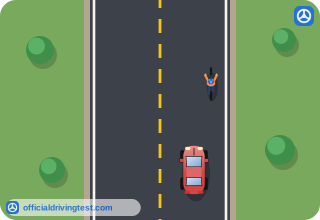
- Stop to read a street sign
- Swerve into traffic to avoid an object on the road
- Ride up onto the sidewalk for a short while
- Signal a turn with the right arm
Show answer
Correct answer: Swerve into traffic to avoid an object on the road
Always be cautious when passing a bicycle, because the cyclist may have to swerve into traffic to avoid an object on the road.
Source: Montana Driver Manual (Revised April 2024), page 54
-
Which road users does the manual say are harder to see than cars and trucks?
- Buses, trucks, and trailers on the road
- School buses and large farm tractors
- Farm vehicles, snowplows, and tow trucks
- Motorcycles, bicycles, and pedestrians
Show answer
Correct answer: Motorcycles, bicycles, and pedestrians
The manual says motorcycles, bicycles, and pedestrians are harder to see than cars and trucks.
Source: Montana Driver Manual (Revised April 2024), page 54
-
What does the manual advise if you notice you are driving on the side and slightly to the rear of another vehicle?
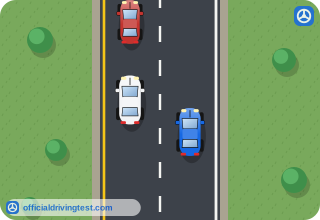
- Stay there so the other driver gets used to your position
- Speed up or drop back so the other driver can see you
- Sound your horn and stay beside the other vehicle
- Move closer to the other vehicle so it must slow down
Show answer
Correct answer: Speed up or drop back so the other driver can see you
You should avoid driving on either side and slightly to the rear of another vehicle, and either speed up or drop back so the other driver can see your vehicle more easily.
Source: Montana Driver Manual (Revised April 2024), page 57
-
When passing another car, how should you get through the other driver’s blind spot?
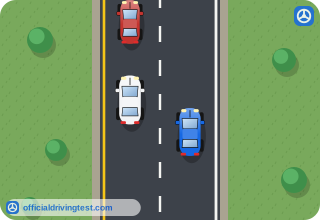
- As slowly as you can
- By matching the other car’s speed beside it
- As quickly as you can
- After pausing for a few seconds beside it
Show answer
Correct answer: As quickly as you can
The longer you stay in the other driver’s blind spot, the longer you are in danger of them turning into you.
Source: Montana Driver Manual (Revised April 2024), page 57
-
What does the manual say about staying alongside a large vehicle such as a truck or bus?
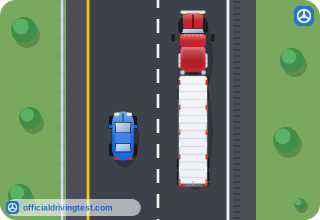
- Never do it, because the driver has trouble seeing you
- Do it only when you are driving below the speed limit
- It is safe as long as your headlights are on
- Do it only for a few seconds at a time
Show answer
Correct answer: Never do it, because the driver has trouble seeing you
Large vehicles have large blind spots, and it is hard for their drivers to see you.
Source: Montana Driver Manual (Revised April 2024), page 57
-
At what times should you be especially aware and look for animals near the road?
- At noon
- During the afternoon rush hour
- Only on rainy afternoons
- At sunrise and sunset
Show answer
Correct answer: At sunrise and sunset
The manual says to be aware and look for animals, especially at sunrise and sunset.
Source: Montana Driver Manual (Revised April 2024), page 61
-
If you see an animal near the road, what should you do?
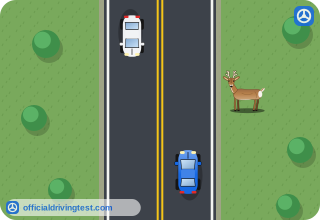
- Speed up to pass it quickly
- Slow down and be prepared to stop
- Flash your lights and keep your speed
- Swerve sharply around it
Show answer
Correct answer: Slow down and be prepared to stop
If you see an animal, slow down and be prepared to stop.
Source: Montana Driver Manual (Revised April 2024), page 61
-
What does the manual say to do if there is not time to stop or avoid an animal in the road?
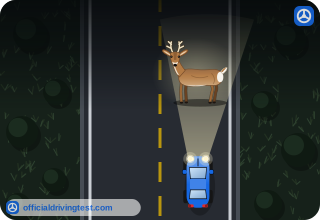
- Do not swerve sharply, even if that means hitting the animal
- Swerve sharply away from it to protect your vehicle
- Brake hard and steer toward the ditch to avoid the animal
- Swerve onto the shoulder and roll the vehicle if you must
Show answer
Correct answer: Do not swerve sharply, even if that means hitting the animal
The driver’s chance of getting seriously hurt is decreased if he or she hits the animal and avoids swerving into oncoming traffic or rolling the vehicle over in the ditch.
Source: Montana Driver Manual (Revised April 2024), page 61
-
If you see one deer or elk near the road, what should you do?
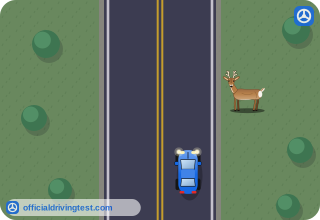
- Assume it is alone and resume your normal speed
- Speed up to pass the area before more appear
- Look for more animals, because they travel in herds
- Honk to scare it away and keep your speed
Show answer
Correct answer: Look for more animals, because they travel in herds
Deer, elk, and similar wildlife travel in herds, so you should always look for more animals if you see one.
Source: Montana Driver Manual (Revised April 2024), page 61
-
If you spot slow-moving vehicles early, what do you have time to do?
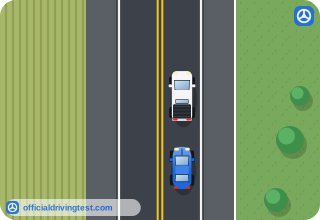
- Pull alongside and signal them to stop
- Change lanes or slow down safely
- Speed up and pass before the next curve
- Sound your horn so they speed up
Show answer
Correct answer: Change lanes or slow down safely
Spotting slow-moving vehicles early gives you time to change lanes or slow down safely, because slowing suddenly can cause a crash.
Source: Montana Driver Manual (Revised April 2024), page 62
-
Where should you watch for large trucks and small, underpowered cars that may lose speed?
- On steep grades or when they enter traffic
- On flat roads with no traffic around them
- On wide, straight roads in dry weather
- Only on narrow bridges and in tunnels
Show answer
Correct answer: On steep grades or when they enter traffic
Large trucks and small, underpowered cars can lose speed on long or steep hills, and it takes them longer to speed up when entering traffic.
Source: Montana Driver Manual (Revised April 2024), page 62
-
How fast do farm tractors, animal-drawn vehicles, and road maintenance vehicles usually go?
- 35 mph or less
- 45 mph or less
- 25 mph or less
- 55 mph or less
Show answer
Correct answer: 25 mph or less
The manual says these vehicles usually go 25 mph or less and must have a slow-moving vehicle sign on the back.
Source: Montana Driver Manual (Revised April 2024), page 62
-
What must farm tractors, animal-drawn vehicles, and road maintenance vehicles have on the back?
- A flashing amber lamp
- A slow-moving vehicle sign
- A reflective white square
- A green diamond-shaped plate
Show answer
Correct answer: A slow-moving vehicle sign
These vehicles must have a slow-moving vehicle sign on the back.
Source: Montana Driver Manual (Revised April 2024), page 62
-
In which lane must slow-moving vehicles drive?
- The center lane
- The left lane
- Whichever lane has the least traffic
- The extreme right lane of the roadway
Show answer
Correct answer: The extreme right lane of the roadway
Slow-moving vehicles must drive in the extreme right lane of the roadway.
Source: Montana Driver Manual (Revised April 2024), page 62
-
What does keeping more distance between yourself and everyone else give you?
- A higher legal speed limit
- More time to react to them
- The right-of-way over them
- A shorter stopping distance
Show answer
Correct answer: More time to react to them
The more distance you keep between yourself and everyone else, the more time you have to react to them; this space is like a safety cushion.
Source: Montana Driver Manual (Revised April 2024), page 64
-
Where should you try to stop when you pick up or let off passengers?
- In the right lane with your turn signal on
- Next to the nearest intersection crosswalk
- In the middle of the street if traffic is light
- A safe place out of the flow of traffic
Show answer
Correct answer: A safe place out of the flow of traffic
When stopping to pick up or let off passengers, you try to find a safe place out of the flow of traffic to stop.
Source: Montana Driver Manual (Revised April 2024), page 65
-
You must drive so slowly that you slow down other cars. What should you do?
- Stay in the center of the lane so no one can pass you
- Speed up until a passing lane or turnout appears
- Pull to the side of the road when it is safe and let them pass
- Stop in your lane and wait for the cars to go around you
Show answer
Correct answer: Pull to the side of the road when it is safe and let them pass
When you must drive so slowly that you slow down other cars, you pull to the side of the road when it is safe to do so and let them pass.
Source: Montana Driver Manual (Revised April 2024), page 65
-
You are being tailgated and there is a right lane. What should you do?
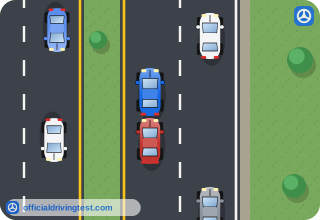
- Slow down quickly to make the driver back off
- Move over to the right
- Speed up to build a gap behind you
- Stay in the left lane and hold your speed
Show answer
Correct answer: Move over to the right
If you are being followed too closely and there is a right lane, you move over to the right.
Source: Montana Driver Manual (Revised April 2024), page 65
-
You are being tailgated and there is no right lane. What should you do?
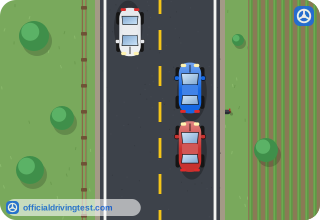
- Brake hard right away so the driver must go around
- Speed up until the driver falls behind
- Stop in your lane so the driver can pass
- Wait until the way is clear, then reduce speed slowly
Show answer
Correct answer: Wait until the way is clear, then reduce speed slowly
With no right lane, you wait until the way is clear and then reduce speed slowly, which encourages the tailgater to drive around you.
Source: Montana Driver Manual (Revised April 2024), page 65
-
How can you avoid driving next to other vehicles on a multi-lane road?
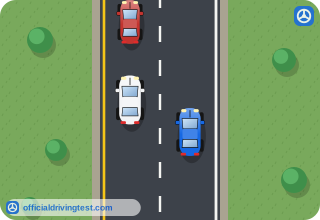
- Stay beside the other vehicle and match its speed
- Move to the center line and keep your speed
- Move ahead or drop to the back of the other vehicle
- Flash your headlights so the other driver sees you
Show answer
Correct answer: Move ahead or drop to the back of the other vehicle
Someone driving next to you may crowd your lane or pull into you, so you move ahead or drop to the back of the other vehicle.
Source: Montana Driver Manual (Revised April 2024), page 65
-
On a two-lane road, what does keeping space between you and oncoming vehicles mean?
- Driving on the right edge of the road
- Not crowding the center line
- Staying very close to parked vehicles
- Driving on the shoulder
Show answer
Correct answer: Not crowding the center line
On a two-lane road, keeping as much space as you can from oncoming vehicles means not crowding the center line.
Source: Montana Driver Manual (Revised April 2024), page 65
-
In general, where in your lane is it safest to drive?
- Near the right edge of your lane
- Near the left edge of your lane
- On the line next to the shoulder
- In the center of your lane
Show answer
Correct answer: In the center of your lane
In general, it is safest to drive in the center of your lane.
Source: Montana Driver Manual (Revised April 2024), page 65
-
Vehicles are entering a roadway that has two or more lanes, and no one is next to you. What should you do?
- Move over a lane to make room for them
- Speed up so you pass the entrance before they enter
- Stay in your lane and flash your headlights
- Move to the shoulder and stop
Show answer
Correct answer: Move over a lane to make room for them
You make room for vehicles entering a roadway with two or more lanes by moving over a lane if there is no one next to you.
Source: Montana Driver Manual (Revised April 2024), page 65
-
Why should you keep extra space between your vehicle and parked vehicles?
- Parked vehicles have the right-of-way when you pass them
- Parked vehicles are required to keep their lights off
- Someone could step out from between parked vehicles
- Parked vehicles may block the lane markings from your view
Show answer
Correct answer: Someone could step out from between parked vehicles
Someone could step out from a parked vehicle or from between vehicles, or a parked vehicle could pull out.
Source: Montana Driver Manual (Revised April 2024), page 65
-
What is the “Split the Difference Rule”?
- Steer a middle course between two hazards on the road
- Drive halfway between the speed limit and the speed of traffic
- Share a lane equally with a bicyclist or pedestrian
- Divide your following distance equally between two vehicles
Show answer
Correct answer: Steer a middle course between two hazards on the road
The “Split the Difference Rule” means splitting the difference between two hazards, for example steering a middle course between oncoming and parked vehicles.
Source: Montana Driver Manual (Revised April 2024), page 66
-
A tractor-trailer is approaching on one side and parked vehicles are on the other. Where should you leave a little more room?
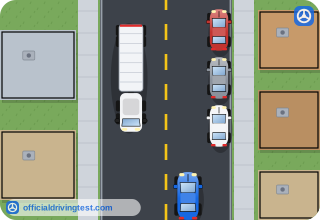
- On the side where the parked vehicles are
- Equally on both sides, with no change
- On the side that the truck will pass
- Toward the center line so the truck can see you
Show answer
Correct answer: On the side that the truck will pass
If one hazard is more dangerous, you leave a little more space on that side; for an oncoming tractor-trailer, that is the side the truck will pass.
Source: Montana Driver Manual (Revised April 2024), page 66
-
You are overtaking a bicycle and an oncoming vehicle is approaching. What should you do?
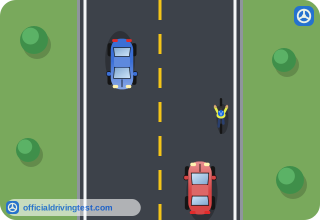
- Speed up and pass the bicycle before the oncoming vehicle arrives
- Slow down and let the vehicle pass first, then give the bicycle extra room
- Stay beside the bicycle and match its speed until the road is clear
- Pass the bicycle at once, staying close to the center line of the road
Show answer
Correct answer: Slow down and let the vehicle pass first, then give the bicycle extra room
Take hazards one at a time: slow down and let the oncoming vehicle pass first so you can give extra room to the bicycle.
Source: Montana Driver Manual (Revised April 2024), page 66
-
As a general rule, how many vehicles should you pass at a time?
- Two
- One
- Three
- As many as the road allows
Show answer
Correct answer: One
As a general rule, you only pass one vehicle at a time, because you should not count on having enough time to pass several cars at once.
Source: Montana Driver Manual (Revised April 2024), page 66
-
At a speed of 55 mph, about how long do you need to pass?
- About 4 seconds
- About 6 seconds
- About 20 seconds
- About 10 seconds
Show answer
Correct answer: About 10 seconds
At 55 mph you need about 10 seconds to pass, which means a 10 second gap in oncoming traffic and sight distance.
Source: Montana Driver Manual (Revised April 2024), page 66
-
At 55 mph, how much space do you need to pass safely, counting an oncoming vehicle?
- Over 1600 feet, or about one-third of a mile
- About 400 feet, or one-twelfth of a mile
- About 1,000 feet, or one-fifth of a mile
- About 2,500 feet, or one-half of a mile
Show answer
Correct answer: Over 1600 feet, or about one-third of a mile
You and an oncoming vehicle each travel over 800 feet in 10 seconds, so you need over 1600 feet, or about one-third of a mile, to pass safely.
Source: Montana Driver Manual (Revised April 2024), page 67
-
How does an oncoming vehicle that is far enough away generally appear when you judge its speed?
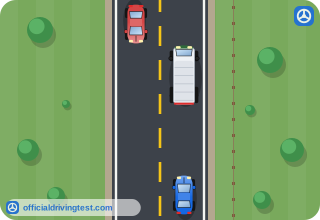
- To be coming faster than it really is
- To be slowing down
- To be standing still
- To be changing lanes
Show answer
Correct answer: To be standing still
A vehicle that is far enough away generally appears to be standing still, so oncoming vehicles do not seem to be coming as fast as they really are.
Source: Montana Driver Manual (Revised April 2024), page 67
-
You are not sure whether there is enough space to pass an oncoming vehicle. What should you do?
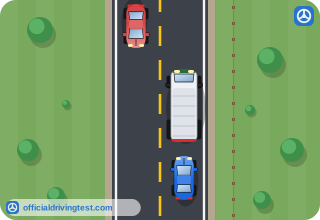
- Pass quickly before the vehicle gets closer
- Wait to pass until you are sure there is enough space
- Start to pass and turn back if the vehicle comes too close
- Pass only if you can still see the vehicle moving closer
Show answer
Correct answer: Wait to pass until you are sure there is enough space
If you are not sure, you wait to pass until you are sure that there is enough space.
Source: Montana Driver Manual (Revised April 2024), page 67
-
Your view is blocked by a curve or a hill. What should you assume?
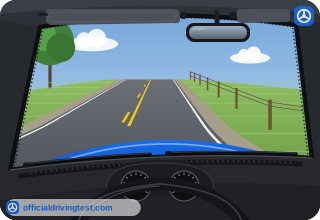
- That an oncoming vehicle is just out of your sight
- That the road ahead is clear for passing
- That oncoming drivers will slow down for you
- That you have the right-of-way over oncoming traffic
Show answer
Correct answer: That an oncoming vehicle is just out of your sight
Anytime your view is blocked by a curve or a hill, you should assume there is an oncoming vehicle just out of your sight and treat the curve or hill like an oncoming vehicle.
Source: Montana Driver Manual (Revised April 2024), page 67
-
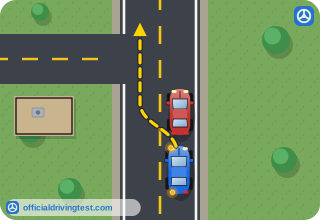
Why is it dangerous to pass where a vehicle is likely to enter or cross the road, such as at an intersection?
- Road markings do not show where you may return to your lane
- Drivers there are not allowed to slow down for passing vehicles
- The vehicle you pass can block your view of people, vehicles or trains
- Traffic signals cannot be seen from the oncoming lane
Show answer
Correct answer: The vehicle you pass can block your view of people, vehicles or trains
While you are passing, the vehicle you are passing can block your view of people, vehicles or trains.
Source: Montana Driver Manual (Revised April 2024), page 67
-
Before you pass, what should you look ahead for?
- Only the vehicles that are in front of the vehicle you are passing
- Conditions and traffic that may push other vehicles into your lane
- Road signs that show the posted speed limit for passing
- Places where the road shoulder is wide enough to drive on
Show answer
Correct answer: Conditions and traffic that may push other vehicles into your lane
Before you pass, you look ahead for road conditions and traffic that may cause other vehicles to move into your lane.
Source: Montana Driver Manual (Revised April 2024), page 67
-
What must you have before you pass?
- A driver ahead who has agreed to make room for you
- A signal from the driver you are passing
- A clear view of the next intersection
- Enough space to return to the driving lane
Show answer
Correct answer: Enough space to return to the driving lane
You do not pass unless you have enough space to return to the driving lane, and you do not count on other drivers to make room for you.
Source: Montana Driver Manual (Revised April 2024), page 67
-
After passing a vehicle, when is it safe to return to the driving lane?
- When you can see both headlights of the passed vehicle in your rearview mirror
- As soon as you can see one headlight of the vehicle in your mirror
- As soon as you are a few feet past the vehicle’s front bumper
- When the driver of the passed vehicle flashes its headlights
Show answer
Correct answer: When you can see both headlights of the passed vehicle in your rearview mirror
When you can see both headlights of the vehicle you just passed in your rearview mirror, it is safe to return to the driving lane.
Source: Montana Driver Manual (Revised April 2024), page 67
-
On the rear of which vehicles must the slow-moving vehicle emblem be displayed?
- Passenger cars and motorcycles that drive slower than traffic
- Animal-drawn vehicles, most farm vehicles and construction equipment
- Delivery trucks, school buses and other commercial vehicles
- Only vehicles that tow a trailer or carry oversize loads
Show answer
Correct answer: Animal-drawn vehicles, most farm vehicles and construction equipment
The emblem must be displayed on the rear of vehicles drawn by animals, and most farm vehicles and construction equipment.
Source: Montana Driver Manual (Revised April 2024), page 67
-
Which vehicles does the United States Postal Service require to display the orange safety triangle?
- All city mail delivery vehicles
- All postal vehicles that carry packages
- Only mail trucks that drive on highways
- All rural mail delivery vehicles
Show answer
Correct answer: All rural mail delivery vehicles
The United States Postal Service requires the orange safety triangles on all rural mail delivery vehicles.
Source: Montana Driver Manual (Revised April 2024), page 67
-
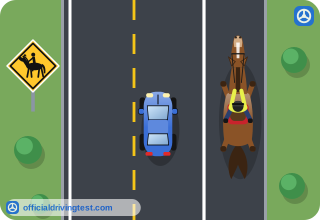
What must you always give to an animal that someone is leading, riding, or driving?
- The right-of-way
- A short horn blast
- A flash of your headlights
- A two-second gap
Show answer
Correct answer: The right-of-way
You always give the right-of-way to an animal that someone is leading, riding, or driving, because animals are easily scared by motor vehicles.
Source: Montana Driver Manual (Revised April 2024), page 67
-
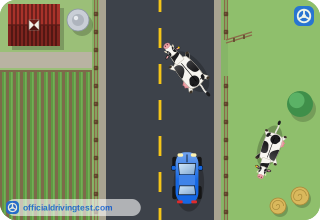
An animal or horse-drawn vehicle is coming toward you or crossing your path. What should you do?
- Speed up and pass before it reaches you
- Honk to make the animal move out of the way
- Stop and allow the animal to pass
- Drive around it at a reasonable speed
Show answer
Correct answer: Stop and allow the animal to pass
You stop if the animal or vehicle is coming toward you or is crossing your path, and allow the animal to pass.
Source: Montana Driver Manual (Revised April 2024), page 67
-
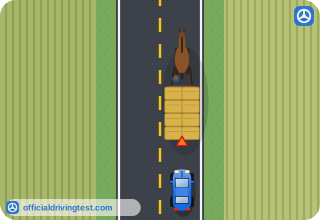
An animal or horse-drawn vehicle is traveling in the same direction as you. What should you do?
- Pass quickly and close to it so you are back in your lane soon
- Allow plenty of room to pass safely, driving at a reasonable speed
- Follow closely behind it until it leaves the road
- Sound your horn once to let it know you are passing
Show answer
Correct answer: Allow plenty of room to pass safely, driving at a reasonable speed
If the animal or vehicle is traveling in the same direction as you, you allow plenty of room to pass safely and drive at a reasonable speed.
Source: Montana Driver Manual (Revised April 2024), page 67
-
Near an animal or horse-drawn vehicle, which of these should you NOT do?
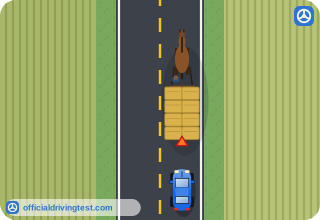
- Slow down as you get near
- Stop if the rider or driver signals you to do so
- Pull to the side and stop if the animal looks scared
- Honk your horn or make a loud noise
Show answer
Correct answer: Honk your horn or make a loud noise
Animals are easily scared by motor vehicles, so you do not honk your horn or make a loud noise near them.
Source: Montana Driver Manual (Revised April 2024), page 67
-
The animal you are passing looks scared. What should you do?
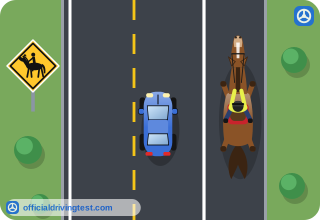
- Pull your vehicle to the side and stop
- Pass quickly to get away from it
- Sound your horn to calm it
- Keep going at the same speed
Show answer
Correct answer: Pull your vehicle to the side and stop
If the animal you are passing looks scared, you pull your vehicle to the side and stop.
Source: Montana Driver Manual (Revised April 2024), page 67
-
A rider or driver of an animal signals you to stop. What should you do?
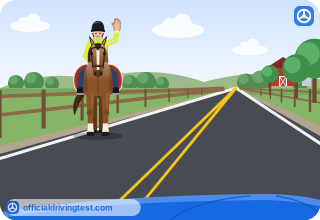
- Slow down and pass
- Sound your horn
- Stop
- Pass quickly
Show answer
Correct answer: Stop
You stop if a rider or driver signals you to do so.
Source: Montana Driver Manual (Revised April 2024), page 67
-
The rules for animals and horse-drawn vehicles apply to which animals?
- Only horses and horse-drawn vehicles
- Horses, cattle, and any other draft animals
- Only cattle that are being driven on the road
- Only animals that someone is riding
Show answer
Correct answer: Horses, cattle, and any other draft animals
These rules apply to horses, cattle, and any other draft animals.
Source: Montana Driver Manual (Revised April 2024), page 67
-
How must horseback riders ride on the road?
- Two abreast near the center line
- Single file near the left edge, facing traffic
- Two abreast in the middle of the lane
- Single file near the right curb or road edge
Show answer
Correct answer: Single file near the right curb or road edge
Horseback riders must ride single file near the right curb or road edge, or on a usable right shoulder, lane, or path.
Source: Montana Driver Manual (Revised April 2024), page 68
-
What does the law say about sounding your horn when approaching or passing a horse?
- It is illegal
- It is required to warn the rider
- It is allowed if you give one short tap
- It is allowed only on a road with no shoulder
Show answer
Correct answer: It is illegal
It is illegal to sound your horn when approaching or passing a horse.
Source: Montana Driver Manual (Revised April 2024), page 68
-
When approaching a horse being ridden or led along a road, what does the law require?
- Stop completely until the horse leaves the road
- Pass within one car length at a low speed
- Exercise due care, with a reasonable speed and distance
- Pull onto the shoulder and turn off your engine
Show answer
Correct answer: Exercise due care, with a reasonable speed and distance
The law requires you to exercise due care and to drive at a reasonable speed and at a reasonable distance away from the horse.
Source: Montana Driver Manual (Revised April 2024), page 68
-
Why should you give extra room to drivers and others who cannot see you?
- They are required to stop when they cannot see traffic
- They may enter your path without knowing you are there
- They always drive more slowly than other traffic
- They are not allowed to enter the roadway
Show answer
Correct answer: They may enter your path without knowing you are there
Anyone who cannot see you may enter your path without knowing you are there.
Source: Montana Driver Manual (Revised April 2024), page 68
-
Even when others can see you, what should you do if you think they may be distracted?
- Sound your horn until they look at you
- Assume they see you and keep your speed
- Pass them as quickly as you can
- Allow extra room or be extra cautious
Show answer
Correct answer: Allow extra room or be extra cautious
Even when others can see you, you allow extra room or are extra cautious if you think they may be distracted.
Source: Montana Driver Manual (Revised April 2024), page 68
-
Which of these is a driver who may be confused?
- A driver who slows down for what seems like no reason
- A driver who signals well before a turn
- A driver who keeps a steady speed in the right lane
- A driver who stays in the center of the lane
Show answer
Correct answer: A driver who slows down for what seems like no reason
The manual lists drivers who slow down for what seems like no reason among the people who may be confused.
Source: Montana Driver Manual (Revised April 2024), page 68
-
Another driver passes you and does not have enough room. What should you do?
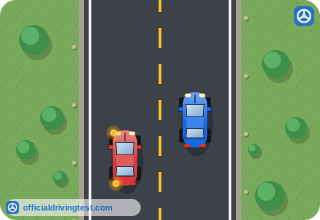
- Speed up so they cannot return to the driving lane
- Hold your speed and sound your horn at the driver
- Slow down and let them return to the driving lane safely
- Move toward the center line to block them from returning
Show answer
Correct answer: Slow down and let them return to the driving lane safely
If another driver makes a mistake, you do not make it worse: you slow down and let them return to the driving lane safely.
Source: Montana Driver Manual (Revised April 2024), page 68
-
Another driver needs to suddenly change lanes. What should you do?
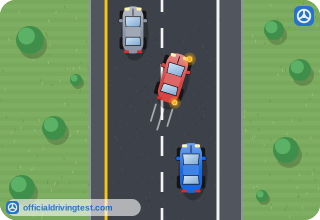
- Speed up to stay ahead of them
- Slow down and let them merge
- Hold your speed and position
- Sound your horn to warn them
Show answer
Correct answer: Slow down and let them merge
If another driver needs to suddenly change lanes, you slow down and let them merge, which keeps traffic moving smoothly and safely.
Source: Montana Driver Manual (Revised April 2024), page 68