Montana: Sharing the road — Part 6 Practice Test
Questions in this part include: “After passing a vehicle, when is it safe to return to the driving lane?” · “What does the law say about sounding your horn when approaching or passing a horse?”
Independent educational site · not affiliated with any government agency or DMV
Ready? Test yourself
- Instant feedback with an explanation
- Every answer cites its source in the manual
- Your best score is saved on this device
- Keyboard: press 1 to 4 to answer and Enter for the next question
Questions are original and based on the official manual "Montana Driver Manual" (Revised April 2024), Montana Department of Justice, Motor Vehicle Division.
All 18 questions in this practice test
Take the test above first, then use this list to study. Tap “Show answer” to see the correct answer and explanation.
Show the questions and answersHide the questions
-
After passing a vehicle, when is it safe to return to the driving lane?
- When you can see both headlights of the passed vehicle in your rearview mirror
- As soon as you can see one headlight of the vehicle in your mirror
- As soon as you are a few feet past the vehicle’s front bumper
- When the driver of the passed vehicle flashes its headlights
Show answer
Correct answer: When you can see both headlights of the passed vehicle in your rearview mirror
When you can see both headlights of the vehicle you just passed in your rearview mirror, it is safe to return to the driving lane.
Source: Montana Driver Manual (Revised April 2024), page 67
-
On the rear of which vehicles must the slow-moving vehicle emblem be displayed?
- Passenger cars and motorcycles that drive slower than traffic
- Animal-drawn vehicles, most farm vehicles and construction equipment
- Delivery trucks, school buses and other commercial vehicles
- Only vehicles that tow a trailer or carry oversize loads
Show answer
Correct answer: Animal-drawn vehicles, most farm vehicles and construction equipment
The emblem must be displayed on the rear of vehicles drawn by animals, and most farm vehicles and construction equipment.
Source: Montana Driver Manual (Revised April 2024), page 67
-
Which vehicles does the United States Postal Service require to display the orange safety triangle?
- All city mail delivery vehicles
- All postal vehicles that carry packages
- Only mail trucks that drive on highways
- All rural mail delivery vehicles
Show answer
Correct answer: All rural mail delivery vehicles
The United States Postal Service requires the orange safety triangles on all rural mail delivery vehicles.
Source: Montana Driver Manual (Revised April 2024), page 67
-
What must you always give to an animal that someone is leading, riding, or driving?
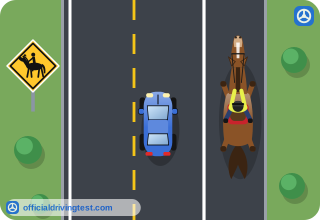
- The right-of-way
- A short horn blast
- A flash of your headlights
- A two-second gap
Show answer
Correct answer: The right-of-way
You always give the right-of-way to an animal that someone is leading, riding, or driving, because animals are easily scared by motor vehicles.
Source: Montana Driver Manual (Revised April 2024), page 67
-
An animal or horse-drawn vehicle is coming toward you or crossing your path. What should you do?
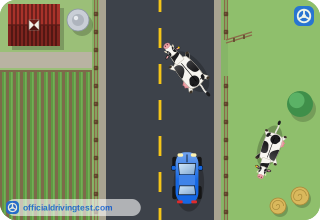
- Speed up and pass before it reaches you
- Honk to make the animal move out of the way
- Stop and allow the animal to pass
- Drive around it at a reasonable speed
Show answer
Correct answer: Stop and allow the animal to pass
You stop if the animal or vehicle is coming toward you or is crossing your path, and allow the animal to pass.
Source: Montana Driver Manual (Revised April 2024), page 67
-
An animal or horse-drawn vehicle is traveling in the same direction as you. What should you do?
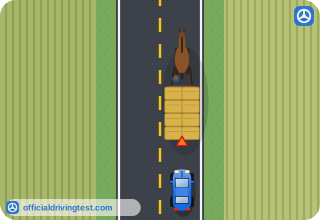
- Pass quickly and close to it so you are back in your lane soon
- Allow plenty of room to pass safely, driving at a reasonable speed
- Follow closely behind it until it leaves the road
- Sound your horn once to let it know you are passing
Show answer
Correct answer: Allow plenty of room to pass safely, driving at a reasonable speed
If the animal or vehicle is traveling in the same direction as you, you allow plenty of room to pass safely and drive at a reasonable speed.
Source: Montana Driver Manual (Revised April 2024), page 67
-
Near an animal or horse-drawn vehicle, which of these should you NOT do?
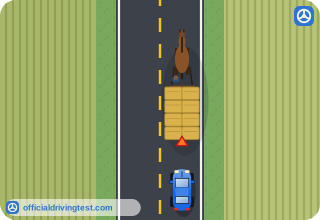
- Slow down as you get near
- Stop if the rider or driver signals you to do so
- Pull to the side and stop if the animal looks scared
- Honk your horn or make a loud noise
Show answer
Correct answer: Honk your horn or make a loud noise
Animals are easily scared by motor vehicles, so you do not honk your horn or make a loud noise near them.
Source: Montana Driver Manual (Revised April 2024), page 67
-
The animal you are passing looks scared. What should you do?
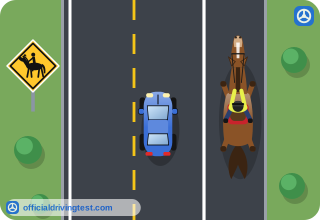
- Pull your vehicle to the side and stop
- Pass quickly to get away from it
- Sound your horn to calm it
- Keep going at the same speed
Show answer
Correct answer: Pull your vehicle to the side and stop
If the animal you are passing looks scared, you pull your vehicle to the side and stop.
Source: Montana Driver Manual (Revised April 2024), page 67
-
A rider or driver of an animal signals you to stop. What should you do?
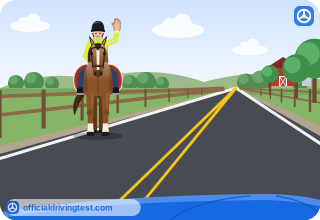
- Slow down and pass
- Sound your horn
- Stop
- Pass quickly
Show answer
Correct answer: Stop
You stop if a rider or driver signals you to do so.
Source: Montana Driver Manual (Revised April 2024), page 67
-
The rules for animals and horse-drawn vehicles apply to which animals?
- Only horses and horse-drawn vehicles
- Horses, cattle, and any other draft animals
- Only cattle that are being driven on the road
- Only animals that someone is riding
Show answer
Correct answer: Horses, cattle, and any other draft animals
These rules apply to horses, cattle, and any other draft animals.
Source: Montana Driver Manual (Revised April 2024), page 67
-
How must horseback riders ride on the road?
- Two abreast near the center line
- Single file near the left edge, facing traffic
- Two abreast in the middle of the lane
- Single file near the right curb or road edge
Show answer
Correct answer: Single file near the right curb or road edge
Horseback riders must ride single file near the right curb or road edge, or on a usable right shoulder, lane, or path.
Source: Montana Driver Manual (Revised April 2024), page 68
-
What does the law say about sounding your horn when approaching or passing a horse?
- It is illegal
- It is required to warn the rider
- It is allowed if you give one short tap
- It is allowed only on a road with no shoulder
Show answer
Correct answer: It is illegal
It is illegal to sound your horn when approaching or passing a horse.
Source: Montana Driver Manual (Revised April 2024), page 68
-
When approaching a horse being ridden or led along a road, what does the law require?
- Stop completely until the horse leaves the road
- Pass within one car length at a low speed
- Exercise due care, with a reasonable speed and distance
- Pull onto the shoulder and turn off your engine
Show answer
Correct answer: Exercise due care, with a reasonable speed and distance
The law requires you to exercise due care and to drive at a reasonable speed and at a reasonable distance away from the horse.
Source: Montana Driver Manual (Revised April 2024), page 68
-
Why should you give extra room to drivers and others who cannot see you?
- They are required to stop when they cannot see traffic
- They may enter your path without knowing you are there
- They always drive more slowly than other traffic
- They are not allowed to enter the roadway
Show answer
Correct answer: They may enter your path without knowing you are there
Anyone who cannot see you may enter your path without knowing you are there.
Source: Montana Driver Manual (Revised April 2024), page 68
-
Even when others can see you, what should you do if you think they may be distracted?
- Sound your horn until they look at you
- Assume they see you and keep your speed
- Pass them as quickly as you can
- Allow extra room or be extra cautious
Show answer
Correct answer: Allow extra room or be extra cautious
Even when others can see you, you allow extra room or are extra cautious if you think they may be distracted.
Source: Montana Driver Manual (Revised April 2024), page 68
-
Which of these is a driver who may be confused?
- A driver who slows down for what seems like no reason
- A driver who signals well before a turn
- A driver who keeps a steady speed in the right lane
- A driver who stays in the center of the lane
Show answer
Correct answer: A driver who slows down for what seems like no reason
The manual lists drivers who slow down for what seems like no reason among the people who may be confused.
Source: Montana Driver Manual (Revised April 2024), page 68
-
Another driver passes you and does not have enough room. What should you do?
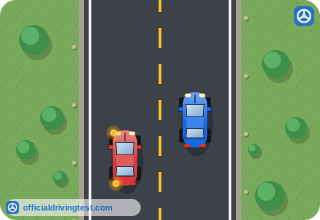
- Speed up so they cannot return to the driving lane
- Hold your speed and sound your horn at the driver
- Slow down and let them return to the driving lane safely
- Move toward the center line to block them from returning
Show answer
Correct answer: Slow down and let them return to the driving lane safely
If another driver makes a mistake, you do not make it worse: you slow down and let them return to the driving lane safely.
Source: Montana Driver Manual (Revised April 2024), page 68
-
Another driver needs to suddenly change lanes. What should you do?
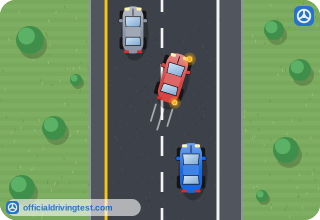
- Speed up to stay ahead of them
- Slow down and let them merge
- Hold your speed and position
- Sound your horn to warn them
Show answer
Correct answer: Slow down and let them merge
If another driver needs to suddenly change lanes, you slow down and let them merge, which keeps traffic moving smoothly and safely.
Source: Montana Driver Manual (Revised April 2024), page 68