Montana: Sharing the road — Part 2 Practice Test
Questions in this part include: “How far to the right are bicyclists required by law to ride?” · “Under Montana law, what rights must motorists grant to people operating bicycles?”
Independent educational site · not affiliated with any government agency or DMV
Ready? Test yourself
- Instant feedback with an explanation
- Every answer cites its source in the manual
- Your best score is saved on this device
- Keyboard: press 1 to 4 to answer and Enter for the next question
Questions are original and based on the official manual "Montana Driver Manual" (Revised April 2024), Montana Department of Justice, Motor Vehicle Division.
All 18 questions in this practice test
Take the test above first, then use this list to study. Tap “Show answer” to see the correct answer and explanation.
Show the questions and answersHide the questions
-
You approach a cyclist from behind on a high-speed, two-lane roadway. According to the manual, what is the safest way to pass?

- Treat the cyclist like any other slow-moving vehicle, such as a farm tractor
- Stay in your lane and pass close beside the cyclist without slowing down
- Use the paved shoulder on the right to pass the cyclist more quickly
- Speed up and pass before the cyclist has time to change position
Show answer
Correct answer: Treat the cyclist like any other slow-moving vehicle, such as a farm tractor
The manual says the safest way to pass a cyclist on a high-speed, two-lane roadway is to view the cyclist as any other legitimate slow-moving vehicle, such as a farm tractor.
Source: Montana Driver Manual (Revised April 2024), page 43
-
You are passing a cyclist on a high-speed, two-lane roadway and there is no oncoming traffic. How much distance does the manual recommend leaving between the cyclist and your vehicle?

- One foot
- Two feet
- Five feet
- Three feet
Show answer
Correct answer: Five feet
With no oncoming traffic, the manual recommends giving the cyclist a five-foot distance between them and your motor vehicle.
Source: Montana Driver Manual (Revised April 2024), page 43
-
You approach a cyclist from behind on a high-speed, two-lane roadway and there is oncoming traffic. What should you do?

- Pass quickly before the oncoming traffic gets near you
- Slow to the speed of the cyclist and wait until it is safe to pass
- Pass within your own lane, keeping close to the cyclist
- Move onto the shoulder and pass the cyclist on the right
Show answer
Correct answer: Slow to the speed of the cyclist and wait until it is safe to pass
If there is oncoming traffic, slow to the speed of the cyclist and wait for it to be safe to pass.
Source: Montana Driver Manual (Revised April 2024), page 43
-
What should you assume when you need to pass a cyclist on the road?

- The cyclist rides on the shoulder, so you can pass within your lane
- The cyclist will move onto the shoulder as soon as you get close
- The cyclist will speed up so that you can pass more quickly
- You will need to wait for a safe time to leave your lane to pass
Show answer
Correct answer: You will need to wait for a safe time to leave your lane to pass
Do not assume a cyclist is riding on the shoulder. Assume that to pass safely you will need to wait for a safe time to leave your driving lane.
Source: Montana Driver Manual (Revised April 2024), page 43
-
Why does the manual warn drivers not to assume a cyclist is riding alone?

- Cyclists must by law ride in groups of two or more on highways
- Cyclists riding in groups must always use the paved shoulder
- Cyclists often travel in single-file groups that take more time to pass
- Cyclists in groups must use bike paths, never the roadway
Show answer
Correct answer: Cyclists often travel in single-file groups that take more time to pass
Cyclists often travel in groups and ride in a single-file line, so it takes more time to pass all of them safely.
Source: Montana Driver Manual (Revised April 2024), page 43
-
How far to the right are bicyclists required by law to ride?
- As far to the right as practical
- Always on the shoulder of the road
- Always in the center of the lane
- Within 3 feet of the center line
Show answer
Correct answer: As far to the right as practical
Bicyclists must by law ride as far to the right as practical, which does not mean they are always on the shoulder.
Source: Montana Driver Manual (Revised April 2024), page 43
-
Many bicyclists ride approximately how far into the lane to discourage drivers from a dangerous in-lane pass?
- 2-6 inches
- 36-48 inches
- 6-8 feet
- 18-24 inches
Show answer
Correct answer: 18-24 inches
Many bicyclists ride further into the lane, approximately 18-24 inches, to discourage motorists from attempting a dangerous in-lane pass.
Source: Montana Driver Manual (Revised April 2024), page 43
-
By following shared lane markings (sharrows), what can cyclists avoid?
- Having to obey the traffic signals and stop signs on the road
- Being hit by an opening car door or squeezed in a narrow lane
- Having to signal before they turn at an intersection ahead
- Having to ride in single file on a busy, narrow roadway
Show answer
Correct answer: Being hit by an opening car door or squeezed in a narrow lane
By following the markings of two arrows over a bicycle, cyclists can avoid being hit by the open door of a parked vehicle or getting squeezed next to a motor vehicle in a narrow lane.
Source: Montana Driver Manual (Revised April 2024), page 43
-
What must you do when you see a shared lane marking (two arrows over a bicycle) in your lane?

- Leave the lane, because it is reserved for bicycles only
- Stop and wait until no bicyclist is left in the lane
- Use the lane only to turn right at the next intersection
- Look out for bicyclists and leave them enough space when passing
Show answer
Correct answer: Look out for bicyclists and leave them enough space when passing
When you see a shared lane marking, you must look out for bicyclists and make sure you leave them enough space when passing.
Source: Montana Driver Manual (Revised April 2024), page 43
-
Under Montana law, what rights must motorists grant to people operating bicycles?
- Fewer rights, since bicycles are not considered vehicles
- Rights only while the bicyclist rides in a bicycle lane
- The same rights as any vehicle legitimately on the road
- Greater rights than any other vehicle in every situation
Show answer
Correct answer: The same rights as any vehicle legitimately on the road
Montana law says motorists must grant people operating bicycles the same rights as the operators of any vehicle legitimately using Montana roadways.
Source: Montana Driver Manual (Revised April 2024), page 43
-
Under Montana law, which of these may a motorist NOT do to a person lawfully riding a bicycle?
- Slow to the bicyclist's speed and wait to pass
- Pass when it can be done without endangering anyone
- Give the bicyclist the same rights as other vehicles
- Intentionally interfere with the bicyclist's movement
Show answer
Correct answer: Intentionally interfere with the bicyclist's movement
Montana law says motorists may not intentionally interfere with the movement of a person lawfully riding a bicycle.
Source: Montana Driver Manual (Revised April 2024), page 43
-
Under Montana law, when may a motorist overtake and pass a person riding a bicycle?

- Whenever the bicyclist is riding slower than the speed limit
- Only when it won't endanger the rider or people in nearby vehicles
- Only after the bicyclist has moved fully onto the shoulder
- Whenever the road has two or more lanes in each direction
Show answer
Correct answer: Only when it won't endanger the rider or people in nearby vehicles
Motorists may not overtake and pass a person riding a bicycle unless it can be done without endangering the bicyclist or those in any nearby motor vehicle.
Source: Montana Driver Manual (Revised April 2024), page 43
-
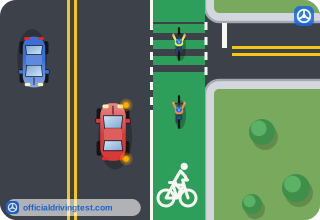
A person is riding a bicycle within a designated bicycle lane. Under Montana law, who must yield the right-of-way?
- The bicyclist
- Whoever arrives first
- The motorist
- Neither one
Show answer
Correct answer: The motorist
Montana law says motorists must yield the right-of-way to a person riding a bicycle within a designated bicycle lane.
Source: Montana Driver Manual (Revised April 2024), page 43
-
Unless one of the law's exceptions applies, how must people riding bicycles on a roadway ride?
- In single file
- Two abreast
- Three abreast
- In a group
Show answer
Correct answer: In single file
Individuals riding bicycles on a roadway must ride in single file, except in the cases the law lists.
Source: Montana Driver Manual (Revised April 2024), page 43
-
On which of these may people riding bicycles ride two abreast?
- A paved shoulder or a parking lane
- A narrow lane on a two-lane highway
- Any lane, if no vehicle is behind them
- A lane next to the center line at night
Show answer
Correct answer: A paved shoulder or a parking lane
Bicyclists riding on a paved shoulder or on a parking lane may ride two abreast.
Source: Montana Driver Manual (Revised April 2024), page 43
-
Bicyclists are riding within a single lane of a roadway with at least two lanes in each direction. When may they ride two abreast?
- Only when no motor vehicle is in sight behind them
- Only in daylight hours on a dry road surface
- If they impede traffic no more than riding single file would
- Never; they must always ride single file there
Show answer
Correct answer: If they impede traffic no more than riding single file would
On a laned roadway with at least two lanes in each direction, bicyclists may ride two abreast in a single lane if they do not impede the normal and reasonable movement of traffic more than they would by riding single file.
Source: Montana Driver Manual (Revised April 2024), page 43
-
A bicyclist is riding slower than the normal speed of traffic. When may the bicyclist move away from the right side of the roadway?
- Whenever the road is wet from rain
- When preparing to turn left at an intersection
- When riding at night on a road with no shoulder
- When the posted speed limit is above 45 mph
Show answer
Correct answer: When preparing to turn left at an intersection
A bicyclist slower than traffic must ride as near to the right side as practicable, except when preparing for a left turn at an intersection or into a private road or driveway, among other listed cases.
Source: Montana Driver Manual (Revised April 2024), page 43
-
Which of these does Montana law list as a condition that lets a slower bicyclist move away from the right side of the roadway?
- A posted speed limit above 45 miles per hour on the road
- A wish to ride beside another bicyclist for company
- Traffic in the lane moving faster than the bicyclist
- A lane too narrow for a bicycle and a vehicle to share safely
Show answer
Correct answer: A lane too narrow for a bicycle and a vehicle to share safely
A bicyclist may leave the right side when necessary to avoid an unsafe condition, such as a lane too narrow for a bicycle and another vehicle to travel safely side-by-side.
Source: Montana Driver Manual (Revised April 2024), page 43