Montana: Sharing the road — Part 4 Practice Test
Questions in this part include: “Which road users does the manual say are harder to see than cars and trucks?” · “What must farm tractors, animal-drawn vehicles, and road maintenance vehicles have on the back?”
Independent educational site · not affiliated with any government agency or DMV
Ready? Test yourself
- Instant feedback with an explanation
- Every answer cites its source in the manual
- Your best score is saved on this device
- Keyboard: press 1 to 4 to answer and Enter for the next question
Questions are original and based on the official manual "Montana Driver Manual" (Revised April 2024), Montana Department of Justice, Motor Vehicle Division.
All 18 questions in this practice test
Take the test above first, then use this list to study. Tap “Show answer” to see the correct answer and explanation.
Show the questions and answersHide the questions
-
You are about to pass a bicycle. What may the cyclist suddenly need to do that calls for caution?
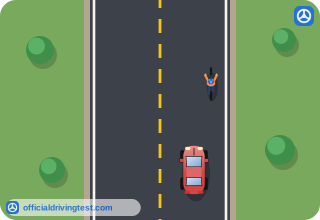
- Stop to read a street sign
- Swerve into traffic to avoid an object on the road
- Ride up onto the sidewalk for a short while
- Signal a turn with the right arm
Show answer
Correct answer: Swerve into traffic to avoid an object on the road
Always be cautious when passing a bicycle, because the cyclist may have to swerve into traffic to avoid an object on the road.
Source: Montana Driver Manual (Revised April 2024), page 54
-
Which road users does the manual say are harder to see than cars and trucks?
- Buses, trucks, and trailers on the road
- School buses and large farm tractors
- Farm vehicles, snowplows, and tow trucks
- Motorcycles, bicycles, and pedestrians
Show answer
Correct answer: Motorcycles, bicycles, and pedestrians
The manual says motorcycles, bicycles, and pedestrians are harder to see than cars and trucks.
Source: Montana Driver Manual (Revised April 2024), page 54
-
What does the manual advise if you notice you are driving on the side and slightly to the rear of another vehicle?
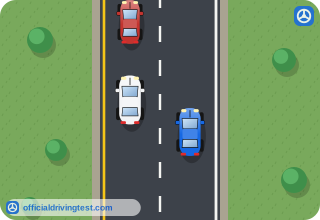
- Stay there so the other driver gets used to your position
- Speed up or drop back so the other driver can see you
- Sound your horn and stay beside the other vehicle
- Move closer to the other vehicle so it must slow down
Show answer
Correct answer: Speed up or drop back so the other driver can see you
You should avoid driving on either side and slightly to the rear of another vehicle, and either speed up or drop back so the other driver can see your vehicle more easily.
Source: Montana Driver Manual (Revised April 2024), page 57
-
When passing another car, how should you get through the other driver’s blind spot?
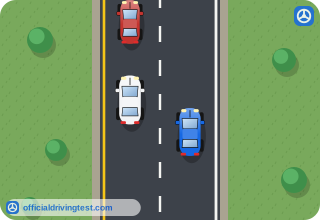
- As slowly as you can
- By matching the other car’s speed beside it
- As quickly as you can
- After pausing for a few seconds beside it
Show answer
Correct answer: As quickly as you can
The longer you stay in the other driver’s blind spot, the longer you are in danger of them turning into you.
Source: Montana Driver Manual (Revised April 2024), page 57
-
What does the manual say about staying alongside a large vehicle such as a truck or bus?
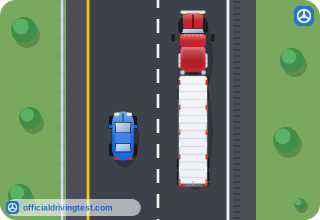
- Never do it, because the driver has trouble seeing you
- Do it only when you are driving below the speed limit
- It is safe as long as your headlights are on
- Do it only for a few seconds at a time
Show answer
Correct answer: Never do it, because the driver has trouble seeing you
Large vehicles have large blind spots, and it is hard for their drivers to see you.
Source: Montana Driver Manual (Revised April 2024), page 57
-
At what times should you be especially aware and look for animals near the road?
- At noon
- During the afternoon rush hour
- Only on rainy afternoons
- At sunrise and sunset
Show answer
Correct answer: At sunrise and sunset
The manual says to be aware and look for animals, especially at sunrise and sunset.
Source: Montana Driver Manual (Revised April 2024), page 61
-
If you see an animal near the road, what should you do?
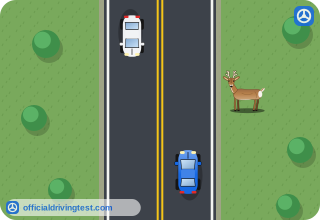
- Speed up to pass it quickly
- Slow down and be prepared to stop
- Flash your lights and keep your speed
- Swerve sharply around it
Show answer
Correct answer: Slow down and be prepared to stop
If you see an animal, slow down and be prepared to stop.
Source: Montana Driver Manual (Revised April 2024), page 61
-
What does the manual say to do if there is not time to stop or avoid an animal in the road?
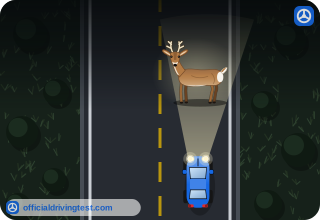
- Do not swerve sharply, even if that means hitting the animal
- Swerve sharply away from it to protect your vehicle
- Brake hard and steer toward the ditch to avoid the animal
- Swerve onto the shoulder and roll the vehicle if you must
Show answer
Correct answer: Do not swerve sharply, even if that means hitting the animal
The driver’s chance of getting seriously hurt is decreased if he or she hits the animal and avoids swerving into oncoming traffic or rolling the vehicle over in the ditch.
Source: Montana Driver Manual (Revised April 2024), page 61
-
If you see one deer or elk near the road, what should you do?
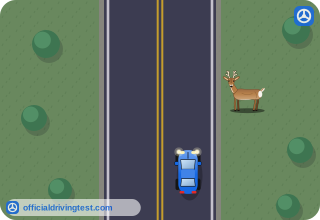
- Assume it is alone and resume your normal speed
- Speed up to pass the area before more appear
- Look for more animals, because they travel in herds
- Honk to scare it away and keep your speed
Show answer
Correct answer: Look for more animals, because they travel in herds
Deer, elk, and similar wildlife travel in herds, so you should always look for more animals if you see one.
Source: Montana Driver Manual (Revised April 2024), page 61
-
If you spot slow-moving vehicles early, what do you have time to do?
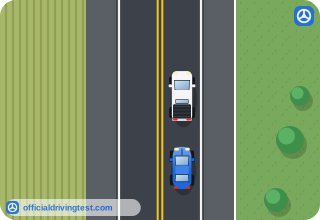
- Pull alongside and signal them to stop
- Change lanes or slow down safely
- Speed up and pass before the next curve
- Sound your horn so they speed up
Show answer
Correct answer: Change lanes or slow down safely
Spotting slow-moving vehicles early gives you time to change lanes or slow down safely, because slowing suddenly can cause a crash.
Source: Montana Driver Manual (Revised April 2024), page 62
-
Where should you watch for large trucks and small, underpowered cars that may lose speed?
- On steep grades or when they enter traffic
- On flat roads with no traffic around them
- On wide, straight roads in dry weather
- Only on narrow bridges and in tunnels
Show answer
Correct answer: On steep grades or when they enter traffic
Large trucks and small, underpowered cars can lose speed on long or steep hills, and it takes them longer to speed up when entering traffic.
Source: Montana Driver Manual (Revised April 2024), page 62
-
How fast do farm tractors, animal-drawn vehicles, and road maintenance vehicles usually go?
- 35 mph or less
- 45 mph or less
- 25 mph or less
- 55 mph or less
Show answer
Correct answer: 25 mph or less
The manual says these vehicles usually go 25 mph or less and must have a slow-moving vehicle sign on the back.
Source: Montana Driver Manual (Revised April 2024), page 62
-
What must farm tractors, animal-drawn vehicles, and road maintenance vehicles have on the back?
- A flashing amber lamp
- A slow-moving vehicle sign
- A reflective white square
- A green diamond-shaped plate
Show answer
Correct answer: A slow-moving vehicle sign
These vehicles must have a slow-moving vehicle sign on the back.
Source: Montana Driver Manual (Revised April 2024), page 62
-
In which lane must slow-moving vehicles drive?
- The center lane
- The left lane
- Whichever lane has the least traffic
- The extreme right lane of the roadway
Show answer
Correct answer: The extreme right lane of the roadway
Slow-moving vehicles must drive in the extreme right lane of the roadway.
Source: Montana Driver Manual (Revised April 2024), page 62
-
What does keeping more distance between yourself and everyone else give you?
- A higher legal speed limit
- More time to react to them
- The right-of-way over them
- A shorter stopping distance
Show answer
Correct answer: More time to react to them
The more distance you keep between yourself and everyone else, the more time you have to react to them; this space is like a safety cushion.
Source: Montana Driver Manual (Revised April 2024), page 64
-
Where should you try to stop when you pick up or let off passengers?
- In the right lane with your turn signal on
- Next to the nearest intersection crosswalk
- In the middle of the street if traffic is light
- A safe place out of the flow of traffic
Show answer
Correct answer: A safe place out of the flow of traffic
When stopping to pick up or let off passengers, you try to find a safe place out of the flow of traffic to stop.
Source: Montana Driver Manual (Revised April 2024), page 65
-
You must drive so slowly that you slow down other cars. What should you do?
- Stay in the center of the lane so no one can pass you
- Speed up until a passing lane or turnout appears
- Pull to the side of the road when it is safe and let them pass
- Stop in your lane and wait for the cars to go around you
Show answer
Correct answer: Pull to the side of the road when it is safe and let them pass
When you must drive so slowly that you slow down other cars, you pull to the side of the road when it is safe to do so and let them pass.
Source: Montana Driver Manual (Revised April 2024), page 65
-
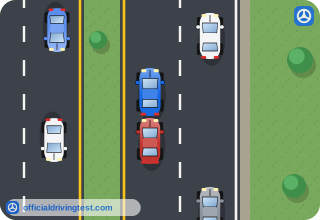
You are being tailgated and there is a right lane. What should you do?
- Slow down quickly to make the driver back off
- Move over to the right
- Speed up to build a gap behind you
- Stay in the left lane and hold your speed
Show answer
Correct answer: Move over to the right
If you are being followed too closely and there is a right lane, you move over to the right.
Source: Montana Driver Manual (Revised April 2024), page 65