Montana: Sharing the road — Part 1 Practice Test
Questions in this part include: “Which slow-moving vehicle is not required to display the slow-moving emblem?” · “On a two-lane road, a school bus is stopped with its red lights flashing. Which drivers must stop?”
Independent educational site · not affiliated with any government agency or DMV
Ready? Test yourself
- Instant feedback with an explanation
- Every answer cites its source in the manual
- Your best score is saved on this device
- Keyboard: press 1 to 4 to answer and Enter for the next question
Questions are original and based on the official manual "Montana Driver Manual" (Revised April 2024), Montana Department of Justice, Motor Vehicle Division.
All 19 questions in this practice test
Take the test above first, then use this list to study. Tap “Show answer” to see the correct answer and explanation.
Show the questions and answersHide the questions
-
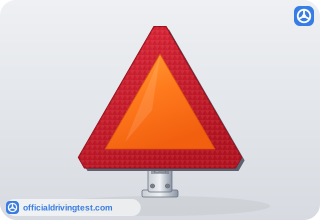
A slow-moving vehicle normally operating at or under what speed must display an emblem on its rear?
- 25 miles per hour
- 15 miles per hour
- 35 miles per hour
- 45 miles per hour
Show answer
Correct answer: 25 miles per hour
The manual says slow-moving vehicles normally operating at or under 25 miles per hour must display an emblem on the rear.
Source: Montana Driver Manual (Revised April 2024), page 18
-
Which slow-moving vehicle is not required to display the slow-moving emblem?
- Road machinery driving on the highway to a job site
- An animal-drawn vehicle on a two-lane highway
- Machinery doing actual road work, guarded by a flagger
- A farm tractor moved on a two-lane highway
Show answer
Correct answer: Machinery doing actual road work, guarded by a flagger
The manual exempts road construction or maintenance machinery engaged in actual work and guarded by a flagger or warning signs.
Source: Montana Driver Manual (Revised April 2024), page 18
-
What are the base and height of the slow-moving vehicle triangle emblem?
- 8 inches and 8 inches
- 14 inches and 14 inches
- 10 inches and 14 inches
- 20 inches and 20 inches
Show answer
Correct answer: 14 inches and 14 inches
The manual says the emblem is a triangle with a base of 14 inches and a height of 14 inches.
Source: Montana Driver Manual (Revised April 2024), page 18
-
At what height above the roadway must the slow-moving vehicle emblem be mounted in the center of the rear of the vehicle?
- One to two feet
- Five to seven feet
- Seven to nine feet
- Three to five feet
Show answer
Correct answer: Three to five feet
The manual says the emblem is mounted in the center of the rear at a height of three to five feet above the roadway.
Source: Montana Driver Manual (Revised April 2024), page 18
-
How wide are the reflective red stripes in the border of the slow-moving vehicle emblem?
- One and one-quarter inches
- Two and one-half inches
- Three and one-quarter inches
- One and three-quarters inches
Show answer
Correct answer: One and three-quarters inches
The manual says the border has reflective red stripes one and three-quarters inches wide.
Source: Montana Driver Manual (Revised April 2024), page 18
-
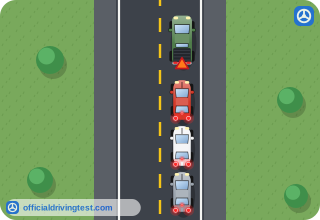
When traffic is held up behind a slow-moving vehicle on a two-lane highway, what must the slow-moving vehicle do?
- Speed up to the posted speed limit
- Pull over at the first safe opportunity
- Stop immediately in the travel lane
- Move to the center of the roadway
Show answer
Correct answer: Pull over at the first safe opportunity
The manual says it must, at the first safe opportunity with sufficient room for turnout, pull over to allow other vehicles to pass.
Source: Montana Driver Manual (Revised April 2024), page 18
-
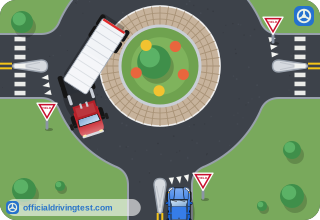
At a single-lane roundabout, what should the driver of a smaller vehicle do while a large truck completes its travel through?
- Pass the truck on the left side
- Drive right beside the truck
- Move up onto the truck apron
- Drop back behind the larger truck
Show answer
Correct answer: Drop back behind the larger truck
The rear wheels of a large vehicle will cross over the truck apron, so the driver of the smaller vehicle should drop back behind the truck.
Source: Montana Driver Manual (Revised April 2024), page 32
-
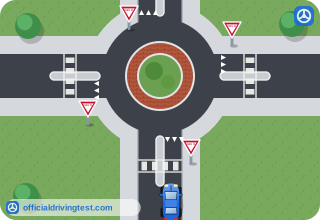
What is the truck apron in a single-lane roundabout?
- A sloped, flat curb on the center island that rear wheels of large vehicles cross
- A painted lane where trucks wait for a gap before entering the roundabout
- A raised island in the crosswalk where pedestrians may stand and wait
- A ramp that lets large vehicles leave the circle without making a turn
Show answer
Correct answer: A sloped, flat curb on the center island that rear wheels of large vehicles cross
The center island of a single-lane roundabout has a gradually sloped and flat curb called a truck apron, which the rear wheels of a large vehicle will cross over.
Source: Montana Driver Manual (Revised April 2024), page 32
-
At a roundabout, what are bicyclists encouraged to do?
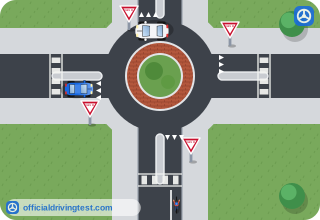
- Ride on the sidewalks and cross at the crosswalks without dismounting
- Ride on the truck apron so that they stay well clear of the cars
- Stay to the left of the center island and ride against the flow
- Walk their bicycles on the sidewalks and use the pedestrian crosswalks
Show answer
Correct answer: Walk their bicycles on the sidewalks and use the pedestrian crosswalks
Bicyclists are encouraged to walk their bicycles on the sidewalks and use the pedestrian crosswalks.
Source: Montana Driver Manual (Revised April 2024), page 32
-
What rules apply to a bicyclist who rides on the circulatory roadway of a roundabout?
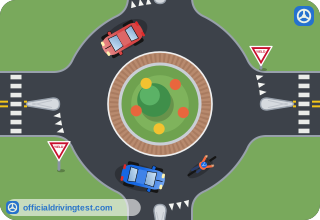
- The same traffic rules as motorized vehicles
- Pedestrian rules only
- No rules, since bicycles are not vehicles
- Rules that apply only on the sidewalk
Show answer
Correct answer: The same traffic rules as motorized vehicles
A bicyclist who is comfortable riding in traffic may ride on the circulatory roadway like a car, obeying the same traffic rules as motorized vehicles.
Source: Montana Driver Manual (Revised April 2024), page 32
-
When you meet or pass a school bus stopped with its red lights flashing, at least how far from the bus must you stop?
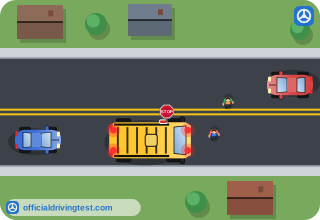
- 30 feet
- 10 feet
- 15 feet
- 50 feet
Show answer
Correct answer: 30 feet
Upon meeting or passing from either direction a school bus stopped with its red lights flashing, you must stop at least 30 feet from the bus.
Source: Montana Driver Manual (Revised April 2024), page 40
-
How long must you stay stopped for a school bus that has its red lights flashing?
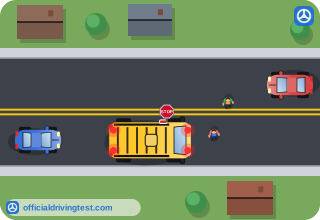
- When the red lights are turned off
- For at least one full minute
- Until the bus driver waves you on
- Until the stop arm starts to fold
Show answer
Correct answer: When the red lights are turned off
A driver stopped for a school bus with its red lights flashing cannot proceed until the red lights are turned off.
Source: Montana Driver Manual (Revised April 2024), page 40
-
On a two-lane road, a school bus is stopped with its red lights flashing. Which drivers must stop?
- Only drivers behind the bus
- Only drivers meeting the bus
- Drivers coming from either direction
- Only drivers in the lane of the bus
Show answer
Correct answer: Drivers coming from either direction
Upon meeting or passing from either direction any school bus stopped with its red lights flashing, a driver must stop.
Source: Montana Driver Manual (Revised April 2024), page 40
-
What must you do when a school bus ahead is slowing down to stop, or is showing a yellow flashing light?
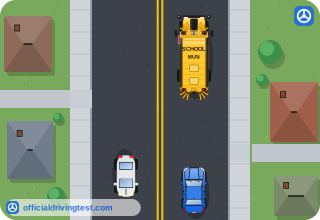
- Speed up to pass before it stops
- Slow down and proceed carefully
- Stop until the yellow lights go off
- Keep your speed and sound your horn
Show answer
Correct answer: Slow down and proceed carefully
If a bus is slowing down to stop to load passengers, or is displaying a yellow flashing light, you must slow down and proceed carefully, because children may be in the road.
Source: Montana Driver Manual (Revised April 2024), page 40
-
In which case does the manual say you do not need to stop for a school bus that has stopped?
- You are behind the bus on a two-lane road
- You are meeting it on a two-lane road
- No children are visible near the bus
- The bus is on a different road
Show answer
Correct answer: The bus is on a different road
You do not need to stop if meeting or passing a school bus that is on a different road.
Source: Montana Driver Manual (Revised April 2024), page 40
-
You do not need to stop for a school bus stopped in an adjacent loading zone when what is true?
- The bus is parked on your side of the road
- The bus door is still closed
- Pedestrians are not allowed to cross the road
- You are traveling below 25 mph
Show answer
Correct answer: Pedestrians are not allowed to cross the road
You do not need to stop for a school bus stopped in an adjacent loading zone where pedestrians are not allowed to cross the road.
Source: Montana Driver Manual (Revised April 2024), page 40
-
When does the manual say to slow down and watch for children when driving past a school?
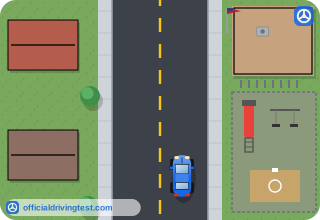
- Day and night
- Only on school days
- Only during school hours
- Only when a sign flashes
Show answer
Correct answer: Day and night
When driving past a school, slow down and watch for children day and night, because kids go back to use the playground at all hours.
Source: Montana Driver Manual (Revised April 2024), page 41
-
Under Montana law, how are bicycles treated?
- As vehicles under the same traffic laws
- As pedestrians whenever they ride on the road
- As toys that no traffic laws apply to
- As motor vehicles that need a license
Show answer
Correct answer: As vehicles under the same traffic laws
Under Montana law, bicycles are considered vehicles and are governed by the same traffic laws that reasonably apply to their operation.
Source: Montana Driver Manual (Revised April 2024), page 42
-
What does the manual say motorists should realize about bicycles and mopeds?
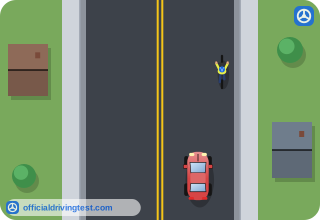
- They travel as fast as cars in town
- They never use rural roadways
- They must ride on the sidewalk
- They travel slower, so adjust when passing
Show answer
Correct answer: They travel slower, so adjust when passing
Bicycles and mopeds travel at a slower speed, so motorists should make the appropriate adjustments when passing or sharing the roadway with them.
Source: Montana Driver Manual (Revised April 2024), page 42