Minnesota: Sharing the road
School buses and their stop arms, bicycles and e-bikes, motorcycles with lane splitting and filtering, neighborhood electric vehicles, trucks and their no-zones, snowplows and other vulnerable road users. Split into 6 shorter tests so you're not stuck in one long quiz.
Independent educational site · not affiliated with any government agency or DMV
Choose a part
Sharing the road — Part 1
Questions in this part include: “What determines where the blind spots of your vehicle are?”
StartSharing the road — Part 2
Questions in this part include: “Besides student safety patrols, which people must you also stop for when they display a stop sign or flag?”
StartSharing the road — Part 3
Questions in this part include: “Which flashing lamp may a bicycle have?”
StartSharing the road — Part 4
Questions in this part include: “At what maximum speed may a motorcycle lane split?”
StartSharing the road — Part 5
Questions in this part include: “A commercial vehicle weighs more than how many pounds and is used to transport passengers or property?”
StartSharing the road — Part 6
Questions in this part include: “Within what distance must an animal-drawn vehicle’s light or lamp be visible from sunset to sunrise?”
StartAll 118 Sharing the road questions with answers
Choose a part above to take a practice test, or study every question and answer here.
Show the questions and answersHide the questions
-
At a stoplight, a motorcycle rides up between your car and the car in the next lane. What does the manual say about this?
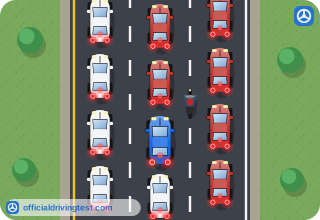
- It is legal, and you may not interfere with its safe movement
- It is illegal, and you should close the gap to stop it
- It is legal only on freeways, so you should report it
- It is illegal unless the motorcycle has its flashers on
Show answer
Correct answer: It is legal, and you may not interfere with its safe movement
Motorcycles may ride or pass between you and the car in the next lane. This is legal, and you may not interfere with their safe movement.
Source: Minnesota Driver’s Manual (June 2026), page 1
-
A school bus ahead has its red lights flashing, but its stop arm has not swung out. What must you do?
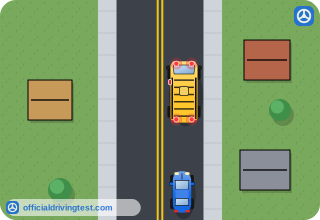
- Pass slowly, since the stop arm is not out
- Stop, as you must for the flashing red lights
- Slow to 10 mph and pass with care
- Stop only if children are in the road
Show answer
Correct answer: Stop, as you must for the flashing red lights
You must stop for flashing red school bus lights even if the stop arm doesn’t swing out.
Source: Minnesota Driver’s Manual (June 2026), page 1
-
When may you go on without stopping for a school bus that is stopped with its red lights flashing?
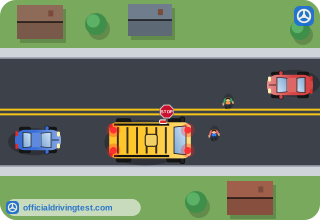
- On a two-lane road when you meet the bus head-on
- On a multilane road that has no median or divider
- When the bus is stopped on a road with no crosswalk
- On a divided highway when you travel the opposite way
Show answer
Correct answer: On a divided highway when you travel the opposite way
The only exception to stopping for a school bus with flashing red lights is on a divided highway when you are traveling in the opposite direction.
Source: Minnesota Driver’s Manual (June 2026), page 1
-
What are blind spots?
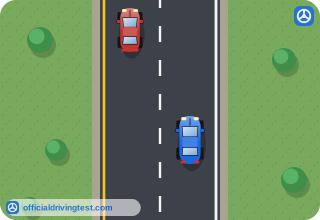
- Areas of the road that are not lit at night
- Areas that are visible only in your rearview mirror
- Areas around your vehicle where your view is blocked
- Areas of the road hidden behind a hilltop
Show answer
Correct answer: Areas around your vehicle where your view is blocked
Blind spots are areas around your vehicle where your view is blocked, so you cannot see pedestrians or vehicles in them in your mirrors.
Source: Minnesota Driver’s Manual (June 2026), page 28
-
What determines where the blind spots of your vehicle are?
- The speed at which you are driving
- The design of your vehicle and the position of the roof pillars
- The size of your side mirrors only
- The number of passengers and the weight of cargo in your vehicle
Show answer
Correct answer: The design of your vehicle and the position of the roof pillars
The design of your vehicle and the position of the roof pillars determine the location of your blind spots.
Source: Minnesota Driver’s Manual (June 2026), page 28
-
Which of these can create a temporary blind spot?
- A clean windshield in daylight
- A full fuel tank
- A low speed on a quiet street
- A dirty windshield or glaring lights
Show answer
Correct answer: A dirty windshield or glaring lights
Dirty windshields and glaring lights can also create temporary blind spots.
Source: Minnesota Driver’s Manual (June 2026), page 28
-
When should you be especially aware of blind spots?
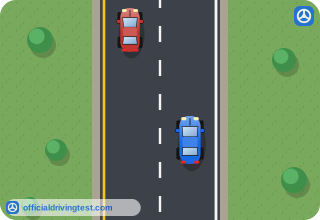
- When driving on gravel or dirt roads
- When driving near road signs
- When driving near commercial vehicles
- When driving on a road with no traffic
Show answer
Correct answer: When driving near commercial vehicles
The manual says to be especially aware of blind spots when driving near commercial vehicles.
Source: Minnesota Driver’s Manual (June 2026), page 28
-
Which advice does the manual give about other drivers’ blind spots?
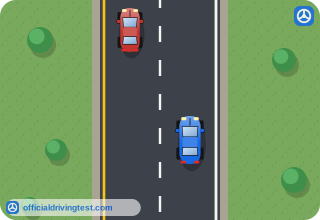
- Avoid driving in other drivers’ blind spots
- Stay in other drivers’ blind spots so they know you are there
- Drive in other drivers’ blind spots only on freeways
- Pass through other drivers’ blind spots as slowly as possible
Show answer
Correct answer: Avoid driving in other drivers’ blind spots
Drivers cannot see you in their blind spots, so the manual says to avoid driving in other drivers’ blind spots.
Source: Minnesota Driver’s Manual (June 2026), page 28
-
Bus drivers activate flashing yellow lights at least how far before a school bus stops in a speed zone of 35 mph or less?
- 50 feet
- 100 feet
- 200 feet
- 400 feet
Show answer
Correct answer: 100 feet
In a speed zone of 35 mph or less, the flashing yellow lights come on at least 100 feet before the bus stops.
Source: Minnesota Driver’s Manual (June 2026), page 41
-
Bus drivers activate flashing yellow lights at least how far before a school bus stops in a speed zone of more than 35 mph?
- 150 feet
- 500 feet
- 1,000 feet
- 300 feet
Show answer
Correct answer: 300 feet
In a speed zone of more than 35 mph, the flashing yellow lights come on at least 300 feet before the bus stops.
Source: Minnesota Driver’s Manual (June 2026), page 41
-
A school bus is displaying flashing yellow lights. Passing it on the right side is...
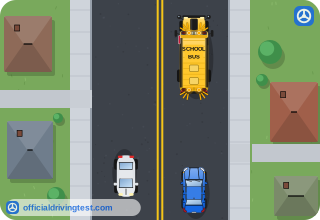
- Against the law
- Legal if you slow down
- Legal on a multilane road
- Legal if no children are visible
Show answer
Correct answer: Against the law
It is against the law to pass on the right side of a school bus while it is displaying red or yellow flashing lights.
Source: Minnesota Driver’s Manual (June 2026), page 41
-
What do the yellow and red lights that flash alternately on a school bus warn drivers of?
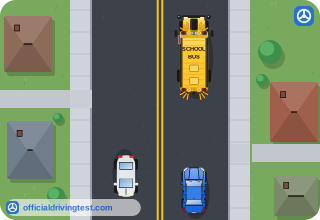
- The bus has broken down on the roadway
- The bus is leaving the school property
- The bus is stopping to load or unload students
- The bus is about to turn left at the corner
Show answer
Correct answer: The bus is stopping to load or unload students
These lights warn drivers that the school bus is stopping to load or unload students.
Source: Minnesota Driver’s Manual (June 2026), page 41
-
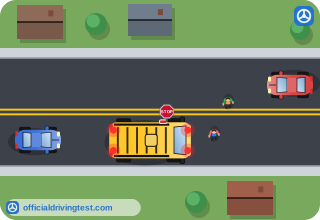
When a school bus is stopped with its red lights flashing, how far from the bus must you stop your vehicle?
- At least 10 feet
- At least 20 feet
- At least 50 feet
- At least 100 feet
Show answer
Correct answer: At least 20 feet
You must stop at least 20 feet from a stopped school bus with its red lights flashing.
Source: Minnesota Driver’s Manual (June 2026), page 42
-
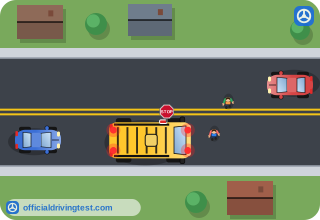
A school bus has its red lights flashing. Regardless of whether you face its front or back, how long must you remain stopped?
- Until the bus driver waves you on
- Until the stop arm is pulled in
- Until you count to ten
- Until the red lights stop flashing
Show answer
Correct answer: Until the red lights stop flashing
You must remain stopped until the red lights stop flashing, whether you are facing the front or back of the bus.
Source: Minnesota Driver’s Manual (June 2026), page 42
-
If you do not remain stopped for a school bus with its red lights flashing, what can you be charged with?
- A misdemeanor
- A petty misdemeanor
- A felony
- A written warning only
Show answer
Correct answer: A misdemeanor
Failing to remain stopped can result in a misdemeanor charge.
Source: Minnesota Driver’s Manual (June 2026), page 42
-
If you are convicted of not remaining stopped for a school bus with its red lights flashing, what is the minimum fine the manual states?
- $100
- $250
- $500
- $1,000
Show answer
Correct answer: $500
The manual says a convicted driver must pay a fine of at least $500.
Source: Minnesota Driver’s Manual (June 2026), page 42
-
When do you not need to stop for a school bus with its red lights flashing?
- When the bus has not yet swung out its stop arm
- When you are on a divided roadway and the bus is across the divider
- When you are driving on a two-lane road with no divider
- When the bus is stopped in a school driveway, not on the road
Show answer
Correct answer: When you are on a divided roadway and the bus is across the divider
On a divided roadway you do not need to stop if the bus is on the opposite side of the divider.
Source: Minnesota Driver’s Manual (June 2026), page 42
-
For how long after a violation may a law enforcement officer with probable cause arrest you for illegally passing a school bus with its red lights flashing?
- Within one hour
- Within 24 hours
- Within seven days
- Within four hours
Show answer
Correct answer: Within four hours
An officer with probable cause may arrest you within four hours of the violation.
Source: Minnesota Driver’s Manual (June 2026), page 42
-
When your vehicle is used to violate the law on stopping for a school bus, and you own or lease it, what are you guilty of?
- A petty misdemeanor
- A misdemeanor
- A gross misdemeanor
- A felony
Show answer
Correct answer: A petty misdemeanor
The owner or lessee of a vehicle used to violate the school bus law is guilty of a petty misdemeanor.
Source: Minnesota Driver’s Manual (June 2026), page 43
-
Your vehicle was used to violate the school bus stopping law, and you can prove another person was driving. Who is charged with the violation?
- The owner
- The owner and the driver
- The driver
- Nobody
Show answer
Correct answer: The driver
If you can prove that another person was driving, the driver will be charged.
Source: Minnesota Driver’s Manual (June 2026), page 43
-
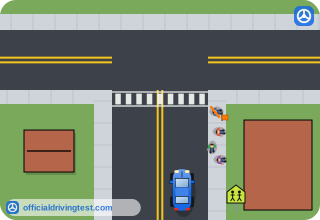
What must you do when you see a student safety patrol helping schoolmates cross a street or highway?
- Slow down and sound your horn
- Slow down and pass with caution
- Stop only if the children are in your lane
- Come to a complete stop
Show answer
Correct answer: Come to a complete stop
You must come to a complete stop for a student safety patrol helping schoolmates cross.
Source: Minnesota Driver’s Manual (June 2026), page 43
-
Besides student safety patrols, which people must you also stop for when they display a stop sign or flag?
- Adult crossing guards
- Parking attendants
- Students waiting at a bus stop
- Any pedestrian
Show answer
Correct answer: Adult crossing guards
You must also stop for adult crossing guards displaying a stop sign or flag.
Source: Minnesota Driver’s Manual (June 2026), page 43
-
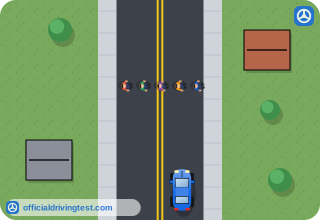
Is it illegal to drive through a line of children crossing the road when no school safety patrol is present?
- No, only when a patrol is helping them
- No, if you drive slowly
- Yes, even without a patrol
- Yes, but only near a school
Show answer
Correct answer: Yes, even without a patrol
Driving through a line of children crossing the road is illegal even if a school safety patrol is not present.
Source: Minnesota Driver’s Manual (June 2026), page 43
-
What is a second violation within a year of the law against driving through a line of children crossing the road?
- A misdemeanor
- A gross misdemeanor
- A petty misdemeanor
- A felony
Show answer
Correct answer: A gross misdemeanor
A first violation is a misdemeanor; a second violation within a year is a gross misdemeanor.
Source: Minnesota Driver’s Manual (June 2026), page 43
-
After being stopped by a school bus flagger, when may you proceed?
- When the school buses have all left the area
- When you see no children nearby in the road
- After waiting at least 20 seconds
- When the flagger or a police officer directs you to
Show answer
Correct answer: When the flagger or a police officer directs you to
After a school bus flagger stops you, you may not proceed until directed by the flagger or a police officer.
Source: Minnesota Driver’s Manual (June 2026), page 43
-
How must a school bus indicate its intent to move into the right-hand lane from a shoulder or right-turn lane where it stopped to load or unload?
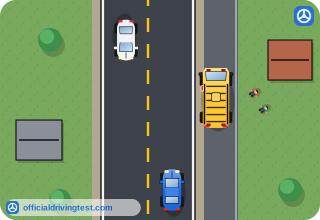
- With the right turn signal
- With the hazard warning lights
- With the left turn signal
- With the flashing yellow lights
Show answer
Correct answer: With the left turn signal
The school bus must use the left turn signal to indicate intent to move into the right-hand lane.
Source: Minnesota Driver’s Manual (June 2026), page 43
-
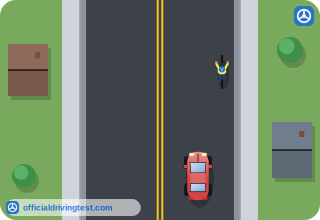
What rights and responsibilities do bicycles have on Minnesota roads?
- Fewer than other vehicles
- Only those of pedestrians
- None, because they are not vehicles
- The same as other vehicles
Show answer
Correct answer: The same as other vehicles
Bicycles are legal vehicles on Minnesota roads and share the same rights and responsibilities as other vehicles.
Source: Minnesota Driver’s Manual (June 2026), page 47
-
For which of these reasons may a driver legally drive in a bicycle lane?
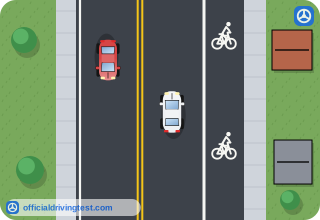
- To prepare for a turn
- To pass a slower vehicle
- To avoid a stopped vehicle ahead
- To get around a long line of traffic
Show answer
Correct answer: To prepare for a turn
Driving in a bicycle lane is illegal except to park (when permitted), to enter or leave the road, or to prepare for a turn.
Source: Minnesota Driver’s Manual (June 2026), page 48
-
Before you cross a bicycle lane, what must you do about bicyclists approaching in it?
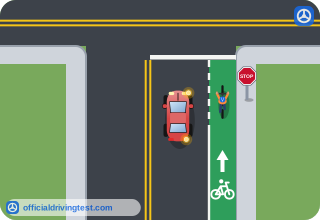
- Sound your horn to warn them
- Speed up to cross ahead of them
- Yield to them
- Flash your headlights at them
Show answer
Correct answer: Yield to them
You must yield to approaching bicyclists before crossing a bicycle lane.
Source: Minnesota Driver’s Manual (June 2026), page 48
-
When the bicycle lane is clear and you want to turn across it, what should you do?
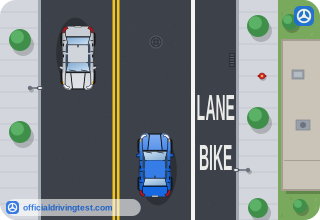
- Turn from the traffic lane without entering the bicycle lane
- Signal, then move into the bicycle lane before turning
- Stop in the bicycle lane until all traffic has passed
- Move into the bicycle lane first and signal after you are in it
Show answer
Correct answer: Signal, then move into the bicycle lane before turning
When the bicycle lane is clear, you signal your intention to turn and then move into the bicycle lane before making the turn.
Source: Minnesota Driver’s Manual (June 2026), page 48
-
What is the minimum space you must keep between the side of your car and a bicyclist you are passing?
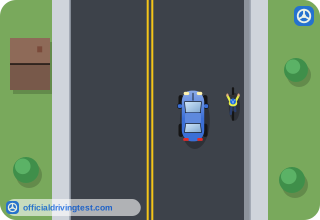
- 1 foot
- 2 feet
- 5 feet
- 3 feet
Show answer
Correct answer: 3 feet
You must keep at least 3 feet between the side of your car and the bicyclist.
Source: Minnesota Driver’s Manual (June 2026), page 48
-
When are you allowed to cross the center of the roadway to pass a bicyclist, even in a no passing zone?
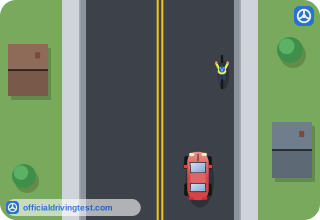
- Only when the bicyclist signals you to pass
- Only when no oncoming vehicle is in sight for a mile
- Only on roads with a speed limit below 30 mph
- When it is safe to do so
Show answer
Correct answer: When it is safe to do so
You are allowed to cross the center of the roadway to pass a bicyclist, even in a no passing zone, when it is safe to do so.
Source: Minnesota Driver’s Manual (June 2026), page 48
-
Before passing a bicyclist, what must you make sure of?
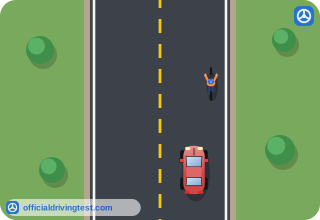
- The bicyclist has moved onto the sidewalk or shoulder
- The bicyclist is not signaling or making a left turn
- The bicyclist has seen your headlights flash
- The bicyclist has slowed down to almost a stop
Show answer
Correct answer: The bicyclist is not signaling or making a left turn
Before passing a bicyclist, make sure the bicyclist is not signaling or making a left turn.
Source: Minnesota Driver’s Manual (June 2026), page 48
-
How are electric-assist bicycles treated regarding the rules of the road and where they may operate?
- As motorized bicycles (mopeds)
- As motorcycles
- As bicycles
- As neighborhood electric vehicles
Show answer
Correct answer: As bicycles
Electric-assist bicycles are considered bicycles regarding rules of the road and where they may operate.
Source: Minnesota Driver’s Manual (June 2026), page 48
-
What does an electric-assist bicycle have?
- An electric motor that helps with pedaling
- A gas engine that powers the rear wheel
- A gas engine that helps with pedaling
- A battery that replaces the pedals
Show answer
Correct answer: An electric motor that helps with pedaling
An electric-assist bicycle has an electric motor that helps with pedaling.
Source: Minnesota Driver’s Manual (June 2026), page 48
-
Which kind of bicycle has a gas engine and must follow different rules from electric-assist bicycles?
- A standard pedal bicycle
- A neighborhood electric vehicle
- A motorized bicycle (moped)
- A tricycle with a rear basket
Show answer
Correct answer: A motorized bicycle (moped)
Motorized bicycles (mopeds) have a gas engine and must adhere to different rules than electric-assist bicycles.
Source: Minnesota Driver’s Manual (June 2026), page 48
-
In which direction must bicycle riders ride?
- In the same direction as the flow of traffic
- Against traffic, so they can see approaching vehicles
- In either direction on roads without a center line
- Facing traffic whenever they are on the shoulder
Show answer
Correct answer: In the same direction as the flow of traffic
Bicycle riders must ride in the same direction as the flow of traffic, not against it.
Source: Minnesota Driver’s Manual (June 2026), page 48
-
At a stop sign with no vehicle nearby, what may a bicycle rider do?
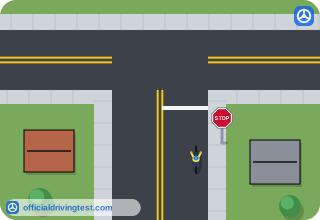
- Always make a complete stop first
- Proceed at normal speed without slowing
- Walk the bicycle through the intersection
- Slow down, then turn or proceed without stopping
Show answer
Correct answer: Slow down, then turn or proceed without stopping
Bicycle riders slow to a speed that allows stopping, and if no vehicle is nearby they may turn or proceed without stopping.
Source: Minnesota Driver’s Manual (June 2026), page 48
-
Where should a bicycle rider generally ride on the road?
- In the center of the lane at all times
- Just to the right of faster-moving traffic
- On the far left side of the lane
- Along the center line of the road
Show answer
Correct answer: Just to the right of faster-moving traffic
Bicycle riders travel just to the right of faster-moving traffic.
Source: Minnesota Driver’s Manual (June 2026), page 48
-
When may a bicycle rider move toward the center of the lane?
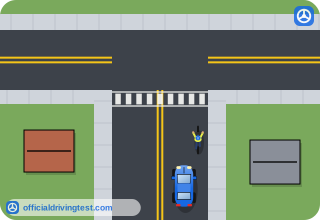
- When making a left turn
- When a vehicle is following closely behind
- When riding on a road that has a bicycle lane
- When approaching a driveway
Show answer
Correct answer: When making a left turn
A bicycle rider moves toward the center of the lane if there are hazards, when passing another vehicle or when making a left turn.
Source: Minnesota Driver’s Manual (June 2026), page 48
-
How does a bicycle rider signal a left turn?
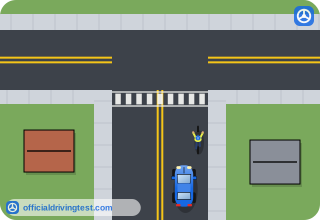
- By holding the right arm straight out
- By holding the left arm out and bending it toward the ground
- By holding the left arm straight out
- By raising both arms above the head
Show answer
Correct answer: By holding the left arm straight out
A bicycle rider signals a left turn by holding the left arm straight out.
Source: Minnesota Driver’s Manual (June 2026), page 48
-
Which is a correct way for a bicycle rider to signal a right turn?
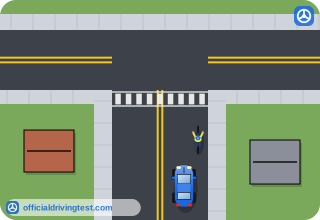
- Holding the left arm straight out
- Holding the right arm straight out
- Holding the left arm out and bending it toward the ground
- Holding the right arm out and bending it toward the ground
Show answer
Correct answer: Holding the right arm straight out
A bicycle rider may signal a right turn by holding the right arm straight out, or the left arm out and bent upward.
Source: Minnesota Driver’s Manual (June 2026), page 48
-
How does a bicycle rider signal that he or she is stopping?
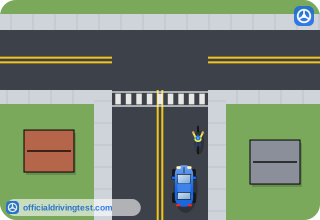
- By holding the left arm straight out to the side
- By holding the left arm out and bending it upward
- By holding the right arm out and bending it upward at the elbow
- By holding the left arm out and bending it toward the ground
Show answer
Correct answer: By holding the left arm out and bending it toward the ground
A stop is signaled by holding the left arm out and bending it toward the ground.
Source: Minnesota Driver’s Manual (June 2026), page 48
-
Under what condition may two bicycle riders ride next to each other?
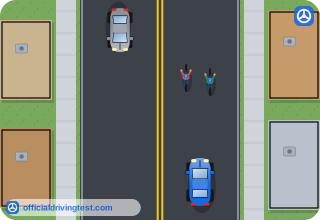
- Only on roads that have a bicycle lane
- Only on roads with a speed limit of 30 mph or less
- Only if both riders wear helmets
- They do not impede traffic and stay within a single lane
Show answer
Correct answer: They do not impede traffic and stay within a single lane
Two people may ride next to each other as long as they do not impede traffic and stay within a single lane.
Source: Minnesota Driver’s Manual (June 2026), page 48
-
Which flashing lamp may a bicycle have?
- A front lamp with a red flashing signal
- A front lamp with a white flashing signal
- A rear lamp with a white flashing signal
- A rear lamp with a green flashing signal
Show answer
Correct answer: A front lamp with a white flashing signal
A bicycle may have a front lamp with a white flashing signal or a rear lamp with a red flashing signal or both.
Source: Minnesota Driver’s Manual (June 2026), page 48
-
What does the manual say about the tires of a bicycle?
- They must have smooth rubber tread only
- They may have only factory-installed knobby tread
- They may have spikes or other traction features
- They may have only reflective tread strips
Show answer
Correct answer: They may have spikes or other traction features
Bicycles may have tires with spikes or other features for increased traction.
Source: Minnesota Driver’s Manual (June 2026), page 48
-
What should a bicycle rider do before passing pedestrians on a sidewalk or crosswalk?
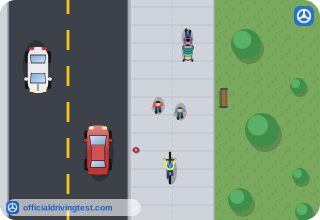
- Yield the right of way and give an audible signal
- Pass them quickly on the left without slowing
- Dismount and ride in the street instead
- Flash the bicycle's lamp at them
Show answer
Correct answer: Yield the right of way and give an audible signal
A bicycle rider on a sidewalk or crosswalk must yield the right of way to pedestrians and give an audible signal before passing them.
Source: Minnesota Driver’s Manual (June 2026), page 48
-
When may a bicycle be ridden on a sidewalk within a business district?
- At any time, if the rider yields to pedestrians
- Only between sunrise and sunset
- Only when allowed by local authorities
- Only when the street has no bicycle lane
Show answer
Correct answer: Only when allowed by local authorities
Riding a bicycle on a sidewalk within a business district is not allowed unless local authorities allow it.
Source: Minnesota Driver’s Manual (June 2026), page 48
-
Who may prohibit riding a bicycle on any sidewalk or crosswalk?
- Local authorities
- Only the state legislature
- Only the driver and vehicle services office
- Only the owner of the nearest business
Show answer
Correct answer: Local authorities
Local authorities may prohibit riding on any sidewalk or crosswalk.
Source: Minnesota Driver’s Manual (June 2026), page 48
-
What rights and duties does a person on a bicycle have when riding on a sidewalk or crosswalk?
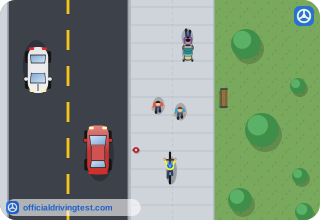
- The same as drivers of motor vehicles
- The same as motorcyclists
- None, because bicycles are not allowed there
- The same as pedestrians
Show answer
Correct answer: The same as pedestrians
When riding on a sidewalk or crosswalk, a bicycle rider has the same rights and duties as pedestrians.
Source: Minnesota Driver’s Manual (June 2026), page 48
-
A signal does not detect a bicyclist at a light. Which condition must be met before the bicyclist may proceed through the intersection after a reasonable amount of time?
- A police officer has waved the bicyclist ahead
- The bicycle has come to a complete stop
- The bicyclist has pressed the pedestrian button twice
- The bicyclist has walked the bicycle onto the sidewalk
Show answer
Correct answer: The bicycle has come to a complete stop
One condition is that the bicycle has come to a complete stop, along with the signal malfunctioning or red for an unreasonable time and no approaching hazards.
Source: Minnesota Driver’s Manual (June 2026), page 49
-
A bicyclist who goes through a red light that fails to detect the bicycle has a defense against which violation?
- Entering an intersection controlled by a red light
- Failing to signal a turn
- Riding against the flow of traffic
- Riding on a sidewalk in a business district
Show answer
Correct answer: Entering an intersection controlled by a red light
The defense applies only to violations for entering or crossing an intersection controlled by a red light, not to other civil or criminal actions.
Source: Minnesota Driver’s Manual (June 2026), page 49
-
When should drivers be extra cautious of bicycle traffic?
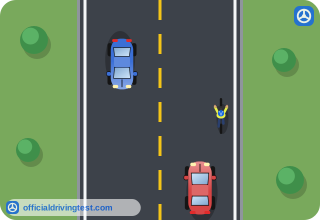
- At midday
- On dry pavement
- At night
- On roads with wide lanes
Show answer
Correct answer: At night
The manual tells drivers to be extra cautious of bicycle traffic at night.
Source: Minnesota Driver’s Manual (June 2026), page 49
-
Where should drivers watch for bicyclists?
- Only on roads that have bicycle lanes
- When entering or leaving alleys and driveways
- Only on residential streets
- Only at intersections with traffic signals
Show answer
Correct answer: When entering or leaving alleys and driveways
Drivers should watch for bicyclists in intersections, on sidewalks, and when entering or leaving alleys and driveways.
Source: Minnesota Driver’s Manual (June 2026), page 49
-
A “motorized bicycle” (moped) is defined by a speed capacity of how many mph?
- 20 mph or less
- 40 mph or less
- 45 mph or less
- 30 mph or less
Show answer
Correct answer: 30 mph or less
A motorized bicycle is a moped and is defined by its speed capacity, which is 30 mph or less.
Source: Minnesota Driver’s Manual (June 2026), page 49
-
Where are motorized bicycles not allowed?
- On streets with a center line
- On roads with a posted speed limit of 30 mph
- On two-way residential streets
- On freeways
Show answer
Correct answer: On freeways
Motorized bicycles are not allowed on sidewalks, freeways, or lanes and trails designated for pedestrians and bicycles.
Source: Minnesota Driver’s Manual (June 2026), page 49
-
Which traffic laws must motorcyclists obey?
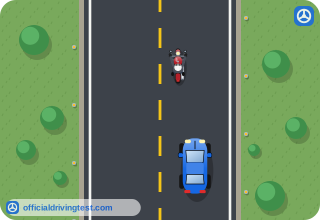
- Only the laws for roads without a center line
- The same traffic laws as other drivers
- Only the speed limit laws
- Special motorcycle laws instead of the laws for other drivers
Show answer
Correct answer: The same traffic laws as other drivers
Motorcyclists must obey the same traffic laws as other drivers.
Source: Minnesota Driver’s Manual (June 2026), page 49
-
Why is it difficult to judge the speed and distance of an approaching motorcycle?
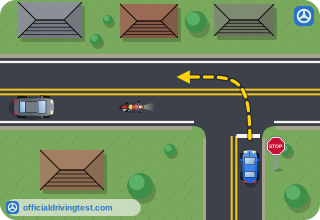
- Motorcycles always travel faster than cars
- Motorcycle headlights are dimmer than car headlights
- Motorcycles are smaller than cars
- Motorcycles are quieter than cars
Show answer
Correct answer: Motorcycles are smaller than cars
Motorcycles are smaller than cars, which makes it difficult to judge their speed and distance when approaching.
Source: Minnesota Driver’s Manual (June 2026), page 49
-
How should your following distance from a motorcycle compare with your following distance from other vehicles?
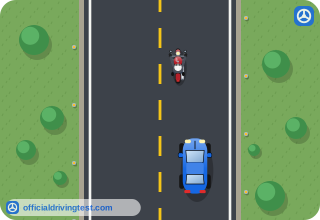
- The same as, or greater than, for other vehicles
- Shorter, because motorcycles are smaller
- Half the distance used for other vehicles
- Exactly the same, never greater
Show answer
Correct answer: The same as, or greater than, for other vehicles
Your following distance from a motorcycle should be the same as, or greater than, your following distance from other vehicles.
Source: Minnesota Driver’s Manual (June 2026), page 49
-
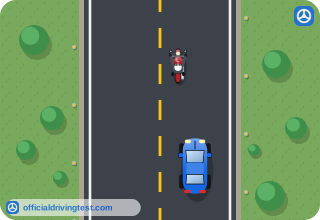
Why should you allow maneuvering room when following a motorcycle?
- Motorcycles can stop faster than cars in any weather
- Motorcycle riders must stay within the lane markings
- Riders may have trouble controlling the motorcycle and weave
- Motorcycles are not required to use turn signals
Show answer
Correct answer: Riders may have trouble controlling the motorcycle and weave
Riders may experience difficulty controlling the motorcycle, which could result in weaving, so you should allow maneuvering room.
Source: Minnesota Driver’s Manual (June 2026), page 49
-
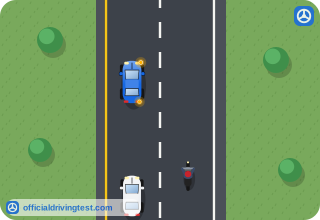
When you prepare to move into a lane in front of a motorcycle, how much space should you allow from the rear of your vehicle?
- As much as you would for a car
- Half the space you would allow for a car
- Twice the space you would allow for a car
- Only a car length
Show answer
Correct answer: As much as you would for a car
You should allow as much space from the rear of your vehicle as you would for a car.
Source: Minnesota Driver’s Manual (June 2026), page 49
-
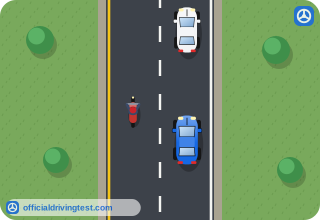
If a motorcyclist attempts to pass you, what should you do?
- Speed up to keep the motorcycle behind you
- Move to the shoulder to give the rider room
- Brake so the rider can pass quickly
- Maintain your lane position and speed
Show answer
Correct answer: Maintain your lane position and speed
When a motorcyclist attempts to pass, you maintain your lane position and speed and allow the rider to complete the pass.
Source: Minnesota Driver’s Manual (June 2026), page 49
-
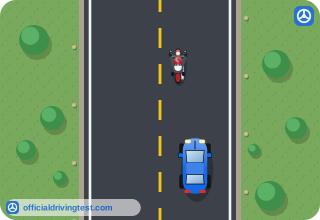
What does the manual say about driving alongside a motorcycle in the same lane?
- It is allowed if you stay near the lane edge
- Never attempt to drive alongside a motorcycle in the same lane
- It is allowed on roads with a speed limit below 35 mph
- It is allowed when you signal first
Show answer
Correct answer: Never attempt to drive alongside a motorcycle in the same lane
Crowding a motorcyclist is illegal and dangerous, and you should never drive alongside a motorcycle in the same lane.
Source: Minnesota Driver’s Manual (June 2026), page 49
-
When a motorcyclist shares your lane to pass you in slow moving or stopped traffic, what must you do?
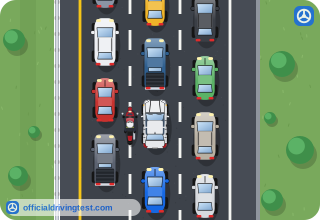
- Not get in the rider's way or try to stop the rider
- Move to the shoulder and stop
- Close the gap to keep the rider from passing
- Honk to warn the rider away
Show answer
Correct answer: Not get in the rider's way or try to stop the rider
Lane splitting and filtering is legal, and you must not get in the motorcyclist's way or attempt to stop the rider.
Source: Minnesota Driver’s Manual (June 2026), page 49
-
At what maximum speed may a motorcycle lane split?
- 20 miles per hour
- 35 miles per hour
- 25 miles per hour
- 45 miles per hour
Show answer
Correct answer: 25 miles per hour
Lane splitting is allowed only at no more than 25 miles per hour.
Source: Minnesota Driver’s Manual (June 2026), page 50
-
When lane splitting, how much faster than the speed of traffic in the relevant lanes may a motorcycle go?
- No more than 5 miles per hour over
- No more than 15 miles per hour over
- No more than 10 miles per hour over
- No more than 20 miles per hour over
Show answer
Correct answer: No more than 15 miles per hour over
Lane splitting requires no more than 15 miles per hour over the speed of traffic in the relevant traffic lanes.
Source: Minnesota Driver’s Manual (June 2026), page 50
-
When is lane splitting allowed?
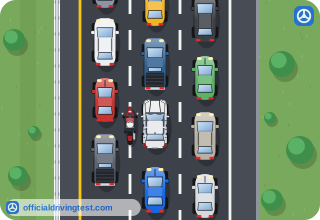
- Only when traffic is stopped
- Only on roads with a single lane in each direction
- Only on roads with a posted speed limit of 45 mph or more
- When traffic is moving in two or more same-direction lanes
Show answer
Correct answer: When traffic is moving in two or more same-direction lanes
Lane splitting is allowed when two or more lanes of traffic are traveling in the same direction and traffic is moving.
Source: Minnesota Driver’s Manual (June 2026), page 50
-
When is lane filtering allowed?
- When traffic is moving at 25 mph or less in any lane
- Only on roads with a single lane in each direction
- Only on roads with a posted speed limit below 25 mph
- When traffic is not moving in two or more same-direction lanes
Show answer
Correct answer: When traffic is not moving in two or more same-direction lanes
Lane filtering is allowed when two or more lanes of traffic are traveling in the same direction and traffic is NOT moving.
Source: Minnesota Driver’s Manual (June 2026), page 50
-
What does lane filtering allow a motorcycle to do?
- Pass other vehicles on the shoulder when traffic is moving
- Move through stopped traffic, such as at a traffic light
- Ride between two lanes of moving traffic at any speed
- Use a lane that is closed off for construction work
Show answer
Correct answer: Move through stopped traffic, such as at a traffic light
Lane filtering allows a motorcycle to move through traffic that is stopped, such as at a traffic light or traffic jam.
Source: Minnesota Driver’s Manual (June 2026), page 50
-
How much faster than the speed of traffic in the relevant lanes may a motorcycle go while lane filtering?
- No more than 5 miles per hour over
- No more than 10 miles per hour over
- No more than 15 miles per hour over
- No more than 25 miles per hour over
Show answer
Correct answer: No more than 15 miles per hour over
Lane filtering is allowed only if the motorcycle goes no more than 15 miles per hour over the speed of traffic in the relevant traffic lanes.
Source: Minnesota Driver’s Manual (June 2026), page 50
-
What is the most common type of crash between motorcycles and cars?
- A crash at an urban intersection
- A crash on a freeway entrance ramp
- A crash on a rural gravel road
- A crash in a parking lot
Show answer
Correct answer: A crash at an urban intersection
Crashes at urban intersections are the most common motorcycle-car collisions.
Source: Minnesota Driver’s Manual (June 2026), page 50
-
Many motorcycle-car collisions occur when drivers do what?
- Change lanes without checking the mirrors for motorcycles
- Stop too close behind a motorcycle at a traffic light
- Fail to yield and turn left in front of an oncoming motorcycle
- Back out of a driveway without looking for traffic
Show answer
Correct answer: Fail to yield and turn left in front of an oncoming motorcycle
Many collisions occur when drivers fail to yield right of way and make a left turn in front of an oncoming motorcycle.
Source: Minnesota Driver’s Manual (June 2026), page 50
-
Which lanes may motorcyclists use?
- High-occupancy vehicle lanes
- Only lanes marked for bicycles
- Only the left lane of a freeway
- Lanes closed for construction
Show answer
Correct answer: High-occupancy vehicle lanes
Motorcyclists may use high-occupancy vehicle lanes.
Source: Minnesota Driver’s Manual (June 2026), page 50
-
Which statement about right-of-way laws is correct for motorcyclists?
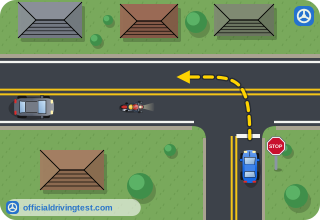
- They do not apply to motorcyclists
- They apply only to motorcyclists on freeways
- They apply only to motorcyclists in a marked lane
- They apply to motorcyclists as well as other drivers
Show answer
Correct answer: They apply to motorcyclists as well as other drivers
Right-of-way laws apply to motorcyclists, as well as other drivers.
Source: Minnesota Driver’s Manual (June 2026), page 50
-
What makes someone a vulnerable road user?
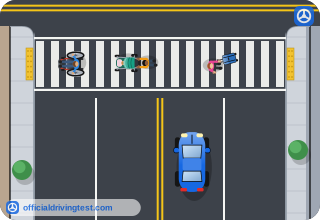
- They are riding a vehicle that has a gas engine
- They have less protection than the people in cars
- They are driving on a rural road
- They are traveling on a road with a speed limit above 45 mph
Show answer
Correct answer: They have less protection than the people in cars
Vulnerable road users are people on highways, bikeways, sidewalks or trails who have less protection than those in cars.
Source: Minnesota Driver’s Manual (June 2026), page 51
-
Which of these is listed as a vulnerable road user?
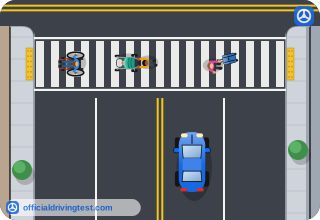
- A person riding a horse
- A person driving a pickup truck
- A person driving a school bus
- A person driving a motor home
Show answer
Correct answer: A person riding a horse
Vulnerable road users include people riding two- or three-wheeled vehicles, using electric mobility devices, riding horses, walking or using motorized scooters.
Source: Minnesota Driver’s Manual (June 2026), page 51
-
What must vulnerable road users do?
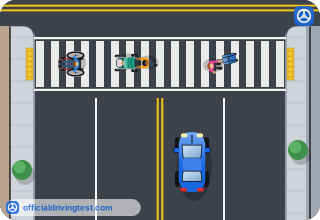
- Stay off roads with a speed limit above 35 mph
- Use only roads that have bicycle lanes
- Follow all traffic laws
- Yield to every vehicle at every intersection
Show answer
Correct answer: Follow all traffic laws
Vulnerable road users must also follow all traffic laws, and drivers must share the road safely with them.
Source: Minnesota Driver’s Manual (June 2026), page 51
-
Which is true of a Neighborhood Electric Vehicle (NEV)?
- It is gas-powered with two wheels and reaches speeds up to 45 mph
- It is electric-powered with three or four wheels and reaches 20 to 25 mph
- It is electric-powered with two wheels and reaches speeds up to 55 mph
- It is gas-powered with four wheels and reaches speeds of 30 mph or less
Show answer
Correct answer: It is electric-powered with three or four wheels and reaches 20 to 25 mph
A Neighborhood Electric Vehicle is an electric-powered vehicle with three or four wheels that can reach speeds between 20 and 25 mph.
Source: Minnesota Driver’s Manual (June 2026), page 51
-
With whom must NEVs be titled and registered?
- The local police department
- The county sheriff
- The Minnesota State Patrol
- Driver Vehicle Services
Show answer
Correct answer: Driver Vehicle Services
NEVs must be titled and registered with Driver Vehicle Services.
Source: Minnesota Driver’s Manual (June 2026), page 51
-
On which streets may a person with a Class D driver’s license drive an NEV?
- Only streets with speed limits of 25 mph or less
- Only streets with speed limits of 45 mph or less
- Any street except freeways
- Only streets with speed limits of 35 mph or less
Show answer
Correct answer: Only streets with speed limits of 35 mph or less
Anyone with a Class D driver’s license may drive an NEV, but only on streets with speed limits of 35 mph or less.
Source: Minnesota Driver’s Manual (June 2026), page 51
-
A commercial vehicle weighs more than how many pounds and is used to transport passengers or property?
- 16,000 pounds
- 20,000 pounds
- 26,000 pounds
- 30,000 pounds
Show answer
Correct answer: 26,000 pounds
A commercial vehicle is a motor vehicle or combination of vehicles that weighs more than 26,000 pounds and is used to transport passengers or property.
Source: Minnesota Driver’s Manual (June 2026), page 51
-
Which of these is also considered a commercial vehicle?
- A school bus of any size
- A motor home used for personal trips
- A pickup truck towing a small trailer
- A van used only for family trips
Show answer
Correct answer: A school bus of any size
Buses, including school buses of all sizes, are also considered commercial vehicles.
Source: Minnesota Driver’s Manual (June 2026), page 51
-
Besides buses, which smaller vehicles are considered commercial vehicles?
- Vehicles with trailer brakes
- Vehicles carrying more than four passengers
- Vehicles with hazardous materials placards
- Vehicles with dual rear wheels
Show answer
Correct answer: Vehicles with hazardous materials placards
Smaller vehicles with hazardous materials placards are also considered commercial vehicles.
Source: Minnesota Driver’s Manual (June 2026), page 51
-
On a level highway, how much longer does it take to pass a commercial vehicle than a car?
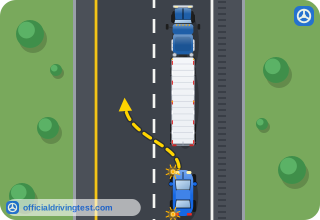
- Three to five seconds longer
- One to two seconds longer
- Six to eight seconds longer
- About ten seconds longer
Show answer
Correct answer: Three to five seconds longer
It takes three to five seconds longer to pass a commercial vehicle than a car.
Source: Minnesota Driver’s Manual (June 2026), page 51
-
When passing a commercial vehicle, when should you return to the right lane?
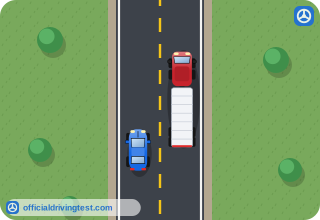
- Only after you are 500 feet ahead of the vehicle
- As soon as your front bumper passes its rear bumper
- Only when the vehicle you passed flashes its lights
- Before coming within 100 feet of oncoming traffic
Show answer
Correct answer: Before coming within 100 feet of oncoming traffic
Allow enough time to pass and return to the right lane before coming within 100 feet of oncoming traffic.
Source: Minnesota Driver’s Manual (June 2026), page 51
-
If you plan to exit or turn off the road soon, what should you do about a commercial vehicle ahead?
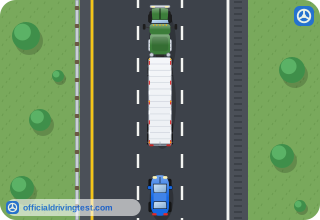
- Pass it quickly on the right side
- Stay behind it until you reach the exit
- Pass it on the shoulder before the exit
- Pass it if it is going uphill
Show answer
Correct answer: Stay behind it until you reach the exit
If you plan to exit or turn off the road soon, you stay behind the commercial vehicle until you reach the exit.
Source: Minnesota Driver’s Manual (June 2026), page 51
-
Why is a commercial vehicle easier to pass when going uphill?
- It often loses speed on an upgrade
- It always stops on a hill
- It must use its right-turn signal
- It uses a lower gear and moves to the shoulder
Show answer
Correct answer: It often loses speed on an upgrade
Commercial vehicles often lose speed on an upgrade, making them easier to pass than a car.
Source: Minnesota Driver’s Manual (June 2026), page 51
-
What should you allow when passing a commercial vehicle that is going downhill?
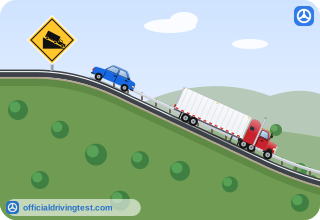
- Less distance, because it slows down
- The same distance as on a level road
- More distance to pass
- No extra distance, because it keeps a steady speed
Show answer
Correct answer: More distance to pass
Commercial vehicles increase speed on a downgrade, so you should allow more distance to pass.
Source: Minnesota Driver’s Manual (June 2026), page 51
-
After passing a commercial vehicle, when should you move back into your lane?
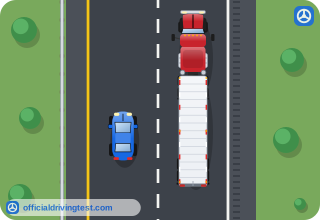
- As soon as your front bumper is even with its cab
- When you can see its front in your rearview mirror
- When your car is about one car length ahead of it
- When the driver of the vehicle flashes its headlights
Show answer
Correct answer: When you can see its front in your rearview mirror
Move back into your lane only when you can see the front of the commercial vehicle in your rearview mirror, and maintain your speed after passing.
Source: Minnesota Driver’s Manual (June 2026), page 51
-
What should you do when a commercial vehicle passes you?
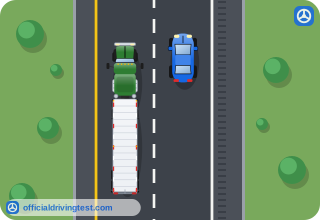
- Speed up to stay beside it until it has passed
- Move toward the center line to give it more room
- Brake hard and pull off onto the road shoulder
- Keep to the far side of your lane and slow slightly
Show answer
Correct answer: Keep to the far side of your lane and slow slightly
When a commercial vehicle passes you, keep to the far side of your lane and slightly reduce your speed, and do not speed up.
Source: Minnesota Driver’s Manual (June 2026), page 51
-
When meeting a commercial vehicle from the opposite direction, where should you stay?
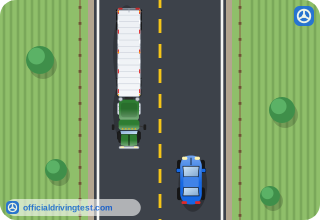
- Near the center line
- In the center of your lane
- As far to the left as possible
- As far to the right as possible
Show answer
Correct answer: As far to the right as possible
Stay as far to the right as possible to avoid a sideswipe crash and reduce wind turbulence between the vehicles.
Source: Minnesota Driver’s Manual (June 2026), page 51
-
What does wind turbulence between a commercial vehicle and a vehicle meeting it do?
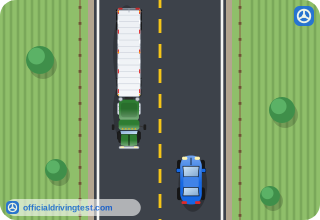
- Pulls the vehicles toward each other
- Pushes the vehicles away from each other
- Pushes both vehicles toward the shoulder
- Has no effect at highway speeds
Show answer
Correct answer: Pushes the vehicles away from each other
Turbulence will push the vehicles away from each other, not toward each other.
Source: Minnesota Driver’s Manual (June 2026), page 51
-
Why do many car-commercial vehicle collisions occur at intersections?
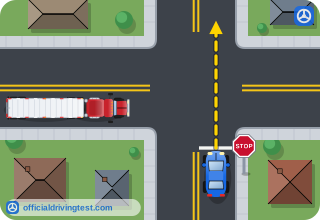
- Commercial vehicles always run red lights
- Commercial vehicles have no turn signals
- The car driver misjudges its speed and distance
- Car drivers cannot see commercial vehicles at night
Show answer
Correct answer: The car driver misjudges its speed and distance
Commercial vehicles often appear to be traveling slower than they actually are because of their large size, so car drivers misjudge speed and distance.
Source: Minnesota Driver’s Manual (June 2026), page 51
-
Why is it especially dangerous to cut in too close in front of a commercial bus or truck?
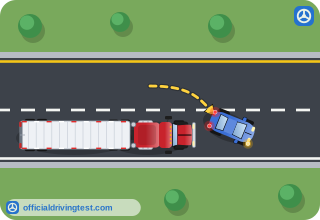
- You are likely to be in a blind spot
- Commercial vehicles have no brakes in front
- Commercial vehicles can stop faster than cars
- Commercial drivers cannot use their mirrors
Show answer
Correct answer: You are likely to be in a blind spot
Moving in quickly from either side likely puts you in a blind spot, and the vehicle may not be able to slow down in time.
Source: Minnesota Driver’s Manual (June 2026), page 52
-
At 55 mph, within what distance can an average passenger car stop?
- 60 to 70 feet
- 200 to 250 feet
- 130 to 140 feet
- 300 to 350 feet
Show answer
Correct answer: 130 to 140 feet
An average passenger car traveling at 55 mph can stop within 130 to 140 feet.
Source: Minnesota Driver’s Manual (June 2026), page 52
-
How far may a fully loaded tractor-trailer need to stop completely?
- More than 400 feet
- About 200 feet
- About 250 feet
- About 300 feet
Show answer
Correct answer: More than 400 feet
A fully loaded tractor-trailer may need more than 400 feet to stop completely.
Source: Minnesota Driver’s Manual (June 2026), page 52
-
When following a commercial vehicle, how should you position your vehicle?
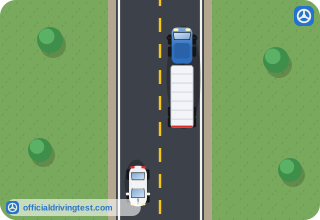
- Directly behind the rear bumper
- Close enough to read its license plate
- Where its mirrors cannot reflect your lights
- So the driver can see you in the side mirrors
Show answer
Correct answer: So the driver can see you in the side mirrors
Maintain a safe following distance and position your vehicle so the driver can see you in their side mirrors.
Source: Minnesota Driver’s Manual (June 2026), page 52
-
Why does following a commercial vehicle too closely cause a problem?
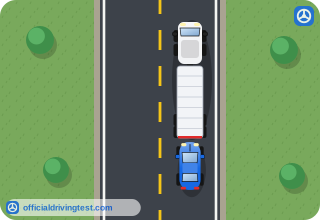
- The driver may slow down to let you pass
- You cannot see the road ahead as well
- It makes the driver see you more clearly
- It lowers the stopping distance you need
Show answer
Correct answer: You cannot see the road ahead as well
Following a commercial vehicle too closely reduces your ability to see the road ahead.
Source: Minnesota Driver’s Manual (June 2026), page 52
-
What should you do when following a commercial vehicle at night?
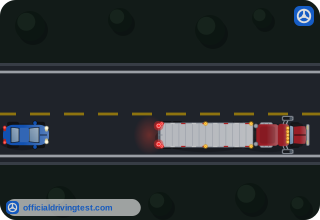
- Always dim your headlights
- Use high beams to see the road
- Turn off your headlights
- Flash your headlights at the driver
Show answer
Correct answer: Always dim your headlights
Commercial vehicles have large side mirrors that can reflect light, so you should always dim your headlights to avoid blinding the driver.
Source: Minnesota Driver’s Manual (June 2026), page 52
-
When a commercial vehicle merges into traffic, what should you be prepared to do?
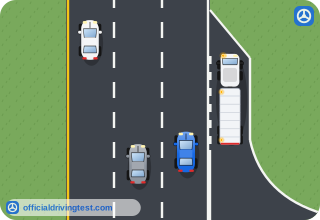
- Speed up to pass it before it merges
- Stay in the lane and sound your horn
- Slow down or change lanes to let it merge
- Move close behind it to follow it in
Show answer
Correct answer: Slow down or change lanes to let it merge
A commercial vehicle needs more time than a car to accelerate and reach normal speed, so be prepared to slow down or change lanes to let it merge safely.
Source: Minnesota Driver’s Manual (June 2026), page 52
-
If you stop behind a commercial vehicle on an upgrade, what should you allow?
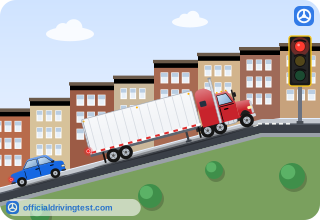
- No space, because trucks cannot roll back
- Space for the truck to roll back slightly
- Space for the truck to stop on the shoulder
- Space for the truck to turn right
Show answer
Correct answer: Space for the truck to roll back slightly
On an upgrade you should allow space for the truck to roll back slightly when it starts to move.
Source: Minnesota Driver’s Manual (June 2026), page 52
-
If you stop behind a commercial vehicle on an upgrade, where in your lane should you position your vehicle?
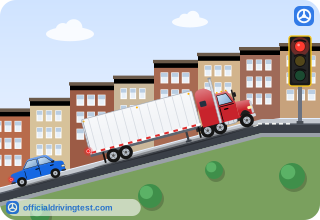
- On the right side of your lane
- Straight behind the center of the truck
- Half in the next lane
- On the left side of your lane
Show answer
Correct answer: On the left side of your lane
You position your vehicle on the left side of your lane so the driver can see you in the side mirror.
Source: Minnesota Driver’s Manual (June 2026), page 52
-
Why should you not pass a commercial vehicle on the right if it might make a right turn?
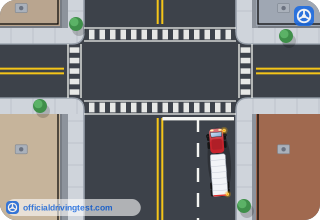
- Commercial vehicles never signal right turns
- Commercial vehicles turn only from the right lane
- The rear wheels of a turning vehicle follow a longer path than the front wheels
- The rear wheels of a turning vehicle follow a shorter path than the front wheels
Show answer
Correct answer: The rear wheels of a turning vehicle follow a shorter path than the front wheels
The rear wheels of a turning vehicle follow a shorter path than the front wheels, and many commercial vehicles make wide right turns.
Source: Minnesota Driver’s Manual (June 2026), page 52
-
What may a commercial vehicle do just before turning right?
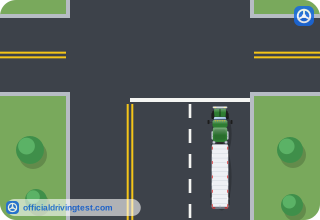
- Move to the left shoulder
- Leave an open space to the right
- Stop in the middle of the road
- Turn on its hazard lights
Show answer
Correct answer: Leave an open space to the right
Many commercial vehicles make wide right turns and must sometimes leave an open space to the right just before turning.
Source: Minnesota Driver’s Manual (June 2026), page 52
-
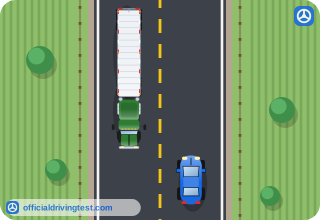
How far in front of the cab may some truck drivers be unable to see?
- Up to 5 feet
- Up to 50 feet
- Up to 20 feet
- Up to 100 feet
Show answer
Correct answer: Up to 20 feet
Some truck drivers may not be able to see up to 20 feet in front of the cab.
Source: Minnesota Driver’s Manual (June 2026), page 52
-
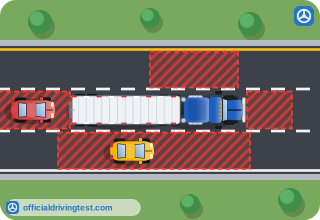
How far behind a truck may some truck drivers be unable to see?
- Up to 200 feet
- Up to 20 feet
- Up to 50 feet
- Up to 500 feet
Show answer
Correct answer: Up to 200 feet
Some truck drivers may not be able to see up to 200 feet to the rear of the truck.
Source: Minnesota Driver’s Manual (June 2026), page 52
-
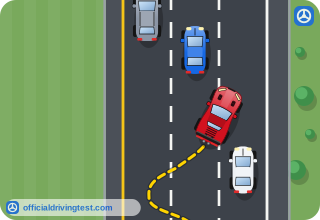
What do honking, driving aggressively or weaving through traffic around trucks and buses do?
- Help the trucks and buses move over sooner
- Make your trip faster if you do it safely
- Cause dangerous distractions and crashes
- Reduce the stopping distance of trucks
Show answer
Correct answer: Cause dangerous distractions and crashes
Honking, driving aggressively or weaving through traffic won’t make your trip faster but can cause dangerous distractions and crashes.
Source: Minnesota Driver’s Manual (June 2026), page 53
-
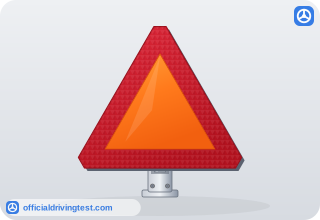
The slow-moving vehicle emblem must be displayed on vehicles that travel at what speed?
- 25 mph or less
- 30 mph or less
- 35 mph or less
- 40 mph or less
Show answer
Correct answer: 30 mph or less
The emblem must be displayed on all vehicles that travel at 30 mph or less when they use a public road.
Source: Minnesota Driver’s Manual (June 2026), page 61
-
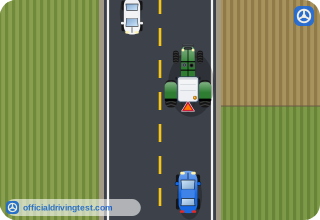
What should you do when you see the slow-moving vehicle emblem?
- Pass the vehicle as quickly as possible
- Follow it as closely as you can
- Flash your headlights to warn the other driver
- Adjust your vehicle speed or prepare to change lanes
Show answer
Correct answer: Adjust your vehicle speed or prepare to change lanes
When you see the emblem, you adjust your speed or prepare to change lanes.
Source: Minnesota Driver’s Manual (June 2026), page 61
-
What should you do when you see a sign with a horse-drawn buggy symbol?
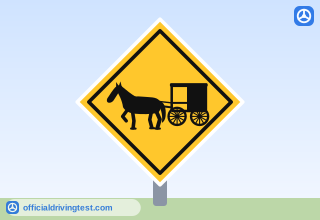
- Reduce your speed and pass slowly
- Pass quickly to avoid delay
- Sound your horn to move it aside
- Stay close behind until it turns
Show answer
Correct answer: Reduce your speed and pass slowly
Be alert for slow-moving animal-drawn vehicles, reduce your speed and pass slowly.
Source: Minnesota Driver’s Manual (June 2026), page 61
-
Within what distance must an animal-drawn vehicle’s light or lamp be visible from sunset to sunrise?
- 100 feet
- 200 feet
- 500 feet
- 300 feet
Show answer
Correct answer: 500 feet
Animal-drawn vehicles must have a light or lamp visible within 500 feet from sunset to sunrise or in reduced visibility.
Source: Minnesota Driver’s Manual (June 2026), page 61
-
Which behavior does the manual say aggressive driving usually involves?
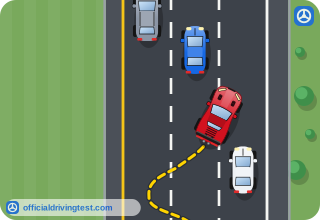
- Yielding the right-of-way to others
- Passing other vehicles on the shoulder
- Staying in the right lane at the speed limit
- Signaling every lane change
Show answer
Correct answer: Passing other vehicles on the shoulder
Aggressive driving usually involves faster driving, following too closely, frequent and abrupt lane changes, passing on the shoulder, and glaring at or threatening other motorists.
Source: Minnesota Driver’s Manual (June 2026), page 79
-
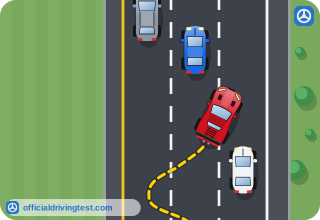
What should you do if you are confronted by an aggressive driver?
- Challenge them by driving closer to their vehicle
- Honk repeatedly to get their attention
- Speed up to stay ahead of them for as long as you can
- Stay out of their way and avoid eye contact
Show answer
Correct answer: Stay out of their way and avoid eye contact
The manual says not to challenge an aggressive driver, to stay out of their way, avoid eye contact and not let the situation escalate.
Source: Minnesota Driver’s Manual (June 2026), page 79
-
What colors of flashing lights should you watch for on snowplows when roads are covered with snow or ice?

- White, yellow and blue
- Red, white and blue
- Green, yellow and white
- Red, yellow and amber
Show answer
Correct answer: White, yellow and blue
The manual says to watch for the flashing white, yellow and blue lights of snowplows.
Source: Minnesota Driver’s Manual (June 2026), page 81
-
When should you pass a snowplow?

- Only when its blue lights are not flashing
- Whenever it moves slower than the traffic
- Only when you can see the entire vehicle
- Only when you are in a residential area
Show answer
Correct answer: Only when you can see the entire vehicle
The manual says to never crowd a snowplow and to pass snowplows only when you can see the entire vehicle.
Source: Minnesota Driver’s Manual (June 2026), page 81
-
Why should you stay well behind a snowplow?

- To keep the plow’s flashing lights from distracting you while you drive
- To use the plow as a windbreak for your vehicle
- To keep the plow’s heat from melting ice under your tires
- To avoid flying sanding materials, snow and ice that could hit your vehicle
Show answer
Correct answer: To avoid flying sanding materials, snow and ice that could hit your vehicle
Staying well behind plows keeps you clear of flying sanding materials, snow and ice that could hit your vehicle.
Source: Minnesota Driver’s Manual (June 2026), page 81
-
What can snowplows create that may conceal the road and hide driving hazards?

- Clouds of blowing snow
- Sheets of black ice
- Deep ruts in the lanes
- Clouds of diesel exhaust
Show answer
Correct answer: Clouds of blowing snow
Snowplows can create clouds of blowing snow that may conceal the road and hide driving hazards.
Source: Minnesota Driver’s Manual (June 2026), page 81
-
What may snowplows do in residential areas?
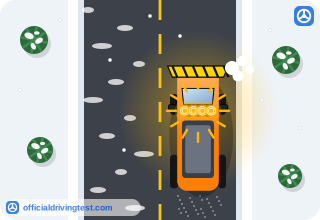
- Drive on the wrong side of the road
- Stop in the middle of the street
- Back up to turn around
- Turn off their flashing lights
Show answer
Correct answer: Back up to turn around
The manual says snowplows may back up to turn around in residential areas, so you should give operators room.
Source: Minnesota Driver’s Manual (June 2026), page 81