Minnesota: Sharing the road — Part 5 Practice Test
Questions in this part include: “A commercial vehicle weighs more than how many pounds and is used to transport passengers or property?” · “Why is a commercial vehicle easier to pass when going uphill?”
Independent educational site · not affiliated with any government agency or DMV
Ready? Test yourself
- Instant feedback with an explanation
- Every answer cites its source in the manual
- Your best score is saved on this device
Questions are original and based on the official manual "Minnesota Driver’s Manual" (June 2026), Minnesota Driver and Vehicle Services.
All 19 questions in this practice test
Take the test above first, then use this list to study. Tap “Show answer” to see the correct answer and explanation.
Show the questions and answersHide the questions
-
A commercial vehicle weighs more than how many pounds and is used to transport passengers or property?
- 16,000 pounds
- 20,000 pounds
- 26,000 pounds
- 30,000 pounds
Show answer
Correct answer: 26,000 pounds
A commercial vehicle is a motor vehicle or combination of vehicles that weighs more than 26,000 pounds and is used to transport passengers or property.
Source: Minnesota Driver’s Manual (June 2026), page 51
-
Which of these is also considered a commercial vehicle?
- A school bus of any size
- A motor home used for personal trips
- A pickup truck towing a small trailer
- A van used only for family trips
Show answer
Correct answer: A school bus of any size
Buses, including school buses of all sizes, are also considered commercial vehicles.
Source: Minnesota Driver’s Manual (June 2026), page 51
-
Besides buses, which smaller vehicles are considered commercial vehicles?
- Vehicles with trailer brakes
- Vehicles carrying more than four passengers
- Vehicles with hazardous materials placards
- Vehicles with dual rear wheels
Show answer
Correct answer: Vehicles with hazardous materials placards
Smaller vehicles with hazardous materials placards are also considered commercial vehicles.
Source: Minnesota Driver’s Manual (June 2026), page 51
-
On a level highway, how much longer does it take to pass a commercial vehicle than a car?
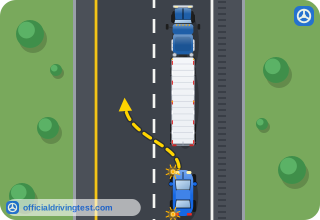
- Three to five seconds longer
- One to two seconds longer
- Six to eight seconds longer
- About ten seconds longer
Show answer
Correct answer: Three to five seconds longer
It takes three to five seconds longer to pass a commercial vehicle than a car.
Source: Minnesota Driver’s Manual (June 2026), page 51
-
When passing a commercial vehicle, when should you return to the right lane?
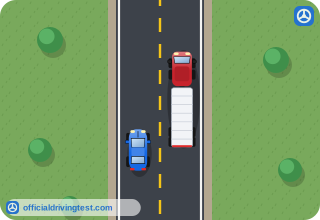
- Only after you are 500 feet ahead of the vehicle
- As soon as your front bumper passes its rear bumper
- Only when the vehicle you passed flashes its lights
- Before coming within 100 feet of oncoming traffic
Show answer
Correct answer: Before coming within 100 feet of oncoming traffic
Allow enough time to pass and return to the right lane before coming within 100 feet of oncoming traffic.
Source: Minnesota Driver’s Manual (June 2026), page 51
-
If you plan to exit or turn off the road soon, what should you do about a commercial vehicle ahead?
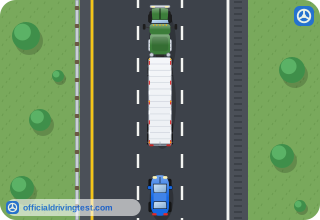
- Pass it quickly on the right side
- Stay behind it until you reach the exit
- Pass it on the shoulder before the exit
- Pass it if it is going uphill
Show answer
Correct answer: Stay behind it until you reach the exit
If you plan to exit or turn off the road soon, you stay behind the commercial vehicle until you reach the exit.
Source: Minnesota Driver’s Manual (June 2026), page 51
-
Why is a commercial vehicle easier to pass when going uphill?
- It often loses speed on an upgrade
- It always stops on a hill
- It must use its right-turn signal
- It uses a lower gear and moves to the shoulder
Show answer
Correct answer: It often loses speed on an upgrade
Commercial vehicles often lose speed on an upgrade, making them easier to pass than a car.
Source: Minnesota Driver’s Manual (June 2026), page 51
-
What should you allow when passing a commercial vehicle that is going downhill?
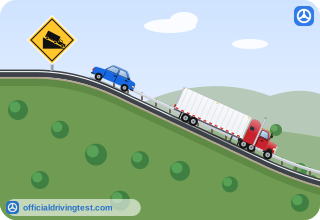
- Less distance, because it slows down
- The same distance as on a level road
- More distance to pass
- No extra distance, because it keeps a steady speed
Show answer
Correct answer: More distance to pass
Commercial vehicles increase speed on a downgrade, so you should allow more distance to pass.
Source: Minnesota Driver’s Manual (June 2026), page 51
-
After passing a commercial vehicle, when should you move back into your lane?
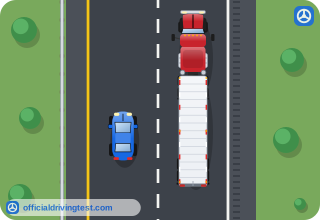
- As soon as your front bumper is even with its cab
- When you can see its front in your rearview mirror
- When your car is about one car length ahead of it
- When the driver of the vehicle flashes its headlights
Show answer
Correct answer: When you can see its front in your rearview mirror
Move back into your lane only when you can see the front of the commercial vehicle in your rearview mirror, and maintain your speed after passing.
Source: Minnesota Driver’s Manual (June 2026), page 51
-
What should you do when a commercial vehicle passes you?
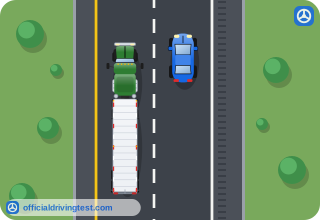
- Speed up to stay beside it until it has passed
- Move toward the center line to give it more room
- Brake hard and pull off onto the road shoulder
- Keep to the far side of your lane and slow slightly
Show answer
Correct answer: Keep to the far side of your lane and slow slightly
When a commercial vehicle passes you, keep to the far side of your lane and slightly reduce your speed, and do not speed up.
Source: Minnesota Driver’s Manual (June 2026), page 51
-
When meeting a commercial vehicle from the opposite direction, where should you stay?
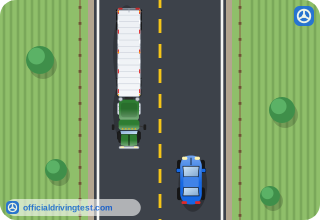
- Near the center line
- In the center of your lane
- As far to the left as possible
- As far to the right as possible
Show answer
Correct answer: As far to the right as possible
Stay as far to the right as possible to avoid a sideswipe crash and reduce wind turbulence between the vehicles.
Source: Minnesota Driver’s Manual (June 2026), page 51
-
What does wind turbulence between a commercial vehicle and a vehicle meeting it do?
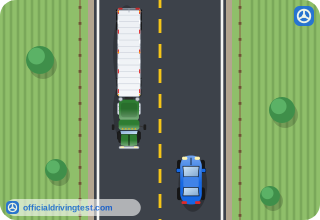
- Pulls the vehicles toward each other
- Pushes the vehicles away from each other
- Pushes both vehicles toward the shoulder
- Has no effect at highway speeds
Show answer
Correct answer: Pushes the vehicles away from each other
Turbulence will push the vehicles away from each other, not toward each other.
Source: Minnesota Driver’s Manual (June 2026), page 51
-
Why do many car-commercial vehicle collisions occur at intersections?
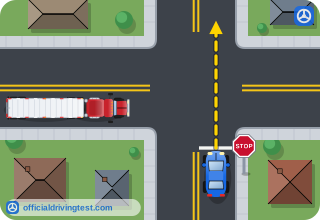
- Commercial vehicles always run red lights
- Commercial vehicles have no turn signals
- The car driver misjudges its speed and distance
- Car drivers cannot see commercial vehicles at night
Show answer
Correct answer: The car driver misjudges its speed and distance
Commercial vehicles often appear to be traveling slower than they actually are because of their large size, so car drivers misjudge speed and distance.
Source: Minnesota Driver’s Manual (June 2026), page 51
-
Why is it especially dangerous to cut in too close in front of a commercial bus or truck?
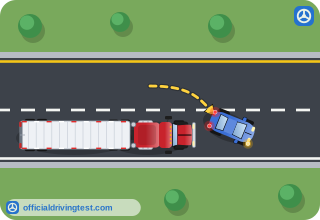
- You are likely to be in a blind spot
- Commercial vehicles have no brakes in front
- Commercial vehicles can stop faster than cars
- Commercial drivers cannot use their mirrors
Show answer
Correct answer: You are likely to be in a blind spot
Moving in quickly from either side likely puts you in a blind spot, and the vehicle may not be able to slow down in time.
Source: Minnesota Driver’s Manual (June 2026), page 52
-
At 55 mph, within what distance can an average passenger car stop?
- 60 to 70 feet
- 200 to 250 feet
- 130 to 140 feet
- 300 to 350 feet
Show answer
Correct answer: 130 to 140 feet
An average passenger car traveling at 55 mph can stop within 130 to 140 feet.
Source: Minnesota Driver’s Manual (June 2026), page 52
-
How far may a fully loaded tractor-trailer need to stop completely?
- More than 400 feet
- About 200 feet
- About 250 feet
- About 300 feet
Show answer
Correct answer: More than 400 feet
A fully loaded tractor-trailer may need more than 400 feet to stop completely.
Source: Minnesota Driver’s Manual (June 2026), page 52
-
When following a commercial vehicle, how should you position your vehicle?
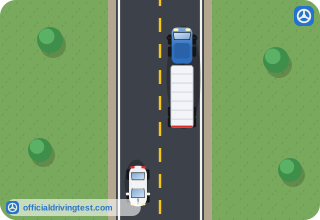
- Directly behind the rear bumper
- Close enough to read its license plate
- Where its mirrors cannot reflect your lights
- So the driver can see you in the side mirrors
Show answer
Correct answer: So the driver can see you in the side mirrors
Maintain a safe following distance and position your vehicle so the driver can see you in their side mirrors.
Source: Minnesota Driver’s Manual (June 2026), page 52
-
Why does following a commercial vehicle too closely cause a problem?
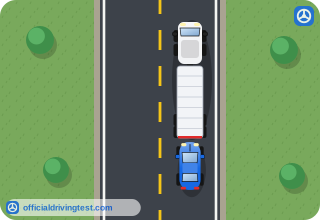
- The driver may slow down to let you pass
- You cannot see the road ahead as well
- It makes the driver see you more clearly
- It lowers the stopping distance you need
Show answer
Correct answer: You cannot see the road ahead as well
Following a commercial vehicle too closely reduces your ability to see the road ahead.
Source: Minnesota Driver’s Manual (June 2026), page 52
-
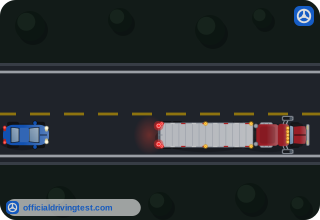
What should you do when following a commercial vehicle at night?
- Always dim your headlights
- Use high beams to see the road
- Turn off your headlights
- Flash your headlights at the driver
Show answer
Correct answer: Always dim your headlights
Commercial vehicles have large side mirrors that can reflect light, so you should always dim your headlights to avoid blinding the driver.
Source: Minnesota Driver’s Manual (June 2026), page 52