Minnesota: Sharing the road — Part 6 Practice Test
Questions in this part include: “Within what distance must an animal-drawn vehicle’s light or lamp be visible from sunset to sunrise?”
Independent educational site · not affiliated with any government agency or DMV
Ready? Test yourself
- Instant feedback with an explanation
- Every answer cites its source in the manual
- Your best score is saved on this device
Questions are original and based on the official manual "Minnesota Driver’s Manual" (June 2026), Minnesota Driver and Vehicle Services.
All 19 questions in this practice test
Take the test above first, then use this list to study. Tap “Show answer” to see the correct answer and explanation.
Show the questions and answersHide the questions
-
When a commercial vehicle merges into traffic, what should you be prepared to do?
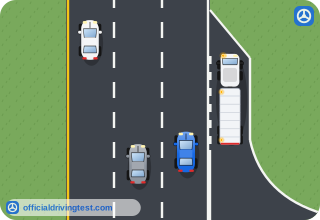
- Speed up to pass it before it merges
- Stay in the lane and sound your horn
- Slow down or change lanes to let it merge
- Move close behind it to follow it in
Show answer
Correct answer: Slow down or change lanes to let it merge
A commercial vehicle needs more time than a car to accelerate and reach normal speed, so be prepared to slow down or change lanes to let it merge safely.
Source: Minnesota Driver’s Manual (June 2026), page 52
-
If you stop behind a commercial vehicle on an upgrade, what should you allow?
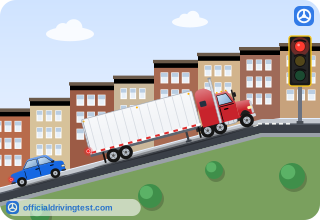
- No space, because trucks cannot roll back
- Space for the truck to roll back slightly
- Space for the truck to stop on the shoulder
- Space for the truck to turn right
Show answer
Correct answer: Space for the truck to roll back slightly
On an upgrade you should allow space for the truck to roll back slightly when it starts to move.
Source: Minnesota Driver’s Manual (June 2026), page 52
-
If you stop behind a commercial vehicle on an upgrade, where in your lane should you position your vehicle?
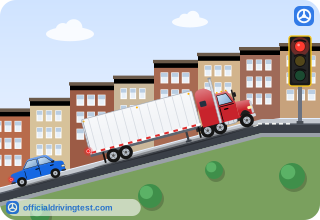
- On the right side of your lane
- Straight behind the center of the truck
- Half in the next lane
- On the left side of your lane
Show answer
Correct answer: On the left side of your lane
You position your vehicle on the left side of your lane so the driver can see you in the side mirror.
Source: Minnesota Driver’s Manual (June 2026), page 52
-
Why should you not pass a commercial vehicle on the right if it might make a right turn?
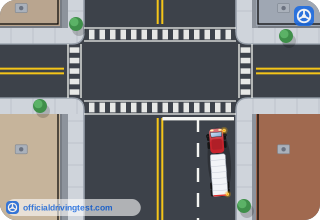
- Commercial vehicles never signal right turns
- Commercial vehicles turn only from the right lane
- The rear wheels of a turning vehicle follow a longer path than the front wheels
- The rear wheels of a turning vehicle follow a shorter path than the front wheels
Show answer
Correct answer: The rear wheels of a turning vehicle follow a shorter path than the front wheels
The rear wheels of a turning vehicle follow a shorter path than the front wheels, and many commercial vehicles make wide right turns.
Source: Minnesota Driver’s Manual (June 2026), page 52
-
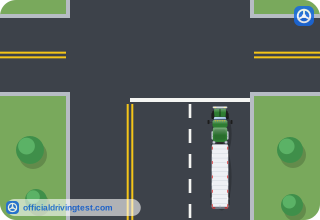
What may a commercial vehicle do just before turning right?
- Move to the left shoulder
- Leave an open space to the right
- Stop in the middle of the road
- Turn on its hazard lights
Show answer
Correct answer: Leave an open space to the right
Many commercial vehicles make wide right turns and must sometimes leave an open space to the right just before turning.
Source: Minnesota Driver’s Manual (June 2026), page 52
-
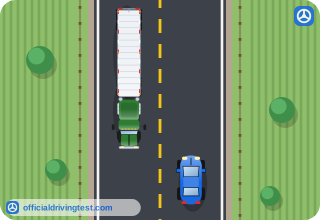
How far in front of the cab may some truck drivers be unable to see?
- Up to 5 feet
- Up to 50 feet
- Up to 20 feet
- Up to 100 feet
Show answer
Correct answer: Up to 20 feet
Some truck drivers may not be able to see up to 20 feet in front of the cab.
Source: Minnesota Driver’s Manual (June 2026), page 52
-
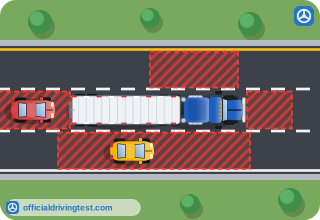
How far behind a truck may some truck drivers be unable to see?
- Up to 200 feet
- Up to 20 feet
- Up to 50 feet
- Up to 500 feet
Show answer
Correct answer: Up to 200 feet
Some truck drivers may not be able to see up to 200 feet to the rear of the truck.
Source: Minnesota Driver’s Manual (June 2026), page 52
-
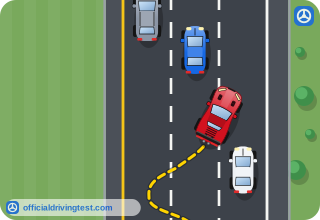
What do honking, driving aggressively or weaving through traffic around trucks and buses do?
- Help the trucks and buses move over sooner
- Make your trip faster if you do it safely
- Cause dangerous distractions and crashes
- Reduce the stopping distance of trucks
Show answer
Correct answer: Cause dangerous distractions and crashes
Honking, driving aggressively or weaving through traffic won’t make your trip faster but can cause dangerous distractions and crashes.
Source: Minnesota Driver’s Manual (June 2026), page 53
-
The slow-moving vehicle emblem must be displayed on vehicles that travel at what speed?
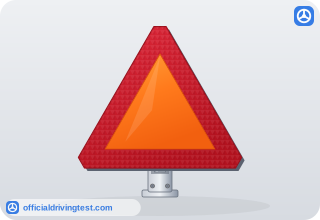
- 25 mph or less
- 30 mph or less
- 35 mph or less
- 40 mph or less
Show answer
Correct answer: 30 mph or less
The emblem must be displayed on all vehicles that travel at 30 mph or less when they use a public road.
Source: Minnesota Driver’s Manual (June 2026), page 61
-
What should you do when you see the slow-moving vehicle emblem?
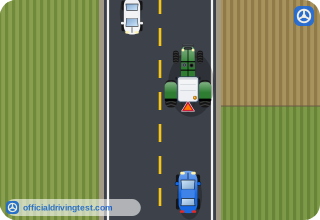
- Pass the vehicle as quickly as possible
- Follow it as closely as you can
- Flash your headlights to warn the other driver
- Adjust your vehicle speed or prepare to change lanes
Show answer
Correct answer: Adjust your vehicle speed or prepare to change lanes
When you see the emblem, you adjust your speed or prepare to change lanes.
Source: Minnesota Driver’s Manual (June 2026), page 61
-
What should you do when you see a sign with a horse-drawn buggy symbol?
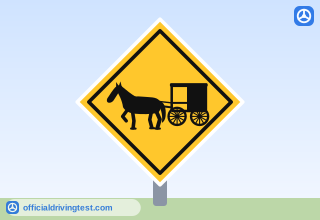
- Reduce your speed and pass slowly
- Pass quickly to avoid delay
- Sound your horn to move it aside
- Stay close behind until it turns
Show answer
Correct answer: Reduce your speed and pass slowly
Be alert for slow-moving animal-drawn vehicles, reduce your speed and pass slowly.
Source: Minnesota Driver’s Manual (June 2026), page 61
-
Within what distance must an animal-drawn vehicle’s light or lamp be visible from sunset to sunrise?
- 100 feet
- 200 feet
- 500 feet
- 300 feet
Show answer
Correct answer: 500 feet
Animal-drawn vehicles must have a light or lamp visible within 500 feet from sunset to sunrise or in reduced visibility.
Source: Minnesota Driver’s Manual (June 2026), page 61
-
Which behavior does the manual say aggressive driving usually involves?
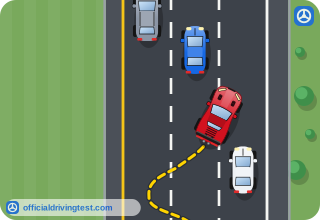
- Yielding the right-of-way to others
- Passing other vehicles on the shoulder
- Staying in the right lane at the speed limit
- Signaling every lane change
Show answer
Correct answer: Passing other vehicles on the shoulder
Aggressive driving usually involves faster driving, following too closely, frequent and abrupt lane changes, passing on the shoulder, and glaring at or threatening other motorists.
Source: Minnesota Driver’s Manual (June 2026), page 79
-
What should you do if you are confronted by an aggressive driver?
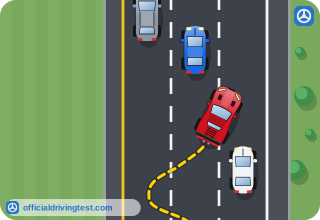
- Challenge them by driving closer to their vehicle
- Honk repeatedly to get their attention
- Speed up to stay ahead of them for as long as you can
- Stay out of their way and avoid eye contact
Show answer
Correct answer: Stay out of their way and avoid eye contact
The manual says not to challenge an aggressive driver, to stay out of their way, avoid eye contact and not let the situation escalate.
Source: Minnesota Driver’s Manual (June 2026), page 79
-
What colors of flashing lights should you watch for on snowplows when roads are covered with snow or ice?
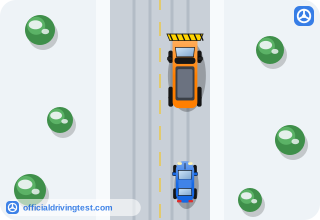
- White, yellow and blue
- Red, white and blue
- Green, yellow and white
- Red, yellow and amber
Show answer
Correct answer: White, yellow and blue
The manual says to watch for the flashing white, yellow and blue lights of snowplows.
Source: Minnesota Driver’s Manual (June 2026), page 81
-
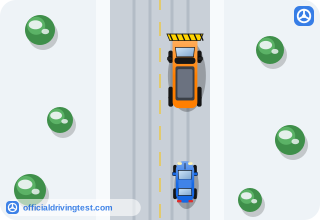
When should you pass a snowplow?
- Only when its blue lights are not flashing
- Whenever it moves slower than the traffic
- Only when you can see the entire vehicle
- Only when you are in a residential area
Show answer
Correct answer: Only when you can see the entire vehicle
The manual says to never crowd a snowplow and to pass snowplows only when you can see the entire vehicle.
Source: Minnesota Driver’s Manual (June 2026), page 81
-
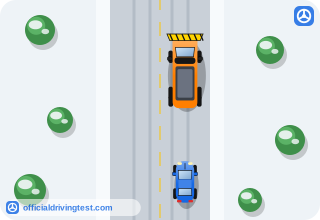
Why should you stay well behind a snowplow?
- To keep the plow’s flashing lights from distracting you while you drive
- To use the plow as a windbreak for your vehicle
- To keep the plow’s heat from melting ice under your tires
- To avoid flying sanding materials, snow and ice that could hit your vehicle
Show answer
Correct answer: To avoid flying sanding materials, snow and ice that could hit your vehicle
Staying well behind plows keeps you clear of flying sanding materials, snow and ice that could hit your vehicle.
Source: Minnesota Driver’s Manual (June 2026), page 81
-
What can snowplows create that may conceal the road and hide driving hazards?
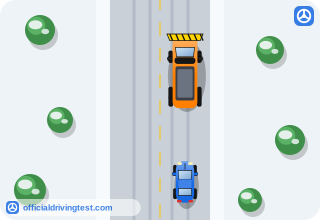
- Clouds of blowing snow
- Sheets of black ice
- Deep ruts in the lanes
- Clouds of diesel exhaust
Show answer
Correct answer: Clouds of blowing snow
Snowplows can create clouds of blowing snow that may conceal the road and hide driving hazards.
Source: Minnesota Driver’s Manual (June 2026), page 81
-
What may snowplows do in residential areas?
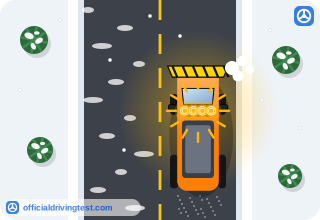
- Drive on the wrong side of the road
- Stop in the middle of the street
- Back up to turn around
- Turn off their flashing lights
Show answer
Correct answer: Back up to turn around
The manual says snowplows may back up to turn around in residential areas, so you should give operators room.
Source: Minnesota Driver’s Manual (June 2026), page 81