Minnesota: Sharing the road — Part 4 Practice Test
Questions in this part include: “At what maximum speed may a motorcycle lane split?” · “What is the most common type of crash between motorcycles and cars?”
Independent educational site · not affiliated with any government agency or DMV
Ready? Test yourself
- Instant feedback with an explanation
- Every answer cites its source in the manual
- Your best score is saved on this device
Questions are original and based on the official manual "Minnesota Driver’s Manual" (June 2026), Minnesota Driver and Vehicle Services.
All 20 questions in this practice test
Take the test above first, then use this list to study. Tap “Show answer” to see the correct answer and explanation.
Show the questions and answersHide the questions
-
When you prepare to move into a lane in front of a motorcycle, how much space should you allow from the rear of your vehicle?
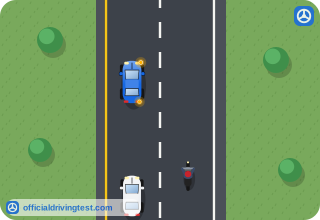
- As much as you would for a car
- Half the space you would allow for a car
- Twice the space you would allow for a car
- Only a car length
Show answer
Correct answer: As much as you would for a car
You should allow as much space from the rear of your vehicle as you would for a car.
Source: Minnesota Driver’s Manual (June 2026), page 49
-
If a motorcyclist attempts to pass you, what should you do?
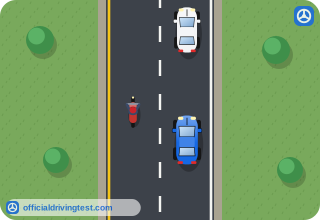
- Speed up to keep the motorcycle behind you
- Move to the shoulder to give the rider room
- Brake so the rider can pass quickly
- Maintain your lane position and speed
Show answer
Correct answer: Maintain your lane position and speed
When a motorcyclist attempts to pass, you maintain your lane position and speed and allow the rider to complete the pass.
Source: Minnesota Driver’s Manual (June 2026), page 49
-
What does the manual say about driving alongside a motorcycle in the same lane?
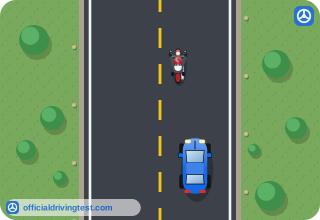
- It is allowed if you stay near the lane edge
- Never attempt to drive alongside a motorcycle in the same lane
- It is allowed on roads with a speed limit below 35 mph
- It is allowed when you signal first
Show answer
Correct answer: Never attempt to drive alongside a motorcycle in the same lane
Crowding a motorcyclist is illegal and dangerous, and you should never drive alongside a motorcycle in the same lane.
Source: Minnesota Driver’s Manual (June 2026), page 49
-
When a motorcyclist shares your lane to pass you in slow moving or stopped traffic, what must you do?
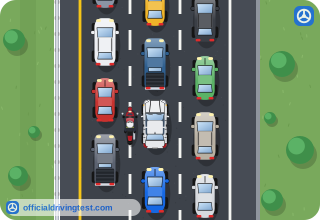
- Not get in the rider's way or try to stop the rider
- Move to the shoulder and stop
- Close the gap to keep the rider from passing
- Honk to warn the rider away
Show answer
Correct answer: Not get in the rider's way or try to stop the rider
Lane splitting and filtering is legal, and you must not get in the motorcyclist's way or attempt to stop the rider.
Source: Minnesota Driver’s Manual (June 2026), page 49
-
At what maximum speed may a motorcycle lane split?
- 20 miles per hour
- 35 miles per hour
- 25 miles per hour
- 45 miles per hour
Show answer
Correct answer: 25 miles per hour
Lane splitting is allowed only at no more than 25 miles per hour.
Source: Minnesota Driver’s Manual (June 2026), page 50
-
When lane splitting, how much faster than the speed of traffic in the relevant lanes may a motorcycle go?
- No more than 5 miles per hour over
- No more than 15 miles per hour over
- No more than 10 miles per hour over
- No more than 20 miles per hour over
Show answer
Correct answer: No more than 15 miles per hour over
Lane splitting requires no more than 15 miles per hour over the speed of traffic in the relevant traffic lanes.
Source: Minnesota Driver’s Manual (June 2026), page 50
-
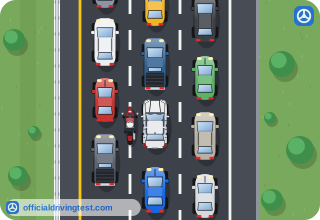
When is lane splitting allowed?
- Only when traffic is stopped
- Only on roads with a single lane in each direction
- Only on roads with a posted speed limit of 45 mph or more
- When traffic is moving in two or more same-direction lanes
Show answer
Correct answer: When traffic is moving in two or more same-direction lanes
Lane splitting is allowed when two or more lanes of traffic are traveling in the same direction and traffic is moving.
Source: Minnesota Driver’s Manual (June 2026), page 50
-
When is lane filtering allowed?
- When traffic is moving at 25 mph or less in any lane
- Only on roads with a single lane in each direction
- Only on roads with a posted speed limit below 25 mph
- When traffic is not moving in two or more same-direction lanes
Show answer
Correct answer: When traffic is not moving in two or more same-direction lanes
Lane filtering is allowed when two or more lanes of traffic are traveling in the same direction and traffic is NOT moving.
Source: Minnesota Driver’s Manual (June 2026), page 50
-
What does lane filtering allow a motorcycle to do?
- Pass other vehicles on the shoulder when traffic is moving
- Move through stopped traffic, such as at a traffic light
- Ride between two lanes of moving traffic at any speed
- Use a lane that is closed off for construction work
Show answer
Correct answer: Move through stopped traffic, such as at a traffic light
Lane filtering allows a motorcycle to move through traffic that is stopped, such as at a traffic light or traffic jam.
Source: Minnesota Driver’s Manual (June 2026), page 50
-
How much faster than the speed of traffic in the relevant lanes may a motorcycle go while lane filtering?
- No more than 5 miles per hour over
- No more than 10 miles per hour over
- No more than 15 miles per hour over
- No more than 25 miles per hour over
Show answer
Correct answer: No more than 15 miles per hour over
Lane filtering is allowed only if the motorcycle goes no more than 15 miles per hour over the speed of traffic in the relevant traffic lanes.
Source: Minnesota Driver’s Manual (June 2026), page 50
-
What is the most common type of crash between motorcycles and cars?
- A crash at an urban intersection
- A crash on a freeway entrance ramp
- A crash on a rural gravel road
- A crash in a parking lot
Show answer
Correct answer: A crash at an urban intersection
Crashes at urban intersections are the most common motorcycle-car collisions.
Source: Minnesota Driver’s Manual (June 2026), page 50
-
Many motorcycle-car collisions occur when drivers do what?
- Change lanes without checking the mirrors for motorcycles
- Stop too close behind a motorcycle at a traffic light
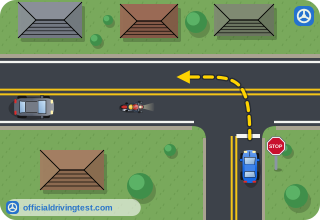
- Fail to yield and turn left in front of an oncoming motorcycle
- Back out of a driveway without looking for traffic
Show answer
Correct answer: Fail to yield and turn left in front of an oncoming motorcycle
Many collisions occur when drivers fail to yield right of way and make a left turn in front of an oncoming motorcycle.
Source: Minnesota Driver’s Manual (June 2026), page 50
-
Which lanes may motorcyclists use?
- High-occupancy vehicle lanes
- Only lanes marked for bicycles
- Only the left lane of a freeway
- Lanes closed for construction
Show answer
Correct answer: High-occupancy vehicle lanes
Motorcyclists may use high-occupancy vehicle lanes.
Source: Minnesota Driver’s Manual (June 2026), page 50
-
Which statement about right-of-way laws is correct for motorcyclists?
- They do not apply to motorcyclists
- They apply only to motorcyclists on freeways
- They apply only to motorcyclists in a marked lane
- They apply to motorcyclists as well as other drivers
Show answer
Correct answer: They apply to motorcyclists as well as other drivers
Right-of-way laws apply to motorcyclists, as well as other drivers.
Source: Minnesota Driver’s Manual (June 2026), page 50
-
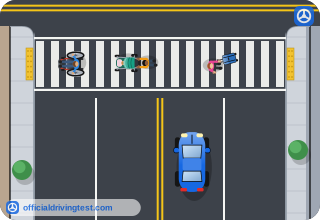
What makes someone a vulnerable road user?
- They are riding a vehicle that has a gas engine
- They have less protection than the people in cars
- They are driving on a rural road
- They are traveling on a road with a speed limit above 45 mph
Show answer
Correct answer: They have less protection than the people in cars
Vulnerable road users are people on highways, bikeways, sidewalks or trails who have less protection than those in cars.
Source: Minnesota Driver’s Manual (June 2026), page 51
-
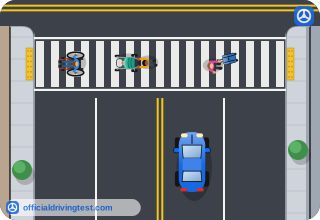
Which of these is listed as a vulnerable road user?
- A person riding a horse
- A person driving a pickup truck
- A person driving a school bus
- A person driving a motor home
Show answer
Correct answer: A person riding a horse
Vulnerable road users include people riding two- or three-wheeled vehicles, using electric mobility devices, riding horses, walking or using motorized scooters.
Source: Minnesota Driver’s Manual (June 2026), page 51
-
What must vulnerable road users do?
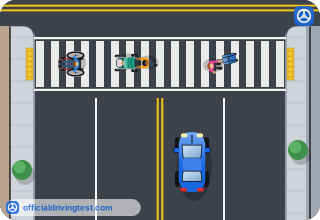
- Stay off roads with a speed limit above 35 mph
- Use only roads that have bicycle lanes
- Follow all traffic laws
- Yield to every vehicle at every intersection
Show answer
Correct answer: Follow all traffic laws
Vulnerable road users must also follow all traffic laws, and drivers must share the road safely with them.
Source: Minnesota Driver’s Manual (June 2026), page 51
-
Which is true of a Neighborhood Electric Vehicle (NEV)?
- It is gas-powered with two wheels and reaches speeds up to 45 mph
- It is electric-powered with three or four wheels and reaches 20 to 25 mph
- It is electric-powered with two wheels and reaches speeds up to 55 mph
- It is gas-powered with four wheels and reaches speeds of 30 mph or less
Show answer
Correct answer: It is electric-powered with three or four wheels and reaches 20 to 25 mph
A Neighborhood Electric Vehicle is an electric-powered vehicle with three or four wheels that can reach speeds between 20 and 25 mph.
Source: Minnesota Driver’s Manual (June 2026), page 51
-
With whom must NEVs be titled and registered?
- The local police department
- The county sheriff
- The Minnesota State Patrol
- Driver Vehicle Services
Show answer
Correct answer: Driver Vehicle Services
NEVs must be titled and registered with Driver Vehicle Services.
Source: Minnesota Driver’s Manual (June 2026), page 51
-
On which streets may a person with a Class D driver’s license drive an NEV?
- Only streets with speed limits of 25 mph or less
- Only streets with speed limits of 45 mph or less
- Any street except freeways
- Only streets with speed limits of 35 mph or less
Show answer
Correct answer: Only streets with speed limits of 35 mph or less
Anyone with a Class D driver’s license may drive an NEV, but only on streets with speed limits of 35 mph or less.
Source: Minnesota Driver’s Manual (June 2026), page 51