Minnesota: Sharing the road — Part 3 Practice Test
Questions in this part include: “Which flashing lamp may a bicycle have?” · “A bicyclist who goes through a red light that fails to detect the bicycle has a defense against which violation?”
Independent educational site · not affiliated with any government agency or DMV
Ready? Test yourself
- Instant feedback with an explanation
- Every answer cites its source in the manual
- Your best score is saved on this device
Questions are original and based on the official manual "Minnesota Driver’s Manual" (June 2026), Minnesota Driver and Vehicle Services.
All 20 questions in this practice test
Take the test above first, then use this list to study. Tap “Show answer” to see the correct answer and explanation.
Show the questions and answersHide the questions
-
How does a bicycle rider signal a left turn?
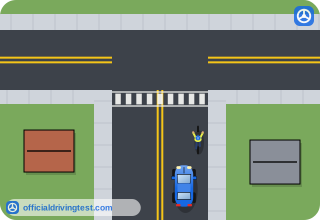
- By holding the right arm straight out
- By holding the left arm out and bending it toward the ground
- By holding the left arm straight out
- By raising both arms above the head
Show answer
Correct answer: By holding the left arm straight out
A bicycle rider signals a left turn by holding the left arm straight out.
Source: Minnesota Driver’s Manual (June 2026), page 48
-
Which is a correct way for a bicycle rider to signal a right turn?
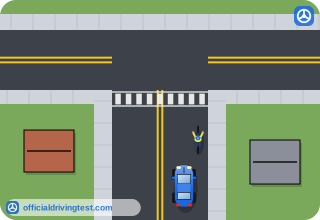
- Holding the left arm straight out
- Holding the right arm straight out
- Holding the left arm out and bending it toward the ground
- Holding the right arm out and bending it toward the ground
Show answer
Correct answer: Holding the right arm straight out
A bicycle rider may signal a right turn by holding the right arm straight out, or the left arm out and bent upward.
Source: Minnesota Driver’s Manual (June 2026), page 48
-
How does a bicycle rider signal that he or she is stopping?
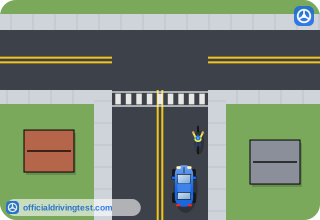
- By holding the left arm straight out to the side
- By holding the left arm out and bending it upward
- By holding the right arm out and bending it upward at the elbow
- By holding the left arm out and bending it toward the ground
Show answer
Correct answer: By holding the left arm out and bending it toward the ground
A stop is signaled by holding the left arm out and bending it toward the ground.
Source: Minnesota Driver’s Manual (June 2026), page 48
-
Under what condition may two bicycle riders ride next to each other?
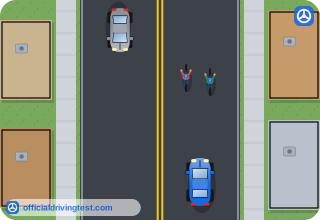
- Only on roads that have a bicycle lane
- Only on roads with a speed limit of 30 mph or less
- Only if both riders wear helmets
- They do not impede traffic and stay within a single lane
Show answer
Correct answer: They do not impede traffic and stay within a single lane
Two people may ride next to each other as long as they do not impede traffic and stay within a single lane.
Source: Minnesota Driver’s Manual (June 2026), page 48
-
Which flashing lamp may a bicycle have?
- A front lamp with a red flashing signal
- A front lamp with a white flashing signal
- A rear lamp with a white flashing signal
- A rear lamp with a green flashing signal
Show answer
Correct answer: A front lamp with a white flashing signal
A bicycle may have a front lamp with a white flashing signal or a rear lamp with a red flashing signal or both.
Source: Minnesota Driver’s Manual (June 2026), page 48
-
What does the manual say about the tires of a bicycle?
- They must have smooth rubber tread only
- They may have only factory-installed knobby tread
- They may have spikes or other traction features
- They may have only reflective tread strips
Show answer
Correct answer: They may have spikes or other traction features
Bicycles may have tires with spikes or other features for increased traction.
Source: Minnesota Driver’s Manual (June 2026), page 48
-
What should a bicycle rider do before passing pedestrians on a sidewalk or crosswalk?
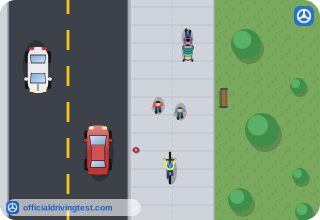
- Yield the right of way and give an audible signal
- Pass them quickly on the left without slowing
- Dismount and ride in the street instead
- Flash the bicycle's lamp at them
Show answer
Correct answer: Yield the right of way and give an audible signal
A bicycle rider on a sidewalk or crosswalk must yield the right of way to pedestrians and give an audible signal before passing them.
Source: Minnesota Driver’s Manual (June 2026), page 48
-
When may a bicycle be ridden on a sidewalk within a business district?
- At any time, if the rider yields to pedestrians
- Only between sunrise and sunset
- Only when allowed by local authorities
- Only when the street has no bicycle lane
Show answer
Correct answer: Only when allowed by local authorities
Riding a bicycle on a sidewalk within a business district is not allowed unless local authorities allow it.
Source: Minnesota Driver’s Manual (June 2026), page 48
-
Who may prohibit riding a bicycle on any sidewalk or crosswalk?
- Local authorities
- Only the state legislature
- Only the driver and vehicle services office
- Only the owner of the nearest business
Show answer
Correct answer: Local authorities
Local authorities may prohibit riding on any sidewalk or crosswalk.
Source: Minnesota Driver’s Manual (June 2026), page 48
-
What rights and duties does a person on a bicycle have when riding on a sidewalk or crosswalk?
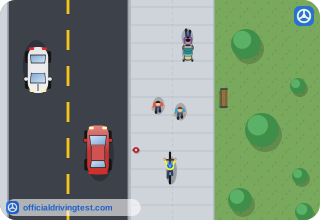
- The same as drivers of motor vehicles
- The same as motorcyclists
- None, because bicycles are not allowed there
- The same as pedestrians
Show answer
Correct answer: The same as pedestrians
When riding on a sidewalk or crosswalk, a bicycle rider has the same rights and duties as pedestrians.
Source: Minnesota Driver’s Manual (June 2026), page 48
-
A signal does not detect a bicyclist at a light. Which condition must be met before the bicyclist may proceed through the intersection after a reasonable amount of time?
- A police officer has waved the bicyclist ahead
- The bicycle has come to a complete stop
- The bicyclist has pressed the pedestrian button twice
- The bicyclist has walked the bicycle onto the sidewalk
Show answer
Correct answer: The bicycle has come to a complete stop
One condition is that the bicycle has come to a complete stop, along with the signal malfunctioning or red for an unreasonable time and no approaching hazards.
Source: Minnesota Driver’s Manual (June 2026), page 49
-
A bicyclist who goes through a red light that fails to detect the bicycle has a defense against which violation?
- Entering an intersection controlled by a red light
- Failing to signal a turn
- Riding against the flow of traffic
- Riding on a sidewalk in a business district
Show answer
Correct answer: Entering an intersection controlled by a red light
The defense applies only to violations for entering or crossing an intersection controlled by a red light, not to other civil or criminal actions.
Source: Minnesota Driver’s Manual (June 2026), page 49
-
When should drivers be extra cautious of bicycle traffic?
- At midday
- On dry pavement
- At night
- On roads with wide lanes
Show answer
Correct answer: At night
The manual tells drivers to be extra cautious of bicycle traffic at night.
Source: Minnesota Driver’s Manual (June 2026), page 49
-
Where should drivers watch for bicyclists?
- Only on roads that have bicycle lanes
- When entering or leaving alleys and driveways
- Only on residential streets
- Only at intersections with traffic signals
Show answer
Correct answer: When entering or leaving alleys and driveways
Drivers should watch for bicyclists in intersections, on sidewalks, and when entering or leaving alleys and driveways.
Source: Minnesota Driver’s Manual (June 2026), page 49
-
A “motorized bicycle” (moped) is defined by a speed capacity of how many mph?
- 20 mph or less
- 40 mph or less
- 45 mph or less
- 30 mph or less
Show answer
Correct answer: 30 mph or less
A motorized bicycle is a moped and is defined by its speed capacity, which is 30 mph or less.
Source: Minnesota Driver’s Manual (June 2026), page 49
-
Where are motorized bicycles not allowed?
- On streets with a center line
- On roads with a posted speed limit of 30 mph
- On two-way residential streets
- On freeways
Show answer
Correct answer: On freeways
Motorized bicycles are not allowed on sidewalks, freeways, or lanes and trails designated for pedestrians and bicycles.
Source: Minnesota Driver’s Manual (June 2026), page 49
-
Which traffic laws must motorcyclists obey?
- Only the laws for roads without a center line
- The same traffic laws as other drivers
- Only the speed limit laws
- Special motorcycle laws instead of the laws for other drivers
Show answer
Correct answer: The same traffic laws as other drivers
Motorcyclists must obey the same traffic laws as other drivers.
Source: Minnesota Driver’s Manual (June 2026), page 49
-
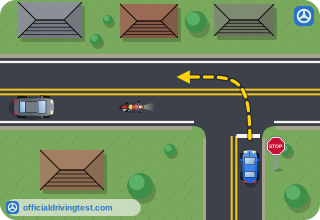
Why is it difficult to judge the speed and distance of an approaching motorcycle?
- Motorcycles always travel faster than cars
- Motorcycle headlights are dimmer than car headlights
- Motorcycles are smaller than cars
- Motorcycles are quieter than cars
Show answer
Correct answer: Motorcycles are smaller than cars
Motorcycles are smaller than cars, which makes it difficult to judge their speed and distance when approaching.
Source: Minnesota Driver’s Manual (June 2026), page 49
-
How should your following distance from a motorcycle compare with your following distance from other vehicles?
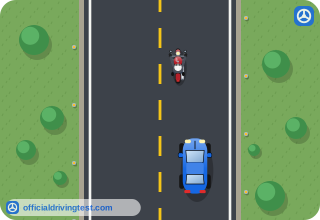
- The same as, or greater than, for other vehicles
- Shorter, because motorcycles are smaller
- Half the distance used for other vehicles
- Exactly the same, never greater
Show answer
Correct answer: The same as, or greater than, for other vehicles
Your following distance from a motorcycle should be the same as, or greater than, your following distance from other vehicles.
Source: Minnesota Driver’s Manual (June 2026), page 49
-
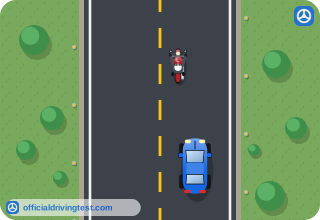
Why should you allow maneuvering room when following a motorcycle?
- Motorcycles can stop faster than cars in any weather
- Motorcycle riders must stay within the lane markings
- Riders may have trouble controlling the motorcycle and weave
- Motorcycles are not required to use turn signals
Show answer
Correct answer: Riders may have trouble controlling the motorcycle and weave
Riders may experience difficulty controlling the motorcycle, which could result in weaving, so you should allow maneuvering room.
Source: Minnesota Driver’s Manual (June 2026), page 49