Minnesota: Sharing the road — Part 1 Practice Test
Questions in this part include: “What determines where the blind spots of your vehicle are?” · “If you do not remain stopped for a school bus with its red lights flashing, what can you be charged with?”
Independent educational site · not affiliated with any government agency or DMV
Ready? Test yourself
- Instant feedback with an explanation
- Every answer cites its source in the manual
- Your best score is saved on this device
Questions are original and based on the official manual "Minnesota Driver’s Manual" (June 2026), Minnesota Driver and Vehicle Services.
All 20 questions in this practice test
Take the test above first, then use this list to study. Tap “Show answer” to see the correct answer and explanation.
Show the questions and answersHide the questions
-
At a stoplight, a motorcycle rides up between your car and the car in the next lane. What does the manual say about this?
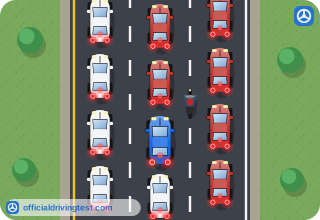
- It is legal, and you may not interfere with its safe movement
- It is illegal, and you should close the gap to stop it
- It is legal only on freeways, so you should report it
- It is illegal unless the motorcycle has its flashers on
Show answer
Correct answer: It is legal, and you may not interfere with its safe movement
Motorcycles may ride or pass between you and the car in the next lane. This is legal, and you may not interfere with their safe movement.
Source: Minnesota Driver’s Manual (June 2026), page 1
-
A school bus ahead has its red lights flashing, but its stop arm has not swung out. What must you do?
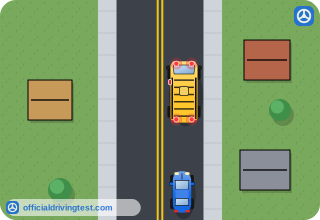
- Pass slowly, since the stop arm is not out
- Stop, as you must for the flashing red lights
- Slow to 10 mph and pass with care
- Stop only if children are in the road
Show answer
Correct answer: Stop, as you must for the flashing red lights
You must stop for flashing red school bus lights even if the stop arm doesn’t swing out.
Source: Minnesota Driver’s Manual (June 2026), page 1
-
When may you go on without stopping for a school bus that is stopped with its red lights flashing?
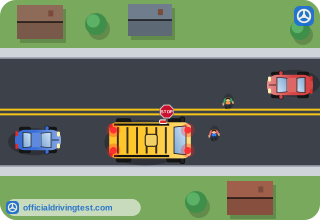
- On a two-lane road when you meet the bus head-on
- On a multilane road that has no median or divider
- When the bus is stopped on a road with no crosswalk
- On a divided highway when you travel the opposite way
Show answer
Correct answer: On a divided highway when you travel the opposite way
The only exception to stopping for a school bus with flashing red lights is on a divided highway when you are traveling in the opposite direction.
Source: Minnesota Driver’s Manual (June 2026), page 1
-
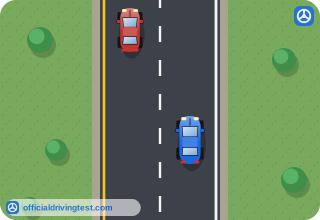
What are blind spots?
- Areas of the road that are not lit at night
- Areas that are visible only in your rearview mirror
- Areas around your vehicle where your view is blocked
- Areas of the road hidden behind a hilltop
Show answer
Correct answer: Areas around your vehicle where your view is blocked
Blind spots are areas around your vehicle where your view is blocked, so you cannot see pedestrians or vehicles in them in your mirrors.
Source: Minnesota Driver’s Manual (June 2026), page 28
-
What determines where the blind spots of your vehicle are?
- The speed at which you are driving
- The design of your vehicle and the position of the roof pillars
- The size of your side mirrors only
- The number of passengers and the weight of cargo in your vehicle
Show answer
Correct answer: The design of your vehicle and the position of the roof pillars
The design of your vehicle and the position of the roof pillars determine the location of your blind spots.
Source: Minnesota Driver’s Manual (June 2026), page 28
-
Which of these can create a temporary blind spot?
- A clean windshield in daylight
- A full fuel tank
- A low speed on a quiet street
- A dirty windshield or glaring lights
Show answer
Correct answer: A dirty windshield or glaring lights
Dirty windshields and glaring lights can also create temporary blind spots.
Source: Minnesota Driver’s Manual (June 2026), page 28
-
When should you be especially aware of blind spots?
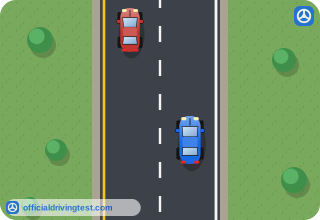
- When driving on gravel or dirt roads
- When driving near road signs
- When driving near commercial vehicles
- When driving on a road with no traffic
Show answer
Correct answer: When driving near commercial vehicles
The manual says to be especially aware of blind spots when driving near commercial vehicles.
Source: Minnesota Driver’s Manual (June 2026), page 28
-
Which advice does the manual give about other drivers’ blind spots?
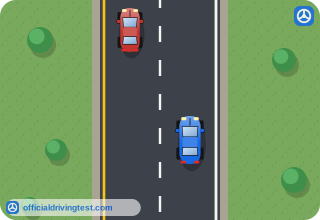
- Avoid driving in other drivers’ blind spots
- Stay in other drivers’ blind spots so they know you are there
- Drive in other drivers’ blind spots only on freeways
- Pass through other drivers’ blind spots as slowly as possible
Show answer
Correct answer: Avoid driving in other drivers’ blind spots
Drivers cannot see you in their blind spots, so the manual says to avoid driving in other drivers’ blind spots.
Source: Minnesota Driver’s Manual (June 2026), page 28
-
Bus drivers activate flashing yellow lights at least how far before a school bus stops in a speed zone of 35 mph or less?
- 50 feet
- 100 feet
- 200 feet
- 400 feet
Show answer
Correct answer: 100 feet
In a speed zone of 35 mph or less, the flashing yellow lights come on at least 100 feet before the bus stops.
Source: Minnesota Driver’s Manual (June 2026), page 41
-
Bus drivers activate flashing yellow lights at least how far before a school bus stops in a speed zone of more than 35 mph?
- 150 feet
- 500 feet
- 1,000 feet
- 300 feet
Show answer
Correct answer: 300 feet
In a speed zone of more than 35 mph, the flashing yellow lights come on at least 300 feet before the bus stops.
Source: Minnesota Driver’s Manual (June 2026), page 41
-
A school bus is displaying flashing yellow lights. Passing it on the right side is...
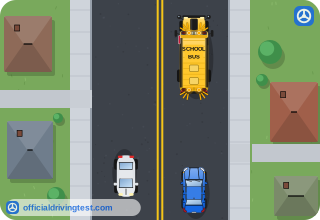
- Against the law
- Legal if you slow down
- Legal on a multilane road
- Legal if no children are visible
Show answer
Correct answer: Against the law
It is against the law to pass on the right side of a school bus while it is displaying red or yellow flashing lights.
Source: Minnesota Driver’s Manual (June 2026), page 41
-
What do the yellow and red lights that flash alternately on a school bus warn drivers of?
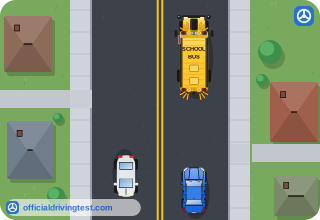
- The bus has broken down on the roadway
- The bus is leaving the school property
- The bus is stopping to load or unload students
- The bus is about to turn left at the corner
Show answer
Correct answer: The bus is stopping to load or unload students
These lights warn drivers that the school bus is stopping to load or unload students.
Source: Minnesota Driver’s Manual (June 2026), page 41
-
When a school bus is stopped with its red lights flashing, how far from the bus must you stop your vehicle?
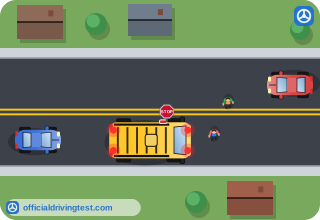
- At least 10 feet
- At least 20 feet
- At least 50 feet
- At least 100 feet
Show answer
Correct answer: At least 20 feet
You must stop at least 20 feet from a stopped school bus with its red lights flashing.
Source: Minnesota Driver’s Manual (June 2026), page 42
-
A school bus has its red lights flashing. Regardless of whether you face its front or back, how long must you remain stopped?
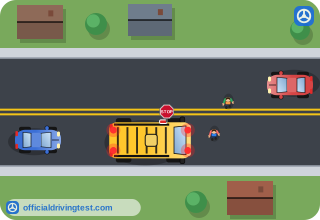
- Until the bus driver waves you on
- Until the stop arm is pulled in
- Until you count to ten
- Until the red lights stop flashing
Show answer
Correct answer: Until the red lights stop flashing
You must remain stopped until the red lights stop flashing, whether you are facing the front or back of the bus.
Source: Minnesota Driver’s Manual (June 2026), page 42
-
If you do not remain stopped for a school bus with its red lights flashing, what can you be charged with?
- A misdemeanor
- A petty misdemeanor
- A felony
- A written warning only
Show answer
Correct answer: A misdemeanor
Failing to remain stopped can result in a misdemeanor charge.
Source: Minnesota Driver’s Manual (June 2026), page 42
-
If you are convicted of not remaining stopped for a school bus with its red lights flashing, what is the minimum fine the manual states?
- $100
- $250
- $500
- $1,000
Show answer
Correct answer: $500
The manual says a convicted driver must pay a fine of at least $500.
Source: Minnesota Driver’s Manual (June 2026), page 42
-
When do you not need to stop for a school bus with its red lights flashing?
- When the bus has not yet swung out its stop arm
- When you are on a divided roadway and the bus is across the divider
- When you are driving on a two-lane road with no divider
- When the bus is stopped in a school driveway, not on the road
Show answer
Correct answer: When you are on a divided roadway and the bus is across the divider
On a divided roadway you do not need to stop if the bus is on the opposite side of the divider.
Source: Minnesota Driver’s Manual (June 2026), page 42
-
For how long after a violation may a law enforcement officer with probable cause arrest you for illegally passing a school bus with its red lights flashing?
- Within one hour
- Within 24 hours
- Within seven days
- Within four hours
Show answer
Correct answer: Within four hours
An officer with probable cause may arrest you within four hours of the violation.
Source: Minnesota Driver’s Manual (June 2026), page 42
-
When your vehicle is used to violate the law on stopping for a school bus, and you own or lease it, what are you guilty of?
- A petty misdemeanor
- A misdemeanor
- A gross misdemeanor
- A felony
Show answer
Correct answer: A petty misdemeanor
The owner or lessee of a vehicle used to violate the school bus law is guilty of a petty misdemeanor.
Source: Minnesota Driver’s Manual (June 2026), page 43
-
Your vehicle was used to violate the school bus stopping law, and you can prove another person was driving. Who is charged with the violation?
- The owner
- The owner and the driver
- The driver
- Nobody
Show answer
Correct answer: The driver
If you can prove that another person was driving, the driver will be charged.
Source: Minnesota Driver’s Manual (June 2026), page 43