Minnesota: Sharing the road — Part 2 Practice Test
Questions in this part include: “Besides student safety patrols, which people must you also stop for when they display a stop sign or flag?” · “What does an electric-assist bicycle have?”
Independent educational site · not affiliated with any government agency or DMV
Ready? Test yourself
- Instant feedback with an explanation
- Every answer cites its source in the manual
- Your best score is saved on this device
Questions are original and based on the official manual "Minnesota Driver’s Manual" (June 2026), Minnesota Driver and Vehicle Services.
All 20 questions in this practice test
Take the test above first, then use this list to study. Tap “Show answer” to see the correct answer and explanation.
Show the questions and answersHide the questions
-
What must you do when you see a student safety patrol helping schoolmates cross a street or highway?
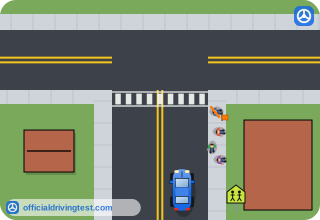
- Slow down and sound your horn
- Slow down and pass with caution
- Stop only if the children are in your lane
- Come to a complete stop
Show answer
Correct answer: Come to a complete stop
You must come to a complete stop for a student safety patrol helping schoolmates cross.
Source: Minnesota Driver’s Manual (June 2026), page 43
-
Besides student safety patrols, which people must you also stop for when they display a stop sign or flag?
- Adult crossing guards
- Parking attendants
- Students waiting at a bus stop
- Any pedestrian
Show answer
Correct answer: Adult crossing guards
You must also stop for adult crossing guards displaying a stop sign or flag.
Source: Minnesota Driver’s Manual (June 2026), page 43
-
Is it illegal to drive through a line of children crossing the road when no school safety patrol is present?
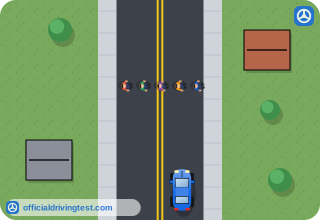
- No, only when a patrol is helping them
- No, if you drive slowly
- Yes, even without a patrol
- Yes, but only near a school
Show answer
Correct answer: Yes, even without a patrol
Driving through a line of children crossing the road is illegal even if a school safety patrol is not present.
Source: Minnesota Driver’s Manual (June 2026), page 43
-
What is a second violation within a year of the law against driving through a line of children crossing the road?
- A misdemeanor
- A gross misdemeanor
- A petty misdemeanor
- A felony
Show answer
Correct answer: A gross misdemeanor
A first violation is a misdemeanor; a second violation within a year is a gross misdemeanor.
Source: Minnesota Driver’s Manual (June 2026), page 43
-
After being stopped by a school bus flagger, when may you proceed?
- When the school buses have all left the area
- When you see no children nearby in the road
- After waiting at least 20 seconds
- When the flagger or a police officer directs you to
Show answer
Correct answer: When the flagger or a police officer directs you to
After a school bus flagger stops you, you may not proceed until directed by the flagger or a police officer.
Source: Minnesota Driver’s Manual (June 2026), page 43
-
How must a school bus indicate its intent to move into the right-hand lane from a shoulder or right-turn lane where it stopped to load or unload?
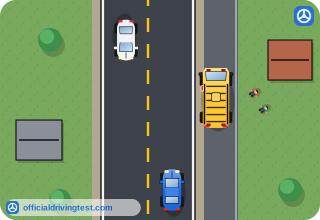
- With the right turn signal
- With the hazard warning lights
- With the left turn signal
- With the flashing yellow lights
Show answer
Correct answer: With the left turn signal
The school bus must use the left turn signal to indicate intent to move into the right-hand lane.
Source: Minnesota Driver’s Manual (June 2026), page 43
-
What rights and responsibilities do bicycles have on Minnesota roads?
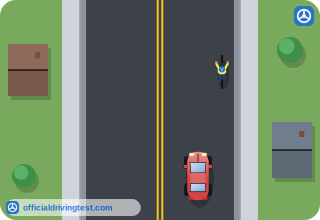
- Fewer than other vehicles
- Only those of pedestrians
- None, because they are not vehicles
- The same as other vehicles
Show answer
Correct answer: The same as other vehicles
Bicycles are legal vehicles on Minnesota roads and share the same rights and responsibilities as other vehicles.
Source: Minnesota Driver’s Manual (June 2026), page 47
-
For which of these reasons may a driver legally drive in a bicycle lane?
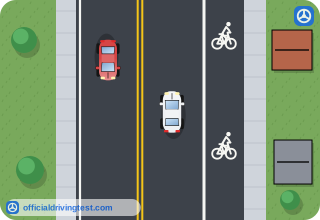
- To prepare for a turn
- To pass a slower vehicle
- To avoid a stopped vehicle ahead
- To get around a long line of traffic
Show answer
Correct answer: To prepare for a turn
Driving in a bicycle lane is illegal except to park (when permitted), to enter or leave the road, or to prepare for a turn.
Source: Minnesota Driver’s Manual (June 2026), page 48
-
Before you cross a bicycle lane, what must you do about bicyclists approaching in it?
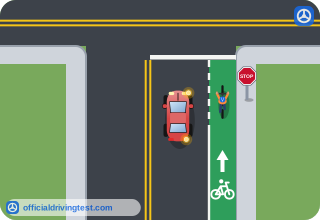
- Sound your horn to warn them
- Speed up to cross ahead of them
- Yield to them
- Flash your headlights at them
Show answer
Correct answer: Yield to them
You must yield to approaching bicyclists before crossing a bicycle lane.
Source: Minnesota Driver’s Manual (June 2026), page 48
-
When the bicycle lane is clear and you want to turn across it, what should you do?
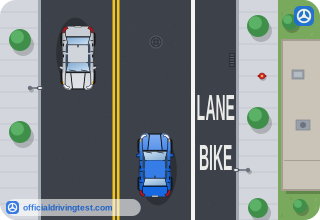
- Turn from the traffic lane without entering the bicycle lane
- Signal, then move into the bicycle lane before turning
- Stop in the bicycle lane until all traffic has passed
- Move into the bicycle lane first and signal after you are in it
Show answer
Correct answer: Signal, then move into the bicycle lane before turning
When the bicycle lane is clear, you signal your intention to turn and then move into the bicycle lane before making the turn.
Source: Minnesota Driver’s Manual (June 2026), page 48
-
What is the minimum space you must keep between the side of your car and a bicyclist you are passing?
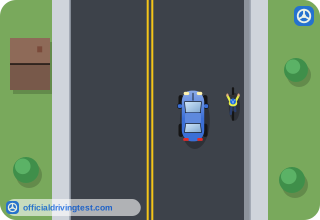
- 1 foot
- 2 feet
- 5 feet
- 3 feet
Show answer
Correct answer: 3 feet
You must keep at least 3 feet between the side of your car and the bicyclist.
Source: Minnesota Driver’s Manual (June 2026), page 48
-
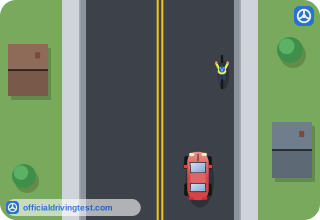
When are you allowed to cross the center of the roadway to pass a bicyclist, even in a no passing zone?
- Only when the bicyclist signals you to pass
- Only when no oncoming vehicle is in sight for a mile
- Only on roads with a speed limit below 30 mph
- When it is safe to do so
Show answer
Correct answer: When it is safe to do so
You are allowed to cross the center of the roadway to pass a bicyclist, even in a no passing zone, when it is safe to do so.
Source: Minnesota Driver’s Manual (June 2026), page 48
-
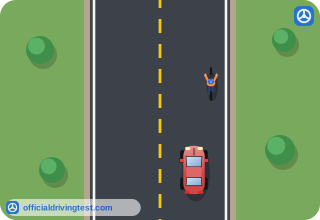
Before passing a bicyclist, what must you make sure of?
- The bicyclist has moved onto the sidewalk or shoulder
- The bicyclist is not signaling or making a left turn
- The bicyclist has seen your headlights flash
- The bicyclist has slowed down to almost a stop
Show answer
Correct answer: The bicyclist is not signaling or making a left turn
Before passing a bicyclist, make sure the bicyclist is not signaling or making a left turn.
Source: Minnesota Driver’s Manual (June 2026), page 48
-
How are electric-assist bicycles treated regarding the rules of the road and where they may operate?
- As motorized bicycles (mopeds)
- As motorcycles
- As bicycles
- As neighborhood electric vehicles
Show answer
Correct answer: As bicycles
Electric-assist bicycles are considered bicycles regarding rules of the road and where they may operate.
Source: Minnesota Driver’s Manual (June 2026), page 48
-
What does an electric-assist bicycle have?
- An electric motor that helps with pedaling
- A gas engine that powers the rear wheel
- A gas engine that helps with pedaling
- A battery that replaces the pedals
Show answer
Correct answer: An electric motor that helps with pedaling
An electric-assist bicycle has an electric motor that helps with pedaling.
Source: Minnesota Driver’s Manual (June 2026), page 48
-
Which kind of bicycle has a gas engine and must follow different rules from electric-assist bicycles?
- A standard pedal bicycle
- A neighborhood electric vehicle
- A motorized bicycle (moped)
- A tricycle with a rear basket
Show answer
Correct answer: A motorized bicycle (moped)
Motorized bicycles (mopeds) have a gas engine and must adhere to different rules than electric-assist bicycles.
Source: Minnesota Driver’s Manual (June 2026), page 48
-
In which direction must bicycle riders ride?
- In the same direction as the flow of traffic
- Against traffic, so they can see approaching vehicles
- In either direction on roads without a center line
- Facing traffic whenever they are on the shoulder
Show answer
Correct answer: In the same direction as the flow of traffic
Bicycle riders must ride in the same direction as the flow of traffic, not against it.
Source: Minnesota Driver’s Manual (June 2026), page 48
-
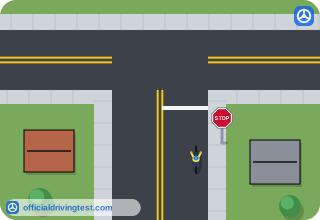
At a stop sign with no vehicle nearby, what may a bicycle rider do?
- Always make a complete stop first
- Proceed at normal speed without slowing
- Walk the bicycle through the intersection
- Slow down, then turn or proceed without stopping
Show answer
Correct answer: Slow down, then turn or proceed without stopping
Bicycle riders slow to a speed that allows stopping, and if no vehicle is nearby they may turn or proceed without stopping.
Source: Minnesota Driver’s Manual (June 2026), page 48
-
Where should a bicycle rider generally ride on the road?
- In the center of the lane at all times
- Just to the right of faster-moving traffic
- On the far left side of the lane
- Along the center line of the road
Show answer
Correct answer: Just to the right of faster-moving traffic
Bicycle riders travel just to the right of faster-moving traffic.
Source: Minnesota Driver’s Manual (June 2026), page 48
-
When may a bicycle rider move toward the center of the lane?
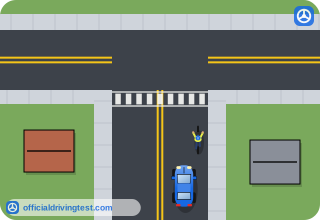
- When making a left turn
- When a vehicle is following closely behind
- When riding on a road that has a bicycle lane
- When approaching a driveway
Show answer
Correct answer: When making a left turn
A bicycle rider moves toward the center of the lane if there are hazards, when passing another vehicle or when making a left turn.
Source: Minnesota Driver’s Manual (June 2026), page 48