Massachusetts: Sharing the road — Part 6 Practice Test
Vulnerable road users and the four-foot passing rule, bicycles and bicycle lanes, motorcycles, mopeds, scooters, trucks and buses, school buses, farm vehicles, animals and funeral processions. — Part 6
Independent educational site · not affiliated with any government agency or DMV
Ready? Test yourself
- Instant feedback with an explanation
- Every answer cites its source in the manual
- Your best score is saved on this device
Questions are original and based on the official manual "Massachusetts Driver's Manual" (Revised April 2026), Massachusetts Registry of Motor Vehicles.
All 34 questions in this practice test
Take the test above first, then use this list to study. Tap “Show answer” to see the correct answer and explanation.
Show the questions and answersHide the questions
-
How fast must a bicyclist ride on a sidewalk where riding there is legal?
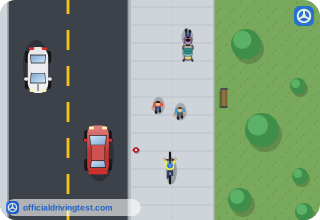
- At a walking speed
- No faster than 15 mph
- At the speed of nearby traffic
- At any speed when no pedestrians are close
Show answer
Correct answer: At a walking speed
The manual says that on a sidewalk where it is legal you must ride at a walking speed and yield to pedestrians.
Source: Massachusetts Driver's Manual (Revised April 2026), page 114 · Open this page in the manual (Manual page 114)
-
What does the manual say bicyclists should do with their phone while biking?
- Use it only at stop signs
- Use it only in a bike lane
- Put it away and do not text
- Hold it in the hand that is not signaling
Show answer
Correct answer: Put it away and do not text
The manual tells bicyclists to put their phone away when biking and not to text and bike.
Source: Massachusetts Driver's Manual (Revised April 2026), page 114 · Open this page in the manual (Manual page 114)
-
Why should bicyclists ride in a straight line?
- So their wheels stay clear of any road paint
- So drivers and pedestrians know where to expect them
- So they can ride faster than the traffic around
- So they can keep a hand free for signaling at all times
Show answer
Correct answer: So drivers and pedestrians know where to expect them
The manual says bicyclists should ride in a straight line so drivers and pedestrians know where to expect them.
Source: Massachusetts Driver's Manual (Revised April 2026), page 114 · Open this page in the manual (Manual page 114)
-
On which side should a bicyclist pass other bicyclists?
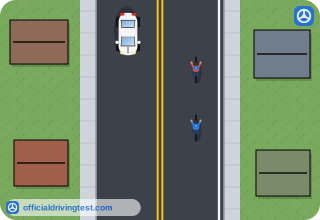
- On the right, not the left
- On whichever side has more room
- On the side nearest the curb
- On the left, not the right
Show answer
Correct answer: On the left, not the right
The manual says to pass other bicyclists on the left, not the right.
Source: Massachusetts Driver's Manual (Revised April 2026), page 114 · Open this page in the manual (Manual page 114)
-
What should bicyclists assume about drivers at intersections?
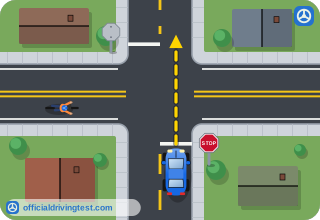
- That drivers will yield to them
- That drivers will signal their turns
- That drivers will stop for them in a bike lane
- That drivers cannot see them
Show answer
Correct answer: That drivers cannot see them
The manual says that at intersections bicyclists should assume drivers cannot see them.
Source: Massachusetts Driver's Manual (Revised April 2026), page 114 · Open this page in the manual (Manual page 114)
-
Why should bicyclists avoid riding next to or passing buses, trucks, and other large vehicles?
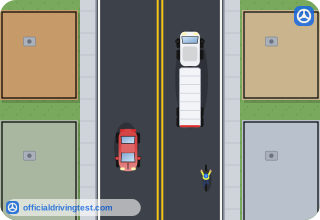
- They must stop for every bicyclist that they happen to see
- They make wide turns, take time to stop, and have large blind spots
- They are not allowed to share a lane with any bicycle
- They have no way of signaling their turns to other traffic
Show answer
Correct answer: They make wide turns, take time to stop, and have large blind spots
The manual says large vehicles make wide turns, take time to come to a full stop, and have large blind spots.
Source: Massachusetts Driver's Manual (Revised April 2026), page 114 · Open this page in the manual (Manual page 114)
-
On which side should a bicyclist never pass a moving tractor trailer?
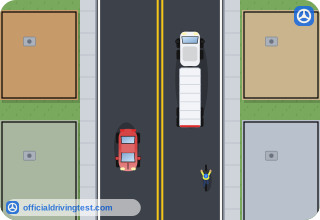
- On the left
- On either side
- On the right
- There is no rule about the side
Show answer
Correct answer: On the right
The manual says never to pass a moving tractor trailer on the right.
Source: Massachusetts Driver's Manual (Revised April 2026), page 114 · Open this page in the manual (Manual page 114)
-
Why should a bicyclist not pass a bus on the right?
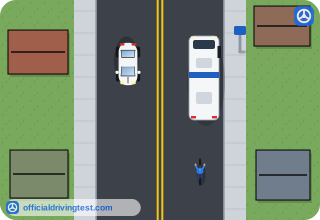
- You might hit someone exiting the bus or get squeezed into the curb
- The bus may drive straight up onto the sidewalk ahead of you
- You might not hear the bus driver's horn in time to react
- The bus lane on the right is closed to all bicycles at stops
Show answer
Correct answer: You might hit someone exiting the bus or get squeezed into the curb
The manual says that on the right you might hit someone exiting the bus or get squeezed into the curb.
Source: Massachusetts Driver's Manual (Revised April 2026), page 114 · Open this page in the manual (Manual page 114)
-
What does the manual say about headphones or earbuds while biking?
- Wear them in both ears to hear your phone
- Do not wear them in both ears
- Wear them only on bike paths
- Wear them only at night
Show answer
Correct answer: Do not wear them in both ears
The manual says not to wear headphones or earbuds in both ears while biking.
Source: Massachusetts Driver's Manual (Revised April 2026), page 114 · Open this page in the manual (Manual page 114)
-
What does the manual say wearing a proper bicycle helmet significantly reduces?
- The time needed to stop a bicycle
- The chance of getting a ticket for riding on a sidewalk
- The need to ride in a bike lane
- The risk of bicycle-related deaths and disabling injuries
Show answer
Correct answer: The risk of bicycle-related deaths and disabling injuries
The manual says wearing a proper bicycle helmet significantly reduces the risk of bicycle-related deaths and disabling injuries.
Source: Massachusetts Driver's Manual (Revised April 2026), page 114 · Open this page in the manual (Manual page 114)
-
You are passing a bicycle traveling in the same direction that is on your right. When may you return to the right?
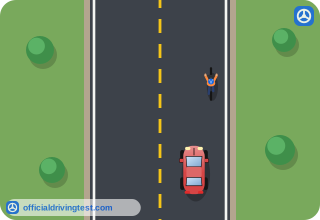
- Not until you have safely passed the overtaken bicycle
- As soon as your rear bumper is ahead of the bicycle's front wheel
- As soon as you signal a move to the right
- As soon as the bicyclist slows down
Show answer
Correct answer: Not until you have safely passed the overtaken bicycle
The manual says you must not return to the right until you have safely passed the overtaken bicycle.
Source: Massachusetts Driver's Manual (Revised April 2026), page 115 · Open this page in the manual (Manual page 115)
-
A lane is too narrow to pass a bicycle at a safe distance. What should you do?
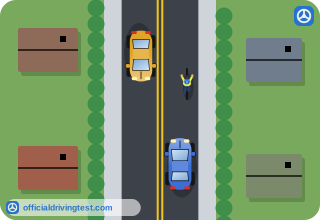
- Squeeze past slowly, keeping as close to the bicycle as you safely can
- Honk once and pass at once, staying near the center line of the road
- Be patient until you can safely use an adjacent lane, or wait until it is safe
- Follow the bicycle closely and pass as soon as it moves to the right
Show answer
Correct answer: Be patient until you can safely use an adjacent lane, or wait until it is safe
The manual says to be patient until you can safely use an adjacent lane or wait until it is safe to pass in the lane you share.
Source: Massachusetts Driver's Manual (Revised April 2026), page 115 · Open this page in the manual (Manual page 115)
-
How far away must you stay when passing a bicycle?
- At least four feet
- At least two feet
- At least three feet
- At least six feet
Show answer
Correct answer: At least four feet
The manual says you must stay at least four feet away when passing a bicycle.
Source: Massachusetts Driver's Manual (Revised April 2026), page 115 · Open this page in the manual (Manual page 115)
-
What does the law say about a motorist who causes a crash with a bicycle that was to the right of other traffic?
- It is a defense, because bicycles must keep to the left of traffic
- It is not a defense that the bicycle was to the right of other traffic
- It is a defense only after dark, when bicycles are hard to see
- It is a defense on roads that have a marked bike lane beside them
Show answer
Correct answer: It is not a defense that the bicycle was to the right of other traffic
The manual says bicycles can legally ride to the right of motor vehicle traffic and that it is not a defense for a motorist causing a crash that the bicycle was to the right of other traffic.
Source: Massachusetts Driver's Manual (Revised April 2026), page 115 · Open this page in the manual (Manual page 115)
-
What is the most that drivers and passengers can be fined for opening a vehicle door into an oncoming bicycle?
- $100
- $25
- $50
- $250
Show answer
Correct answer: $100
The manual says drivers and passengers can be fined up to $100 for opening a vehicle door into an oncoming bicycle.
Source: Massachusetts Driver's Manual (Revised April 2026), page 115 · Open this page in the manual (Manual page 115)
-
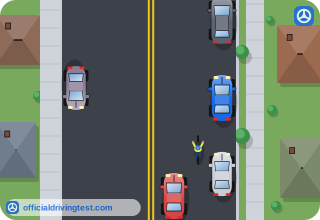
Before you open your vehicle door, what should you always do?
- Honk once to warn any bicyclists that the door will open
- Open the door a few inches and wait for a bicyclist to signal
- Check behind you to make sure no bicyclists are approaching
- Check only the traffic that is in front of your vehicle
Show answer
Correct answer: Check behind you to make sure no bicyclists are approaching
The manual says that before opening your door you should always check behind you to make sure that no bicyclists are approaching.
Source: Massachusetts Driver's Manual (Revised April 2026), page 115 · Open this page in the manual (Manual page 115)
-
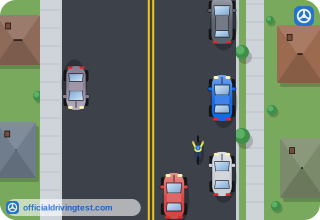
In the "Dutch Reach" method, which hand do you use to open the vehicle door?
- Your near hand, the hand closer to the door
- Your far hand, the hand farther from the door
- Whichever hand is closer to the side mirror
- Your left hand only
Show answer
Correct answer: Your far hand, the hand farther from the door
The manual says to open the door with your far hand, the hand farther from the door.
Source: Massachusetts Driver's Manual (Revised April 2026), page 116 · Open this page in the manual (Manual page 116)
-
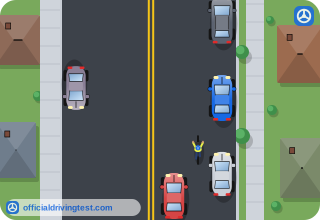
Before opening a vehicle door, which two mirrors does the manual say drivers and passengers should check?
- The rear-view mirror and the sun visor mirror
- The side-view mirror and the blind-spot mirror only
- Neither mirror, since only the hand checks are needed
- The rear-view mirror and the side-view mirror
Show answer
Correct answer: The rear-view mirror and the side-view mirror
The manual says to check your rear-view mirror and your side-view mirror before opening the door.
Source: Massachusetts Driver's Manual (Revised April 2026), page 116 · Open this page in the manual (Manual page 116)
-
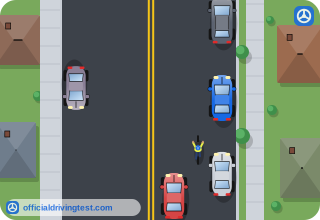
Why does the "Dutch Reach" method help you see approaching bicyclists?
- It raises your seat height
- It opens the door wider
- It lets you see through the door window
- It forces your body to turn
Show answer
Correct answer: It forces your body to turn
The manual says the method forces your body to turn, which will better allow you to see approaching bicyclists.
Source: Massachusetts Driver's Manual (Revised April 2026), page 116 · Open this page in the manual (Manual page 116)
-
Where did the "Dutch Reach" method for opening vehicle doors originate?
- In Germany
- In the Netherlands
- In Denmark
- In Belgium
Show answer
Correct answer: In the Netherlands
The manual says it is called the Dutch Reach method because it originated in the Netherlands.
Source: Massachusetts Driver's Manual (Revised April 2026), page 116 · Open this page in the manual (Manual page 116)
-
How far from parked cars should bicyclists ride to avoid opening doors?
- At least one foot, but only on streets with bike lanes
- At least two feet, but only on streets without bike lanes
- At least three feet, on streets with and without bike lanes
- At least five feet, on streets with and without bike lanes
Show answer
Correct answer: At least three feet, on streets with and without bike lanes
The manual says bicyclists should ride at least three feet from parked cars to avoid doors, both on streets with and without bike lanes.
Source: Massachusetts Driver's Manual (Revised April 2026), page 116 · Open this page in the manual (Manual page 116)
-
What should a bicyclist who is turning left do at a bicycle box?
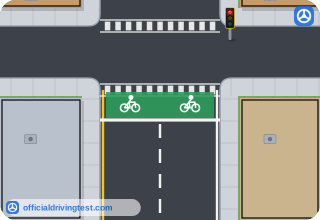
- Stop behind the box, signal the turn, and cross when no cars are near
- Stop in the box, move to its right side, and turn on the red light
- Stop in the box, move to its left side, signal the turn, and wait for green
- Stop in the box, get off the bicycle, and walk across at the crosswalk
Show answer
Correct answer: Stop in the box, move to its left side, signal the turn, and wait for green
The manual says bicyclists turning left should stop in the bicycle box, move to the left side of the box, signal the turn, and wait for the green light.
Source: Massachusetts Driver's Manual (Revised April 2026), page 116 · Open this page in the manual (Manual page 116)
-
Where should bicyclists who are traveling straight or turning right stay in a bicycle box?
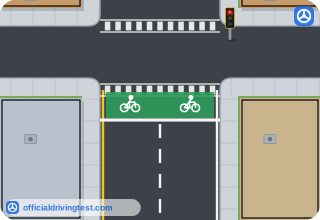
- To the left in the box, in a single line
- In the center of the box, side by side
- To the right in the box, in a staggered formation
- Behind the box, outside of the painted area
Show answer
Correct answer: To the right in the box, in a staggered formation
The manual says bicyclists traveling straight or turning right should stay to the right in the bicycle box, in a staggered formation, and wait for the green light.
Source: Massachusetts Driver's Manual (Revised April 2026), page 117 · Open this page in the manual (Manual page 117)
-
What does a two-stage left turn allow bicyclists to do?
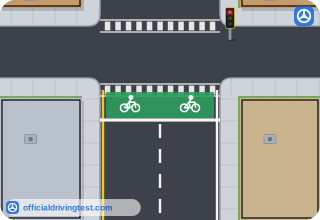
- Make a left turn in two separate steps, not crossing multiple lanes at once
- Make a left turn in one step from the right lane of traffic ahead
- Turn left on a red light after stopping in the bicycle box first
- Cross all lanes of traffic at one time, before the green light shows
Show answer
Correct answer: Make a left turn in two separate steps, not crossing multiple lanes at once
The manual says a two-stage left turn allows bicyclists to make a left turn in two separate steps, rather than crossing multiple lanes of traffic.
Source: Massachusetts Driver's Manual (Revised April 2026), page 117 · Open this page in the manual (Manual page 117)
-
What is Step 1 of a two-stage left turn made with a bicycle box?
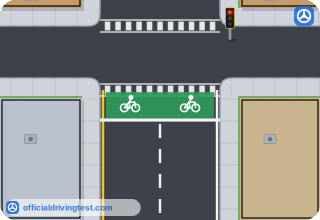
- Stop in the bicycle box for the road you are leaving and wait for the red light to turn left
- Turn left from the left side of the first bicycle box on the green light and keep going
- Stop at the curb, get off the bicycle, and walk it straight across the whole intersection
- Cross straight through on the green light and stop in the bicycle box for the road you are turning onto
Show answer
Correct answer: Cross straight through on the green light and stop in the bicycle box for the road you are turning onto
The manual says Step 1 is to cross straight through the intersection on the green light and stop in the bicycle box for the road you are turning onto.
Source: Massachusetts Driver's Manual (Revised April 2026), page 117 · Open this page in the manual (Manual page 117)
-
What is Step 2 of a two-stage left turn made with a bicycle box?
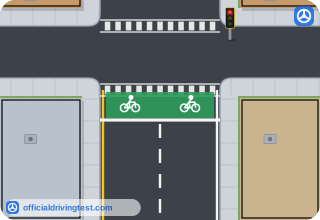
- Turn left right away, across all of the lanes of traffic
- Wait for the green light and go straight through the intersection
- Wait for the green light and then turn left a second time
- Get off the bicycle and walk across on the sidewalk
Show answer
Correct answer: Wait for the green light and go straight through the intersection
The manual says Step 2 is to wait for the green light and go straight through the intersection.
Source: Massachusetts Driver's Manual (Revised April 2026), page 117 · Open this page in the manual (Manual page 117)
-
What are separated bicycle lanes also known as?
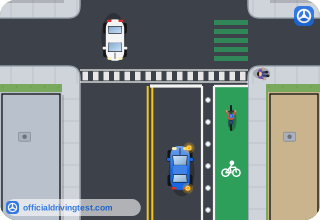
- Cycle tracks and protected bike lanes
- Shared use paths and sidewalk lanes
- Bike routes and shared lane markings
- Bicycle boxes and two-stage lanes
Show answer
Correct answer: Cycle tracks and protected bike lanes
The manual says separated bicycle lanes are also known as cycle tracks and protected bike lanes.
Source: Massachusetts Driver's Manual (Revised April 2026), page 117 · Open this page in the manual (Manual page 117)
-
What do separated bicycle lanes do?
- Mark the places where bicyclists must get off and walk
- Allow bicycles to share the sidewalk with pedestrians
- Physically separate bicycle traffic from vehicular traffic
- Replace the crosswalk at the intersection for bicyclists
Show answer
Correct answer: Physically separate bicycle traffic from vehicular traffic
The manual says separated bicycle lanes physically separate bicycle traffic from vehicular traffic.
Source: Massachusetts Driver's Manual (Revised April 2026), page 117 · Open this page in the manual (Manual page 117)
-
What must bicyclists do about pedestrians who are crossing at a separated bicycle lane intersection?
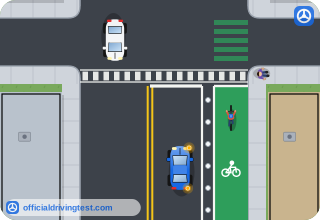
- Yield to the crossing pedestrians
- Ring a bell and keep going
- Ride around them on the sidewalk
- Speed up to clear the crossing
Show answer
Correct answer: Yield to the crossing pedestrians
The manual says bicyclists must yield to crossing pedestrians.
Source: Massachusetts Driver's Manual (Revised April 2026), page 117 · Open this page in the manual (Manual page 117)
-
How should bicyclists ride through an intersection on a separated bicycle lane?
- Outside the lane, in the travel lane next to it
- In the lane, while watching for turning vehicles
- On the sidewalk, in the crosswalk beside the lane
- In the lane, with no need to watch for turning vehicles
Show answer
Correct answer: In the lane, while watching for turning vehicles
The manual says that at intersections bicyclists should ride in the lane through the intersection, while watching for turning vehicles.
Source: Massachusetts Driver's Manual (Revised April 2026), page 117 · Open this page in the manual (Manual page 117)
-
According to the manual's common bicycle crash scenarios, who is at fault in all of them?
- The bicyclist
- Whoever arrived first
- It depends on the speed
- The motor vehicle
Show answer
Correct answer: The motor vehicle
The manual says the motor vehicle is at fault in all of the common crash scenarios between motor vehicles and bicyclists.
Source: Massachusetts Driver's Manual (Revised April 2026), page 117 · Open this page in the manual (Manual page 117)
-
What must drivers always be alert for, according to the manual's common bicycle crash scenarios?
- Bicycles that may be hidden by other vehicles or buildings
- Bicycles that always ride in the center of the lane
- Bicycles that are moving slower than all other traffic
- Bicycles that ride only on sidewalks near buildings
Show answer
Correct answer: Bicycles that may be hidden by other vehicles or buildings
The manual says drivers must always be alert for bicycles that may be hidden by other vehicles or buildings.
Source: Massachusetts Driver's Manual (Revised April 2026), page 117 · Open this page in the manual (Manual page 117)
-
What must drivers be careful not to underestimate when they pass a bicyclist?
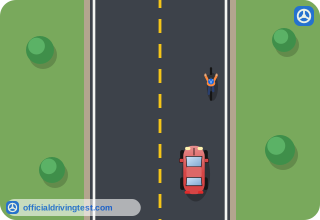
- A bicyclist's skill level or the weather conditions
- The number of bicyclists on the road or the time of day
- A bicyclist's speed or the amount of space needed to pass
- A bicyclist's helmet quality or the bicycle's lights
Show answer
Correct answer: A bicyclist's speed or the amount of space needed to pass
The manual says drivers must be careful not to underestimate a bicyclist's speed or the amount of space needed to pass.
Source: Massachusetts Driver's Manual (Revised April 2026), page 117 · Open this page in the manual (Manual page 117)
-
In the common bicycle crash scenarios the manual describes (left cross, right hook, drive out, sideswipe), how can bicyclists increase their visibility and reduce the risk of a crash?
- By riding farther right in the lane
- By riding on the sidewalk instead
- By riding farther left in the lane
- By riding closer to parked cars
Show answer
Correct answer: By riding farther left in the lane
The manual says bicyclists can increase their visibility and reduce the risk of a crash by riding farther left in the lane.
Source: Massachusetts Driver's Manual (Revised April 2026), page 117 · Open this page in the manual (Manual page 117)