Iowa: Right-of-way and turning
Who yields at intersections, uncontrolled intersections and all-way stops, turning, roundabouts, reduced-conflict intersections and diverging diamond interchanges. Split into 5 shorter tests so you're not stuck in one long quiz.
Independent educational site · not affiliated with any government agency or DMV
Choose a part
Right-of-way and turning — Part 1
Questions in this part include: “No signs or lane markings control turning. Which lanes should you use for the turn?”
StartRight-of-way and turning — Part 2
Questions in this part include: “Which of these requires you to stop?”
StartRight-of-way and turning — Part 3
Questions in this part include: “Where should you avoid passing because a vehicle may enter the roadway ahead of you?”
StartRight-of-way and turning — Part 4
Questions in this part include: “Which group of items does the manual list as traffic control devices at an intersection?”
StartRight-of-way and turning — Part 5
Questions in this part include: “What do roundabouts NOT have?”
StartAll 84 Right-of-way and turning questions with answers
Choose a part above to take a practice test, or study every question and answer here.
Show the questions and answersHide the questions
-
No signs or lane markings control turning. Which lanes should you use for the turn?
- Turn from the center lane into the lane that is farthest from the one you came from, whatever the traffic
- Turn from the lane closest to the direction you want to go, into the lane closest to the one you came from
- Turn from the lane that is farthest from the direction you want to go, into any lane that is open
- Turn from any lane you choose and then move into the left lane as soon as you finish the turn
Show answer
Correct answer: Turn from the lane closest to the direction you want to go, into the lane closest to the one you came from
Where nothing controls turning, you should turn from the lane closest to the direction you want to go, and into the lane closest to the one you came from.
Source: Iowa Driver’s License Manual (July 2026), page 16
-
How should you go from one lane to the other when making a turn?
- As directly as possible, without crossing lane lines or interfering with traffic
- By crossing into the far lane before the turn begins, then straightening out
- By swinging wide, then cutting across the lane lines when it is clear
- By changing lanes in the middle of the turn whenever there is room
Show answer
Correct answer: As directly as possible, without crossing lane lines or interfering with traffic
When making turns, go from one lane to the other as directly as possible without crossing lane lines or interfering with traffic.
Source: Iowa Driver’s License Manual (July 2026), page 16
-
When may you change to another lane when making a turn?
- While you are in the middle of the turn
- Only at the next intersection
- Once you have completed your turn
- Only after you have stopped and checked
Show answer
Correct answer: Once you have completed your turn
Once you have completed your turn, you can change to another lane if you need to.
Source: Iowa Driver’s License Manual (July 2026), page 16
-
What does staying in your own lane through a turn allow other drivers to do safely?
- Pass on the shoulder
- Turn right on red
- Make a U-turn
- Change lanes inside the intersection
Show answer
Correct answer: Turn right on red
Staying in your lane allows others to safely turn right on red.
Source: Iowa Driver’s License Manual (July 2026), page 16
-
What will staying in your own lane through a turn prevent?
- Collisions with pedestrians in the crosswalk
- Collisions with traffic going straight ahead
- Collisions with vehicles on the shoulder
- Collisions with traffic turning left
Show answer
Correct answer: Collisions with traffic turning left
Staying in your lane will prevent collisions with traffic turning left.
Source: Iowa Driver’s License Manual (July 2026), page 16
-
What does the law do about the right-of-way?
- It gives the right-of-way to the driver who signals first
- It gives the right-of-way to the driver with the larger vehicle
- It gives the right-of-way to the driver who is traveling faster
- It says who must yield, but it does not give anyone the right-of-way
Show answer
Correct answer: It says who must yield, but it does not give anyone the right-of-way
The law says who must yield the right-of-way; it does not give anyone the right-of-way.
Source: Iowa Driver’s License Manual (July 2026), page 18
-
Regardless of who has the right-of-way, what should you do?
- Do everything you can to prevent striking a pedestrian or another vehicle
- Maintain your speed and sound your horn so others know to yield to you
- Stop completely at every intersection and wait for others to pass
- Move to the center of the road so that other drivers can see you
Show answer
Correct answer: Do everything you can to prevent striking a pedestrian or another vehicle
Whoever has the right-of-way, a driver should do everything possible to avoid striking a pedestrian or another vehicle.
Source: Iowa Driver’s License Manual (July 2026), page 18
-
What must you do when you want to make a right turn after stopping at a red light?
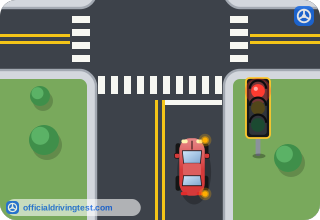
- Wait for the signal to turn green before turning
- Turn right ahead of any oncoming traffic
- Turn right without yielding because you already stopped
- Yield before you turn right
Show answer
Correct answer: Yield before you turn right
A driver who wants to turn right after stopping at a red light must yield.
Source: Iowa Driver’s License Manual (July 2026), page 19
-
Right turns on red are permitted unless what?
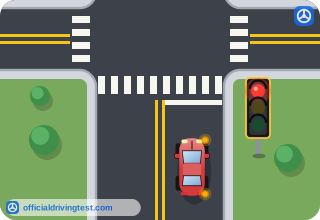
- There is a sign prohibiting them
- Another car is waiting behind you
- It is dark outside
- You are on a street with more than two lanes
Show answer
Correct answer: There is a sign prohibiting them
Right turns on red are permitted unless a sign prohibits them.
Source: Iowa Driver’s License Manual (July 2026), page 19
-
Drivers turning left must yield to which vehicles?
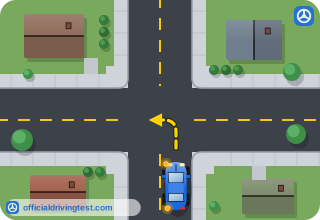
- Vehicles stopped at the stop line behind them
- Only vehicles approaching from behind
- Parked cars along the curb
- Oncoming cars that are going straight ahead
Show answer
Correct answer: Oncoming cars that are going straight ahead
Drivers turning left must yield to oncoming cars that are going straight ahead.
Source: Iowa Driver’s License Manual (July 2026), page 19
-
At an all-way stop, who gets to go first after coming to a complete stop?
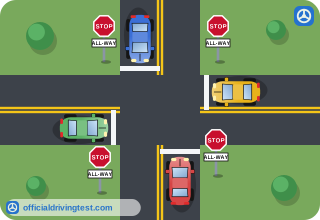
- Whoever got to the intersection before the others
- Whoever is driving the largest vehicle on the road
- Whoever is approaching at the highest speed of all
- Whoever is turning left toward the other vehicles
Show answer
Correct answer: Whoever got to the intersection before the others
At an all-way stop, the driver reaching the intersection first gets to go first, after coming to a complete stop.
Source: Iowa Driver’s License Manual (July 2026), page 19
-
Two vehicles arrive at an all-way stop at the same time. Which one gets to go first?
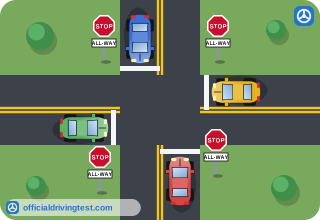
- The vehicle to the left
- The larger of the two vehicles
- The vehicle to the right
- The vehicle that is going faster
Show answer
Correct answer: The vehicle to the right
For vehicles arriving at the same time at an all-way stop, the vehicle to the right gets to go first.
Source: Iowa Driver’s License Manual (July 2026), page 19
-
Drivers entering a road from a driveway, alley, or roadside must yield to whom?
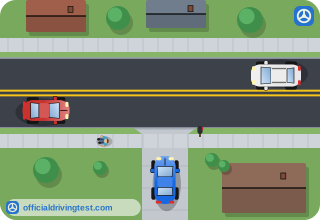
- Only vehicles approaching from the right
- Vehicles already on the main road
- Vehicles waiting to enter the road behind them
- Only larger vehicles such as trucks and buses
Show answer
Correct answer: Vehicles already on the main road
Drivers entering a road from a driveway, alley, or roadside must yield to vehicles already on the main road.
Source: Iowa Driver’s License Manual (July 2026), page 19
-
What is the responsibility of all drivers at an intersection that has no stop sign or traffic signal?
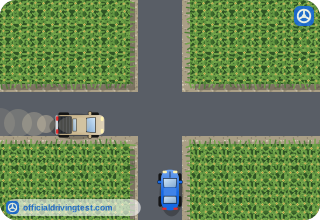
- To slow down and approach carefully
- To stop completely and wait for others to pass
- To maintain speed so that traffic keeps moving
- To flash their headlights to signal others to go ahead
Show answer
Correct answer: To slow down and approach carefully
At an intersection with no stop sign or traffic signal, all drivers must slow down and approach carefully.
Source: Iowa Driver’s License Manual (July 2026), page 19
-
Which right-of-way rules apply at an uncontrolled intersection?
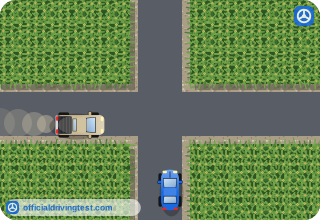
- No right-of-way rules, because there are no signs
- Only the rules for left turns and driveways
- All the rules that apply at a controlled intersection
- Only the rules for all-way stops
Show answer
Correct answer: All the rules that apply at a controlled intersection
All of the rules that apply at a controlled intersection also apply at an uncontrolled intersection.
Source: Iowa Driver’s License Manual (July 2026), page 19
-
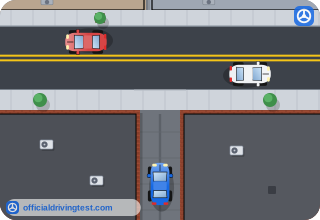
What must you always do before crossing a sidewalk when exiting a private roadway, driveway or alleyway?
- Slow to a walking pace
- Sound your horn
- Flash your headlights
- Stop
Show answer
Correct answer: Stop
The manual lists stopping before crossing a sidewalk when leaving a private roadway, driveway or alleyway as a required stop.
Source: Iowa Driver’s License Manual (July 2026), page 41
-
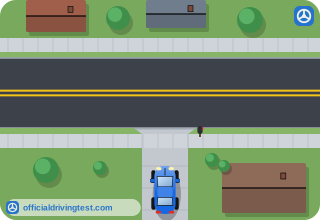
What must you always do when entering a public road from a private drive, such as a parking lot, school or gas station?
- Slow down and merge
- Stop
- Stop only if traffic is close
- Speed up to match traffic
Show answer
Correct answer: Stop
The manual lists entering a public road from a private drive, including parking lots, businesses, schools and gas stations, as a required stop.
Source: Iowa Driver’s License Manual (July 2026), page 41
-
Which of these requires you to stop?
- A bicyclist riding in the next lane
- A car behind you with its turn signal on
- A request from any law officer
- A parked car with its hazard lights on
Show answer
Correct answer: A request from any law officer
The manual says you must always stop at the request of any law officer.
Source: Iowa Driver’s License Manual (July 2026), page 41
-
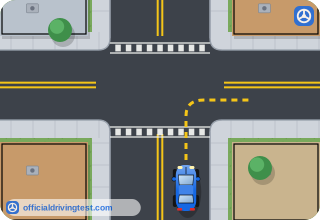
What does the manual say about last minute sharp turns?
- They are dangerous and should be avoided
- They are safe if you signal
- They are acceptable on residential streets
- They are the best way to avoid a missed turn
Show answer
Correct answer: They are dangerous and should be avoided
Last minute sharp turns are dangerous and should be avoided, so plan your turns ahead of time.
Source: Iowa Driver’s License Manual (July 2026), page 43
-
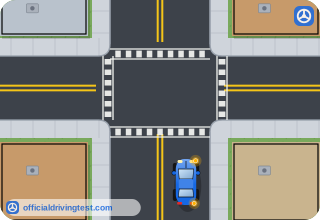
Which actions increase your chances of being in a crash when turning?
- Cutting corners and swinging wide
- Slowing down before the turn
- Watching for pedestrians and other vehicles
- Deciding where you want to be when the turn is done
Show answer
Correct answer: Cutting corners and swinging wide
The manual says that cutting corners and swinging wide on turns increase your chances of being in a crash.
Source: Iowa Driver’s License Manual (July 2026), page 43
-
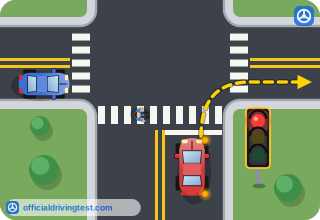
At a traffic signal, when may you NOT make a right turn at a red light?
- When another vehicle is behind you
- When it is raining
- When you are in the right lane
- When there is a “NO TURN ON RED” sign
Show answer
Correct answer: When there is a “NO TURN ON RED” sign
You may make a right turn at a red light unless there is a “NO TURN ON RED” sign.
Source: Iowa Driver’s License Manual (July 2026), page 43
-
Before turning right at a red light, what must you do?
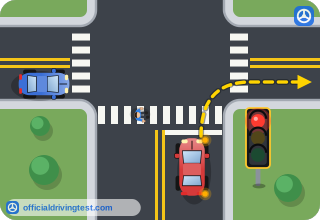
- Stop completely and yield to all traffic
- Slow down and yield only to pedestrians
- Come to a rolling stop if no one is near
- Stop only if another vehicle is approaching
Show answer
Correct answer: Stop completely and yield to all traffic
Prior to safely turning, you must come to a complete stop and yield to all other traffic.
Source: Iowa Driver’s License Manual (July 2026), page 43
-
When may you also make a left turn at a red light?
- When turning from any lane of a two-way street
- When turning from a one-way street onto a two-way street
- From the left lane of a one-way street onto another one-way street
- When no other vehicle is in sight
Show answer
Correct answer: From the left lane of a one-way street onto another one-way street
You may make a left turn at a red light if you are turning from the left lane of a one-way street onto another one-way street.
Source: Iowa Driver’s License Manual (July 2026), page 43
-
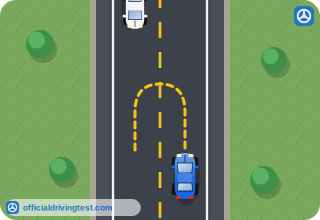
Where should U-turns be performed?
- Anywhere there is no oncoming traffic
- Only at intersections with a traffic signal
- Anywhere on a road with a single lane each way
- Only where they are not prohibited and where it is safe
Show answer
Correct answer: Only where they are not prohibited and where it is safe
U-turns should only be performed where their use is not prohibited and where it is safe to do so.
Source: Iowa Driver’s License Manual (July 2026), page 43
-
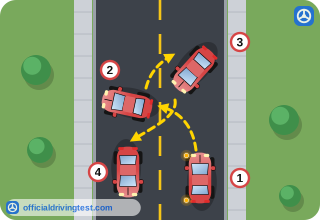
What does the manual say is better than making a three-point turn?
- Back into the nearest driveway
- Proceed to the nearest intersection
- Stop and wait for traffic to clear
- Turn around in the middle of the block
Show answer
Correct answer: Proceed to the nearest intersection
Three-point turns are generally not a safe maneuver and can increase your risk and exposure to collisions, so it is better to proceed to the nearest intersection.
Source: Iowa Driver’s License Manual (July 2026), page 43
-
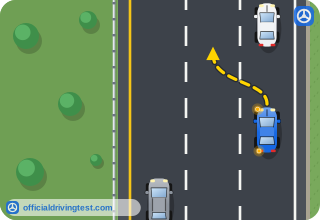
Which of these is a lane change according to the manual?
- Slowing down in your own lane
- Driving through an intersection in your lane
- Entering the roadway from the curb or shoulder
- Following a curve while staying in your lane
Show answer
Correct answer: Entering the roadway from the curb or shoulder
Lane changes include changing from one lane to another, merging from an entrance ramp, and entering the roadway from the curb or shoulder.
Source: Iowa Driver’s License Manual (July 2026), page 44
-
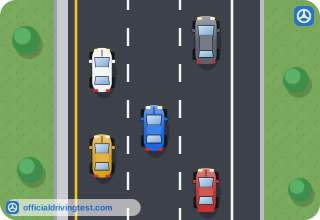
How many lanes should you change at a time?
- One lane at a time
- Two lanes at a time
- As many as you need when the road is clear
- Two lanes when traffic is slow
Show answer
Correct answer: One lane at a time
The manual says to only change lanes one lane at a time.
Source: Iowa Driver’s License Manual (July 2026), page 44
-
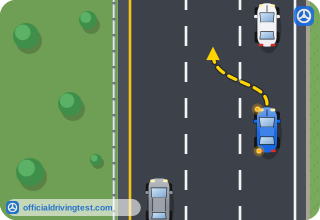
Before changing lanes, you must confirm there is space to safely enter the lane and yield to whom?
- Any vehicles already in that lane
- Vehicles in the lane you are leaving
- Only vehicles that are signaling
- Only vehicles that are traveling faster
Show answer
Correct answer: Any vehicles already in that lane
You must confirm there is space to safely enter the lane and yield to any vehicles already in that lane.
Source: Iowa Driver’s License Manual (July 2026), page 44
-
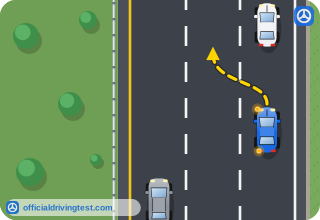
When changing lanes, when should you slow down?
- Always, to be safe
- Never, whatever the traffic
- Only when moving into a slower lane
- Only when the other lane is empty
Show answer
Correct answer: Only when moving into a slower lane
Make the lane change carefully but without slowing down unless you are moving into a slower lane of traffic.
Source: Iowa Driver’s License Manual (July 2026), page 44
-
While you are changing lanes, what should you constantly do?
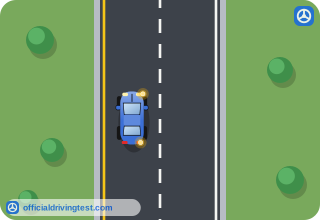
- Look only at the mirror in the new lane
- Check traffic
- Watch your speedometer
- Keep your eyes on the vehicle ahead only
Show answer
Correct answer: Check traffic
While changing lanes you constantly check traffic so you will see anyone coming up on you unexpectedly.
Source: Iowa Driver’s License Manual (July 2026), page 44
-
When you check your mirrors before a lane change, which two things should you make sure of?
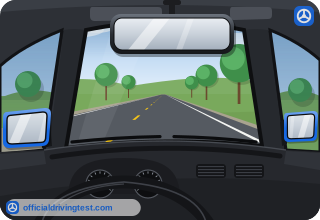
- Your signal is off and nobody is behind you
- The lane you are leaving is clear and your speed is steady
- Your mirrors are clean and the road is dry
- No vehicles in the lane you want to enter, nobody about to pass
Show answer
Correct answer: No vehicles in the lane you want to enter, nobody about to pass
Look in your rearview and side mirrors to make sure there are no vehicles in the lane you want to enter and nobody is about to pass you.
Source: Iowa Driver’s License Manual (July 2026), page 44
-
How should you check your blind spots before changing lanes?
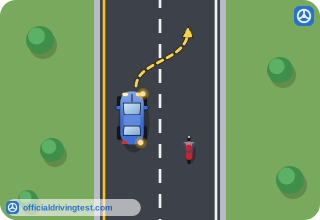
- Look over the shoulder opposite to the direction you plan to move
- Look only in the rearview mirror
- Look over your shoulder in the direction you plan to move
- Look only at the side mirror on that side
Show answer
Correct answer: Look over your shoulder in the direction you plan to move
Look over your shoulder in the direction you plan to move and be sure no one is near the rear corners of your vehicle.
Source: Iowa Driver’s License Manual (July 2026), page 44
-
When you turn your head to check your blind spots, what should you make sure of?
- You keep the steering wheel straight
- You slow down to half speed
- You turn the wheel slightly toward the lane
- You keep one hand off the wheel
Show answer
Correct answer: You keep the steering wheel straight
People have a natural tendency to turn their arms in the same direction as their head, so you keep the steering wheel straight.
Source: Iowa Driver’s License Manual (July 2026), page 44
-
Why should you check the far lane, if there is one, before changing lanes?
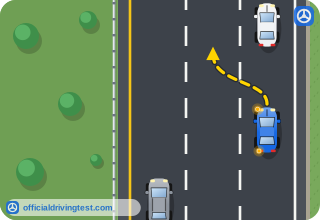
- That lane is always the fastest
- Vehicles in that lane are required to yield to you
- That lane shows how much traffic is ahead
- Someone there may plan to move into the same lane
Show answer
Correct answer: Someone there may plan to move into the same lane
Someone in the far lane may be planning to move into the same lane you want to enter.
Source: Iowa Driver’s License Manual (July 2026), page 44
-
Under what conditions may you pass another vehicle?
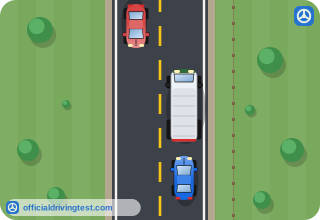
- Only when signs or road markings permit it and you have enough room to pass safely
- Whenever the vehicle ahead is traveling below the posted speed limit
- Whenever you have signaled and the passing lane ahead looks empty
- Whenever no oncoming vehicle is in sight, whatever the road markings say
Show answer
Correct answer: Only when signs or road markings permit it and you have enough room to pass safely
The manual says to pass only when signs or road markings permit it and you have determined there is enough room to pass safely.
Source: Iowa Driver’s License Manual (July 2026), page 45
-
As a rule, how many vehicles should you pass at one time?
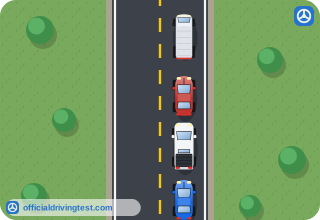
- Two vehicles
- Three vehicles
- One vehicle
- As many as the passing lane has room for
Show answer
Correct answer: One vehicle
The manual says that, as a rule, you should only pass one vehicle at a time.
Source: Iowa Driver’s License Manual (July 2026), page 45
-
Where should you avoid passing because a vehicle may enter the roadway ahead of you?
- On a multilane road with broken white lane lines
- At intersections and driveways
- On a long straight stretch with a wide shoulder
- In the lane next to a vehicle that is slowing down
Show answer
Correct answer: At intersections and driveways
The manual tells drivers to avoid passing in places where a vehicle may enter the roadway ahead of them, such as intersections and driveways.
Source: Iowa Driver’s License Manual (July 2026), page 45
-
When passing is necessary, what is the first step the manual lists?
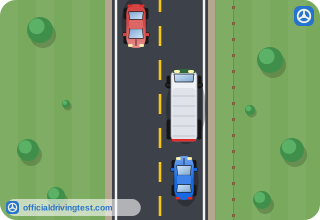
- Move to the left edge of your lane and sound your horn
- Brake gently so you can see around the vehicle ahead
- Speed up to close the gap behind the vehicle ahead
- Check the passing lane ahead for plenty of space
Show answer
Correct answer: Check the passing lane ahead for plenty of space
The first step is to check the passing lane ahead to make sure there is plenty of space before you try to pass.
Source: Iowa Driver’s License Manual (July 2026), page 45
-
While you are passing, what should you monitor?
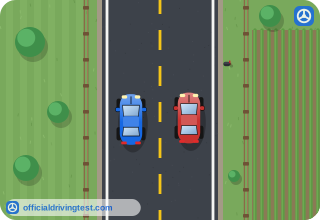
- Only the space in front of you, so your eyes stay on the road ahead
- Only the vehicle you are passing, so you can stay even with its driver
- Only the oncoming lane, so you can judge when a gap will close
- The space in front of and behind your vehicle, checking the rearview mirror
Show answer
Correct answer: The space in front of and behind your vehicle, checking the rearview mirror
While passing, you should monitor the space in front of and behind your vehicle and check the rearview mirror.
Source: Iowa Driver’s License Manual (July 2026), page 45
-
When may you move back into your original lane after passing?
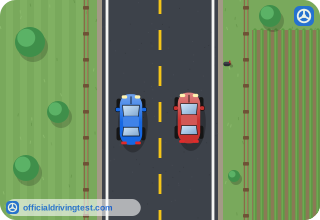
- As soon as your front bumper is even with the back bumper of the passed car
- When you see the front of the passed car in your rearview mirror and are well clear
- As soon as the driver you are passing flashes headlights to let you in
- After you have driven at least one full minute in the passing lane
Show answer
Correct answer: When you see the front of the passed car in your rearview mirror and are well clear
You return to the original lane when you can see the front of the passed car in the rearview mirror and your vehicle is well clear.
Source: Iowa Driver’s License Manual (July 2026), page 45
-
After you have moved back into your original lane following a pass, what should you do with your signal and speed?
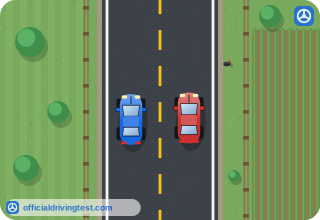
- Leave the signal on for several seconds and keep accelerating
- Cancel the signal and slow down below the passed car's speed
- Cancel the signal and return to a safe speed
- Leave the signal on until you reach the next turn
Show answer
Correct answer: Cancel the signal and return to a safe speed
After moving back gently and slowly, you cancel the signal and return to a safe speed.
Source: Iowa Driver’s License Manual (July 2026), page 45
-
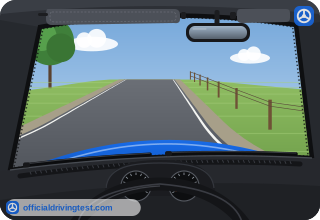
You are approaching the top of a hill on a two-lane road. May you pass?
- Yes, if you signal first and no oncoming vehicle is visible
- Yes, if you are passing only one slow vehicle
- Yes, if the road markings show a broken line
- No, passing when approaching the top of a hill is illegal
Show answer
Correct answer: No, passing when approaching the top of a hill is illegal
The manual lists approaching the top of a hill as a situation where passing is illegal.
Source: Iowa Driver’s License Manual (July 2026), page 46
-
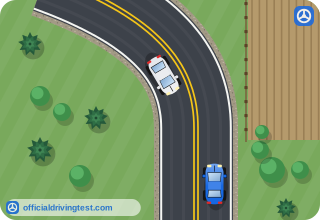
Passing while going around a curve is illegal in which situation?
- When another vehicle is following right behind you
- When your view along the roadway is obstructed
- When the road surface is wet from rain or snow
- When the vehicle you are passing is a large truck
Show answer
Correct answer: When your view along the roadway is obstructed
Do not pass going around a curve when your view along the roadway is obstructed.
Source: Iowa Driver’s License Manual (July 2026), page 46
-
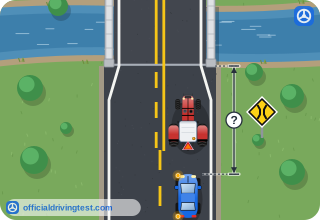
How close to a narrow bridge, viaduct, or tunnel that has a sign posted is passing illegal?
- Within 25 feet
- Within 200 feet
- Within 100 feet
- Within 300 feet
Show answer
Correct answer: Within 100 feet
Do not pass within 100 feet of a narrow bridge, viaduct, or tunnel that has a sign posted.
Source: Iowa Driver’s License Manual (July 2026), page 46
-
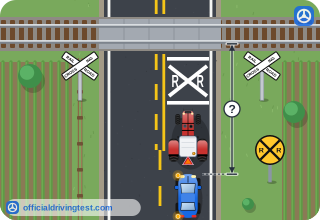
How close to a railroad crossing is passing illegal?
- Within 100 feet
- Within 25 feet
- Within 200 feet
- Within 500 feet
Show answer
Correct answer: Within 100 feet
Do not pass within 100 feet of a railroad crossing.
Source: Iowa Driver’s License Manual (July 2026), page 46
-
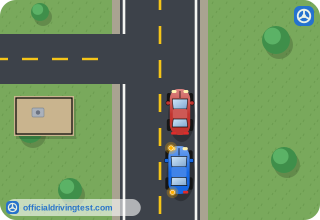
How close to an intersection is passing illegal?
- Within 100 feet
- Within 50 feet
- Within 150 feet
- Within 300 feet
Show answer
Correct answer: Within 100 feet
Do not pass within 100 feet of an intersection.
Source: Iowa Driver’s License Manual (July 2026), page 46
-
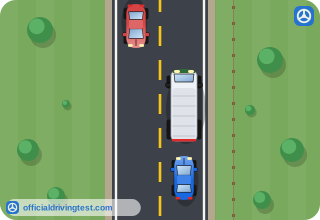
On which side of another vehicle must you not pass?
- On the left, where the road markings permit passing
- On the left, once you have checked your blind spots
- On the right
- On the left, with your turn signal on
Show answer
Correct answer: On the right
The manual lists passing on the right as illegal: do not pass on the right.
Source: Iowa Driver’s License Manual (July 2026), page 46
-
When is passing illegal because of oncoming traffic?
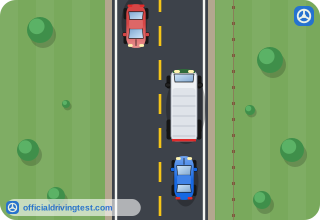
- When any oncoming vehicle is visible, however far away
- When oncoming traffic is so close it would be dangerous to try
- When the oncoming driver has headlights on
- When oncoming traffic is traveling faster than you are
Show answer
Correct answer: When oncoming traffic is so close it would be dangerous to try
Do not pass when oncoming traffic is so close it would be dangerous to try to make it around the vehicle you are passing.
Source: Iowa Driver’s License Manual (July 2026), page 46
-
What should you assume about drivers approaching red lights and stop signs?
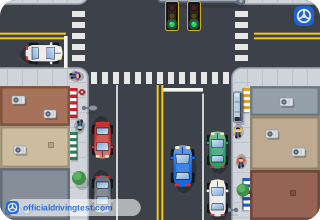
- That some will run through them, so be prepared to react
- That they will stop because the law requires it
- That they will always stop when they see your vehicle
- That they will stop if you flash your headlights at them
Show answer
Correct answer: That some will run through them, so be prepared to react
The manual says to assume that drivers will run through red lights or stop signs and to be prepared to react.
Source: Iowa Driver’s License Manual (July 2026), page 47
-
According to the manual, what is an intersection?
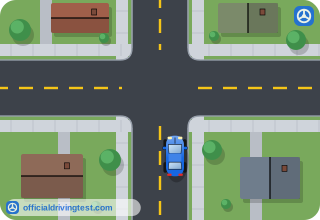
- Any place where traffic merges or crosses
- Only a place where two public streets meet at a traffic signal
- Only a roadway with a stop sign or yield sign on every approach
- Only a place where two paved roads cross at right angles
Show answer
Correct answer: Any place where traffic merges or crosses
The manual defines intersections as any place where traffic merges or crosses.
Source: Iowa Driver’s License Manual (July 2026), page 50
-
Which of these does the manual include in its list of intersections?
- A freeway shoulder
- A bridge with no side roads
- A parking lot
- A straight stretch of interstate
Show answer
Correct answer: A parking lot
The manual's list of intersections includes cross streets, side streets, driveways, parking lots, and roadways open to public travel.
Source: Iowa Driver’s License Manual (July 2026), page 50
-
What is Step 1 before you enter an intersection?
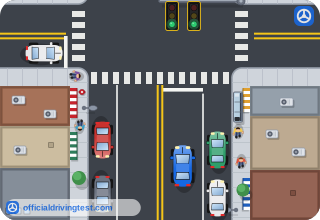
- Speed up so you clear the intersection before other traffic arrives
- Look ahead to identify the type of intersection and any traffic control devices
- Move toward the center of the roadway to see around parked vehicles
- Turn on your high beams so approaching drivers notice you
Show answer
Correct answer: Look ahead to identify the type of intersection and any traffic control devices
Before entering, you look ahead to identify the type of intersection and the traffic control devices that apply.
Source: Iowa Driver’s License Manual (July 2026), page 50
-
Which group of items does the manual list as traffic control devices at an intersection?
- Signs, crossing gates, and brake lights
- Traffic signals, horns, and speed limit tables
- Pavement markings, mirrors, and turn signals
- Signs, traffic signals, and pavement markings
Show answer
Correct answer: Signs, traffic signals, and pavement markings
The manual names signs, traffic signals, and pavement markings as the traffic control devices to identify before entering an intersection.
Source: Iowa Driver’s License Manual (July 2026), page 50
-
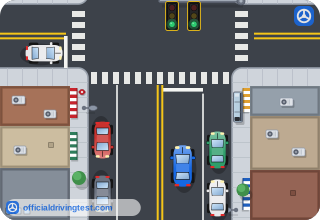
What is the purpose of Step 2, scanning the intersection before you proceed?
- To find the nearest place to stop in the intersection
- To ensure the path is clear through the intersection
- To count how many vehicles are waiting behind you
- To decide which lane has the shortest wait
Show answer
Correct answer: To ensure the path is clear through the intersection
Step 2 tells you to scan the intersection before proceeding to ensure the path is clear through the intersection.
Source: Iowa Driver’s License Manual (July 2026), page 50
-
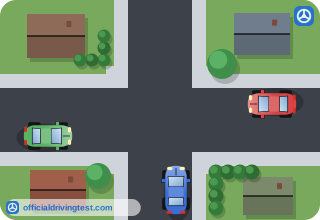
In which order should you look for approaching vehicles and pedestrians at an intersection?
- Right, left, and right again
- Straight ahead, then left only
- Left, then right only once
- Left, right, and left again
Show answer
Correct answer: Left, right, and left again
Step 3 says to look left, right, and left again for approaching vehicles and pedestrians.
Source: Iowa Driver’s License Manual (July 2026), page 50
-
What should you never assume at an intersection?
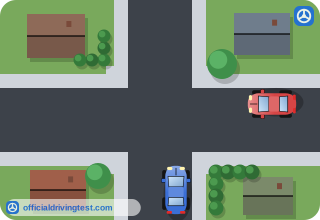
- That another driver will share space with you or give you space
- That a traffic signal will change within a few seconds
- That pavement markings are present on every road
- That pedestrians will use the crosswalk
Show answer
Correct answer: That another driver will share space with you or give you space
The manual says never to assume another driver will share space with you or give you space.
Source: Iowa Driver’s License Manual (July 2026), page 50
-
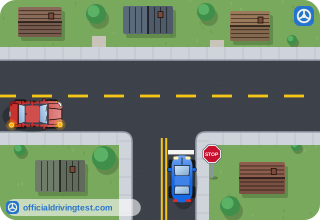
An approaching vehicle has its turn signal on while you wait to turn. What should you do?
- Turn at once, because the signal shows the driver will turn
- Flash your headlights and then proceed ahead of the vehicle
- Wait until the other driver starts to turn, then proceed if it is safe
- Proceed only if the vehicle is a passenger car
Show answer
Correct answer: Wait until the other driver starts to turn, then proceed if it is safe
Do not turn just because an approaching vehicle has a turn signal on; wait until the driver actually starts to turn, then go if it is safe.
Source: Iowa Driver’s License Manual (July 2026), page 50
-
You are at a stop sign on a rural four-lane road with a median. How should you cross it?
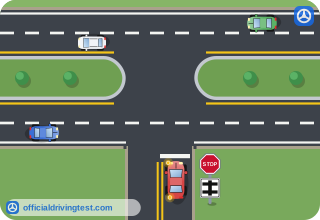
- Wait until both directions are clear, then cross all four lanes at once
- Enter the median without stopping at the stop sign
- Cross one direction of traffic at a time and stop in the median
- Stop in the median only if a vehicle is approaching from the right
Show answer
Correct answer: Cross one direction of traffic at a time and stop in the median
The manual says not to try to cross both directions of traffic at one time, and to stop in the median instead.
Source: Iowa Driver’s License Manual (July 2026), page 51
-
Crossing a rural four-lane road with a median, which direction do you look first after stopping at the stop sign?
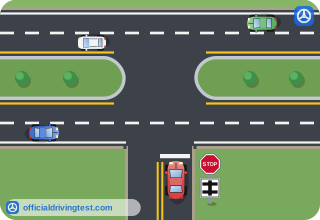
- Right
- Left
- Straight ahead only
- Behind you
Show answer
Correct answer: Left
Step 1 says to stop at the stop sign, look left, and proceed into the median when it is safe.
Source: Iowa Driver’s License Manual (July 2026), page 51
-
After you proceed into the median of a rural four-lane road, what should you do?
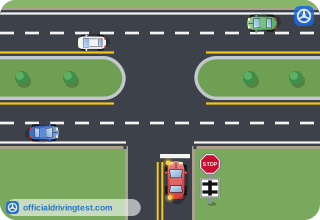
- Continue across without stopping to avoid blocking traffic
- Look left again and then accelerate quickly
- Turn on your hazard lights and wait for a signal
- Remain stopped, look right, and cross or turn left when it is safe
Show answer
Correct answer: Remain stopped, look right, and cross or turn left when it is safe
Step 2 says to remain stopped in the median, look right, and cross or turn left when it is safe to do so.
Source: Iowa Driver’s License Manual (July 2026), page 51
-
Why must you be careful about stopping in the median when crossing a rural four-lane road?
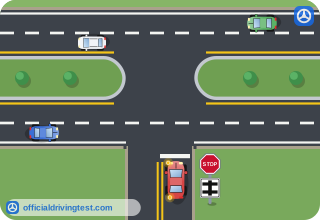
- Medians on rural roads are always too narrow for any vehicle to stop in
- Longer vehicles, such as semis, may not be able to stop in a narrow median
- Stopping in the median is against the law for all types of vehicles
- Traffic on the road stops completely when a vehicle enters the median
Show answer
Correct answer: Longer vehicles, such as semis, may not be able to stop in a narrow median
The manual warns that longer vehicles, such as semis, may not be able to stop in the median if it is narrow.
Source: Iowa Driver’s License Manual (July 2026), page 51
-
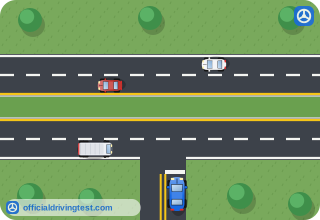
What are reduced-conflict intersections designed to do?
- Add traffic signals at every side road so vehicles can cross safely
- Reduce the number of conflict points where vehicles can crash into each other
- Stop all traffic on the highway at once so side roads can cross
- Give side-road drivers the right-of-way over all highway traffic
Show answer
Correct answer: Reduce the number of conflict points where vehicles can crash into each other
Reduced-conflict intersections are designed to reduce the number of conflict points where vehicles can crash into each other.
Source: Iowa Driver’s License Manual (July 2026), page 52
-
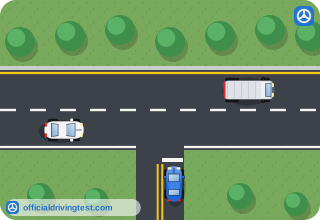
At a reduced-conflict intersection, what does a side-road driver who wants to turn left or cross the four-lane highway do?
- Stop in the median and cross both directions of the highway at one time
- Turn left directly across both directions of traffic
- Wait for a gap in both directions of highway traffic and then cross
- Turn right, merge into the left lane, and make a U-turn at a median opening
Show answer
Correct answer: Turn right, merge into the left lane, and make a U-turn at a median opening
Side-road drivers turn right onto the highway, merge into the left lane, and then make a U-turn at a designated median opening.
Source: Iowa Driver’s License Manual (July 2026), page 52
-
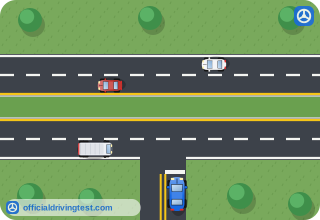
Why do reduced-conflict intersections improve safety?
- They remove every vehicle from the side road so it is never used
- Drivers are only concerned with one direction of highway traffic at a time
- They require every driver to stop on the highway before turning
- They keep drivers from entering the highway from a side road at all
Show answer
Correct answer: Drivers are only concerned with one direction of highway traffic at a time
Drivers only have to watch one direction of traffic on the highway at a time, and they do not need a gap in both directions.
Source: Iowa Driver’s License Manual (July 2026), page 52
-
Where is a diverging diamond interchange used?
- Only on low-volume rural roads outside of cities
- At the end of every on-ramp
- Only where a railroad crosses a highway
- At the intersection of two high-volume traffic roads
Show answer
Correct answer: At the intersection of two high-volume traffic roads
The manual says this type of interchange is used at the intersection of two high-volume traffic roads.
Source: Iowa Driver’s License Manual (July 2026), page 53
-
What is unusual about the design of a diverging diamond interchange?
- It briefly directs drivers to the opposite side of the road
- It sends all traffic around a center island in a counterclockwise direction
- It has no traffic signals and uses only yield signs
- It turns all left turns into U-turns at a median opening
Show answer
Correct answer: It briefly directs drivers to the opposite side of the road
The design is unusual because it directs drivers on the opposite side of the road briefly before diverging back into the correct direction.
Source: Iowa Driver’s License Manual (July 2026), page 53
-
How does a diverging diamond interchange maximize efficiency?
- Traffic never has to stop for any traffic signal along the route
- Traffic is limited to one direction at a time on each road
- Traffic spends less time at a traditional traffic light intersection
- Traffic is moved onto the shoulder to bypass waiting vehicles
Show answer
Correct answer: Traffic spends less time at a traditional traffic light intersection
The manual says it maximizes efficiency by requiring traffic to spend less time at a traditional traffic light controlled intersection.
Source: Iowa Driver’s License Manual (July 2026), page 53
-
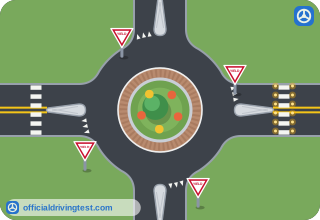
In which direction does traffic move around a roundabout?
- Clockwise
- Counterclockwise
- Toward the outside lane only
- In whichever direction is shortest
Show answer
Correct answer: Counterclockwise
Roundabouts direct traffic in a counterclockwise direction around a center island.
Source: Iowa Driver’s License Manual (July 2026), page 54
-
What do roundabouts NOT have?
- Yield signs or directional signs
- Crosswalks or pavement markings
- A center island
- Stop signs or traffic signals
Show answer
Correct answer: Stop signs or traffic signals
Roundabouts have no stop signs or traffic signals; yield signs, directional signs, and pavement markings guide traffic.
Source: Iowa Driver’s License Manual (July 2026), page 54
-
What guides traffic through a roundabout?
- Stop signs, flashing beacons, and crosswalk guards
- Yield signs, directional signs, and pavement markings
- Traffic signals, crossing gates, and warning flashers
- Stop lines, school zone signs, and pedestrian signals
Show answer
Correct answer: Yield signs, directional signs, and pavement markings
Yield signs, directional signs, and pavement markings guide traffic through the roundabout.
Source: Iowa Driver’s License Manual (July 2026), page 54
-
How does traffic generally move in a roundabout compared with a traditional intersection?
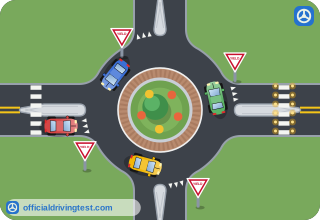
- It moves faster because there are no traffic signals
- It stops and starts in cycles
- It moves one direction at a time
- It generally continues to move, but at a slower speed
Show answer
Correct answer: It generally continues to move, but at a slower speed
Traffic generally continues to move at a slower speed, which reduces traffic backup at traditional intersections.
Source: Iowa Driver’s License Manual (July 2026), page 54
-
What should you do as you approach a single-lane roundabout?
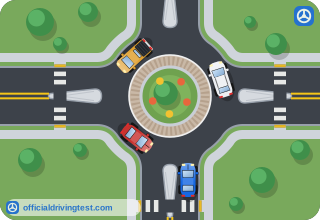
- Slow down to the posted advisory speed and yield to anyone in the crosswalk
- Maintain your speed and stop only when you reach the center island
- Stop completely before every roundabout, even when it is clear
- Move to the inside lane and speed up to merge with the traffic
Show answer
Correct answer: Slow down to the posted advisory speed and yield to anyone in the crosswalk
On approach, slow down to the posted advisory speed and yield to anyone in the crosswalk.
Source: Iowa Driver’s License Manual (July 2026), page 54
-
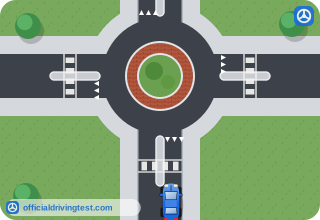
At a single-lane roundabout, how do you enter after reaching the yield line markings?
- Enter first, because traffic entering has the right-of-way over it
- Stop and let all vehicles in the roundabout wait for you to enter
- Yield to vehicles in it, wait for a gap in traffic, then merge counterclockwise
- Merge clockwise into the closest gap in the circulating traffic
Show answer
Correct answer: Yield to vehicles in it, wait for a gap in traffic, then merge counterclockwise
As you approach the yield line markings, you yield to vehicles in the roundabout, wait for a gap, and merge counterclockwise.
Source: Iowa Driver’s License Manual (July 2026), page 54
-
What should you avoid doing while proceeding through a roundabout?
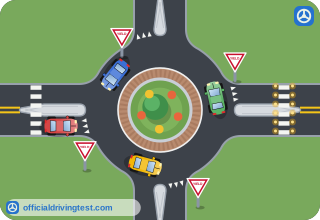
- Stopping in the roundabout
- Using your turn signal
- Continuing until you reach your street
- Yielding to a pedestrian in the crosswalk
Show answer
Correct answer: Stopping in the roundabout
After entering, continue until you reach your street and avoid stopping in the roundabout.
Source: Iowa Driver’s License Manual (July 2026), page 54
-
How should you leave a single-lane roundabout?
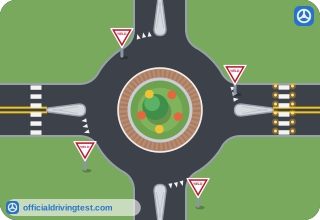
- Exit to your left after stopping at the center island
- Exit without signaling, because you are already in a lane
- Signal, then exit to your right and yield to anyone in the crosswalk
- Exit across the splitter island to avoid the crosswalk
Show answer
Correct answer: Signal, then exit to your right and yield to anyone in the crosswalk
Signal, then exit the roundabout to your right, yielding to anyone in the crosswalk.
Source: Iowa Driver’s License Manual (July 2026), page 54
-
In a multi-lane roundabout, how should you choose your lane as you approach?
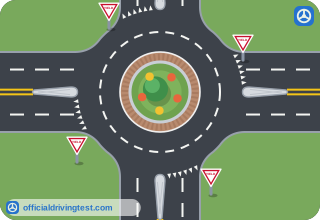
- Always use the outside lane
- Wait until you are at the yield line, then choose the faster lane
- By the lane control signs and pavement markings, before the yield line
- Follow the vehicle ahead of you
Show answer
Correct answer: By the lane control signs and pavement markings, before the yield line
Select the appropriate lane according to the lane control signs and pavement markings in advance of the yield line.
Source: Iowa Driver’s License Manual (July 2026), page 54
-
When entering a multi-lane roundabout, whom must you yield to?
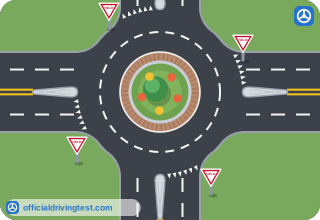
- All traffic already in the roundabout
- Only vehicles in your own lane of the roundabout
- Only vehicles that are signaling a turn
- Only trucks and buses in the roundabout
Show answer
Correct answer: All traffic already in the roundabout
When entering the roundabout, you yield to all traffic already in the roundabout.
Source: Iowa Driver’s License Manual (July 2026), page 54
-
When should you signal for a right turn to exit a multi-lane roundabout?
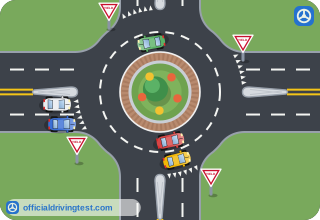
- As soon as you enter the roundabout
- Only after you have stopped at the exit
- After passing the street before your exit
- Never, because roundabout exits do not need a signal
Show answer
Correct answer: After passing the street before your exit
After passing the street before your exit, signal for a right turn, then exit.
Source: Iowa Driver’s License Manual (July 2026), page 54
-
What should you not do in a multi-lane roundabout?
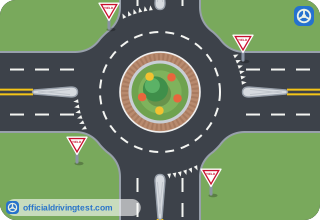
- Stay in your lane
- Change lanes
- Signal to exit
- Yield to traffic already in the roundabout
Show answer
Correct answer: Change lanes
The manual lists "Do not change lanes in the roundabout" among the things not to do.
Source: Iowa Driver’s License Manual (July 2026), page 54
-
What does driving in the outside lane of a roundabout farther than allowed do?
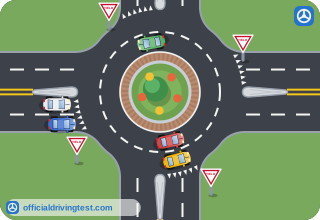
- It speeds up the flow of traffic for vehicles behind you
- It decreases the efficiency of the roundabout
- It makes the inside lane safer for exiting vehicles
- It lets vehicles exit more easily from either lane
Show answer
Correct answer: It decreases the efficiency of the roundabout
Driving farther than allowed in the outside lane decreases the efficiency of the roundabout and creates a hazard to vehicles legally exiting from the inside lane.
Source: Iowa Driver’s License Manual (July 2026), page 54
-
What is a truck apron at a roundabout designed to accommodate?
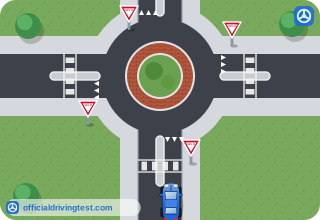
- Pedestrians who are waiting to cross the roundabout at the crosswalk
- Bicycles that are riding next to the curb around the roundabout
- Vehicles that are stopped to yield at the yield line markings
- The rear wheels of long vehicles, if needed
Show answer
Correct answer: The rear wheels of long vehicles, if needed
A truck apron is designed to accommodate the rear wheels of long vehicles such as semis, vehicles with trailers, and firetrucks if needed when navigating the roundabout.
Source: Iowa Driver’s License Manual (July 2026), page 55
-
On which kind of road are uncontrolled intersections more common?
- Interstate highways
- Divided four-lane roads
- Roundabout approaches
- Gravel roads
Show answer
Correct answer: Gravel roads
The manual states that uncontrolled intersections are more common on gravel roads.
Source: Iowa Driver’s License Manual (July 2026), page 55
-
How does the manual describe uncontrolled intersections on gravel roads?
- They have yield signs only on the narrower road
- They are not controlled by yield or stop signs
- They have a stop sign on the narrower road
- They are controlled by flashing beacons
Show answer
Correct answer: They are not controlled by yield or stop signs
The manual describes uncontrolled intersections as not controlled by yield or stop signs.
Source: Iowa Driver’s License Manual (July 2026), page 55
-
What should all drivers do at an uncontrolled intersection on a gravel road?
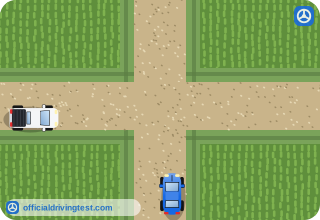
- Assume the intersection is clear unless dust is visible
- Speed up to cross before the other vehicles arrive at the intersection
- Follow the dust cloud of the vehicle ahead
- Use caution, slow down, and be prepared to stop for oncoming traffic
Show answer
Correct answer: Use caution, slow down, and be prepared to stop for oncoming traffic
All drivers should use caution, slow down, and be prepared to stop for oncoming traffic at uncontrolled intersections.
Source: Iowa Driver’s License Manual (July 2026), page 55