Iowa: Right-of-way and turning — Part 1 Practice Test
Questions in this part include: “No signs or lane markings control turning. Which lanes should you use for the turn?” · “What does staying in your own lane through a turn allow other drivers to do safely?”
Independent educational site · not affiliated with any government agency or DMV
Ready? Test yourself
- Instant feedback with an explanation
- Every answer cites its source in the manual
- Your best score is saved on this device
Questions are original and based on the official manual "Iowa Driver’s License Manual" (July 2026), Iowa Department of Transportation.
All 17 questions in this practice test
Take the test above first, then use this list to study. Tap “Show answer” to see the correct answer and explanation.
Show the questions and answersHide the questions
-
No signs or lane markings control turning. Which lanes should you use for the turn?
- Turn from the center lane into the lane that is farthest from the one you came from, whatever the traffic
- Turn from the lane closest to the direction you want to go, into the lane closest to the one you came from
- Turn from the lane that is farthest from the direction you want to go, into any lane that is open
- Turn from any lane you choose and then move into the left lane as soon as you finish the turn
Show answer
Correct answer: Turn from the lane closest to the direction you want to go, into the lane closest to the one you came from
Where nothing controls turning, you should turn from the lane closest to the direction you want to go, and into the lane closest to the one you came from.
Source: Iowa Driver’s License Manual (July 2026), page 16
-
How should you go from one lane to the other when making a turn?
- As directly as possible, without crossing lane lines or interfering with traffic
- By crossing into the far lane before the turn begins, then straightening out
- By swinging wide, then cutting across the lane lines when it is clear
- By changing lanes in the middle of the turn whenever there is room
Show answer
Correct answer: As directly as possible, without crossing lane lines or interfering with traffic
When making turns, go from one lane to the other as directly as possible without crossing lane lines or interfering with traffic.
Source: Iowa Driver’s License Manual (July 2026), page 16
-
When may you change to another lane when making a turn?
- While you are in the middle of the turn
- Only at the next intersection
- Once you have completed your turn
- Only after you have stopped and checked
Show answer
Correct answer: Once you have completed your turn
Once you have completed your turn, you can change to another lane if you need to.
Source: Iowa Driver’s License Manual (July 2026), page 16
-
What does staying in your own lane through a turn allow other drivers to do safely?
- Pass on the shoulder
- Turn right on red
- Make a U-turn
- Change lanes inside the intersection
Show answer
Correct answer: Turn right on red
Staying in your lane allows others to safely turn right on red.
Source: Iowa Driver’s License Manual (July 2026), page 16
-
What will staying in your own lane through a turn prevent?
- Collisions with pedestrians in the crosswalk
- Collisions with traffic going straight ahead
- Collisions with vehicles on the shoulder
- Collisions with traffic turning left
Show answer
Correct answer: Collisions with traffic turning left
Staying in your lane will prevent collisions with traffic turning left.
Source: Iowa Driver’s License Manual (July 2026), page 16
-
What does the law do about the right-of-way?
- It gives the right-of-way to the driver who signals first
- It gives the right-of-way to the driver with the larger vehicle
- It gives the right-of-way to the driver who is traveling faster
- It says who must yield, but it does not give anyone the right-of-way
Show answer
Correct answer: It says who must yield, but it does not give anyone the right-of-way
The law says who must yield the right-of-way; it does not give anyone the right-of-way.
Source: Iowa Driver’s License Manual (July 2026), page 18
-
Regardless of who has the right-of-way, what should you do?
- Do everything you can to prevent striking a pedestrian or another vehicle
- Maintain your speed and sound your horn so others know to yield to you
- Stop completely at every intersection and wait for others to pass
- Move to the center of the road so that other drivers can see you
Show answer
Correct answer: Do everything you can to prevent striking a pedestrian or another vehicle
Whoever has the right-of-way, a driver should do everything possible to avoid striking a pedestrian or another vehicle.
Source: Iowa Driver’s License Manual (July 2026), page 18
-
What must you do when you want to make a right turn after stopping at a red light?
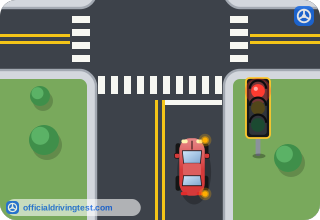
- Wait for the signal to turn green before turning
- Turn right ahead of any oncoming traffic
- Turn right without yielding because you already stopped
- Yield before you turn right
Show answer
Correct answer: Yield before you turn right
A driver who wants to turn right after stopping at a red light must yield.
Source: Iowa Driver’s License Manual (July 2026), page 19
-
Right turns on red are permitted unless what?
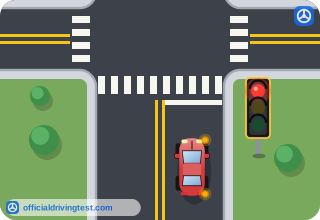
- There is a sign prohibiting them
- Another car is waiting behind you
- It is dark outside
- You are on a street with more than two lanes
Show answer
Correct answer: There is a sign prohibiting them
Right turns on red are permitted unless a sign prohibits them.
Source: Iowa Driver’s License Manual (July 2026), page 19
-
Drivers turning left must yield to which vehicles?
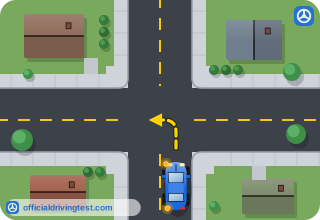
- Vehicles stopped at the stop line behind them
- Only vehicles approaching from behind
- Parked cars along the curb
- Oncoming cars that are going straight ahead
Show answer
Correct answer: Oncoming cars that are going straight ahead
Drivers turning left must yield to oncoming cars that are going straight ahead.
Source: Iowa Driver’s License Manual (July 2026), page 19
-
At an all-way stop, who gets to go first after coming to a complete stop?
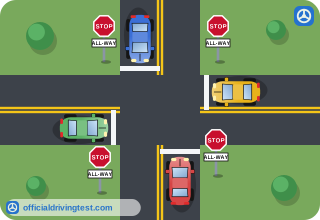
- Whoever got to the intersection before the others
- Whoever is driving the largest vehicle on the road
- Whoever is approaching at the highest speed of all
- Whoever is turning left toward the other vehicles
Show answer
Correct answer: Whoever got to the intersection before the others
At an all-way stop, the driver reaching the intersection first gets to go first, after coming to a complete stop.
Source: Iowa Driver’s License Manual (July 2026), page 19
-
Two vehicles arrive at an all-way stop at the same time. Which one gets to go first?
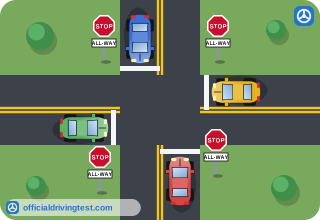
- The vehicle to the left
- The larger of the two vehicles
- The vehicle to the right
- The vehicle that is going faster
Show answer
Correct answer: The vehicle to the right
For vehicles arriving at the same time at an all-way stop, the vehicle to the right gets to go first.
Source: Iowa Driver’s License Manual (July 2026), page 19
-
Drivers entering a road from a driveway, alley, or roadside must yield to whom?
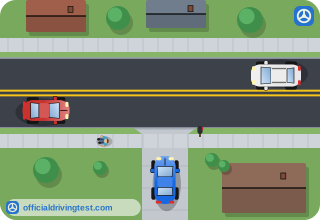
- Only vehicles approaching from the right
- Vehicles already on the main road
- Vehicles waiting to enter the road behind them
- Only larger vehicles such as trucks and buses
Show answer
Correct answer: Vehicles already on the main road
Drivers entering a road from a driveway, alley, or roadside must yield to vehicles already on the main road.
Source: Iowa Driver’s License Manual (July 2026), page 19
-
What is the responsibility of all drivers at an intersection that has no stop sign or traffic signal?
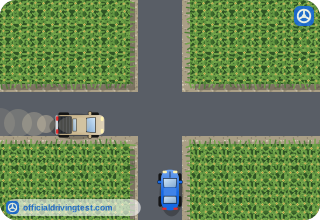
- To slow down and approach carefully
- To stop completely and wait for others to pass
- To maintain speed so that traffic keeps moving
- To flash their headlights to signal others to go ahead
Show answer
Correct answer: To slow down and approach carefully
At an intersection with no stop sign or traffic signal, all drivers must slow down and approach carefully.
Source: Iowa Driver’s License Manual (July 2026), page 19
-
Which right-of-way rules apply at an uncontrolled intersection?
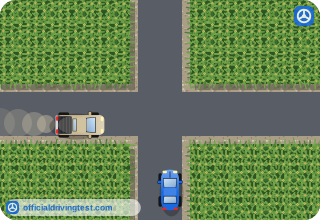
- No right-of-way rules, because there are no signs
- Only the rules for left turns and driveways
- All the rules that apply at a controlled intersection
- Only the rules for all-way stops
Show answer
Correct answer: All the rules that apply at a controlled intersection
All of the rules that apply at a controlled intersection also apply at an uncontrolled intersection.
Source: Iowa Driver’s License Manual (July 2026), page 19
-
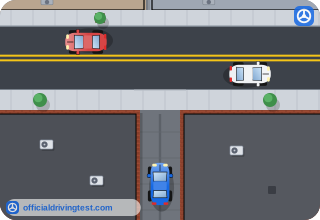
What must you always do before crossing a sidewalk when exiting a private roadway, driveway or alleyway?
- Slow to a walking pace
- Sound your horn
- Flash your headlights
- Stop
Show answer
Correct answer: Stop
The manual lists stopping before crossing a sidewalk when leaving a private roadway, driveway or alleyway as a required stop.
Source: Iowa Driver’s License Manual (July 2026), page 41
-
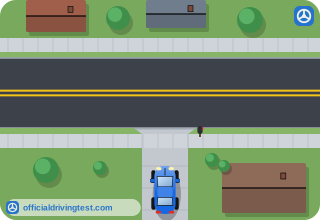
What must you always do when entering a public road from a private drive, such as a parking lot, school or gas station?
- Slow down and merge
- Stop
- Stop only if traffic is close
- Speed up to match traffic
Show answer
Correct answer: Stop
The manual lists entering a public road from a private drive, including parking lots, businesses, schools and gas stations, as a required stop.
Source: Iowa Driver’s License Manual (July 2026), page 41