Iowa: Right-of-way and turning — Part 5 Practice Test
Questions in this part include: “What do roundabouts NOT have?” · “On which kind of road are uncontrolled intersections more common?”
Independent educational site · not affiliated with any government agency or DMV
Ready? Test yourself
- Instant feedback with an explanation
- Every answer cites its source in the manual
- Your best score is saved on this device
Questions are original and based on the official manual "Iowa Driver’s License Manual" (July 2026), Iowa Department of Transportation.
All 16 questions in this practice test
Take the test above first, then use this list to study. Tap “Show answer” to see the correct answer and explanation.
Show the questions and answersHide the questions
-
What do roundabouts NOT have?
- Yield signs or directional signs
- Crosswalks or pavement markings
- A center island
- Stop signs or traffic signals
Show answer
Correct answer: Stop signs or traffic signals
Roundabouts have no stop signs or traffic signals; yield signs, directional signs, and pavement markings guide traffic.
Source: Iowa Driver’s License Manual (July 2026), page 54
-
What guides traffic through a roundabout?
- Stop signs, flashing beacons, and crosswalk guards
- Yield signs, directional signs, and pavement markings
- Traffic signals, crossing gates, and warning flashers
- Stop lines, school zone signs, and pedestrian signals
Show answer
Correct answer: Yield signs, directional signs, and pavement markings
Yield signs, directional signs, and pavement markings guide traffic through the roundabout.
Source: Iowa Driver’s License Manual (July 2026), page 54
-
How does traffic generally move in a roundabout compared with a traditional intersection?
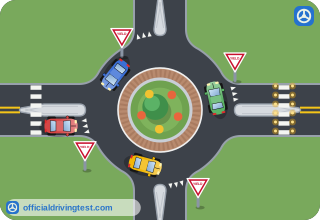
- It moves faster because there are no traffic signals
- It stops and starts in cycles
- It moves one direction at a time
- It generally continues to move, but at a slower speed
Show answer
Correct answer: It generally continues to move, but at a slower speed
Traffic generally continues to move at a slower speed, which reduces traffic backup at traditional intersections.
Source: Iowa Driver’s License Manual (July 2026), page 54
-
What should you do as you approach a single-lane roundabout?
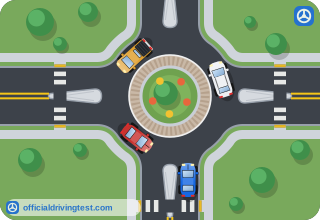
- Slow down to the posted advisory speed and yield to anyone in the crosswalk
- Maintain your speed and stop only when you reach the center island
- Stop completely before every roundabout, even when it is clear
- Move to the inside lane and speed up to merge with the traffic
Show answer
Correct answer: Slow down to the posted advisory speed and yield to anyone in the crosswalk
On approach, slow down to the posted advisory speed and yield to anyone in the crosswalk.
Source: Iowa Driver’s License Manual (July 2026), page 54
-
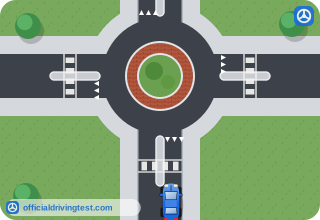
At a single-lane roundabout, how do you enter after reaching the yield line markings?
- Enter first, because traffic entering has the right-of-way over it
- Stop and let all vehicles in the roundabout wait for you to enter
- Yield to vehicles in it, wait for a gap in traffic, then merge counterclockwise
- Merge clockwise into the closest gap in the circulating traffic
Show answer
Correct answer: Yield to vehicles in it, wait for a gap in traffic, then merge counterclockwise
As you approach the yield line markings, you yield to vehicles in the roundabout, wait for a gap, and merge counterclockwise.
Source: Iowa Driver’s License Manual (July 2026), page 54
-
What should you avoid doing while proceeding through a roundabout?
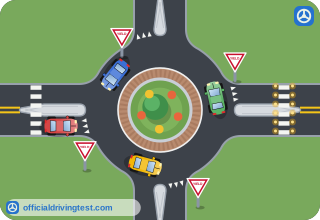
- Stopping in the roundabout
- Using your turn signal
- Continuing until you reach your street
- Yielding to a pedestrian in the crosswalk
Show answer
Correct answer: Stopping in the roundabout
After entering, continue until you reach your street and avoid stopping in the roundabout.
Source: Iowa Driver’s License Manual (July 2026), page 54
-
How should you leave a single-lane roundabout?
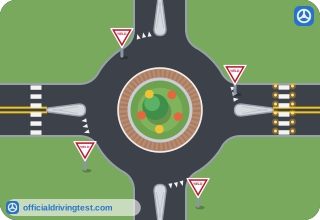
- Exit to your left after stopping at the center island
- Exit without signaling, because you are already in a lane
- Signal, then exit to your right and yield to anyone in the crosswalk
- Exit across the splitter island to avoid the crosswalk
Show answer
Correct answer: Signal, then exit to your right and yield to anyone in the crosswalk
Signal, then exit the roundabout to your right, yielding to anyone in the crosswalk.
Source: Iowa Driver’s License Manual (July 2026), page 54
-
In a multi-lane roundabout, how should you choose your lane as you approach?
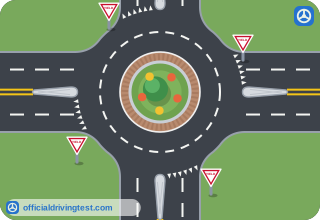
- Always use the outside lane
- Wait until you are at the yield line, then choose the faster lane
- By the lane control signs and pavement markings, before the yield line
- Follow the vehicle ahead of you
Show answer
Correct answer: By the lane control signs and pavement markings, before the yield line
Select the appropriate lane according to the lane control signs and pavement markings in advance of the yield line.
Source: Iowa Driver’s License Manual (July 2026), page 54
-
When entering a multi-lane roundabout, whom must you yield to?
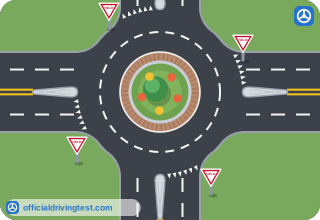
- All traffic already in the roundabout
- Only vehicles in your own lane of the roundabout
- Only vehicles that are signaling a turn
- Only trucks and buses in the roundabout
Show answer
Correct answer: All traffic already in the roundabout
When entering the roundabout, you yield to all traffic already in the roundabout.
Source: Iowa Driver’s License Manual (July 2026), page 54
-
When should you signal for a right turn to exit a multi-lane roundabout?
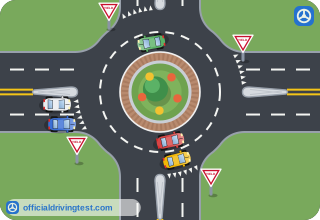
- As soon as you enter the roundabout
- Only after you have stopped at the exit
- After passing the street before your exit
- Never, because roundabout exits do not need a signal
Show answer
Correct answer: After passing the street before your exit
After passing the street before your exit, signal for a right turn, then exit.
Source: Iowa Driver’s License Manual (July 2026), page 54
-
What should you not do in a multi-lane roundabout?
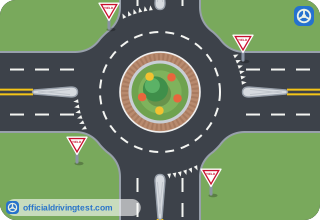
- Stay in your lane
- Change lanes
- Signal to exit
- Yield to traffic already in the roundabout
Show answer
Correct answer: Change lanes
The manual lists "Do not change lanes in the roundabout" among the things not to do.
Source: Iowa Driver’s License Manual (July 2026), page 54
-
What does driving in the outside lane of a roundabout farther than allowed do?
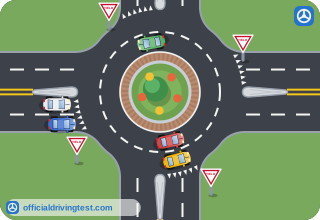
- It speeds up the flow of traffic for vehicles behind you
- It decreases the efficiency of the roundabout
- It makes the inside lane safer for exiting vehicles
- It lets vehicles exit more easily from either lane
Show answer
Correct answer: It decreases the efficiency of the roundabout
Driving farther than allowed in the outside lane decreases the efficiency of the roundabout and creates a hazard to vehicles legally exiting from the inside lane.
Source: Iowa Driver’s License Manual (July 2026), page 54
-
What is a truck apron at a roundabout designed to accommodate?
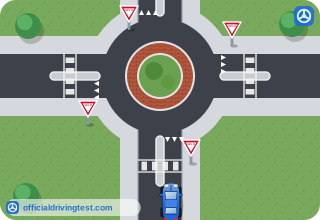
- Pedestrians who are waiting to cross the roundabout at the crosswalk
- Bicycles that are riding next to the curb around the roundabout
- Vehicles that are stopped to yield at the yield line markings
- The rear wheels of long vehicles, if needed
Show answer
Correct answer: The rear wheels of long vehicles, if needed
A truck apron is designed to accommodate the rear wheels of long vehicles such as semis, vehicles with trailers, and firetrucks if needed when navigating the roundabout.
Source: Iowa Driver’s License Manual (July 2026), page 55
-
On which kind of road are uncontrolled intersections more common?
- Interstate highways
- Divided four-lane roads
- Roundabout approaches
- Gravel roads
Show answer
Correct answer: Gravel roads
The manual states that uncontrolled intersections are more common on gravel roads.
Source: Iowa Driver’s License Manual (July 2026), page 55
-
How does the manual describe uncontrolled intersections on gravel roads?
- They have yield signs only on the narrower road
- They are not controlled by yield or stop signs
- They have a stop sign on the narrower road
- They are controlled by flashing beacons
Show answer
Correct answer: They are not controlled by yield or stop signs
The manual describes uncontrolled intersections as not controlled by yield or stop signs.
Source: Iowa Driver’s License Manual (July 2026), page 55
-
What should all drivers do at an uncontrolled intersection on a gravel road?
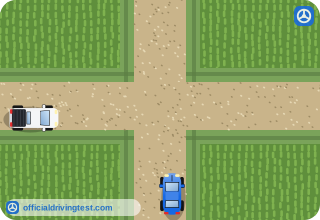
- Assume the intersection is clear unless dust is visible
- Speed up to cross before the other vehicles arrive at the intersection
- Follow the dust cloud of the vehicle ahead
- Use caution, slow down, and be prepared to stop for oncoming traffic
Show answer
Correct answer: Use caution, slow down, and be prepared to stop for oncoming traffic
All drivers should use caution, slow down, and be prepared to stop for oncoming traffic at uncontrolled intersections.
Source: Iowa Driver’s License Manual (July 2026), page 55