Iowa: Right-of-way and turning — Part 2 Practice Test
Questions in this part include: “Which of these requires you to stop?” · “When may you also make a left turn at a red light?”
Independent educational site · not affiliated with any government agency or DMV
Ready? Test yourself
- Instant feedback with an explanation
- Every answer cites its source in the manual
- Your best score is saved on this device
Questions are original and based on the official manual "Iowa Driver’s License Manual" (July 2026), Iowa Department of Transportation.
All 17 questions in this practice test
Take the test above first, then use this list to study. Tap “Show answer” to see the correct answer and explanation.
Show the questions and answersHide the questions
-
Which of these requires you to stop?
- A bicyclist riding in the next lane
- A car behind you with its turn signal on
- A request from any law officer
- A parked car with its hazard lights on
Show answer
Correct answer: A request from any law officer
The manual says you must always stop at the request of any law officer.
Source: Iowa Driver’s License Manual (July 2026), page 41
-
What does the manual say about last minute sharp turns?
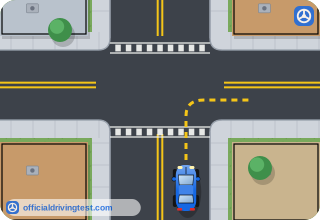
- They are dangerous and should be avoided
- They are safe if you signal
- They are acceptable on residential streets
- They are the best way to avoid a missed turn
Show answer
Correct answer: They are dangerous and should be avoided
Last minute sharp turns are dangerous and should be avoided, so plan your turns ahead of time.
Source: Iowa Driver’s License Manual (July 2026), page 43
-
Which actions increase your chances of being in a crash when turning?
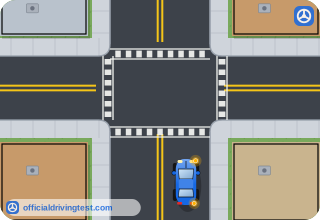
- Cutting corners and swinging wide
- Slowing down before the turn
- Watching for pedestrians and other vehicles
- Deciding where you want to be when the turn is done
Show answer
Correct answer: Cutting corners and swinging wide
The manual says that cutting corners and swinging wide on turns increase your chances of being in a crash.
Source: Iowa Driver’s License Manual (July 2026), page 43
-
At a traffic signal, when may you NOT make a right turn at a red light?
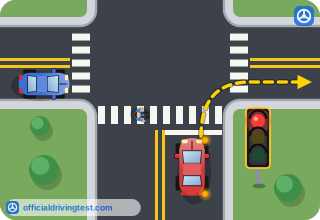
- When another vehicle is behind you
- When it is raining
- When you are in the right lane
- When there is a “NO TURN ON RED” sign
Show answer
Correct answer: When there is a “NO TURN ON RED” sign
You may make a right turn at a red light unless there is a “NO TURN ON RED” sign.
Source: Iowa Driver’s License Manual (July 2026), page 43
-
Before turning right at a red light, what must you do?
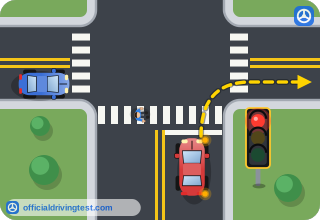
- Stop completely and yield to all traffic
- Slow down and yield only to pedestrians
- Come to a rolling stop if no one is near
- Stop only if another vehicle is approaching
Show answer
Correct answer: Stop completely and yield to all traffic
Prior to safely turning, you must come to a complete stop and yield to all other traffic.
Source: Iowa Driver’s License Manual (July 2026), page 43
-
When may you also make a left turn at a red light?
- When turning from any lane of a two-way street
- When turning from a one-way street onto a two-way street
- From the left lane of a one-way street onto another one-way street
- When no other vehicle is in sight
Show answer
Correct answer: From the left lane of a one-way street onto another one-way street
You may make a left turn at a red light if you are turning from the left lane of a one-way street onto another one-way street.
Source: Iowa Driver’s License Manual (July 2026), page 43
-
Where should U-turns be performed?
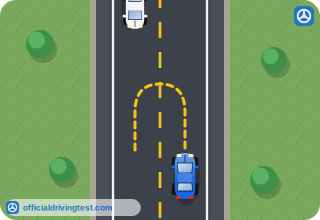
- Anywhere there is no oncoming traffic
- Only at intersections with a traffic signal
- Anywhere on a road with a single lane each way
- Only where they are not prohibited and where it is safe
Show answer
Correct answer: Only where they are not prohibited and where it is safe
U-turns should only be performed where their use is not prohibited and where it is safe to do so.
Source: Iowa Driver’s License Manual (July 2026), page 43
-
What does the manual say is better than making a three-point turn?
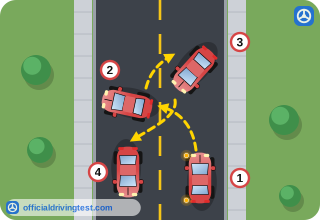
- Back into the nearest driveway
- Proceed to the nearest intersection
- Stop and wait for traffic to clear
- Turn around in the middle of the block
Show answer
Correct answer: Proceed to the nearest intersection
Three-point turns are generally not a safe maneuver and can increase your risk and exposure to collisions, so it is better to proceed to the nearest intersection.
Source: Iowa Driver’s License Manual (July 2026), page 43
-
Which of these is a lane change according to the manual?
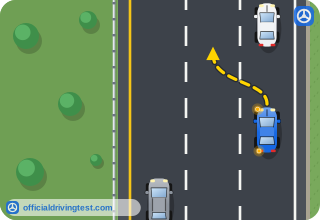
- Slowing down in your own lane
- Driving through an intersection in your lane
- Entering the roadway from the curb or shoulder
- Following a curve while staying in your lane
Show answer
Correct answer: Entering the roadway from the curb or shoulder
Lane changes include changing from one lane to another, merging from an entrance ramp, and entering the roadway from the curb or shoulder.
Source: Iowa Driver’s License Manual (July 2026), page 44
-
How many lanes should you change at a time?
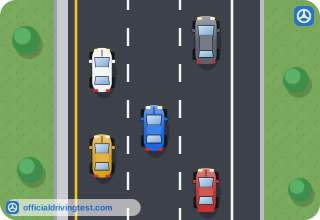
- One lane at a time
- Two lanes at a time
- As many as you need when the road is clear
- Two lanes when traffic is slow
Show answer
Correct answer: One lane at a time
The manual says to only change lanes one lane at a time.
Source: Iowa Driver’s License Manual (July 2026), page 44
-
Before changing lanes, you must confirm there is space to safely enter the lane and yield to whom?
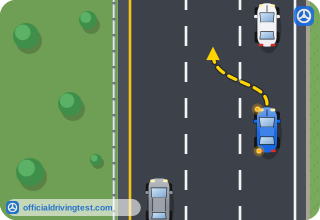
- Any vehicles already in that lane
- Vehicles in the lane you are leaving
- Only vehicles that are signaling
- Only vehicles that are traveling faster
Show answer
Correct answer: Any vehicles already in that lane
You must confirm there is space to safely enter the lane and yield to any vehicles already in that lane.
Source: Iowa Driver’s License Manual (July 2026), page 44
-
When changing lanes, when should you slow down?
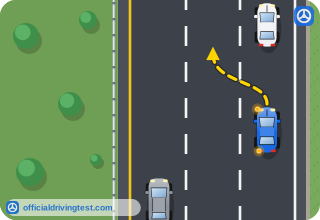
- Always, to be safe
- Never, whatever the traffic
- Only when moving into a slower lane
- Only when the other lane is empty
Show answer
Correct answer: Only when moving into a slower lane
Make the lane change carefully but without slowing down unless you are moving into a slower lane of traffic.
Source: Iowa Driver’s License Manual (July 2026), page 44
-
While you are changing lanes, what should you constantly do?
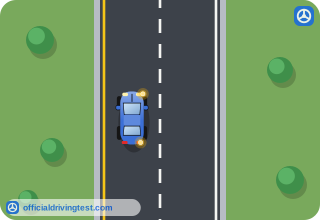
- Look only at the mirror in the new lane
- Check traffic
- Watch your speedometer
- Keep your eyes on the vehicle ahead only
Show answer
Correct answer: Check traffic
While changing lanes you constantly check traffic so you will see anyone coming up on you unexpectedly.
Source: Iowa Driver’s License Manual (July 2026), page 44
-
When you check your mirrors before a lane change, which two things should you make sure of?
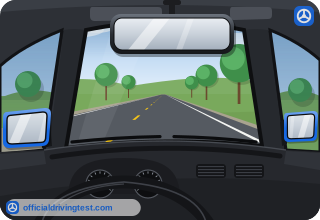
- Your signal is off and nobody is behind you
- The lane you are leaving is clear and your speed is steady
- Your mirrors are clean and the road is dry
- No vehicles in the lane you want to enter, nobody about to pass
Show answer
Correct answer: No vehicles in the lane you want to enter, nobody about to pass
Look in your rearview and side mirrors to make sure there are no vehicles in the lane you want to enter and nobody is about to pass you.
Source: Iowa Driver’s License Manual (July 2026), page 44
-
How should you check your blind spots before changing lanes?
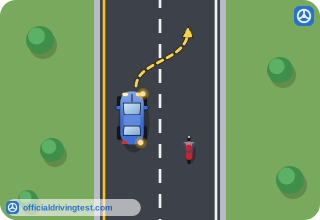
- Look over the shoulder opposite to the direction you plan to move
- Look only in the rearview mirror
- Look over your shoulder in the direction you plan to move
- Look only at the side mirror on that side
Show answer
Correct answer: Look over your shoulder in the direction you plan to move
Look over your shoulder in the direction you plan to move and be sure no one is near the rear corners of your vehicle.
Source: Iowa Driver’s License Manual (July 2026), page 44
-
When you turn your head to check your blind spots, what should you make sure of?
- You keep the steering wheel straight
- You slow down to half speed
- You turn the wheel slightly toward the lane
- You keep one hand off the wheel
Show answer
Correct answer: You keep the steering wheel straight
People have a natural tendency to turn their arms in the same direction as their head, so you keep the steering wheel straight.
Source: Iowa Driver’s License Manual (July 2026), page 44
-
Why should you check the far lane, if there is one, before changing lanes?
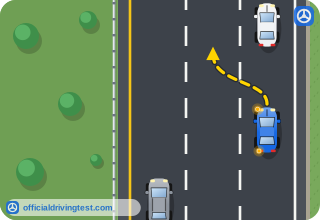
- That lane is always the fastest
- Vehicles in that lane are required to yield to you
- That lane shows how much traffic is ahead
- Someone there may plan to move into the same lane
Show answer
Correct answer: Someone there may plan to move into the same lane
Someone in the far lane may be planning to move into the same lane you want to enter.
Source: Iowa Driver’s License Manual (July 2026), page 44