Iowa: Right-of-way and turning — Part 3 Practice Test
Questions in this part include: “Where should you avoid passing because a vehicle may enter the roadway ahead of you?” · “Which of these does the manual include in its list of intersections?”
Independent educational site · not affiliated with any government agency or DMV
Ready? Test yourself
- Instant feedback with an explanation
- Every answer cites its source in the manual
- Your best score is saved on this device
Questions are original and based on the official manual "Iowa Driver’s License Manual" (July 2026), Iowa Department of Transportation.
All 17 questions in this practice test
Take the test above first, then use this list to study. Tap “Show answer” to see the correct answer and explanation.
Show the questions and answersHide the questions
-
Under what conditions may you pass another vehicle?
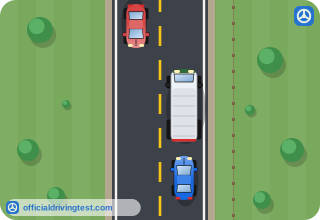
- Only when signs or road markings permit it and you have enough room to pass safely
- Whenever the vehicle ahead is traveling below the posted speed limit
- Whenever you have signaled and the passing lane ahead looks empty
- Whenever no oncoming vehicle is in sight, whatever the road markings say
Show answer
Correct answer: Only when signs or road markings permit it and you have enough room to pass safely
The manual says to pass only when signs or road markings permit it and you have determined there is enough room to pass safely.
Source: Iowa Driver’s License Manual (July 2026), page 45
-
As a rule, how many vehicles should you pass at one time?
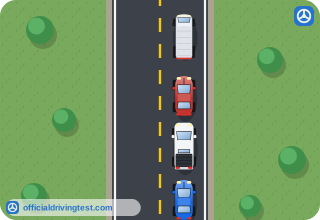
- Two vehicles
- Three vehicles
- One vehicle
- As many as the passing lane has room for
Show answer
Correct answer: One vehicle
The manual says that, as a rule, you should only pass one vehicle at a time.
Source: Iowa Driver’s License Manual (July 2026), page 45
-
Where should you avoid passing because a vehicle may enter the roadway ahead of you?
- On a multilane road with broken white lane lines
- At intersections and driveways
- On a long straight stretch with a wide shoulder
- In the lane next to a vehicle that is slowing down
Show answer
Correct answer: At intersections and driveways
The manual tells drivers to avoid passing in places where a vehicle may enter the roadway ahead of them, such as intersections and driveways.
Source: Iowa Driver’s License Manual (July 2026), page 45
-
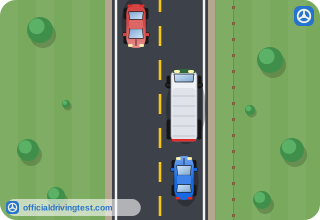
When passing is necessary, what is the first step the manual lists?
- Move to the left edge of your lane and sound your horn
- Brake gently so you can see around the vehicle ahead
- Speed up to close the gap behind the vehicle ahead
- Check the passing lane ahead for plenty of space
Show answer
Correct answer: Check the passing lane ahead for plenty of space
The first step is to check the passing lane ahead to make sure there is plenty of space before you try to pass.
Source: Iowa Driver’s License Manual (July 2026), page 45
-
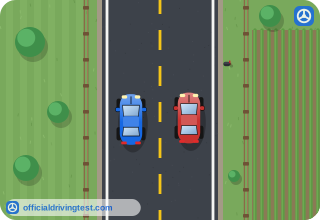
While you are passing, what should you monitor?
- Only the space in front of you, so your eyes stay on the road ahead
- Only the vehicle you are passing, so you can stay even with its driver
- Only the oncoming lane, so you can judge when a gap will close
- The space in front of and behind your vehicle, checking the rearview mirror
Show answer
Correct answer: The space in front of and behind your vehicle, checking the rearview mirror
While passing, you should monitor the space in front of and behind your vehicle and check the rearview mirror.
Source: Iowa Driver’s License Manual (July 2026), page 45
-
When may you move back into your original lane after passing?
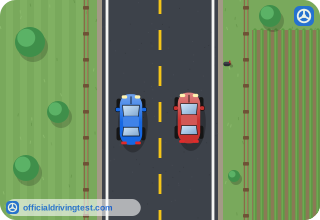
- As soon as your front bumper is even with the back bumper of the passed car
- When you see the front of the passed car in your rearview mirror and are well clear
- As soon as the driver you are passing flashes headlights to let you in
- After you have driven at least one full minute in the passing lane
Show answer
Correct answer: When you see the front of the passed car in your rearview mirror and are well clear
You return to the original lane when you can see the front of the passed car in the rearview mirror and your vehicle is well clear.
Source: Iowa Driver’s License Manual (July 2026), page 45
-
After you have moved back into your original lane following a pass, what should you do with your signal and speed?
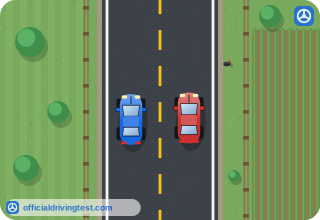
- Leave the signal on for several seconds and keep accelerating
- Cancel the signal and slow down below the passed car's speed
- Cancel the signal and return to a safe speed
- Leave the signal on until you reach the next turn
Show answer
Correct answer: Cancel the signal and return to a safe speed
After moving back gently and slowly, you cancel the signal and return to a safe speed.
Source: Iowa Driver’s License Manual (July 2026), page 45
-
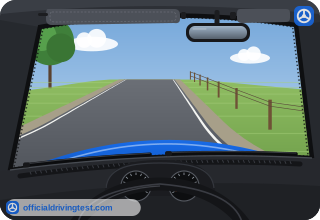
You are approaching the top of a hill on a two-lane road. May you pass?
- Yes, if you signal first and no oncoming vehicle is visible
- Yes, if you are passing only one slow vehicle
- Yes, if the road markings show a broken line
- No, passing when approaching the top of a hill is illegal
Show answer
Correct answer: No, passing when approaching the top of a hill is illegal
The manual lists approaching the top of a hill as a situation where passing is illegal.
Source: Iowa Driver’s License Manual (July 2026), page 46
-
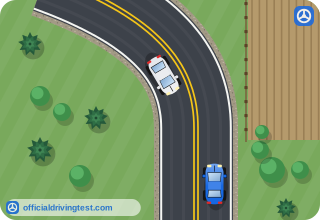
Passing while going around a curve is illegal in which situation?
- When another vehicle is following right behind you
- When your view along the roadway is obstructed
- When the road surface is wet from rain or snow
- When the vehicle you are passing is a large truck
Show answer
Correct answer: When your view along the roadway is obstructed
Do not pass going around a curve when your view along the roadway is obstructed.
Source: Iowa Driver’s License Manual (July 2026), page 46
-
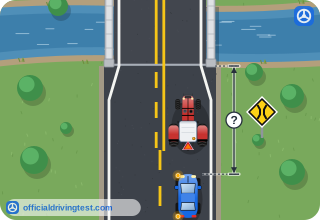
How close to a narrow bridge, viaduct, or tunnel that has a sign posted is passing illegal?
- Within 25 feet
- Within 200 feet
- Within 100 feet
- Within 300 feet
Show answer
Correct answer: Within 100 feet
Do not pass within 100 feet of a narrow bridge, viaduct, or tunnel that has a sign posted.
Source: Iowa Driver’s License Manual (July 2026), page 46
-
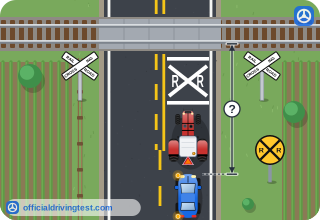
How close to a railroad crossing is passing illegal?
- Within 100 feet
- Within 25 feet
- Within 200 feet
- Within 500 feet
Show answer
Correct answer: Within 100 feet
Do not pass within 100 feet of a railroad crossing.
Source: Iowa Driver’s License Manual (July 2026), page 46
-
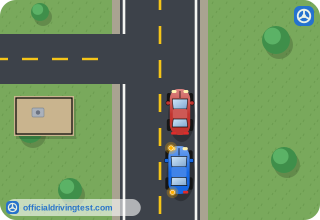
How close to an intersection is passing illegal?
- Within 100 feet
- Within 50 feet
- Within 150 feet
- Within 300 feet
Show answer
Correct answer: Within 100 feet
Do not pass within 100 feet of an intersection.
Source: Iowa Driver’s License Manual (July 2026), page 46
-
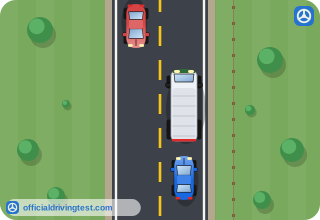
On which side of another vehicle must you not pass?
- On the left, where the road markings permit passing
- On the left, once you have checked your blind spots
- On the right
- On the left, with your turn signal on
Show answer
Correct answer: On the right
The manual lists passing on the right as illegal: do not pass on the right.
Source: Iowa Driver’s License Manual (July 2026), page 46
-
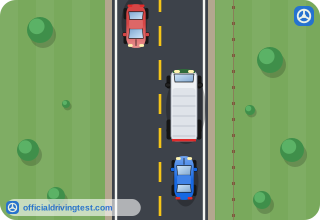
When is passing illegal because of oncoming traffic?
- When any oncoming vehicle is visible, however far away
- When oncoming traffic is so close it would be dangerous to try
- When the oncoming driver has headlights on
- When oncoming traffic is traveling faster than you are
Show answer
Correct answer: When oncoming traffic is so close it would be dangerous to try
Do not pass when oncoming traffic is so close it would be dangerous to try to make it around the vehicle you are passing.
Source: Iowa Driver’s License Manual (July 2026), page 46
-
What should you assume about drivers approaching red lights and stop signs?
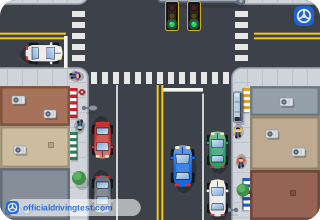
- That some will run through them, so be prepared to react
- That they will stop because the law requires it
- That they will always stop when they see your vehicle
- That they will stop if you flash your headlights at them
Show answer
Correct answer: That some will run through them, so be prepared to react
The manual says to assume that drivers will run through red lights or stop signs and to be prepared to react.
Source: Iowa Driver’s License Manual (July 2026), page 47
-
According to the manual, what is an intersection?
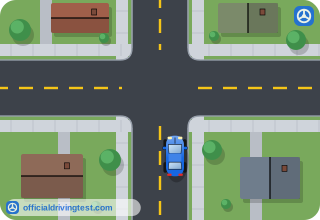
- Any place where traffic merges or crosses
- Only a place where two public streets meet at a traffic signal
- Only a roadway with a stop sign or yield sign on every approach
- Only a place where two paved roads cross at right angles
Show answer
Correct answer: Any place where traffic merges or crosses
The manual defines intersections as any place where traffic merges or crosses.
Source: Iowa Driver’s License Manual (July 2026), page 50
-
Which of these does the manual include in its list of intersections?
- A freeway shoulder
- A bridge with no side roads
- A parking lot
- A straight stretch of interstate
Show answer
Correct answer: A parking lot
The manual's list of intersections includes cross streets, side streets, driveways, parking lots, and roadways open to public travel.
Source: Iowa Driver’s License Manual (July 2026), page 50