Iowa: Right-of-way and turning — Part 4 Practice Test
Questions in this part include: “Which group of items does the manual list as traffic control devices at an intersection?” · “What is unusual about the design of a diverging diamond interchange?”
Independent educational site · not affiliated with any government agency or DMV
Ready? Test yourself
- Instant feedback with an explanation
- Every answer cites its source in the manual
- Your best score is saved on this device
Questions are original and based on the official manual "Iowa Driver’s License Manual" (July 2026), Iowa Department of Transportation.
All 17 questions in this practice test
Take the test above first, then use this list to study. Tap “Show answer” to see the correct answer and explanation.
Show the questions and answersHide the questions
-
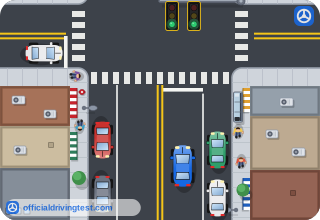
What is Step 1 before you enter an intersection?
- Speed up so you clear the intersection before other traffic arrives
- Look ahead to identify the type of intersection and any traffic control devices
- Move toward the center of the roadway to see around parked vehicles
- Turn on your high beams so approaching drivers notice you
Show answer
Correct answer: Look ahead to identify the type of intersection and any traffic control devices
Before entering, you look ahead to identify the type of intersection and the traffic control devices that apply.
Source: Iowa Driver’s License Manual (July 2026), page 50
-
Which group of items does the manual list as traffic control devices at an intersection?
- Signs, crossing gates, and brake lights
- Traffic signals, horns, and speed limit tables
- Pavement markings, mirrors, and turn signals
- Signs, traffic signals, and pavement markings
Show answer
Correct answer: Signs, traffic signals, and pavement markings
The manual names signs, traffic signals, and pavement markings as the traffic control devices to identify before entering an intersection.
Source: Iowa Driver’s License Manual (July 2026), page 50
-
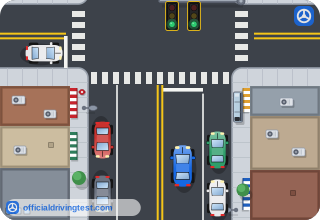
What is the purpose of Step 2, scanning the intersection before you proceed?
- To find the nearest place to stop in the intersection
- To ensure the path is clear through the intersection
- To count how many vehicles are waiting behind you
- To decide which lane has the shortest wait
Show answer
Correct answer: To ensure the path is clear through the intersection
Step 2 tells you to scan the intersection before proceeding to ensure the path is clear through the intersection.
Source: Iowa Driver’s License Manual (July 2026), page 50
-
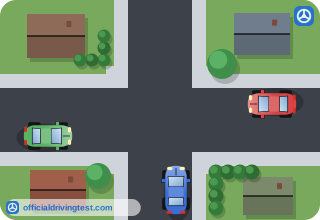
In which order should you look for approaching vehicles and pedestrians at an intersection?
- Right, left, and right again
- Straight ahead, then left only
- Left, then right only once
- Left, right, and left again
Show answer
Correct answer: Left, right, and left again
Step 3 says to look left, right, and left again for approaching vehicles and pedestrians.
Source: Iowa Driver’s License Manual (July 2026), page 50
-
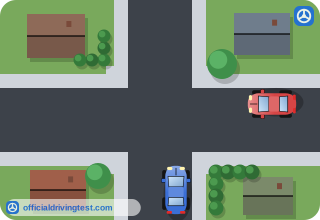
What should you never assume at an intersection?
- That another driver will share space with you or give you space
- That a traffic signal will change within a few seconds
- That pavement markings are present on every road
- That pedestrians will use the crosswalk
Show answer
Correct answer: That another driver will share space with you or give you space
The manual says never to assume another driver will share space with you or give you space.
Source: Iowa Driver’s License Manual (July 2026), page 50
-
An approaching vehicle has its turn signal on while you wait to turn. What should you do?
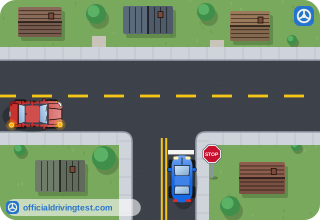
- Turn at once, because the signal shows the driver will turn
- Flash your headlights and then proceed ahead of the vehicle
- Wait until the other driver starts to turn, then proceed if it is safe
- Proceed only if the vehicle is a passenger car
Show answer
Correct answer: Wait until the other driver starts to turn, then proceed if it is safe
Do not turn just because an approaching vehicle has a turn signal on; wait until the driver actually starts to turn, then go if it is safe.
Source: Iowa Driver’s License Manual (July 2026), page 50
-
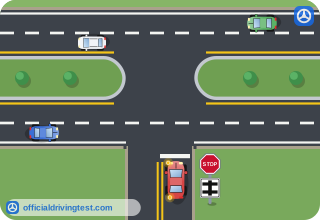
You are at a stop sign on a rural four-lane road with a median. How should you cross it?
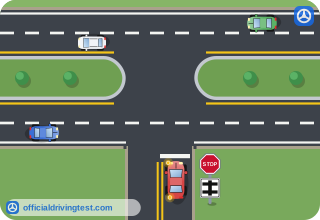
- Wait until both directions are clear, then cross all four lanes at once
- Enter the median without stopping at the stop sign
- Cross one direction of traffic at a time and stop in the median
- Stop in the median only if a vehicle is approaching from the right
Show answer
Correct answer: Cross one direction of traffic at a time and stop in the median
The manual says not to try to cross both directions of traffic at one time, and to stop in the median instead.
Source: Iowa Driver’s License Manual (July 2026), page 51
-
Crossing a rural four-lane road with a median, which direction do you look first after stopping at the stop sign?
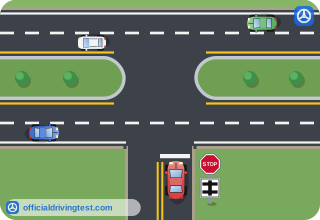
- Right
- Left
- Straight ahead only
- Behind you
Show answer
Correct answer: Left
Step 1 says to stop at the stop sign, look left, and proceed into the median when it is safe.
Source: Iowa Driver’s License Manual (July 2026), page 51
-
After you proceed into the median of a rural four-lane road, what should you do?
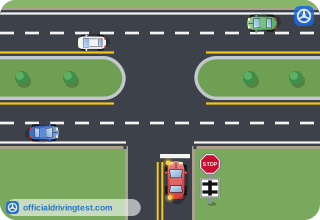
- Continue across without stopping to avoid blocking traffic
- Look left again and then accelerate quickly
- Turn on your hazard lights and wait for a signal
- Remain stopped, look right, and cross or turn left when it is safe
Show answer
Correct answer: Remain stopped, look right, and cross or turn left when it is safe
Step 2 says to remain stopped in the median, look right, and cross or turn left when it is safe to do so.
Source: Iowa Driver’s License Manual (July 2026), page 51
-
Why must you be careful about stopping in the median when crossing a rural four-lane road?
- Medians on rural roads are always too narrow for any vehicle to stop in
- Longer vehicles, such as semis, may not be able to stop in a narrow median
- Stopping in the median is against the law for all types of vehicles
- Traffic on the road stops completely when a vehicle enters the median
Show answer
Correct answer: Longer vehicles, such as semis, may not be able to stop in a narrow median
The manual warns that longer vehicles, such as semis, may not be able to stop in the median if it is narrow.
Source: Iowa Driver’s License Manual (July 2026), page 51
-
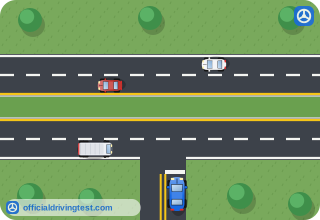
What are reduced-conflict intersections designed to do?
- Add traffic signals at every side road so vehicles can cross safely
- Reduce the number of conflict points where vehicles can crash into each other
- Stop all traffic on the highway at once so side roads can cross
- Give side-road drivers the right-of-way over all highway traffic
Show answer
Correct answer: Reduce the number of conflict points where vehicles can crash into each other
Reduced-conflict intersections are designed to reduce the number of conflict points where vehicles can crash into each other.
Source: Iowa Driver’s License Manual (July 2026), page 52
-
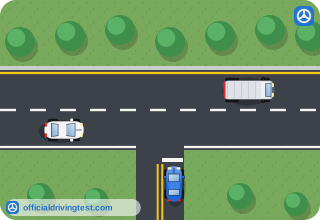
At a reduced-conflict intersection, what does a side-road driver who wants to turn left or cross the four-lane highway do?
- Stop in the median and cross both directions of the highway at one time
- Turn left directly across both directions of traffic
- Wait for a gap in both directions of highway traffic and then cross
- Turn right, merge into the left lane, and make a U-turn at a median opening
Show answer
Correct answer: Turn right, merge into the left lane, and make a U-turn at a median opening
Side-road drivers turn right onto the highway, merge into the left lane, and then make a U-turn at a designated median opening.
Source: Iowa Driver’s License Manual (July 2026), page 52
-
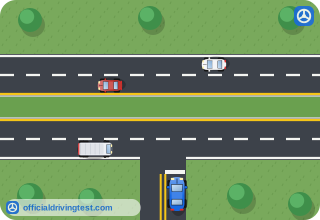
Why do reduced-conflict intersections improve safety?
- They remove every vehicle from the side road so it is never used
- Drivers are only concerned with one direction of highway traffic at a time
- They require every driver to stop on the highway before turning
- They keep drivers from entering the highway from a side road at all
Show answer
Correct answer: Drivers are only concerned with one direction of highway traffic at a time
Drivers only have to watch one direction of traffic on the highway at a time, and they do not need a gap in both directions.
Source: Iowa Driver’s License Manual (July 2026), page 52
-
Where is a diverging diamond interchange used?
- Only on low-volume rural roads outside of cities
- At the end of every on-ramp
- Only where a railroad crosses a highway
- At the intersection of two high-volume traffic roads
Show answer
Correct answer: At the intersection of two high-volume traffic roads
The manual says this type of interchange is used at the intersection of two high-volume traffic roads.
Source: Iowa Driver’s License Manual (July 2026), page 53
-
What is unusual about the design of a diverging diamond interchange?
- It briefly directs drivers to the opposite side of the road
- It sends all traffic around a center island in a counterclockwise direction
- It has no traffic signals and uses only yield signs
- It turns all left turns into U-turns at a median opening
Show answer
Correct answer: It briefly directs drivers to the opposite side of the road
The design is unusual because it directs drivers on the opposite side of the road briefly before diverging back into the correct direction.
Source: Iowa Driver’s License Manual (July 2026), page 53
-
How does a diverging diamond interchange maximize efficiency?
- Traffic never has to stop for any traffic signal along the route
- Traffic is limited to one direction at a time on each road
- Traffic spends less time at a traditional traffic light intersection
- Traffic is moved onto the shoulder to bypass waiting vehicles
Show answer
Correct answer: Traffic spends less time at a traditional traffic light intersection
The manual says it maximizes efficiency by requiring traffic to spend less time at a traditional traffic light controlled intersection.
Source: Iowa Driver’s License Manual (July 2026), page 53
-
In which direction does traffic move around a roundabout?
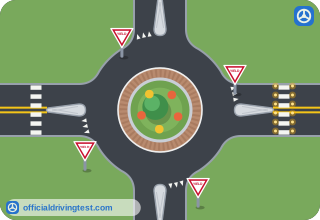
- Clockwise
- Counterclockwise
- Toward the outside lane only
- In whichever direction is shortest
Show answer
Correct answer: Counterclockwise
Roundabouts direct traffic in a counterclockwise direction around a center island.
Source: Iowa Driver’s License Manual (July 2026), page 54