Indiana: Sharing the road
Tractor-trailers and their no-zones, motorcycles, bicycles, school buses, farm machinery and horse-drawn vehicles. Split into 4 shorter tests so you're not stuck in one long quiz.
Independent educational site · not affiliated with any government agency or DMV
Choose a part
Sharing the road — Part 1
Questions in this part include: “What does a slow-moving vehicle emblem look like?”
StartSharing the road — Part 2
Questions in this part include: “What is the maximum weight of a vehicle that may be operated without a special permit?”
StartSharing the road — Part 3
Questions in this part include: “Because of its large size, how does a tractor-trailer often appear?”
StartSharing the road — Part 4
Questions in this part include: “Except on paths or roadways set aside for bicycles, how many bicyclists may ride abreast?”
StartAll 71 Sharing the road questions with answers
Choose a part above to take a practice test, or study every question and answer here.
Show the questions and answersHide the questions
-
A slow-moving vehicle emblem indicates a slow-moving vehicle that cannot exceed what speed?
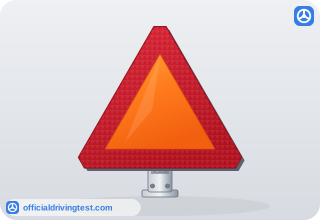
- 25 miles per hour
- 15 miles per hour
- 35 miles per hour
- 45 miles per hour
Show answer
Correct answer: 25 miles per hour
The manual says the emblem indicates a slow-moving vehicle which cannot exceed 25 miles per hour.
Source: Indiana Driver’s Manual (July 2026), page 30 · Open this page in the manual (Manual page 30)
-
What does a slow-moving vehicle emblem look like?
- A yellow center with thick black reflective borders
- A white center with wide blue reflective borders
- An orange, fluorescent center with red reflective borders
- A fluorescent red center with white reflective borders
Show answer
Correct answer: An orange, fluorescent center with red reflective borders
The manual describes the emblem as having an orange, fluorescent center and red reflective borders.
Source: Indiana Driver’s Manual (July 2026), page 30 · Open this page in the manual (Manual page 30)
-
How many lanes should you change at a time?
- Two lanes if the road ahead is clear
- As many as needed to reach your exit
- Two lanes if you use your signal
- Only one lane at a time
Show answer
Correct answer: Only one lane at a time
The manual says to change only one lane at a time.
Source: Indiana Driver’s Manual (July 2026), page 37 · Open this page in the manual (Manual page 37)
-
What greatly increases your risk of an accident when you drive on a multi-lane road?
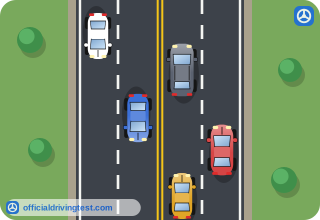
- Weaving in and out of lanes
- Signaling before each lane change
- Changing lanes only one at a time
- Checking your mirrors before moving
Show answer
Correct answer: Weaving in and out of lanes
The manual warns that weaving in and out of lanes will greatly increase your risk of an accident.
Source: Indiana Driver’s Manual (July 2026), page 37 · Open this page in the manual (Manual page 37)
-
When you are changing lanes, what should you briefly do to make sure no vehicle is in your blind spot?
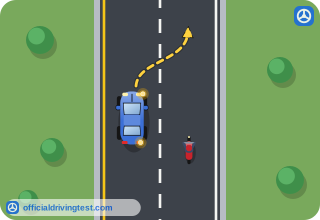
- Rely only on the view in your side mirror and your signal
- Turn your head toward the lane you are entering
- Tap your horn to warn the driver who is beside you
- Slow down and flash your headlights at that driver
Show answer
Correct answer: Turn your head toward the lane you are entering
The manual says to briefly turn your head toward the lane you are entering to check your blind spot.
Source: Indiana Driver’s Manual (July 2026), page 37 · Open this page in the manual (Manual page 37)
-
When you are changing lanes, what should you check your mirrors for?
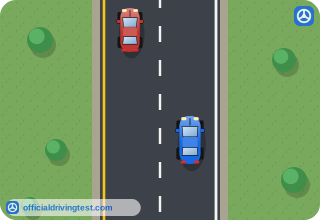
- Vehicles parked on the shoulder ahead
- Pedestrians waiting to cross the road
- Signs that mark the end of the lane
- Vehicles that are preparing to pass you
Show answer
Correct answer: Vehicles that are preparing to pass you
The manual says to check your mirrors for any vehicles that are preparing to pass you.
Source: Indiana Driver’s Manual (July 2026), page 37 · Open this page in the manual (Manual page 37)
-
Before you change lanes, what must be true of the lane you want to enter?
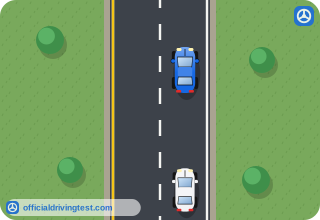
- There is no traffic ahead of you in that lane
- It has a broken white line on both sides
- It is the lane closest to the center line
- It is free of vehicles for the next mile
Show answer
Correct answer: There is no traffic ahead of you in that lane
The manual says to make sure there is no traffic ahead of you in the lane you would like to enter.
Source: Indiana Driver’s Manual (July 2026), page 37 · Open this page in the manual (Manual page 37)
-
When you pass another vehicle, you must return to the right side of the road no less than how far before any oncoming vehicle?
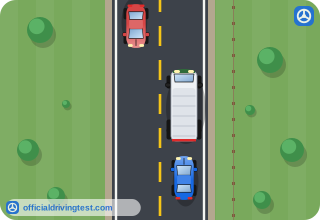
- 50 feet
- 100 feet
- 200 feet
- 500 feet
Show answer
Correct answer: 100 feet
The manual says you must return to the right side of the road no less than 100 feet before any oncoming vehicle.
Source: Indiana Driver’s Manual (July 2026), page 38 · Open this page in the manual (Manual page 38)
-
Before you pass another vehicle, what should you check behind and to the left of your vehicle?
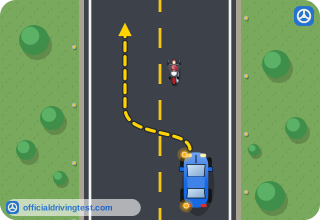
- That the vehicle ahead has its brake lights on
- That no pedestrians are in the crosswalk
- That your hazard lights are working
- That another vehicle is not attempting to pass you
Show answer
Correct answer: That another vehicle is not attempting to pass you
The manual says to check behind and to the left to make sure another vehicle is not attempting to pass you.
Source: Indiana Driver’s Manual (July 2026), page 38 · Open this page in the manual (Manual page 38)
-
When passing, how long should you accelerate and continue to move forward in the passing lane?
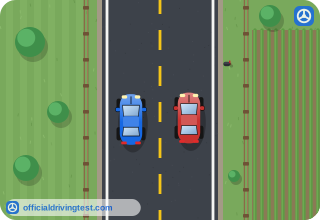
- Until you can see the vehicle you are passing in your rearview mirror
- Until you have driven past the next intersection ahead of you
- Until the vehicle you are passing begins to slow down and move over
- Until the oncoming lane is completely clear of all other traffic
Show answer
Correct answer: Until you can see the vehicle you are passing in your rearview mirror
The manual says to continue forward until you can see the vehicle you are passing in your rearview mirror.
Source: Indiana Driver’s Manual (July 2026), page 38 · Open this page in the manual (Manual page 38)
-
Passing is dangerous and illegal when which line is marked on the driver’s side of the center line of the road?
- A broken yellow line
- A solid yellow line
- A broken white line
- A solid white edge line
Show answer
Correct answer: A solid yellow line
The manual lists a solid yellow line on the driver’s side of the center line as a situation where passing is prohibited.
Source: Indiana Driver’s Manual (July 2026), page 38 · Open this page in the manual (Manual page 38)
-
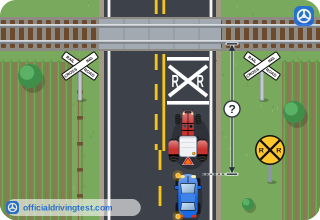
Within what distance of an intersection, railroad crossing, bridge, viaduct, or tunnel is it dangerous and illegal to pass another vehicle?
- 50 feet
- 200 feet
- 100 feet
- 500 feet
Show answer
Correct answer: 100 feet
The manual prohibits passing within 100 feet of an intersection, railroad crossing, bridge, viaduct, or tunnel.
Source: Indiana Driver’s Manual (July 2026), page 38 · Open this page in the manual (Manual page 38)
-
In which situation is it dangerous and illegal to try to pass other vehicles?
- On a straight road with a broken yellow line on your side
- When you are approaching the crest of a hill or grade in the road
- On a multi-lane road with broken white lines
- In a lane with no oncoming traffic in sight
Show answer
Correct answer: When you are approaching the crest of a hill or grade in the road
The manual lists approaching the crest of a hill or grade in the road as a prohibited passing situation.
Source: Indiana Driver’s Manual (July 2026), page 38 · Open this page in the manual (Manual page 38)
-
In which situation is it dangerous and illegal to try to pass other vehicles?
- On a straight road with a broken yellow line on your side
- On a multi-lane road with broken white lines
- In a lane with no oncoming traffic in sight
- When you are driving on or approaching a curve in the road
Show answer
Correct answer: When you are driving on or approaching a curve in the road
The manual lists driving on or approaching a curve in the road as a prohibited passing situation.
Source: Indiana Driver’s Manual (July 2026), page 38 · Open this page in the manual (Manual page 38)
-
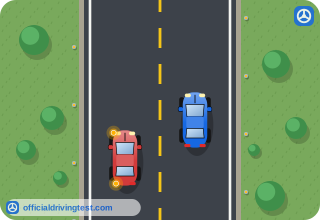
If another vehicle is passing you on the left-hand side of the road, what should you do?
- Allow it to pass safely and do not increase your speed
- Speed up so that it can finish passing you more quickly
- Move onto the shoulder to give it plenty of room to pass
- Sound your horn to warn it of your position beside you
Show answer
Correct answer: Allow it to pass safely and do not increase your speed
The manual says to allow the other vehicle to pass safely and not increase your speed.
Source: Indiana Driver’s Manual (July 2026), page 38 · Open this page in the manual (Manual page 38)
-
What does a defensive driver do?
- Drives only on roads that have posted speed limits and few curves
- Avoids using the lane next to the center line of the road
- Follows other vehicles at the same speed as the traffic ahead
- Looks out for the actions of other drivers and anticipates potential problems
Show answer
Correct answer: Looks out for the actions of other drivers and anticipates potential problems
The manual says a defensive driver looks out for the actions of other drivers and anticipates potential problems.
Source: Indiana Driver’s Manual (July 2026), page 37 · Open this page in the manual (Manual page 37)
-
What is the maximum width of a vehicle that may be operated without a special permit?
- Eight feet
- Eight feet and six inches
- Nine feet
- Nine feet and six inches
Show answer
Correct answer: Eight feet and six inches
The maximum width without a special permit is eight feet and six inches.
Source: Indiana Driver’s Manual (July 2026), page 49 · Open this page in the manual (Manual page 49)
-
What is the maximum height of a vehicle that may be operated without a special permit?
- 12 feet, 6 inches
- 14 feet
- 15 feet, 6 inches
- 13 feet, 6 inches
Show answer
Correct answer: 13 feet, 6 inches
The maximum height without a special permit is 13 feet, 6 inches.
Source: Indiana Driver’s Manual (July 2026), page 49 · Open this page in the manual (Manual page 49)
-
What is the maximum weight of a vehicle that may be operated without a special permit?
- 80,000 lbs
- 60,000 lbs
- 100,000 lbs
- 40,000 lbs
Show answer
Correct answer: 80,000 lbs
The maximum weight without a special permit is 80,000 lbs.
Source: Indiana Driver’s Manual (July 2026), page 49 · Open this page in the manual (Manual page 49)
-
What must you secure before moving a vehicle that exceeds the size or weight limits of public highways?
- A commercial vehicle inspection sticker
- A special route insurance policy
- An oversize/overweight permit
- A temporary vehicle registration
Show answer
Correct answer: An oversize/overweight permit
The manual requires an oversize/overweight permit before moving a vehicle over the limits.
Source: Indiana Driver’s Manual (July 2026), page 49 · Open this page in the manual (Manual page 49)
-
Every truck or bus of what width must have additional lighting markers and reflectors to show its width at night?
- 60 inches or wider
- 80 inches or wider
- 72 inches or wider
- 100 inches or wider
Show answer
Correct answer: 80 inches or wider
Every truck or bus 80 inches in width or wider must have additional lighting markers and reflectors.
Source: Indiana Driver’s Manual (July 2026), page 49 · Open this page in the manual (Manual page 49)
-
About how far does the average passenger car traveling at 55 miles per hour need to stop?
- 60 to 70 feet
- 200 to 210 feet
- 260 to 280 feet
- 130 to 140 feet
Show answer
Correct answer: 130 to 140 feet
The average passenger car at 55 mph can stop in approximately 130 to 140 feet.
Source: Indiana Driver’s Manual (July 2026), page 50 · Open this page in the manual (Manual page 50)
-
How far may a fully loaded tractor-trailer with hot brakes need to come to a complete stop?
- More than 400 feet
- About 200 feet
- About 250 feet
- About 300 feet
Show answer
Correct answer: More than 400 feet
A fully loaded tractor-trailer with hot brakes may take more than 400 feet to stop.
Source: Indiana Driver’s Manual (July 2026), page 50 · Open this page in the manual (Manual page 50)
-
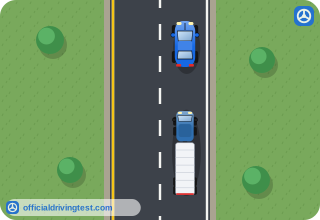
Because a tractor-trailer takes longer to stop than a car, what should you not do in front of it?
- Maintain a steady speed behind it
- Use your turn signal well in advance
- Make a sudden lane change or stop
- Drive in the center lane for a while
Show answer
Correct answer: Make a sudden lane change or stop
A tractor-trailer takes longer to stop, so you should not make a sudden lane change or stop in front of it.
Source: Indiana Driver’s Manual (July 2026), page 50 · Open this page in the manual (Manual page 50)
-
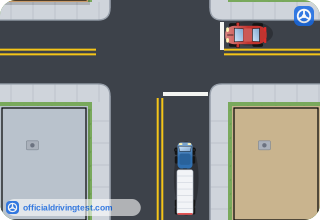
How do the rear wheels of a turning vehicle travel compared with the front wheels?
- They follow a longer path, and the difference grows with vehicle length
- They follow a shorter path, and the difference grows with vehicle length
- They follow the same path as the front wheels at all times
- They follow a shorter path, but only on vehicles that pull a trailer
Show answer
Correct answer: They follow a shorter path, and the difference grows with vehicle length
With any turning vehicle, the rear wheels follow a shorter path, and the longer the vehicle, the greater the difference.
Source: Indiana Driver’s Manual (July 2026), page 50 · Open this page in the manual (Manual page 50)
-
What do tractor-trailer drivers often do as the first step in making a tight turn?
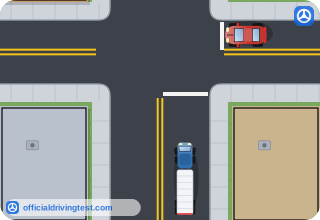
- Back up slightly
- Turn on hazard lights
- Sound the horn
- Swing out
Show answer
Correct answer: Swing out
Tractor-trailer drivers often swing out as the first step in a tight turn.
Source: Indiana Driver’s Manual (July 2026), page 50 · Open this page in the manual (Manual page 50)
-
You are following a tractor-trailer that appears to be moving to the left. What should you do?
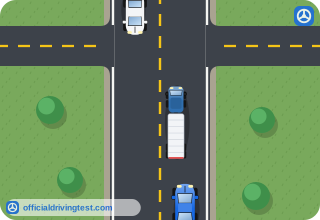
- Wait a moment to see which way the driver is signaling, and watch for a right turn
- Pass quickly on the right side before the truck has finished turning left
- Pass on the left right away because the driver is clearly moving left
- Move close behind the truck to stay out of its blind spots on both sides
Show answer
Correct answer: Wait a moment to see which way the driver is signaling, and watch for a right turn
The manual says to wait and check the driver's signal, since the truck may be making a right turn.
Source: Indiana Driver’s Manual (July 2026), page 50 · Open this page in the manual (Manual page 50)
-
How far in front of the cab can a tractor-trailer driver's blind spot extend?
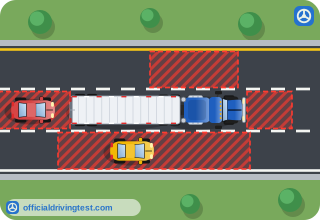
- Up to 5 feet
- Up to 50 feet
- Up to 20 feet
- Up to 100 feet
Show answer
Correct answer: Up to 20 feet
Blind spots extend up to 20 feet in front of the cab.
Source: Indiana Driver’s Manual (July 2026), page 50 · Open this page in the manual (Manual page 50)
-
How far behind a tractor-trailer can the driver's blind spot extend?
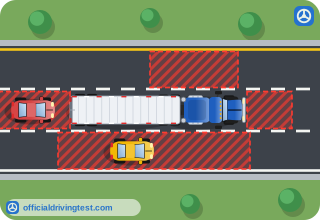
- Up to 20 feet
- Up to 200 feet
- Up to 50 feet
- Up to 100 feet
Show answer
Correct answer: Up to 200 feet
Blind spots extend up to 200 feet behind the vehicle.
Source: Indiana Driver’s Manual (July 2026), page 50 · Open this page in the manual (Manual page 50)
-
On multi-lane highways, which lane do tractor-trailers stay in to help local traffic flow on and off the highway?
- The far left lane
- The far right lane
- The shoulder
- The center lane
Show answer
Correct answer: The center lane
On multi-lane highways, tractor-trailers stay in the center lane to help the flow of local traffic on and off the highway.
Source: Indiana Driver’s Manual (July 2026), page 50 · Open this page in the manual (Manual page 50)
-
Why does staying in the middle lane help a tractor-trailer driver?
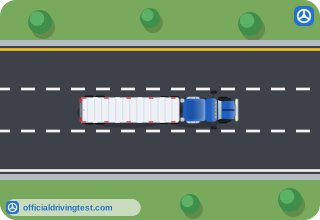
- It increases the driver's options if he or she has to switch lanes to avoid danger
- It lets the driver avoid every blind spot on both sides of the trailer
- It lets the driver use the shoulder to pass slower traffic
- It keeps the trailer from swinging into the lanes next to it on curves
Show answer
Correct answer: It increases the driver's options if he or she has to switch lanes to avoid danger
Staying in the middle lane increases the driver's options if he or she has to switch lanes to avoid an accident.
Source: Indiana Driver’s Manual (July 2026), page 50 · Open this page in the manual (Manual page 50)
-
Compared with cars, which is true of tractor-trailers?
- They have shorter stopping distances but a much wider turning radius than cars
- They accelerate faster but need a longer distance to come to a stop
- They have longer stopping and accelerating distances and a wider turning radius
- They stop more quickly than cars because of their larger, stronger brakes
Show answer
Correct answer: They have longer stopping and accelerating distances and a wider turning radius
Tractor-trailers weigh more, have longer stopping and accelerating distances, and have a wider turning radius.
Source: Indiana Driver’s Manual (July 2026), page 50 · Open this page in the manual (Manual page 50)
-
Why should you not linger in a tractor-trailer's side and rear blind spots?
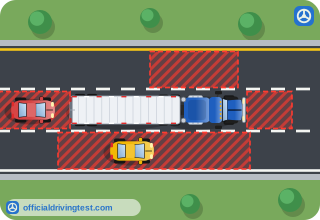
- It makes the trailer sway toward your lane at higher speeds
- It hinders the driver's ability to take evasive action to avoid danger
- It prevents the driver from signaling a lane change in time
- It forces the driver to brake more often on the highway
Show answer
Correct answer: It hinders the driver's ability to take evasive action to avoid danger
Drivers lingering in the blind spots hinder the driver's ability to take evasive action.
Source: Indiana Driver’s Manual (July 2026), page 50 · Open this page in the manual (Manual page 50)
-
What does cutting into the open space in front of a tractor-trailer remove?
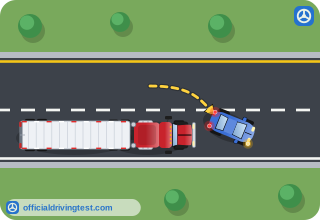
- The driver's use of the center lane
- The driver's view of the road ahead
- The driver's ability to signal a turn
- The driver's cushion of safety
Show answer
Correct answer: The driver's cushion of safety
Cutting into the open space in front removes the tractor-trailer driver's cushion of safety.
Source: Indiana Driver’s Manual (July 2026), page 50 · Open this page in the manual (Manual page 50)
-
How should you pass a tractor-trailer?
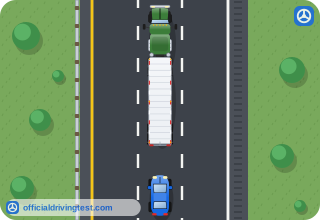
- Completely, and always on the left side
- On the right side, if the truck is turning left
- Slowly, staying alongside it as long as you can
- On either side, whichever has more room
Show answer
Correct answer: Completely, and always on the left side
The manual says to always pass a tractor-trailer completely and always on the left side.
Source: Indiana Driver’s Manual (July 2026), page 50 · Open this page in the manual (Manual page 50)
-
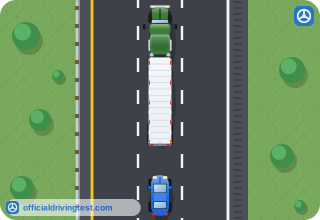
When following a tractor-trailer, what does it mean if you cannot see the driver's rearview mirrors?
- The driver is about to change lanes
- The trailer is too long to pass
- The driver cannot see you
- The driver is about to brake
Show answer
Correct answer: The driver cannot see you
If you cannot see the driver's rearview mirrors, the driver cannot see you.
Source: Indiana Driver’s Manual (July 2026), page 50 · Open this page in the manual (Manual page 50)
-
Because of its large size, how does a tractor-trailer often appear?
- To be traveling at a faster speed than it is
- To be traveling at a slower speed than it is
- To be taller than it actually is
- To be easier to stop than it really is
Show answer
Correct answer: To be traveling at a slower speed than it is
Because of its size, a tractor-trailer often appears to be traveling slower than it is.
Source: Indiana Driver’s Manual (July 2026), page 50 · Open this page in the manual (Manual page 50)
-
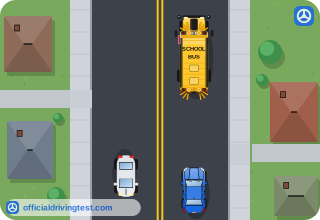
What does it mean when a school bus driver activates the amber lights?
- The bus has stopped and traffic behind it may pass slowly
- The bus is broken down and the driver needs help from others
- The bus is slowing and is going to load or unload children
- The bus driver is about to make a left turn at the next corner
Show answer
Correct answer: The bus is slowing and is going to load or unload children
The amber lights warn that the bus is slowing and is going to load or unload children.
Source: Indiana Driver’s Manual (July 2026), page 51 · Open this page in the manual (Manual page 51)
-
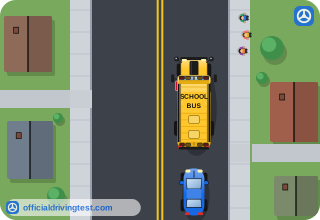
What will be activated once a school bus stops to load or unload children?
- Only the amber lights
- The red lights and stop arm
- The hazard flashers only
- The headlights and back-up alarm
Show answer
Correct answer: The red lights and stop arm
Once the bus stops, the red lights and stop arm are activated.
Source: Indiana Driver’s Manual (July 2026), page 51 · Open this page in the manual (Manual page 51)
-
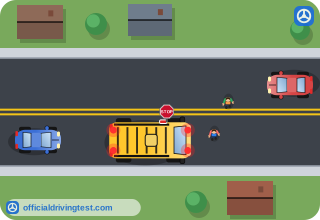
What must you do when you approach a school bus with flashing red lights and its stop arm extended?
- Slow down and pass with caution
- Stop only if children are visible
- Proceed if no children are crossing
- Stop
Show answer
Correct answer: Stop
You must stop when you approach a school bus with flashing red lights activated and stop arm extended.
Source: Indiana Driver’s Manual (July 2026), page 52 · Open this page in the manual (Manual page 52)
-
On a roadway divided by a barrier or unimproved median, when must you stop for a school bus with flashing red lights?
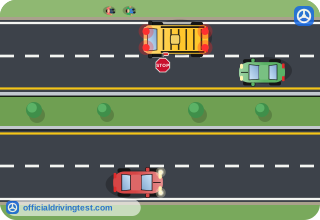
- Only if you are traveling in the same direction as the bus
- Never, because the median separates the lanes
- Only if the bus is in the lane next to the median
- Always, whichever direction you are traveling
Show answer
Correct answer: Only if you are traveling in the same direction as the bus
On a divided roadway you must stop only if you are traveling in the same direction as the school bus.
Source: Indiana Driver’s Manual (July 2026), page 52 · Open this page in the manual (Manual page 52)
-
According to the manual, what is the biggest threat to children who ride a bus to school?
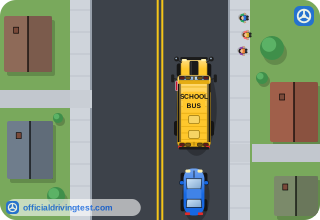
- The bus ride itself
- Drivers who follow too closely
- Approaching or leaving the bus
- Crowded seating on the bus
Show answer
Correct answer: Approaching or leaving the bus
The biggest threat is not the bus ride but approaching or leaving the bus.
Source: Indiana Driver’s Manual (July 2026), page 52 · Open this page in the manual (Manual page 52)
-
When approaching a bus stop, what should you be aware of about children arriving late for the bus?
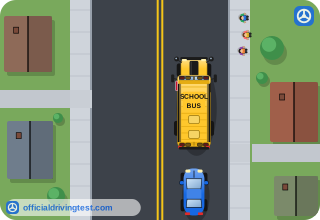
- They will wait on the curb for the bus to arrive
- They may dart into the street without looking
- They will stop and look for approaching traffic
- They must cross in front of the bus
Show answer
Correct answer: They may dart into the street without looking
Children arriving late for the bus may dart into the street without looking.
Source: Indiana Driver’s Manual (July 2026), page 52 · Open this page in the manual (Manual page 52)
-
Disregarding a school bus stop arm can result in what penalty?
- A Class B infraction
- A Class A infraction
- A written warning only
- A Class A misdemeanor
Show answer
Correct answer: A Class A misdemeanor
Disregarding a school bus stop arm can result in a Class A misdemeanor.
Source: Indiana Driver’s Manual (July 2026), page 52 · Open this page in the manual (Manual page 52)
-
Disregarding a school bus stop arm is what offense if it results in bodily injury?
- A Level 6 felony
- A written warning only
- A Class A infraction
- A Class B infraction
Show answer
Correct answer: A Level 6 felony
The offense is a Level 6 felony if it results in bodily injury.
Source: Indiana Driver’s Manual (July 2026), page 52 · Open this page in the manual (Manual page 52)
-
Disregarding a school bus stop arm is what offense if it results in death?
- A Class B infraction
- A written warning only
- A Level 5 felony
- A Class A infraction
Show answer
Correct answer: A Level 5 felony
The offense is a Level 5 felony if it results in death.
Source: Indiana Driver’s Manual (July 2026), page 52 · Open this page in the manual (Manual page 52)
-
How much of the lane should you allow motorcyclists and motor driven cycle operators?
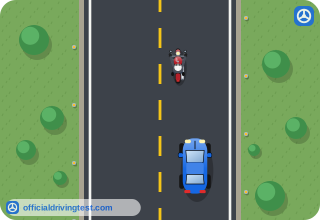
- Half of the lane
- Only the left side of the lane
- Whatever room is left by your own vehicle
- The width of a full lane
Show answer
Correct answer: The width of a full lane
Always allow all motor vehicle operators the width of a full lane.
Source: Indiana Driver’s Manual (July 2026), page 52 · Open this page in the manual (Manual page 52)
-
Compared with other motor vehicles, how quickly can motorcycles and motor driven cycles stop?
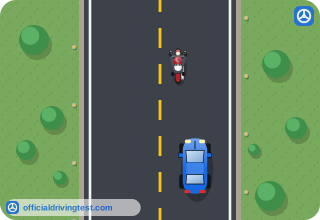
- Much more quickly
- Much more slowly
- About the same
- Slightly more slowly
Show answer
Correct answer: Much more quickly
Motorcycles and motor driven cycles can stop much more quickly than other motor vehicles.
Source: Indiana Driver’s Manual (July 2026), page 52 · Open this page in the manual (Manual page 52)
-
Why can it be harder to judge the speed and distance of a motorcycle?
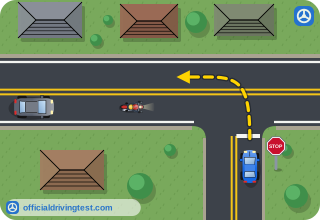
- Because of its louder engine
- Because of its brighter headlight
- Because of its smaller profile
- Because of its lack of mirrors
Show answer
Correct answer: Because of its smaller profile
The smaller profile of a motorcycle makes it more difficult to judge its speed and distance.
Source: Indiana Driver’s Manual (July 2026), page 52 · Open this page in the manual (Manual page 52)
-
When should you check your mirrors and blind spots so you do not miss a motorcycle?
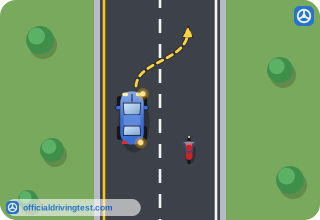
- Only when changing lanes on a freeway or multi-lane road
- Before entering or leaving a lane and at intersections
- Only after you have seen a motorcycle's headlight ahead
- Only when a motorcycle has sounded its horn near you
Show answer
Correct answer: Before entering or leaving a lane and at intersections
Check mirrors and blind spots before entering or leaving a lane of traffic and at intersections.
Source: Indiana Driver’s Manual (July 2026), page 52 · Open this page in the manual (Manual page 52)
-
Why should you not assume a flashing signal on a motorcycle means a turn is coming soon?
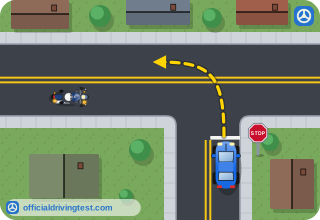
- Motorcycle signals flash at random whenever the engine is running at low speeds
- Motorcycle signals are only used to warn of braking, never to show turns ahead
- Motorcycle signals are usually too dim to be seen by other drivers in daylight
- The signals are usually not self-canceling, and riders sometimes forget to turn them off
Show answer
Correct answer: The signals are usually not self-canceling, and riders sometimes forget to turn them off
Motorcycle signals are usually not self-canceling, and riders sometimes forget to turn them off.
Source: Indiana Driver’s Manual (July 2026), page 52 · Open this page in the manual (Manual page 52)
-
A motorcycle ahead has its turn signal flashing. What should you do?
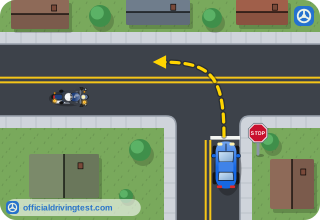
- Wait to be sure the rider is going to take action before you proceed
- Proceed because the rider is going to turn right away in front of you
- Pass on the left immediately before the rider can turn across your path
- Honk the horn to remind the rider to turn off the signal right away
Show answer
Correct answer: Wait to be sure the rider is going to take action before you proceed
Wait to be sure the rider is going to take action before you proceed.
Source: Indiana Driver’s Manual (July 2026), page 52 · Open this page in the manual (Manual page 52)
-
How many seconds should you allow at least when following a motorcycle?
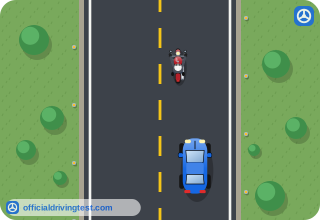
- One second
- Two seconds
- Three or four seconds
- Only one or two seconds
Show answer
Correct answer: Three or four seconds
Allow at least three or four seconds when following a motorcycle so the rider has time to maneuver or stop.
Source: Indiana Driver’s Manual (July 2026), page 52 · Open this page in the manual (Manual page 52)
-
How may a motorcyclist react to potholes, gravel, or wet or slippery surfaces?
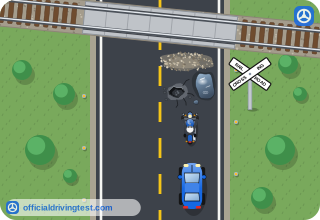
- By always coming to a complete stop right where they are
- By suddenly changing speed or position within the lane
- By leaving the roadway and riding on the shoulder instead
- By keeping the same speed and position inside the lane
Show answer
Correct answer: By suddenly changing speed or position within the lane
Motorcyclists may change speed or adjust their position within a lane suddenly in reaction to road conditions.
Source: Indiana Driver’s Manual (July 2026), page 52 · Open this page in the manual (Manual page 52)
-
On most roadways, what rights and responsibilities do bicyclists have?
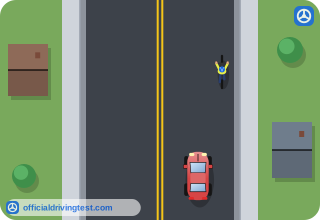
- Fewer than other roadway users
- Only those of pedestrians
- Rights only in bike lanes
- The same as other roadway users
Show answer
Correct answer: The same as other roadway users
On most roadways, bicyclists have the same rights and responsibilities as other roadway users.
Source: Indiana Driver’s Manual (July 2026), page 52 · Open this page in the manual (Manual page 52)
-
What is the minimum amount of room beside a bicyclist when you pass?
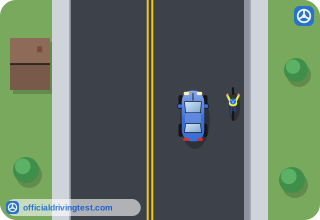
- Three feet
- One foot
- Two feet
- Six inches
Show answer
Correct answer: Three feet
Drivers may pass when there is a safe amount of room beside the bicyclist, minimum three feet.
Source: Indiana Driver’s Manual (July 2026), page 52 · Open this page in the manual (Manual page 52)
-
How must drivers yield the right of way to a bicyclist?
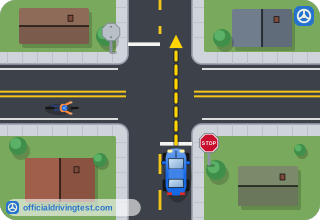
- Only when a bike lane is present
- Only to bicyclists riding in groups
- Just as they would to another vehicle
- Only at marked crosswalks
Show answer
Correct answer: Just as they would to another vehicle
Drivers must yield to a bicyclist just as they would to another vehicle.
Source: Indiana Driver’s Manual (July 2026), page 52 · Open this page in the manual (Manual page 52)
-
Except on paths or roadways set aside for bicycles, how many bicyclists may ride abreast?
- No more than three
- No more than two
- No more than four
- Any number
Show answer
Correct answer: No more than two
Bicyclists may not ride more than two abreast except on paths set aside for exclusive bicycle use.
Source: Indiana Driver’s Manual (July 2026), page 52 · Open this page in the manual (Manual page 52)
-
Is a bicyclist required to ride in a designated bike lane?
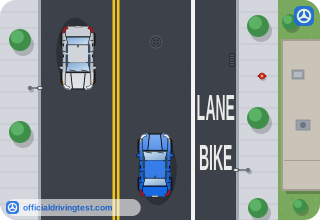
- Yes, whenever a bike lane is available on the road they are using
- Yes, but only when riding in a group of two or more bicyclists
- Yes, unless the bicyclist is about to make a left turn ahead
- No, the bicyclist may use either the bike lane or the travel lane
Show answer
Correct answer: No, the bicyclist may use either the bike lane or the travel lane
The bicyclist has the right to use either the bike lane or the travel lane.
Source: Indiana Driver’s Manual (July 2026), page 52 · Open this page in the manual (Manual page 52)
-
You are turning left and a bicyclist is entering the intersection from the opposite direction. What should you do?
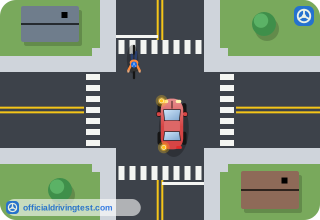
- Wait for the bicyclist to pass before making the turn
- Turn quickly before the bicyclist reaches you
- Signal the bicyclist to stop, then turn
- Edge forward so the bicyclist goes around you
Show answer
Correct answer: Wait for the bicyclist to pass before making the turn
The driver should wait for the bicyclist to pass before making the turn.
Source: Indiana Driver’s Manual (July 2026), page 53 · Open this page in the manual (Manual page 53)
-
If you share a left turn lane with a bicyclist, what should you do?
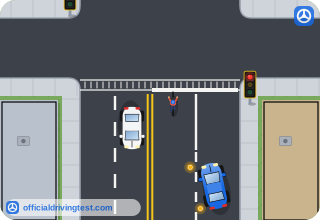
- Move alongside the cyclist so that you both turn at the same time
- Pass the cyclist inside the turn lane before starting your turn
- Stay behind the cyclist until the left turn is safely completed
- Turn first because a car can accelerate faster than a bicycle
Show answer
Correct answer: Stay behind the cyclist until the left turn is safely completed
Stay behind the cyclist until he or she has safely completed the left turn.
Source: Indiana Driver’s Manual (July 2026), page 53 · Open this page in the manual (Manual page 53)
-
You are turning right and a bicyclist is approaching on the right. What should you do?
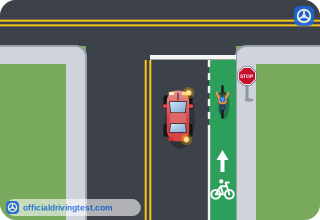
- Turn quickly ahead of the cyclist
- Let the cyclist go through the intersection first
- Speed up to pass the cyclist before turning
- Honk the horn and then turn
Show answer
Correct answer: Let the cyclist go through the intersection first
Let the cyclist go through the intersection first before making a right turn.
Source: Indiana Driver’s Manual (July 2026), page 53 · Open this page in the manual (Manual page 53)
-
After parking and before opening your vehicle door, what should you first do?
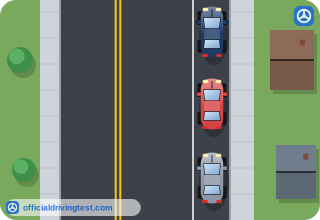
- Turn on your hazard lights
- Sound the horn
- Shift into neutral
- Check for bicyclists
Show answer
Correct answer: Check for bicyclists
After parking and before opening vehicle doors, a motorist should first check for bicyclists.
Source: Indiana Driver’s Manual (July 2026), page 53 · Open this page in the manual (Manual page 53)
-
Which driver may use a bicycle path or lane?
- A driver on official duty, such as delivering mail
- A driver who is waiting for a parking space to open up
- A driver who is passing slower traffic on the road
- A driver who is running late for an appointment
Show answer
Correct answer: A driver on official duty, such as delivering mail
Bicycle paths and lanes are for bicycles only unless signs allow joint use or the driver is on official duty.
Source: Indiana Driver’s Manual (July 2026), page 53 · Open this page in the manual (Manual page 53)
-
Which of these is a driver not allowed to do with a bicycle lane?
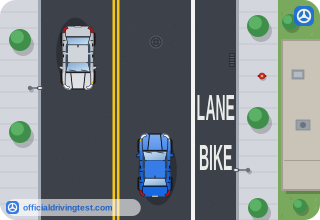
- Cross it when turning
- Cross it to enter a driveway
- Park in it
- Cross it to leave an alley
Show answer
Correct answer: Park in it
Drivers must not drive or park in bicycle paths or lanes.
Source: Indiana Driver’s Manual (July 2026), page 53 · Open this page in the manual (Manual page 53)
-
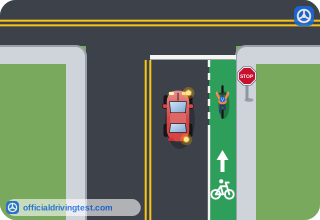
What must you do for an individual operating a bicycle on a designated bicycle path or lane?
- Pass on the left
- Yield the right of way
- Sound your horn as you pass
- Share the lane
Show answer
Correct answer: Yield the right of way
Drivers must yield the right of way to an individual operating a bicycle on a designated bicycle path or lane.
Source: Indiana Driver’s Manual (July 2026), page 53 · Open this page in the manual (Manual page 53)
-
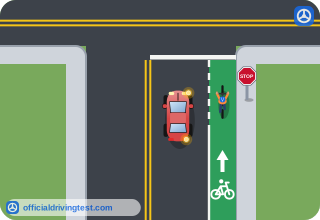
Which is a rule for drivers near a bicycle path or lane when preparing for a turn?
- Move into the bicycle lane early so you can turn smoothly
- Drive in the bicycle lane when no cyclist is visible
- Stop in the bicycle lane to wait for a gap in traffic
- Do not move into the bicycle path or lane in preparation for a turn
Show answer
Correct answer: Do not move into the bicycle path or lane in preparation for a turn
The manual says not to move into a bicycle path or lane in preparation for a turn.
Source: Indiana Driver’s Manual (July 2026), page 53 · Open this page in the manual (Manual page 53)
-
When may a driver cross a bicycle path or lane?
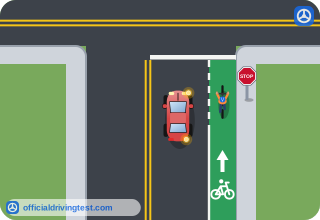
- Only when turning or when entering or leaving an alley, driveway, or private road
- Whenever traffic in the travel lane ahead is moving slowly or stopped
- Only when passing a slower vehicle that is traveling in the travel lane
- Only when no bicyclist can be seen in either direction along the road
Show answer
Correct answer: Only when turning or when entering or leaving an alley, driveway, or private road
A driver may cross a bicycle path or lane only when turning or entering or leaving an alley, driveway, or private road.
Source: Indiana Driver’s Manual (July 2026), page 53 · Open this page in the manual (Manual page 53)
-
What should you be alert for on the rear of a slow-moving vehicle?
- The special emblem the driver must place there
- A flashing white strobe light mounted on the vehicle
- A sign reading ‘Wide Load’ attached to the vehicle
- A flag mounted on a pole at the vehicle's rear edge
Show answer
Correct answer: The special emblem the driver must place there
The driver of a slow-moving vehicle must place a special emblem on its rear.
Source: Indiana Driver’s Manual (July 2026), page 53 · Open this page in the manual (Manual page 53)
-
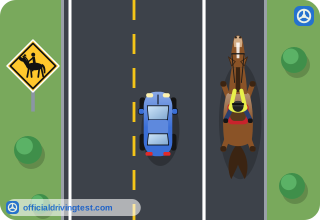
What rights and responsibilities does a rider of a horse have on a public highway?
- The same as a pedestrian
- Fewer than a bicyclist
- The same as a motor vehicle driver
- Only the right to use the shoulder
Show answer
Correct answer: The same as a motor vehicle driver
A rider of a horse or horse-drawn vehicle has the same rights and responsibilities as a motor vehicle driver.
Source: Indiana Driver’s Manual (July 2026), page 53 · Open this page in the manual (Manual page 53)
-
What should you be alert for when approaching a horseback rider or horse-drawn vehicle?
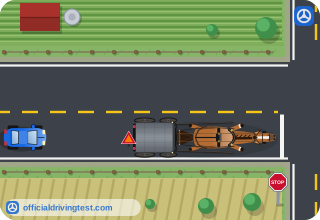
- Turn signal lamps mounted on the horse itself
- Any hand signals used by the rider or driver
- Horn signals from the rider of the horse
- Headlight flashes from the driver of the vehicle
Show answer
Correct answer: Any hand signals used by the rider or driver
Approach with caution and be alert for any hand signals used by a horseback rider or the driver of a horse-drawn vehicle.
Source: Indiana Driver’s Manual (July 2026), page 53 · Open this page in the manual (Manual page 53)