Indiana: Sharing the road — Part 4 Practice Test
Questions in this part include: “Except on paths or roadways set aside for bicycles, how many bicyclists may ride abreast?” · “Which driver may use a bicycle path or lane?”
Independent educational site · not affiliated with any government agency or DMV
Ready? Test yourself
- Instant feedback with an explanation
- Every answer cites its source in the manual
- Your best score is saved on this device
Questions are original and based on the official manual "Indiana Driver’s Manual" (July 2026), Indiana Bureau of Motor Vehicles.
All 17 questions in this practice test
Take the test above first, then use this list to study. Tap “Show answer” to see the correct answer and explanation.
Show the questions and answersHide the questions
-
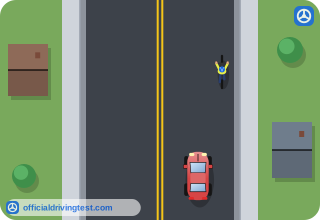
On most roadways, what rights and responsibilities do bicyclists have?
- Fewer than other roadway users
- Only those of pedestrians
- Rights only in bike lanes
- The same as other roadway users
Show answer
Correct answer: The same as other roadway users
On most roadways, bicyclists have the same rights and responsibilities as other roadway users.
Source: Indiana Driver’s Manual (July 2026), page 52 · Open this page in the manual (Manual page 52)
-
What is the minimum amount of room beside a bicyclist when you pass?

- Three feet
- One foot
- Two feet
- Six inches
Show answer
Correct answer: Three feet
Drivers may pass when there is a safe amount of room beside the bicyclist, minimum three feet.
Source: Indiana Driver’s Manual (July 2026), page 52 · Open this page in the manual (Manual page 52)
-
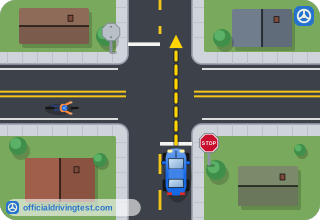
How must drivers yield the right of way to a bicyclist?
- Only when a bike lane is present
- Only to bicyclists riding in groups
- Just as they would to another vehicle
- Only at marked crosswalks
Show answer
Correct answer: Just as they would to another vehicle
Drivers must yield to a bicyclist just as they would to another vehicle.
Source: Indiana Driver’s Manual (July 2026), page 52 · Open this page in the manual (Manual page 52)
-
Except on paths or roadways set aside for bicycles, how many bicyclists may ride abreast?
- No more than three
- No more than two
- No more than four
- Any number
Show answer
Correct answer: No more than two
Bicyclists may not ride more than two abreast except on paths set aside for exclusive bicycle use.
Source: Indiana Driver’s Manual (July 2026), page 52 · Open this page in the manual (Manual page 52)
-
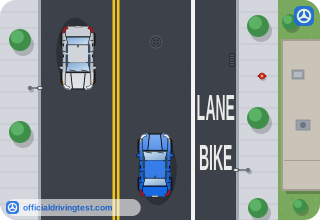
Is a bicyclist required to ride in a designated bike lane?
- Yes, whenever a bike lane is available on the road they are using
- Yes, but only when riding in a group of two or more bicyclists
- Yes, unless the bicyclist is about to make a left turn ahead
- No, the bicyclist may use either the bike lane or the travel lane
Show answer
Correct answer: No, the bicyclist may use either the bike lane or the travel lane
The bicyclist has the right to use either the bike lane or the travel lane.
Source: Indiana Driver’s Manual (July 2026), page 52 · Open this page in the manual (Manual page 52)
-
You are turning left and a bicyclist is entering the intersection from the opposite direction. What should you do?
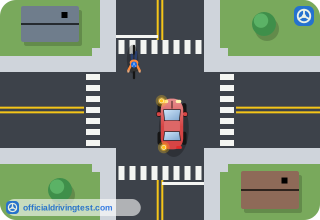
- Wait for the bicyclist to pass before making the turn
- Turn quickly before the bicyclist reaches you
- Signal the bicyclist to stop, then turn
- Edge forward so the bicyclist goes around you
Show answer
Correct answer: Wait for the bicyclist to pass before making the turn
The driver should wait for the bicyclist to pass before making the turn.
Source: Indiana Driver’s Manual (July 2026), page 53 · Open this page in the manual (Manual page 53)
-
If you share a left turn lane with a bicyclist, what should you do?
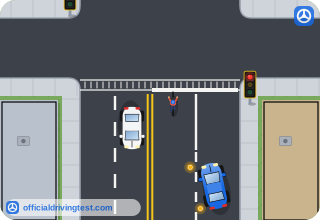
- Move alongside the cyclist so that you both turn at the same time
- Pass the cyclist inside the turn lane before starting your turn
- Stay behind the cyclist until the left turn is safely completed
- Turn first because a car can accelerate faster than a bicycle
Show answer
Correct answer: Stay behind the cyclist until the left turn is safely completed
Stay behind the cyclist until he or she has safely completed the left turn.
Source: Indiana Driver’s Manual (July 2026), page 53 · Open this page in the manual (Manual page 53)
-
You are turning right and a bicyclist is approaching on the right. What should you do?
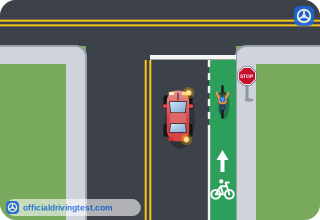
- Turn quickly ahead of the cyclist
- Let the cyclist go through the intersection first
- Speed up to pass the cyclist before turning
- Honk the horn and then turn
Show answer
Correct answer: Let the cyclist go through the intersection first
Let the cyclist go through the intersection first before making a right turn.
Source: Indiana Driver’s Manual (July 2026), page 53 · Open this page in the manual (Manual page 53)
-
After parking and before opening your vehicle door, what should you first do?
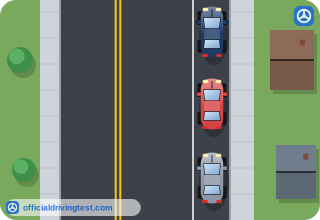
- Turn on your hazard lights
- Sound the horn
- Shift into neutral
- Check for bicyclists
Show answer
Correct answer: Check for bicyclists
After parking and before opening vehicle doors, a motorist should first check for bicyclists.
Source: Indiana Driver’s Manual (July 2026), page 53 · Open this page in the manual (Manual page 53)
-
Which driver may use a bicycle path or lane?
- A driver on official duty, such as delivering mail
- A driver who is waiting for a parking space to open up
- A driver who is passing slower traffic on the road
- A driver who is running late for an appointment
Show answer
Correct answer: A driver on official duty, such as delivering mail
Bicycle paths and lanes are for bicycles only unless signs allow joint use or the driver is on official duty.
Source: Indiana Driver’s Manual (July 2026), page 53 · Open this page in the manual (Manual page 53)
-
Which of these is a driver not allowed to do with a bicycle lane?
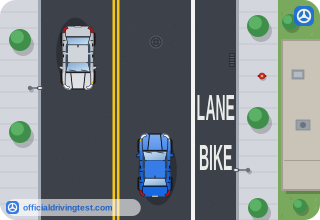
- Cross it when turning
- Cross it to enter a driveway
- Park in it
- Cross it to leave an alley
Show answer
Correct answer: Park in it
Drivers must not drive or park in bicycle paths or lanes.
Source: Indiana Driver’s Manual (July 2026), page 53 · Open this page in the manual (Manual page 53)
-
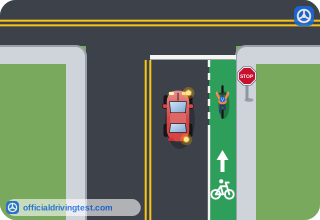
What must you do for an individual operating a bicycle on a designated bicycle path or lane?
- Pass on the left
- Yield the right of way
- Sound your horn as you pass
- Share the lane
Show answer
Correct answer: Yield the right of way
Drivers must yield the right of way to an individual operating a bicycle on a designated bicycle path or lane.
Source: Indiana Driver’s Manual (July 2026), page 53 · Open this page in the manual (Manual page 53)
-
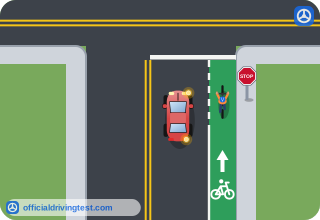
Which is a rule for drivers near a bicycle path or lane when preparing for a turn?
- Move into the bicycle lane early so you can turn smoothly
- Drive in the bicycle lane when no cyclist is visible
- Stop in the bicycle lane to wait for a gap in traffic
- Do not move into the bicycle path or lane in preparation for a turn
Show answer
Correct answer: Do not move into the bicycle path or lane in preparation for a turn
The manual says not to move into a bicycle path or lane in preparation for a turn.
Source: Indiana Driver’s Manual (July 2026), page 53 · Open this page in the manual (Manual page 53)
-
When may a driver cross a bicycle path or lane?
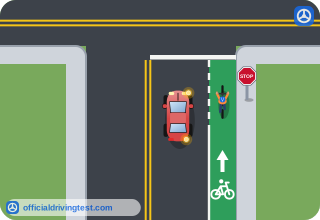
- Only when turning or when entering or leaving an alley, driveway, or private road
- Whenever traffic in the travel lane ahead is moving slowly or stopped
- Only when passing a slower vehicle that is traveling in the travel lane
- Only when no bicyclist can be seen in either direction along the road
Show answer
Correct answer: Only when turning or when entering or leaving an alley, driveway, or private road
A driver may cross a bicycle path or lane only when turning or entering or leaving an alley, driveway, or private road.
Source: Indiana Driver’s Manual (July 2026), page 53 · Open this page in the manual (Manual page 53)
-
What should you be alert for on the rear of a slow-moving vehicle?
- The special emblem the driver must place there
- A flashing white strobe light mounted on the vehicle
- A sign reading ‘Wide Load’ attached to the vehicle
- A flag mounted on a pole at the vehicle's rear edge
Show answer
Correct answer: The special emblem the driver must place there
The driver of a slow-moving vehicle must place a special emblem on its rear.
Source: Indiana Driver’s Manual (July 2026), page 53 · Open this page in the manual (Manual page 53)
-
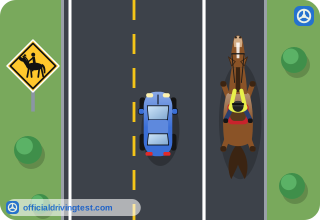
What rights and responsibilities does a rider of a horse have on a public highway?
- The same as a pedestrian
- Fewer than a bicyclist
- The same as a motor vehicle driver
- Only the right to use the shoulder
Show answer
Correct answer: The same as a motor vehicle driver
A rider of a horse or horse-drawn vehicle has the same rights and responsibilities as a motor vehicle driver.
Source: Indiana Driver’s Manual (July 2026), page 53 · Open this page in the manual (Manual page 53)
-
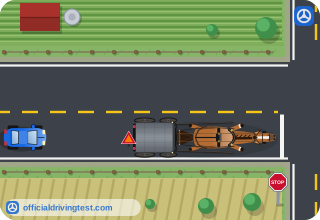
What should you be alert for when approaching a horseback rider or horse-drawn vehicle?
- Turn signal lamps mounted on the horse itself
- Any hand signals used by the rider or driver
- Horn signals from the rider of the horse
- Headlight flashes from the driver of the vehicle
Show answer
Correct answer: Any hand signals used by the rider or driver
Approach with caution and be alert for any hand signals used by a horseback rider or the driver of a horse-drawn vehicle.
Source: Indiana Driver’s Manual (July 2026), page 53 · Open this page in the manual (Manual page 53)