Indiana: Sharing the road — Part 3 Practice Test
Questions in this part include: “Because of its large size, how does a tractor-trailer often appear?” · “Disregarding a school bus stop arm is what offense if it results in bodily injury?”
Independent educational site · not affiliated with any government agency or DMV
Ready? Test yourself
- Instant feedback with an explanation
- Every answer cites its source in the manual
- Your best score is saved on this device
Questions are original and based on the official manual "Indiana Driver’s Manual" (July 2026), Indiana Bureau of Motor Vehicles.
All 18 questions in this practice test
Take the test above first, then use this list to study. Tap “Show answer” to see the correct answer and explanation.
Show the questions and answersHide the questions
-
Because of its large size, how does a tractor-trailer often appear?
- To be traveling at a faster speed than it is
- To be traveling at a slower speed than it is
- To be taller than it actually is
- To be easier to stop than it really is
Show answer
Correct answer: To be traveling at a slower speed than it is
Because of its size, a tractor-trailer often appears to be traveling slower than it is.
Source: Indiana Driver’s Manual (July 2026), page 50 · Open this page in the manual (Manual page 50)
-
What does it mean when a school bus driver activates the amber lights?
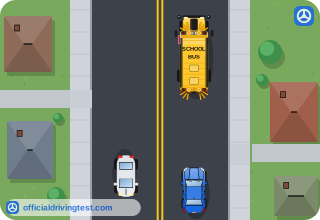
- The bus has stopped and traffic behind it may pass slowly
- The bus is broken down and the driver needs help from others
- The bus is slowing and is going to load or unload children
- The bus driver is about to make a left turn at the next corner
Show answer
Correct answer: The bus is slowing and is going to load or unload children
The amber lights warn that the bus is slowing and is going to load or unload children.
Source: Indiana Driver’s Manual (July 2026), page 51 · Open this page in the manual (Manual page 51)
-
What will be activated once a school bus stops to load or unload children?
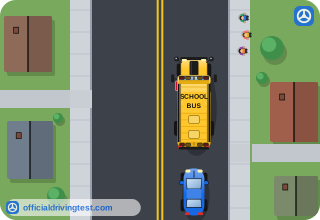
- Only the amber lights
- The red lights and stop arm
- The hazard flashers only
- The headlights and back-up alarm
Show answer
Correct answer: The red lights and stop arm
Once the bus stops, the red lights and stop arm are activated.
Source: Indiana Driver’s Manual (July 2026), page 51 · Open this page in the manual (Manual page 51)
-
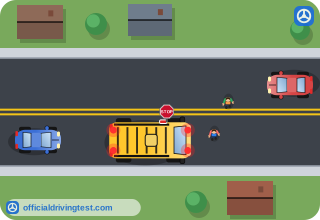
What must you do when you approach a school bus with flashing red lights and its stop arm extended?
- Slow down and pass with caution
- Stop only if children are visible
- Proceed if no children are crossing
- Stop
Show answer
Correct answer: Stop
You must stop when you approach a school bus with flashing red lights activated and stop arm extended.
Source: Indiana Driver’s Manual (July 2026), page 52 · Open this page in the manual (Manual page 52)
-
On a roadway divided by a barrier or unimproved median, when must you stop for a school bus with flashing red lights?
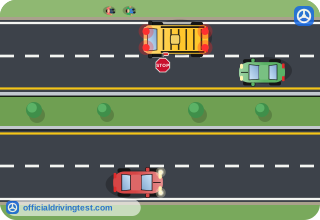
- Only if you are traveling in the same direction as the bus
- Never, because the median separates the lanes
- Only if the bus is in the lane next to the median
- Always, whichever direction you are traveling
Show answer
Correct answer: Only if you are traveling in the same direction as the bus
On a divided roadway you must stop only if you are traveling in the same direction as the school bus.
Source: Indiana Driver’s Manual (July 2026), page 52 · Open this page in the manual (Manual page 52)
-
According to the manual, what is the biggest threat to children who ride a bus to school?
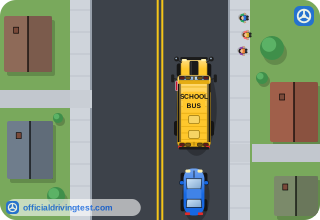
- The bus ride itself
- Drivers who follow too closely
- Approaching or leaving the bus
- Crowded seating on the bus
Show answer
Correct answer: Approaching or leaving the bus
The biggest threat is not the bus ride but approaching or leaving the bus.
Source: Indiana Driver’s Manual (July 2026), page 52 · Open this page in the manual (Manual page 52)
-
When approaching a bus stop, what should you be aware of about children arriving late for the bus?
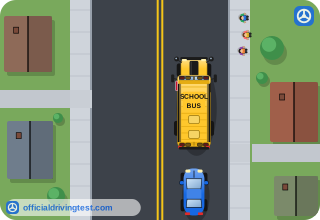
- They will wait on the curb for the bus to arrive
- They may dart into the street without looking
- They will stop and look for approaching traffic
- They must cross in front of the bus
Show answer
Correct answer: They may dart into the street without looking
Children arriving late for the bus may dart into the street without looking.
Source: Indiana Driver’s Manual (July 2026), page 52 · Open this page in the manual (Manual page 52)
-
Disregarding a school bus stop arm can result in what penalty?
- A Class B infraction
- A Class A infraction
- A written warning only
- A Class A misdemeanor
Show answer
Correct answer: A Class A misdemeanor
Disregarding a school bus stop arm can result in a Class A misdemeanor.
Source: Indiana Driver’s Manual (July 2026), page 52 · Open this page in the manual (Manual page 52)
-
Disregarding a school bus stop arm is what offense if it results in bodily injury?
- A Level 6 felony
- A written warning only
- A Class A infraction
- A Class B infraction
Show answer
Correct answer: A Level 6 felony
The offense is a Level 6 felony if it results in bodily injury.
Source: Indiana Driver’s Manual (July 2026), page 52 · Open this page in the manual (Manual page 52)
-
Disregarding a school bus stop arm is what offense if it results in death?
- A Class B infraction
- A written warning only
- A Level 5 felony
- A Class A infraction
Show answer
Correct answer: A Level 5 felony
The offense is a Level 5 felony if it results in death.
Source: Indiana Driver’s Manual (July 2026), page 52 · Open this page in the manual (Manual page 52)
-
How much of the lane should you allow motorcyclists and motor driven cycle operators?
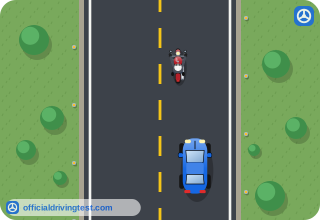
- Half of the lane
- Only the left side of the lane
- Whatever room is left by your own vehicle
- The width of a full lane
Show answer
Correct answer: The width of a full lane
Always allow all motor vehicle operators the width of a full lane.
Source: Indiana Driver’s Manual (July 2026), page 52 · Open this page in the manual (Manual page 52)
-
Compared with other motor vehicles, how quickly can motorcycles and motor driven cycles stop?
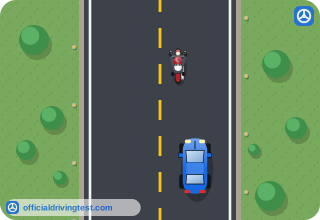
- Much more quickly
- Much more slowly
- About the same
- Slightly more slowly
Show answer
Correct answer: Much more quickly
Motorcycles and motor driven cycles can stop much more quickly than other motor vehicles.
Source: Indiana Driver’s Manual (July 2026), page 52 · Open this page in the manual (Manual page 52)
-
Why can it be harder to judge the speed and distance of a motorcycle?
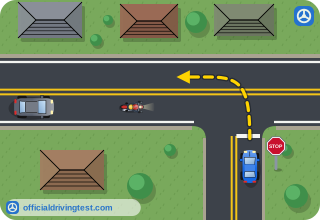
- Because of its louder engine
- Because of its brighter headlight
- Because of its smaller profile
- Because of its lack of mirrors
Show answer
Correct answer: Because of its smaller profile
The smaller profile of a motorcycle makes it more difficult to judge its speed and distance.
Source: Indiana Driver’s Manual (July 2026), page 52 · Open this page in the manual (Manual page 52)
-
When should you check your mirrors and blind spots so you do not miss a motorcycle?
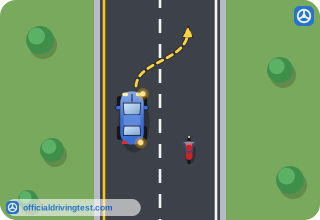
- Only when changing lanes on a freeway or multi-lane road
- Before entering or leaving a lane and at intersections
- Only after you have seen a motorcycle's headlight ahead
- Only when a motorcycle has sounded its horn near you
Show answer
Correct answer: Before entering or leaving a lane and at intersections
Check mirrors and blind spots before entering or leaving a lane of traffic and at intersections.
Source: Indiana Driver’s Manual (July 2026), page 52 · Open this page in the manual (Manual page 52)
-
Why should you not assume a flashing signal on a motorcycle means a turn is coming soon?
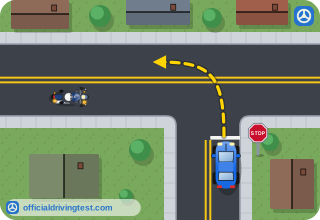
- Motorcycle signals flash at random whenever the engine is running at low speeds
- Motorcycle signals are only used to warn of braking, never to show turns ahead
- Motorcycle signals are usually too dim to be seen by other drivers in daylight
- The signals are usually not self-canceling, and riders sometimes forget to turn them off
Show answer
Correct answer: The signals are usually not self-canceling, and riders sometimes forget to turn them off
Motorcycle signals are usually not self-canceling, and riders sometimes forget to turn them off.
Source: Indiana Driver’s Manual (July 2026), page 52 · Open this page in the manual (Manual page 52)
-
A motorcycle ahead has its turn signal flashing. What should you do?
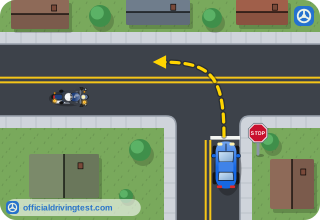
- Wait to be sure the rider is going to take action before you proceed
- Proceed because the rider is going to turn right away in front of you
- Pass on the left immediately before the rider can turn across your path
- Honk the horn to remind the rider to turn off the signal right away
Show answer
Correct answer: Wait to be sure the rider is going to take action before you proceed
Wait to be sure the rider is going to take action before you proceed.
Source: Indiana Driver’s Manual (July 2026), page 52 · Open this page in the manual (Manual page 52)
-
How many seconds should you allow at least when following a motorcycle?
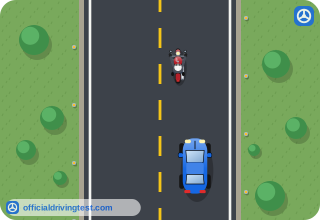
- One second
- Two seconds
- Three or four seconds
- Only one or two seconds
Show answer
Correct answer: Three or four seconds
Allow at least three or four seconds when following a motorcycle so the rider has time to maneuver or stop.
Source: Indiana Driver’s Manual (July 2026), page 52 · Open this page in the manual (Manual page 52)
-
How may a motorcyclist react to potholes, gravel, or wet or slippery surfaces?
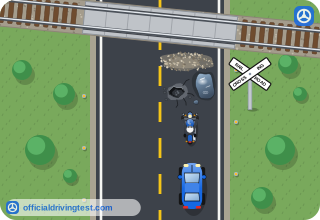
- By always coming to a complete stop right where they are
- By suddenly changing speed or position within the lane
- By leaving the roadway and riding on the shoulder instead
- By keeping the same speed and position inside the lane
Show answer
Correct answer: By suddenly changing speed or position within the lane
Motorcyclists may change speed or adjust their position within a lane suddenly in reaction to road conditions.
Source: Indiana Driver’s Manual (July 2026), page 52 · Open this page in the manual (Manual page 52)