Indiana: Sharing the road — Part 1 Practice Test
Questions in this part include: “What does a slow-moving vehicle emblem look like?” · “What does a defensive driver do?”
Independent educational site · not affiliated with any government agency or DMV
Ready? Test yourself
- Instant feedback with an explanation
- Every answer cites its source in the manual
- Your best score is saved on this device
Questions are original and based on the official manual "Indiana Driver’s Manual" (July 2026), Indiana Bureau of Motor Vehicles.
All 18 questions in this practice test
Take the test above first, then use this list to study. Tap “Show answer” to see the correct answer and explanation.
Show the questions and answersHide the questions
-
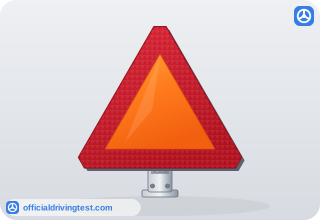
A slow-moving vehicle emblem indicates a slow-moving vehicle that cannot exceed what speed?
- 25 miles per hour
- 15 miles per hour
- 35 miles per hour
- 45 miles per hour
Show answer
Correct answer: 25 miles per hour
The manual says the emblem indicates a slow-moving vehicle which cannot exceed 25 miles per hour.
Source: Indiana Driver’s Manual (July 2026), page 30 · Open this page in the manual (Manual page 30)
-
What does a slow-moving vehicle emblem look like?
- A yellow center with thick black reflective borders
- A white center with wide blue reflective borders
- An orange, fluorescent center with red reflective borders
- A fluorescent red center with white reflective borders
Show answer
Correct answer: An orange, fluorescent center with red reflective borders
The manual describes the emblem as having an orange, fluorescent center and red reflective borders.
Source: Indiana Driver’s Manual (July 2026), page 30 · Open this page in the manual (Manual page 30)
-
How many lanes should you change at a time?
- Two lanes if the road ahead is clear
- As many as needed to reach your exit
- Two lanes if you use your signal
- Only one lane at a time
Show answer
Correct answer: Only one lane at a time
The manual says to change only one lane at a time.
Source: Indiana Driver’s Manual (July 2026), page 37 · Open this page in the manual (Manual page 37)
-
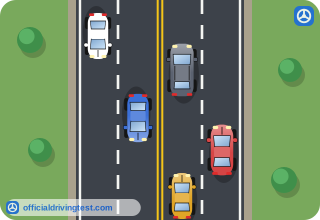
What greatly increases your risk of an accident when you drive on a multi-lane road?
- Weaving in and out of lanes
- Signaling before each lane change
- Changing lanes only one at a time
- Checking your mirrors before moving
Show answer
Correct answer: Weaving in and out of lanes
The manual warns that weaving in and out of lanes will greatly increase your risk of an accident.
Source: Indiana Driver’s Manual (July 2026), page 37 · Open this page in the manual (Manual page 37)
-
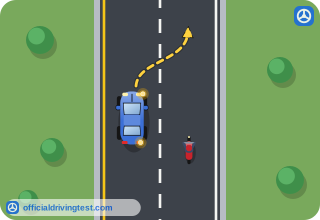
When you are changing lanes, what should you briefly do to make sure no vehicle is in your blind spot?
- Rely only on the view in your side mirror and your signal
- Turn your head toward the lane you are entering
- Tap your horn to warn the driver who is beside you
- Slow down and flash your headlights at that driver
Show answer
Correct answer: Turn your head toward the lane you are entering
The manual says to briefly turn your head toward the lane you are entering to check your blind spot.
Source: Indiana Driver’s Manual (July 2026), page 37 · Open this page in the manual (Manual page 37)
-
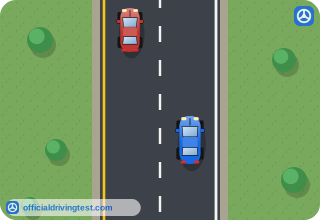
When you are changing lanes, what should you check your mirrors for?
- Vehicles parked on the shoulder ahead
- Pedestrians waiting to cross the road
- Signs that mark the end of the lane
- Vehicles that are preparing to pass you
Show answer
Correct answer: Vehicles that are preparing to pass you
The manual says to check your mirrors for any vehicles that are preparing to pass you.
Source: Indiana Driver’s Manual (July 2026), page 37 · Open this page in the manual (Manual page 37)
-
Before you change lanes, what must be true of the lane you want to enter?
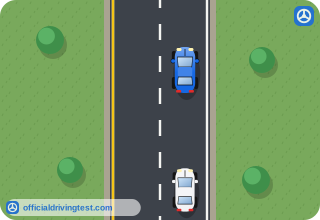
- There is no traffic ahead of you in that lane
- It has a broken white line on both sides
- It is the lane closest to the center line
- It is free of vehicles for the next mile
Show answer
Correct answer: There is no traffic ahead of you in that lane
The manual says to make sure there is no traffic ahead of you in the lane you would like to enter.
Source: Indiana Driver’s Manual (July 2026), page 37 · Open this page in the manual (Manual page 37)
-
When you pass another vehicle, you must return to the right side of the road no less than how far before any oncoming vehicle?
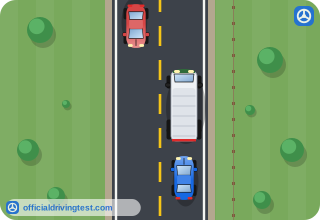
- 50 feet
- 100 feet
- 200 feet
- 500 feet
Show answer
Correct answer: 100 feet
The manual says you must return to the right side of the road no less than 100 feet before any oncoming vehicle.
Source: Indiana Driver’s Manual (July 2026), page 38 · Open this page in the manual (Manual page 38)
-
Before you pass another vehicle, what should you check behind and to the left of your vehicle?
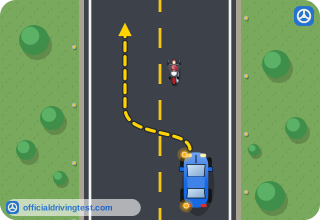
- That the vehicle ahead has its brake lights on
- That no pedestrians are in the crosswalk
- That your hazard lights are working
- That another vehicle is not attempting to pass you
Show answer
Correct answer: That another vehicle is not attempting to pass you
The manual says to check behind and to the left to make sure another vehicle is not attempting to pass you.
Source: Indiana Driver’s Manual (July 2026), page 38 · Open this page in the manual (Manual page 38)
-
When passing, how long should you accelerate and continue to move forward in the passing lane?
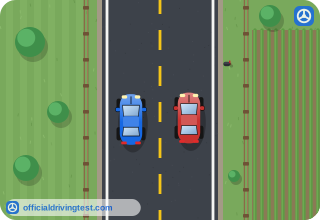
- Until you can see the vehicle you are passing in your rearview mirror
- Until you have driven past the next intersection ahead of you
- Until the vehicle you are passing begins to slow down and move over
- Until the oncoming lane is completely clear of all other traffic
Show answer
Correct answer: Until you can see the vehicle you are passing in your rearview mirror
The manual says to continue forward until you can see the vehicle you are passing in your rearview mirror.
Source: Indiana Driver’s Manual (July 2026), page 38 · Open this page in the manual (Manual page 38)
-
Passing is dangerous and illegal when which line is marked on the driver’s side of the center line of the road?
- A broken yellow line
- A solid yellow line
- A broken white line
- A solid white edge line
Show answer
Correct answer: A solid yellow line
The manual lists a solid yellow line on the driver’s side of the center line as a situation where passing is prohibited.
Source: Indiana Driver’s Manual (July 2026), page 38 · Open this page in the manual (Manual page 38)
-
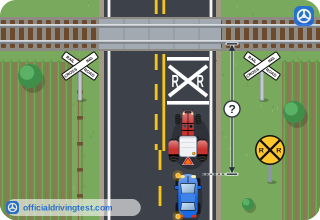
Within what distance of an intersection, railroad crossing, bridge, viaduct, or tunnel is it dangerous and illegal to pass another vehicle?
- 50 feet
- 200 feet
- 100 feet
- 500 feet
Show answer
Correct answer: 100 feet
The manual prohibits passing within 100 feet of an intersection, railroad crossing, bridge, viaduct, or tunnel.
Source: Indiana Driver’s Manual (July 2026), page 38 · Open this page in the manual (Manual page 38)
-
In which situation is it dangerous and illegal to try to pass other vehicles?
- On a straight road with a broken yellow line on your side
- When you are approaching the crest of a hill or grade in the road
- On a multi-lane road with broken white lines
- In a lane with no oncoming traffic in sight
Show answer
Correct answer: When you are approaching the crest of a hill or grade in the road
The manual lists approaching the crest of a hill or grade in the road as a prohibited passing situation.
Source: Indiana Driver’s Manual (July 2026), page 38 · Open this page in the manual (Manual page 38)
-
In which situation is it dangerous and illegal to try to pass other vehicles?
- On a straight road with a broken yellow line on your side
- On a multi-lane road with broken white lines
- In a lane with no oncoming traffic in sight
- When you are driving on or approaching a curve in the road
Show answer
Correct answer: When you are driving on or approaching a curve in the road
The manual lists driving on or approaching a curve in the road as a prohibited passing situation.
Source: Indiana Driver’s Manual (July 2026), page 38 · Open this page in the manual (Manual page 38)
-
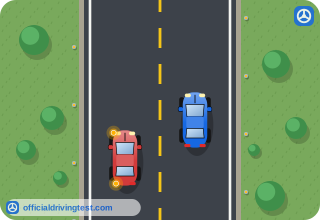
If another vehicle is passing you on the left-hand side of the road, what should you do?
- Allow it to pass safely and do not increase your speed
- Speed up so that it can finish passing you more quickly
- Move onto the shoulder to give it plenty of room to pass
- Sound your horn to warn it of your position beside you
Show answer
Correct answer: Allow it to pass safely and do not increase your speed
The manual says to allow the other vehicle to pass safely and not increase your speed.
Source: Indiana Driver’s Manual (July 2026), page 38 · Open this page in the manual (Manual page 38)
-
What does a defensive driver do?
- Drives only on roads that have posted speed limits and few curves
- Avoids using the lane next to the center line of the road
- Follows other vehicles at the same speed as the traffic ahead
- Looks out for the actions of other drivers and anticipates potential problems
Show answer
Correct answer: Looks out for the actions of other drivers and anticipates potential problems
The manual says a defensive driver looks out for the actions of other drivers and anticipates potential problems.
Source: Indiana Driver’s Manual (July 2026), page 37 · Open this page in the manual (Manual page 37)
-
What is the maximum width of a vehicle that may be operated without a special permit?
- Eight feet
- Eight feet and six inches
- Nine feet
- Nine feet and six inches
Show answer
Correct answer: Eight feet and six inches
The maximum width without a special permit is eight feet and six inches.
Source: Indiana Driver’s Manual (July 2026), page 49 · Open this page in the manual (Manual page 49)
-
What is the maximum height of a vehicle that may be operated without a special permit?
- 12 feet, 6 inches
- 14 feet
- 15 feet, 6 inches
- 13 feet, 6 inches
Show answer
Correct answer: 13 feet, 6 inches
The maximum height without a special permit is 13 feet, 6 inches.
Source: Indiana Driver’s Manual (July 2026), page 49 · Open this page in the manual (Manual page 49)