Indiana: Sharing the road — Part 2 Practice Test
Questions in this part include: “What is the maximum weight of a vehicle that may be operated without a special permit?” · “About how far does the average passenger car traveling at 55 miles per hour need to stop?”
Independent educational site · not affiliated with any government agency or DMV
Ready? Test yourself
- Instant feedback with an explanation
- Every answer cites its source in the manual
- Your best score is saved on this device
Questions are original and based on the official manual "Indiana Driver’s Manual" (July 2026), Indiana Bureau of Motor Vehicles.
All 18 questions in this practice test
Take the test above first, then use this list to study. Tap “Show answer” to see the correct answer and explanation.
Show the questions and answersHide the questions
-
What is the maximum weight of a vehicle that may be operated without a special permit?
- 80,000 lbs
- 60,000 lbs
- 100,000 lbs
- 40,000 lbs
Show answer
Correct answer: 80,000 lbs
The maximum weight without a special permit is 80,000 lbs.
Source: Indiana Driver’s Manual (July 2026), page 49 · Open this page in the manual (Manual page 49)
-
What must you secure before moving a vehicle that exceeds the size or weight limits of public highways?
- A commercial vehicle inspection sticker
- A special route insurance policy
- An oversize/overweight permit
- A temporary vehicle registration
Show answer
Correct answer: An oversize/overweight permit
The manual requires an oversize/overweight permit before moving a vehicle over the limits.
Source: Indiana Driver’s Manual (July 2026), page 49 · Open this page in the manual (Manual page 49)
-
Every truck or bus of what width must have additional lighting markers and reflectors to show its width at night?
- 60 inches or wider
- 80 inches or wider
- 72 inches or wider
- 100 inches or wider
Show answer
Correct answer: 80 inches or wider
Every truck or bus 80 inches in width or wider must have additional lighting markers and reflectors.
Source: Indiana Driver’s Manual (July 2026), page 49 · Open this page in the manual (Manual page 49)
-
About how far does the average passenger car traveling at 55 miles per hour need to stop?
- 60 to 70 feet
- 200 to 210 feet
- 260 to 280 feet
- 130 to 140 feet
Show answer
Correct answer: 130 to 140 feet
The average passenger car at 55 mph can stop in approximately 130 to 140 feet.
Source: Indiana Driver’s Manual (July 2026), page 50 · Open this page in the manual (Manual page 50)
-
How far may a fully loaded tractor-trailer with hot brakes need to come to a complete stop?
- More than 400 feet
- About 200 feet
- About 250 feet
- About 300 feet
Show answer
Correct answer: More than 400 feet
A fully loaded tractor-trailer with hot brakes may take more than 400 feet to stop.
Source: Indiana Driver’s Manual (July 2026), page 50 · Open this page in the manual (Manual page 50)
-
Because a tractor-trailer takes longer to stop than a car, what should you not do in front of it?
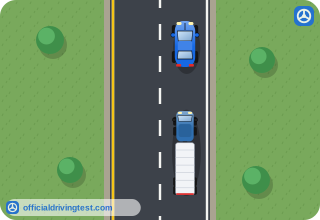
- Maintain a steady speed behind it
- Use your turn signal well in advance
- Make a sudden lane change or stop
- Drive in the center lane for a while
Show answer
Correct answer: Make a sudden lane change or stop
A tractor-trailer takes longer to stop, so you should not make a sudden lane change or stop in front of it.
Source: Indiana Driver’s Manual (July 2026), page 50 · Open this page in the manual (Manual page 50)
-
How do the rear wheels of a turning vehicle travel compared with the front wheels?
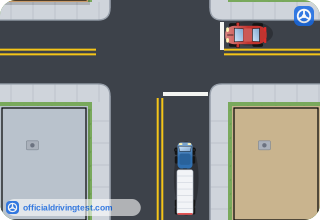
- They follow a longer path, and the difference grows with vehicle length
- They follow a shorter path, and the difference grows with vehicle length
- They follow the same path as the front wheels at all times
- They follow a shorter path, but only on vehicles that pull a trailer
Show answer
Correct answer: They follow a shorter path, and the difference grows with vehicle length
With any turning vehicle, the rear wheels follow a shorter path, and the longer the vehicle, the greater the difference.
Source: Indiana Driver’s Manual (July 2026), page 50 · Open this page in the manual (Manual page 50)
-
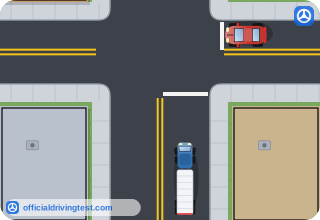
What do tractor-trailer drivers often do as the first step in making a tight turn?
- Back up slightly
- Turn on hazard lights
- Sound the horn
- Swing out
Show answer
Correct answer: Swing out
Tractor-trailer drivers often swing out as the first step in a tight turn.
Source: Indiana Driver’s Manual (July 2026), page 50 · Open this page in the manual (Manual page 50)
-
You are following a tractor-trailer that appears to be moving to the left. What should you do?
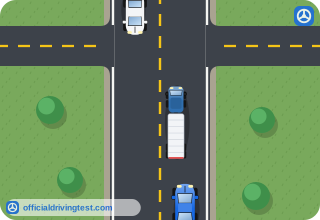
- Wait a moment to see which way the driver is signaling, and watch for a right turn
- Pass quickly on the right side before the truck has finished turning left
- Pass on the left right away because the driver is clearly moving left
- Move close behind the truck to stay out of its blind spots on both sides
Show answer
Correct answer: Wait a moment to see which way the driver is signaling, and watch for a right turn
The manual says to wait and check the driver's signal, since the truck may be making a right turn.
Source: Indiana Driver’s Manual (July 2026), page 50 · Open this page in the manual (Manual page 50)
-
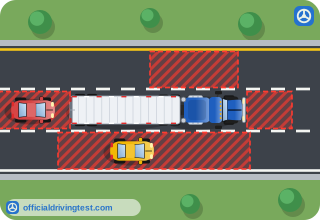
How far in front of the cab can a tractor-trailer driver's blind spot extend?
- Up to 5 feet
- Up to 50 feet
- Up to 20 feet
- Up to 100 feet
Show answer
Correct answer: Up to 20 feet
Blind spots extend up to 20 feet in front of the cab.
Source: Indiana Driver’s Manual (July 2026), page 50 · Open this page in the manual (Manual page 50)
-
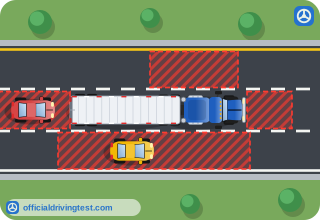
How far behind a tractor-trailer can the driver's blind spot extend?
- Up to 20 feet
- Up to 200 feet
- Up to 50 feet
- Up to 100 feet
Show answer
Correct answer: Up to 200 feet
Blind spots extend up to 200 feet behind the vehicle.
Source: Indiana Driver’s Manual (July 2026), page 50 · Open this page in the manual (Manual page 50)
-
On multi-lane highways, which lane do tractor-trailers stay in to help local traffic flow on and off the highway?
- The far left lane
- The far right lane
- The shoulder
- The center lane
Show answer
Correct answer: The center lane
On multi-lane highways, tractor-trailers stay in the center lane to help the flow of local traffic on and off the highway.
Source: Indiana Driver’s Manual (July 2026), page 50 · Open this page in the manual (Manual page 50)
-
Why does staying in the middle lane help a tractor-trailer driver?
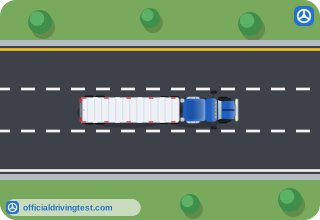
- It increases the driver's options if he or she has to switch lanes to avoid danger
- It lets the driver avoid every blind spot on both sides of the trailer
- It lets the driver use the shoulder to pass slower traffic
- It keeps the trailer from swinging into the lanes next to it on curves
Show answer
Correct answer: It increases the driver's options if he or she has to switch lanes to avoid danger
Staying in the middle lane increases the driver's options if he or she has to switch lanes to avoid an accident.
Source: Indiana Driver’s Manual (July 2026), page 50 · Open this page in the manual (Manual page 50)
-
Compared with cars, which is true of tractor-trailers?
- They have shorter stopping distances but a much wider turning radius than cars
- They accelerate faster but need a longer distance to come to a stop
- They have longer stopping and accelerating distances and a wider turning radius
- They stop more quickly than cars because of their larger, stronger brakes
Show answer
Correct answer: They have longer stopping and accelerating distances and a wider turning radius
Tractor-trailers weigh more, have longer stopping and accelerating distances, and have a wider turning radius.
Source: Indiana Driver’s Manual (July 2026), page 50 · Open this page in the manual (Manual page 50)
-
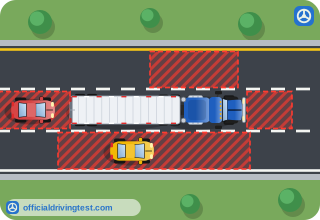
Why should you not linger in a tractor-trailer's side and rear blind spots?
- It makes the trailer sway toward your lane at higher speeds
- It hinders the driver's ability to take evasive action to avoid danger
- It prevents the driver from signaling a lane change in time
- It forces the driver to brake more often on the highway
Show answer
Correct answer: It hinders the driver's ability to take evasive action to avoid danger
Drivers lingering in the blind spots hinder the driver's ability to take evasive action.
Source: Indiana Driver’s Manual (July 2026), page 50 · Open this page in the manual (Manual page 50)
-
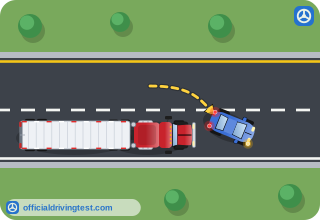
What does cutting into the open space in front of a tractor-trailer remove?
- The driver's use of the center lane
- The driver's view of the road ahead
- The driver's ability to signal a turn
- The driver's cushion of safety
Show answer
Correct answer: The driver's cushion of safety
Cutting into the open space in front removes the tractor-trailer driver's cushion of safety.
Source: Indiana Driver’s Manual (July 2026), page 50 · Open this page in the manual (Manual page 50)
-
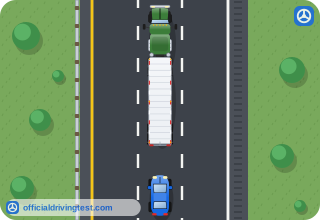
How should you pass a tractor-trailer?
- Completely, and always on the left side
- On the right side, if the truck is turning left
- Slowly, staying alongside it as long as you can
- On either side, whichever has more room
Show answer
Correct answer: Completely, and always on the left side
The manual says to always pass a tractor-trailer completely and always on the left side.
Source: Indiana Driver’s Manual (July 2026), page 50 · Open this page in the manual (Manual page 50)
-
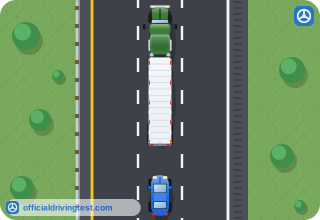
When following a tractor-trailer, what does it mean if you cannot see the driver's rearview mirrors?
- The driver is about to change lanes
- The trailer is too long to pass
- The driver cannot see you
- The driver is about to brake
Show answer
Correct answer: The driver cannot see you
If you cannot see the driver's rearview mirrors, the driver cannot see you.
Source: Indiana Driver’s Manual (July 2026), page 50 · Open this page in the manual (Manual page 50)