Washington, D.C.: Speed and following distance — Part 4 Practice Test
Questions in this part include: “When driving at night in fog, what should you use as a guide?” · “How does departing from the average traffic speed affect your chance of a crash?”
Independent educational site · not affiliated with any government agency or DMV
Ready? Test yourself
Answer to start, or tap Start below:
When driving at night in fog, what should you use as a guide?
- Instant feedback with an explanation
- Every answer cites its source in the manual
- Your best score is saved on this device
- Keyboard: press 1 to 4 to answer and Enter for the next question
Questions are original and based on the official manual "District of Columbia Driver Manual" (Updated January 2024), District of Columbia Department of Motor Vehicles (DC DMV).
All 16 questions in this practice test
Take the test above first, then use this list to study. Tap “Show answer” to see the correct answer and explanation.
Show the questions and answersHide the questions
-
Which headlights should you use in fog?
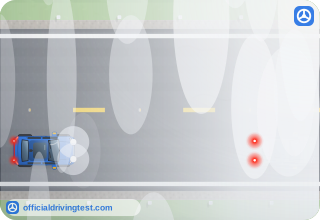
- Low beams
- High beams
- Parking lights
- Hazard flashers
Show answer
Correct answer: Low beams
The manual says to use low beams or special fog lights; high beams often reflect back into your eyes.
Source: District of Columbia Driver Manual (Updated January 2024), page 29
-
In fog, when should you reduce your speed even more?

- When the road ahead curves to the right
- When you pass a sign along the roadside
- When you see headlights or taillights ahead
- When you approach a rest area or exit
Show answer
Correct answer: When you see headlights or taillights ahead
The manual says to reduce your normal speed in fog and to slow even more when you see headlights or taillights ahead.
Source: District of Columbia Driver Manual (Updated January 2024), page 29
-
When driving at night in fog, what should you use as a guide?
- The road edge lines
- The taillights ahead
- Oncoming headlights
- Your rearview mirror
Show answer
Correct answer: The road edge lines
The manual says to use the road edge lines or the right side of the road, because you may not see highway signs until too late.
Source: District of Columbia Driver Manual (Updated January 2024), page 29
-
Which of these should you do to lessen the chance of being hit from the rear when you are the driver being followed?
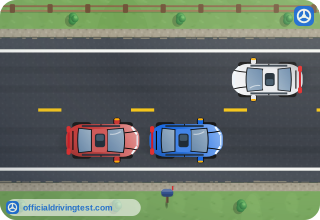
- Slow down gradually, not suddenly
- Slow down as sharply as you can so the driver behind notices
- Slow down only by shifting to a lower gear, never with the brake
- Stay close to the vehicle ahead so no one can squeeze in
Show answer
Correct answer: Slow down gradually, not suddenly
To reduce the chance of a rear-end crash, ease off gradually rather than stopping suddenly, which gives the driver behind time to react.
Source: District of Columbia Driver Manual (Updated January 2024), page 30
-
A vehicle is following your car too closely. What does the manual say you should do?
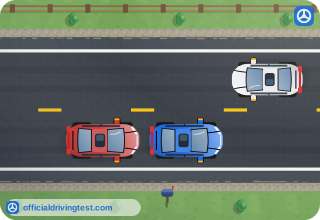
- Speed up to open a gap in front of it
- Stop on the roadway until it goes around
- Slow down and let it pass
- Brake sharply to warn the driver behind you
Show answer
Correct answer: Slow down and let it pass
Letting a tailgater pass removes the danger of being hit from behind, so the manual says to slow down and let the vehicle go by.
Source: District of Columbia Driver Manual (Updated January 2024), page 30
-
Which speed rules must you obey in the District of Columbia?
- Only the specific speed limits shown on signs along the road
- Both the general speed restriction and the specific speed limits
- Only the general speed restriction
- Whichever of the two is higher
Show answer
Correct answer: Both the general speed restriction and the specific speed limits
DC has a general speed restriction and specific speed limits, and you must obey both.
Source: District of Columbia Driver Manual (Updated January 2024), page 46
-
What does the general speed restriction say about how fast you may drive?
- At least as fast as the vehicles traveling around you
- No faster than 10 miles per hour below the posted limit
- No faster than the speed of the slowest vehicle ahead
- No faster than is reasonable under the existing conditions
Show answer
Correct answer: No faster than is reasonable under the existing conditions
No one should drive faster than is reasonable under the existing conditions, taking actual and potential hazards into account.
Source: District of Columbia Driver Manual (Updated January 2024), page 46
-
No one should drive so slowly that they impede the normal and reasonable movement of traffic, except when what applies?
- A reduced speed is necessary for the safe operation of the vehicle or to comply with the law
- The driver wants to save fuel and is traveling well below the posted speed limit
- The driver is unfamiliar with the road and wants extra time to read street signs
- The driver is in the left lane and wants other vehicles to stay behind
Show answer
Correct answer: A reduced speed is necessary for the safe operation of the vehicle or to comply with the law
Driving slowly enough to impede traffic is allowed only when needed for safe operation or to obey the law.
Source: District of Columbia Driver Manual (Updated January 2024), page 46
-
Up to the posted limit, what speed is safest to drive?
- The lowest speed that traffic allows
- Five miles per hour below the average traffic speed
- The average speed at which traffic is moving
- The highest speed you feel comfortable driving
Show answer
Correct answer: The average speed at which traffic is moving
Up to the limit, it is safest to drive at the average speed of traffic.
Source: District of Columbia Driver Manual (Updated January 2024), page 46
-
How does departing from the average traffic speed affect your chance of a crash?
- It increases only if you drive faster
- It increases it, whether you drive faster or slower
- It decreases when you drive slower
- It has no effect if you stay under the limit
Show answer
Correct answer: It increases it, whether you drive faster or slower
The more you depart from the average traffic speed, faster or slower, the greater your chance of a crash.
Source: District of Columbia Driver Manual (Updated January 2024), page 46
-
Unless otherwise posted, what is the speed limit on District of Columbia city streets?
- 20 miles per hour
- 15 miles per hour
- 25 miles per hour
- 30 miles per hour
Show answer
Correct answer: 20 miles per hour
The unposted limit on DC city streets is 20 miles per hour.
Source: District of Columbia Driver Manual (Updated January 2024), page 46
-
Unless otherwise posted, what is the speed limit in a District of Columbia alley?
- 10 miles per hour
- 20 miles per hour
- 15 miles per hour
- 25 miles per hour
Show answer
Correct answer: 15 miles per hour
The unposted limit in a DC alley is 15 miles per hour.
Source: District of Columbia Driver Manual (Updated January 2024), page 46
-
Unless otherwise posted, what is the speed limit in a District of Columbia school zone?
- 10 miles per hour
- 15 miles per hour
- 20 miles per hour
- 25 miles per hour
Show answer
Correct answer: 15 miles per hour
The unposted limit in a DC school zone is 15 miles per hour.
Source: District of Columbia Driver Manual (Updated January 2024), page 46
-
Unless otherwise posted, what speed limits apply on ordinary highways?
- 20 - 45 miles per hour
- 35 - 55 miles per hour
- 25 - 40 miles per hour
- 30 - 50 miles per hour
Show answer
Correct answer: 30 - 50 miles per hour
Ordinary highways have limits of 30 to 50 miles per hour unless otherwise posted.
Source: District of Columbia Driver Manual (Updated January 2024), page 46
-
Unless otherwise posted, what speed limits apply on divided highways?
- 30 - 55 miles per hour
- 20 - 45 miles per hour
- 30 - 50 miles per hour
- 45 - 65 miles per hour
Show answer
Correct answer: 30 - 55 miles per hour
Divided highways have limits of 30 to 55 miles per hour unless otherwise posted.
Source: District of Columbia Driver Manual (Updated January 2024), page 46
-
Does an advisory speed sign have the force of law?
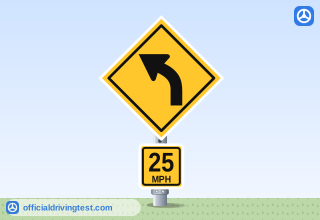
- Yes, exceeding it is always a ticketable offense
- Yes, but only in school zones
- No, but you may be ticketed if you exceed it and have a crash
- No, and it can never be used against you after a crash
Show answer
Correct answer: No, but you may be ticketed if you exceed it and have a crash
An advisory speed sign is not law, but exceeding it and then crashing may lead to a ticket for violating the general speed restriction.
Source: District of Columbia Driver Manual (Updated January 2024), page 46