Washington, D.C.: 30 Hardest Driving Test Questions
Questions that need a second thought, picked for close numbers, exceptions and easy-to-confuse rules. Take your time.
Independent educational site · not affiliated with any government agency or DMV
Ready? Test yourself
Answer to start, or tap Start below:
How does sleep deprivation affect driving compared with alcohol?
- Instant feedback with an explanation
- Every answer cites its source in the manual
- Your best score is saved on this device
- Keyboard: press 1 to 4 to answer and Enter for the next question
Questions are original and based on the official manual "District of Columbia Driver Manual" (Updated January 2024), District of Columbia Department of Motor Vehicles (DC DMV).
All 30 questions in this practice test
Take the test above first, then use this list to study. Tap “Show answer” to see the correct answer and explanation.
Show the questions and answersHide the questions
-
How does sleep deprivation affect driving compared with alcohol?
- Far less than alcohol does
- Not at all if the driver feels alert
- Just as much, and sometimes more
- Only when combined with alcohol
Show answer
Correct answer: Just as much, and sometimes more
The manual says sleep deprivation affects driving just as much as alcohol, and sometimes more.
Source: District of Columbia Driver Manual (Updated January 2024), page 5
-
How far must vehicles stop from the front or rear of a school vehicle that is stopping or stopped on the roadway with its alternating flashing red lights operating?
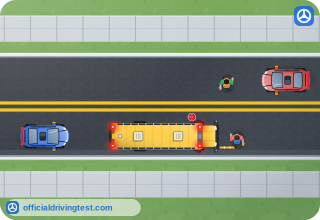
- At least 5 feet
- At least 10 feet
- At least 20 feet
- At least 50 feet
Show answer
Correct answer: At least 20 feet
All vehicles must stop at least 20 feet from the front or rear of the school vehicle.
Source: District of Columbia Driver Manual (Updated January 2024), page 38
-
Unless otherwise posted, what is the speed limit on District of Columbia city streets?
- 20 miles per hour
- 15 miles per hour
- 25 miles per hour
- 30 miles per hour
Show answer
Correct answer: 20 miles per hour
The unposted limit on DC city streets is 20 miles per hour.
Source: District of Columbia Driver Manual (Updated January 2024), page 46
-
Within how many feet in front of a flashing signal, stop sign, or traffic control signal at the side of a roadway must you not stand or park?
- 5 feet
- 10 feet
- 25 feet
- 50 feet
Show answer
Correct answer: 25 feet
You must not stand or park within 25 feet in front of a flashing signal, stop sign, or traffic control signal at the side of the road.
Source: District of Columbia Driver Manual (Updated January 2024), page 44
-
In the District of Columbia, a motor vehicle operator may not transport a child less than what age unless the child is properly secured in a child safety seat in the back seat?
- 1 year
- 5 years
- 8 years
- 3 years
Show answer
Correct answer: 3 years
A child under 3 years old must be secured in a child safety seat in the back seat.
Source: District of Columbia Driver Manual (Updated January 2024), page 48
-
Unless signs or markings show a different length, within how many feet of the points on the curb opposite the ends of a safety zone must you not stop a vehicle?
- 10 feet
- 20 feet
- 50 feet
- 30 feet
Show answer
Correct answer: 30 feet
You must not stop within 30 feet of the curb points opposite the ends of a safety zone unless signs or markings show another length.
Source: District of Columbia Driver Manual (Updated January 2024), page 44
-
Within how many feet of the nearest rail of a railroad crossing is parking prohibited?
- 25 feet
- 50 feet
- 75 feet
- 100 feet
Show answer
Correct answer: 50 feet
You must not park within 50 feet of the nearest rail of a railroad crossing except briefly to load or unload.
Source: District of Columbia Driver Manual (Updated January 2024), page 45
-
What speed or less must a vehicle be traveling to be required to display an orange triangle slow moving vehicle sign on a public highway?
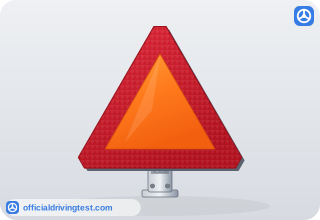
- 15 MPH
- 35 MPH
- 45 MPH
- 25 MPH
Show answer
Correct answer: 25 MPH
Vehicles traveling at 25 MPH or less, such as farm equipment, must display the slow moving vehicle sign.
Source: District of Columbia Driver Manual (Updated January 2024), page 55
-
What shape of sign is used to warn of school crossings?
- Diamond-shaped
- Octagonal
- Round
- Five-sided
Show answer
Correct answer: Five-sided
The manual says a five-sided sign is used to warn of school crossings.
Source: District of Columbia Driver Manual (Updated January 2024), page 36
-
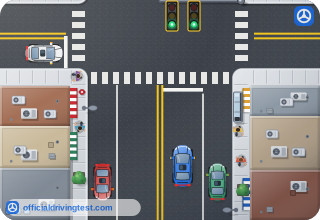
Approaching an intersection controlled by a traffic control device, what may a driver NOT do?
- Stop at the stop line and wait there while the signal is red
- Turn right after a complete stop at a red signal where allowed
- Wait for pedestrians who are in the crosswalk to clear it completely
- Drive across private property, such as a gas station lot, to avoid the signal
Show answer
Correct answer: Drive across private property, such as a gas station lot, to avoid the signal
A driver may not cut across private property, such as gas stations or store parking lots, or leave the roadway to avoid a traffic control device.
Source: District of Columbia Driver Manual (Updated January 2024), page 50
-
What is the minimum revocation period for a first alcohol related offense in the District?
- 30 days
- 90 days
- 6 months
- 1 year
Show answer
Correct answer: 6 months
The minimum revocation is 6 months for a first offense.
Source: District of Columbia Driver Manual (Updated January 2024), page 19
-
What is the minimum revocation period for a third or subsequent alcohol related offense in the District?
- 6 months
- 2 years
- 1 year
- 5 years
Show answer
Correct answer: 2 years
The minimum revocation is 2 years for a third or subsequent offense.
Source: District of Columbia Driver Manual (Updated January 2024), page 19
-
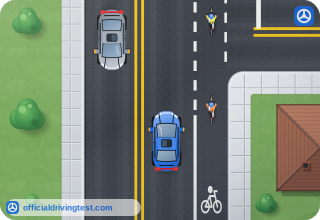
When should drivers drive in a bicycle lane?
- Whenever the road ahead is crowded
- Whenever they need to pass a slower car
- Whenever no bicyclists are visible
- Only when necessary to turn left or right
Show answer
Correct answer: Only when necessary to turn left or right
A bicycle lane is for the preferential use of bicyclists; drivers should not drive in it except when necessary to turn.
Source: District of Columbia Driver Manual (Updated January 2024), page 58
-
How close may you follow a fire apparatus that is responding to an emergency?
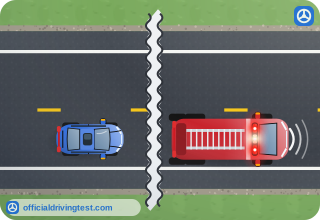
- No closer than 50 feet
- No closer than 200 feet
- No closer than 1,000 feet
- No closer than 500 feet
Show answer
Correct answer: No closer than 500 feet
The manual says not to follow any responding fire apparatus closer than 500 feet.
Source: District of Columbia Driver Manual (Updated January 2024), page 35
-
On a two-lane highway, within how many feet of an intersection must you not pass?
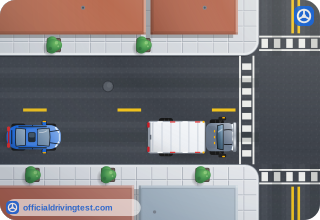
- 100 feet
- 25 feet
- 50 feet
- 200 feet
Show answer
Correct answer: 100 feet
You must not pass when crossing or within 100 feet of an intersection.
Source: District of Columbia Driver Manual (Updated January 2024), page 41
-
You must change to low beams when following a vehicle at what distance or less?
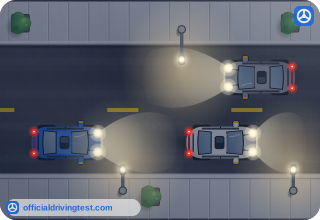
- 300 feet
- 100 feet
- 500 feet
- 1,000 feet
Show answer
Correct answer: 300 feet
You must use low beams when following another vehicle at a distance of 300 feet or less.
Source: District of Columbia Driver Manual (Updated January 2024), page 42
-
At least how far before meeting oncoming vehicles must you change to low beams?
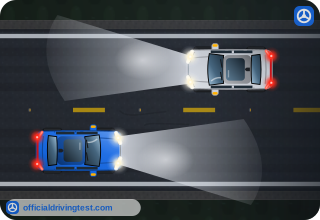
- 100 feet
- 200 feet
- 250 feet
- 500 feet
Show answer
Correct answer: 500 feet
You must switch from high to low beams at least 500 feet before meeting oncoming vehicles.
Source: District of Columbia Driver Manual (Updated January 2024), page 42
-
You cannot make a U-turn on a curve or hill where your vehicle cannot be seen at least how far away by another driver?
- 500 feet
- 100 feet
- 200 feet
- 300 feet
Show answer
Correct answer: 500 feet
A U-turn is not allowed on a curve or hill where other drivers cannot see your vehicle from at least 500 feet away.
Source: District of Columbia Driver Manual (Updated January 2024), page 47
-
You want to make a right turn across a bus lane, and no sign is posted that allows it. Within what distance of an intersection may you turn?
- 40 feet
- 100 feet
- 10 feet
- 200 feet
Show answer
Correct answer: 40 feet
Without a posted sign, you may make the turn within 40 feet of an intersection.
Source: District of Columbia Driver Manual (Updated January 2024), page 39
-
What tread depth do you need in every major groove on the front wheels?
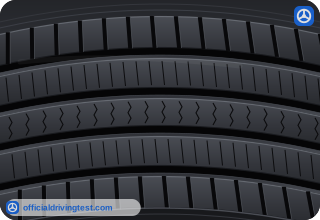
- At least 1/32 inch
- At least 4/32 inch
- At least 2/32 inch
- At least 8/32 inch
Show answer
Correct answer: At least 4/32 inch
The manual requires at least 4/32 inch of tread in every major groove of the front wheels.
Source: District of Columbia Driver Manual (Updated January 2024), page 34
-
When may you cancel the insurance on a registered vehicle?
- Any time after the registration fee is paid
- Not until your vehicle tags are surrendered to DMV
- Ten days before the registration expires
- Whenever you stop driving the vehicle for a while
Show answer
Correct answer: Not until your vehicle tags are surrendered to DMV
Insurance must be kept as long as the vehicle is registered, so do not cancel it until the tags are surrendered to DMV.
Source: District of Columbia Driver Manual (Updated January 2024), page 19
-
Do you receive points for moving violations that occur in other states?
- No, only violations in the District count
- Yes, whether in the District or in other states
- Yes, but only violations in Maryland and Virginia
- Only if the other state is a neighbor of the District
Show answer
Correct answer: Yes, whether in the District or in other states
The manual says points are given whether the violations occur in DC or in other states.
Source: District of Columbia Driver Manual (Updated January 2024), page 19
-
If you fail your road skills test, how soon may you retest?
- The next business day
- Not before 72 hours after the failed test
- Not before 7 calendar days after the failed test
- Not before 5 days after the failed test
Show answer
Correct answer: Not before 72 hours after the failed test
You may not retest before 72 hours have passed.
Source: District of Columbia Driver Manual (Updated January 2024), page 13
-
In July and August, until what time may a provisional license holder drive under the GRAD rules?
- 11:59 p.m. every day
- 10:30 p.m. every day
- 9:30 p.m. every day
- 11:00 p.m. every day
Show answer
Correct answer: 11:59 p.m. every day
Under the GRAD rules, in July and August a provisional license holder may drive every day until 11:59 p.m.
Source: District of Columbia Driver Manual (Updated January 2024), page 14
-
On a curve posted for 35 miles per hour in good weather, what may a safe speed be in wet weather?
- 10 miles per hour
- 20 miles per hour
- 25 miles per hour
- 30 miles per hour
Show answer
Correct answer: 20 miles per hour
The manual says a safe speed may be only 20 miles per hour in wet weather on such a curve.
Source: District of Columbia Driver Manual (Updated January 2024), page 29
-
Unless otherwise posted, what speed limits apply on divided highways?
- 30 - 55 miles per hour
- 20 - 45 miles per hour
- 30 - 50 miles per hour
- 45 - 65 miles per hour
Show answer
Correct answer: 30 - 55 miles per hour
Divided highways have limits of 30 to 55 miles per hour unless otherwise posted.
Source: District of Columbia Driver Manual (Updated January 2024), page 46
-
After running off the road, at what speed should you be before you try to get back on the roadway?
- 25 mph or less
- 30 mph or less
- 5 mph or less
- 15 mph or less
Show answer
Correct answer: 15 mph or less
Wait until you have control, your speed is reduced to 15 mph or less and you have checked traffic behind and beside you.
Source: District of Columbia Driver Manual (Updated January 2024), page 33
-
When the opposite lane is clear and you can pass safely, when may you cross double solid yellow lines?
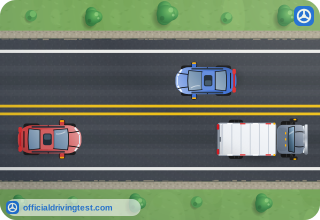
- When making a left turn or passing pedestrians, bicyclists, and riders of scooters or skateboards
- When making a right turn or passing any slower vehicle that is traveling on the road ahead
- When no traffic can be seen in either direction anywhere on the road ahead of you
- When changing over to a lane that has less traffic in it than your current lane has
Show answer
Correct answer: When making a left turn or passing pedestrians, bicyclists, and riders of scooters or skateboards
You may not cross them unless making a left turn or passing pedestrians, bicyclists, and riders of scooters or skateboards, when the opposite lane is clear and you can pass safely.
Source: District of Columbia Driver Manual (Updated January 2024), page 57
-
In a center lane marked for left turns on a three-lane road, how far may you travel in the lane?
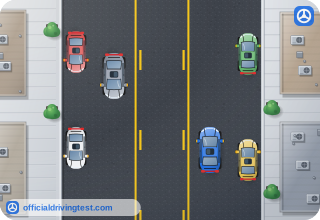
- No further than 50 feet
- No further than 150 feet
- No further than 250 feet
- No further than 500 feet
Show answer
Correct answer: No further than 150 feet
Drivers using the lane for left turns may not travel further than 150 feet in it.
Source: District of Columbia Driver Manual (Updated January 2024), page 58
-
If your vehicle stalls on railroad tracks and a train is coming, what does the manual say to do?
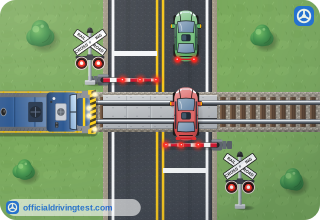
- Stay in the vehicle and sound the horn until the train stops
- Run away from the tracks in the same direction as the train
- Stay in the vehicle and keep trying to restart the engine
- Get out and run along the side of the tracks toward the train
Show answer
Correct answer: Get out and run along the side of the tracks toward the train
You get out and run along the side of the tracks toward the train, to avoid being struck by debris from the crash.
Source: District of Columbia Driver Manual (Updated January 2024), page 33