Washington, D.C.: Speed and following distance — Part 3 Practice Test
Questions in this part include: “When must chains, snow tires or radial tires be used?” · “What should you do to avoid having to rush when road conditions are bad?”
Independent educational site · not affiliated with any government agency or DMV
Ready? Test yourself
Answer to start, or tap Start below:
When must chains, snow tires or radial tires be used?
- Instant feedback with an explanation
- Every answer cites its source in the manual
- Your best score is saved on this device
- Keyboard: press 1 to 4 to answer and Enter for the next question
Questions are original and based on the official manual "District of Columbia Driver Manual" (Updated January 2024), District of Columbia Department of Motor Vehicles (DC DMV).
All 16 questions in this practice test
Take the test above first, then use this list to study. Tap “Show answer” to see the correct answer and explanation.
Show the questions and answersHide the questions
-
When must chains, snow tires or radial tires be used?
- On every District road whenever the temperature falls below freezing
- On designated snow emergency routes when a snow emergency is declared
- On all bridges and ramps from sunset until sunrise in winter
- On any road where a layer of ice or snow is visible
Show answer
Correct answer: On designated snow emergency routes when a snow emergency is declared
The manual says they must be used on designated snow emergency routes when a snow emergency is declared.
Source: District of Columbia Driver Manual (Updated January 2024), page 28
-
What should you keep clear on your vehicle in winter driving?
- Only the windshield
- Only the hood and trunk
- Only the mirrors
- Windows and lights
Show answer
Correct answer: Windows and lights
The manual says to keep windows and lights clear, remove all ice and snow, and keep an ice scraper in the vehicle.
Source: District of Columbia Driver Manual (Updated January 2024), page 28
-
How can you find out how well you can stop on a slippery road?
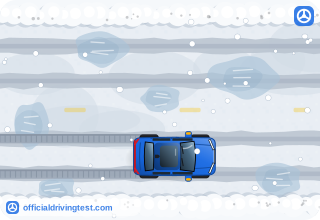
- Test your brakes gently
- Slam the brakes once
- Brake hard at full speed
- Skip testing them
Show answer
Correct answer: Test your brakes gently
The manual says to start out very slowly and then test your brakes gently to find out how well you can stop.
Source: District of Columbia Driver Manual (Updated January 2024), page 28
-
On ice and packed snow, the space you need between you and the car in front of you is:
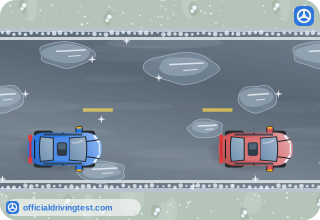
- Slightly smaller
- The same as on dry roads
- Much greater
- Half as much as on dry roads
Show answer
Correct answer: Much greater
The space needed is much greater on ice and packed snow, because even snow tires, radial tires and chains slide.
Source: District of Columbia Driver Manual (Updated January 2024), page 28
-
Which of these should you avoid on ice and snow?
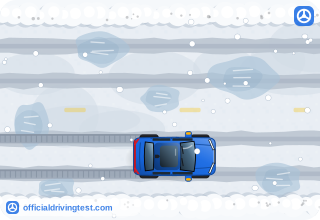
- Steering sharply or changing speed quickly
- Starting out very slowly and carefully
- Testing your brakes gently
- Slowing down long before you reach a turn
Show answer
Correct answer: Steering sharply or changing speed quickly
The manual says not to slam on the brakes and not to steer sharply or change speed quickly.
Source: District of Columbia Driver Manual (Updated January 2024), page 28
-
What is a thin layer of ice produced by melting and re-freezing on a blacktop road sometimes known as?
- Hard frost
- White ice
- Slush
- Black ice
Show answer
Correct answer: Black ice
Blacktop roads can hide a thin layer of ice from melting and re-freezing, sometimes known as black ice.
Source: District of Columbia Driver Manual (Updated January 2024), page 28
-
In winter, which freeze first before highways and roads?
- Tunnels and underpasses
- Parking lots
- Intersections
- Ramps and bridges
Show answer
Correct answer: Ramps and bridges
The manual says ramps and bridges freeze first before highways and roads.
Source: District of Columbia Driver Manual (Updated January 2024), page 28
-
What does the manual say about four-wheel drive vehicles on ice and snow?
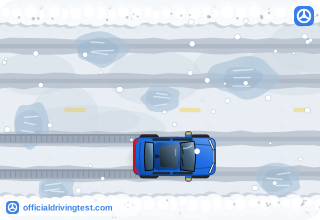
- They grip the road as well as vehicles do on dry pavement
- They slide too, so do not drive as on dry pavement
- They need no extra stopping distance on snow or ice
- They stop faster than any other vehicles on ice
Show answer
Correct answer: They slide too, so do not drive as on dry pavement
Four-wheel drive vehicles slide on ice and snow too, so you should not assume you can drive as you would on dry pavement.
Source: District of Columbia Driver Manual (Updated January 2024), page 28
-
What does the manual say about a safe speed on ice and snow?
- Half the posted limit is safe
- Ten miles per hour is always safe
- No speed is completely safe
- The posted limit is safe with chains
Show answer
Correct answer: No speed is completely safe
The manual says there is no such thing as a completely safe speed on ice and snow.
Source: District of Columbia Driver Manual (Updated January 2024), page 28
-
What should you do to avoid having to rush when road conditions are bad?
- Leave earlier than you normally would
- Drive faster than usual
- Take the shortest route
- Leave later, once the roads have been cleared
Show answer
Correct answer: Leave earlier than you normally would
The manual says to leave earlier than normal when road conditions are bad so you do not have to rush.
Source: District of Columbia Driver Manual (Updated January 2024), page 29
-
On a curve posted for 35 miles per hour in good weather, what may a safe speed be on ice and snow?
- 10 mph
- 15 mph
- 5 mph or less
- 25 mph
Show answer
Correct answer: 5 mph or less
The manual says a safe speed may be only 5 miles per hour or less on ice and snow.
Source: District of Columbia Driver Manual (Updated January 2024), page 29
-
On a curve posted for 35 miles per hour in good weather, what may a safe speed be in wet weather?
- 10 miles per hour
- 20 miles per hour
- 25 miles per hour
- 30 miles per hour
Show answer
Correct answer: 20 miles per hour
The manual says a safe speed may be only 20 miles per hour in wet weather on such a curve.
Source: District of Columbia Driver Manual (Updated January 2024), page 29
-
On which surface should you be most cautious in curves?
- Wet pavement
- Snow
- Dry pavement
- Ice
Show answer
Correct answer: Ice
The manual says to be more concerned about curves in wet weather, even more cautious on snow, and most cautious on ice.
Source: District of Columbia Driver Manual (Updated January 2024), page 29
-
Fog can reduce visibility to how much or less?
- Half a mile
- One mile
- A quarter of a mile
- An eighth of a mile
Show answer
Correct answer: A quarter of a mile
The manual says fog can reduce visibility to 1/4 mile or less.
Source: District of Columbia Driver Manual (Updated January 2024), page 29
-
When it is foggy, what is best?

- To follow taillights closely
- Not to drive at all
- To use your high beams
- To drive faster out of the fog
Show answer
Correct answer: Not to drive at all
The manual says that when it is foggy it is best not to drive at all.
Source: District of Columbia Driver Manual (Updated January 2024), page 29
-
In fog, if you cannot go at least 10 mph, what should you do?

- Stop in the travel lane and wait
- Follow the vehicle ahead closely
- Use your high beams to see farther
- Pull completely off the highway
Show answer
Correct answer: Pull completely off the highway
The manual says that if the fog is so thick you cannot go at least 10 mph, pull completely off the highway or stop at a rest area, service station or parking area.
Source: District of Columbia Driver Manual (Updated January 2024), page 29