Washington, D.C.: Speed and following distance — Part 1 Practice Test
Questions in this part include: “A person may be guilty of aggressive driving if they do which of the following?” · “You must slow down in which of these places?”
Independent educational site · not affiliated with any government agency or DMV
Ready? Test yourself
Answer to start, or tap Start below:
Aggressive driving is described in the manual as a form of:
- Instant feedback with an explanation
- Every answer cites its source in the manual
- Your best score is saved on this device
- Keyboard: press 1 to 4 to answer and Enter for the next question
Questions are original and based on the official manual "District of Columbia Driver Manual" (Updated January 2024), District of Columbia Department of Motor Vehicles (DC DMV).
All 17 questions in this practice test
Take the test above first, then use this list to study. Tap “Show answer” to see the correct answer and explanation.
Show the questions and answersHide the questions
-
Aggressive driving is described in the manual as a form of:
- Negligent driving
- Drag racing
- Reckless driving
- Distracted driving
Show answer
Correct answer: Reckless driving
The manual states that aggressive driving is a form of reckless driving.
Source: District of Columbia Driver Manual (Updated January 2024), page 21
-
A person may be guilty of aggressive driving if they do which of the following?
- Signal your intention well before changing lanes
- Pass traffic lights with a steady red indication
- Yield the right-of-way at an intersection as required
- Leave extra space behind the vehicle ahead of you
Show answer
Correct answer: Pass traffic lights with a steady red indication
Passing traffic lights with a steady red indication is among the acts listed as possible aggressive driving.
Source: District of Columbia Driver Manual (Updated January 2024), page 21
-
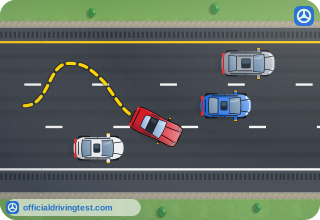
How should you protect yourself from an aggressive driver?
- Speed up to stay ahead of the driver
- Make eye contact to show you are not afraid
- Block the passing lane to slow the driver down
- Get out of the way and let the driver pass
Show answer
Correct answer: Get out of the way and let the driver pass
The manual advises letting an aggressive driver pass, not challenging them, and avoiding eye contact.
Source: District of Columbia Driver Manual (Updated January 2024), page 21
-
Which of these helps you avoid becoming an aggressive driver?
- Make up lost time with extra speed
- Follow slower vehicles closely
- Leave later and drive faster
- Identify alternative routes
Show answer
Correct answer: Identify alternative routes
Planning ahead and identifying alternative routes are listed as ways to avoid becoming an aggressive driver.
Source: District of Columbia Driver Manual (Updated January 2024), page 21
-
What does the manual say you should do to help prevent aggressive driving?
- Follow aggressive drivers home so police can find them
- Report incidents of aggressive driving to the police
- Flash your headlights at aggressive drivers to warn them
- Confront aggressive drivers at the next stop sign or light
Show answer
Correct answer: Report incidents of aggressive driving to the police
Reporting incidents to the police and setting an example for younger passengers are listed as ways to help prevent aggressive driving.
Source: District of Columbia Driver Manual (Updated January 2024), page 21
-
A person is guilty of reckless driving if he drives a motor vehicle:
- Without carrying a valid license in the vehicle at the time
- Only while racing another vehicle on a public roadway
- With a willful disregard for the safety of people or property
- At a speed that is below the minimum posted for the road
Show answer
Correct answer: With a willful disregard for the safety of people or property
Reckless driving is driving with a willful disregard for the safety of people or property.
Source: District of Columbia Driver Manual (Updated January 2024), page 21
-
A person is guilty of negligent driving if he or she drives a motor vehicle:
- In a careless or imprudent manner that endangers property or life
- Without proof of insurance kept inside the vehicle at all times
- With more passengers in the vehicle than it has seat belts
- Without a valid inspection sticker displayed on the vehicle
Show answer
Correct answer: In a careless or imprudent manner that endangers property or life
Negligent driving is driving in a careless or imprudent manner that endangers any property or the life of any individual.
Source: District of Columbia Driver Manual (Updated January 2024), page 21
-
Which of these must you not do on any public street, road, or highway?
- Pass a slower vehicle on a road where passing is clearly allowed
- Take part in a vehicle race, speed exhibition, or speed contest
- Drive in a carpool lane while carrying several passengers
- Park alongside a curb in a space where parking is legal
Show answer
Correct answer: Take part in a vehicle race, speed exhibition, or speed contest
The manual says you must not engage in any vehicle race, speed exhibition or speed contest, including drag races, on a public road.
Source: District of Columbia Driver Manual (Updated January 2024), page 21
-
You must slow down when coming to which of these?
- The crest of a hill
- A long straight road with no traffic
- A road with a wide shoulder
- A divided road with few turns
Show answer
Correct answer: The crest of a hill
The manual lists intersections, railroad grade crossings, curves and the crest of a hill as places where you must slow down.
Source: District of Columbia Driver Manual (Updated January 2024), page 23
-
You must slow down in which of these places?
- On a straight road with a wide shoulder
- Near playgrounds and schools
- On a road with no side streets
- On a road with no parked cars
Show answer
Correct answer: Near playgrounds and schools
The manual says you must slow down near playgrounds and schools, or where children are playing.
Source: District of Columbia Driver Manual (Updated January 2024), page 24
-
You must slow down when traveling upon which kind of road?
- Any road with two lanes in each direction
- Any road with a painted center line
- Any road with a paved shoulder
- Any narrow or winding roadway
Show answer
Correct answer: Any narrow or winding roadway
The manual says to slow down when traveling on any narrow or winding roadway.
Source: District of Columbia Driver Manual (Updated January 2024), page 24
-
What does the manual say about driving so slowly that you interfere with other vehicles moving at normal speeds?
- Never drive that slowly, because it can cause crashes
- It is safe as long as you stay in the right lane
- It is safe as long as you use your hazard lights
- It is safe on roads that have no posted speed limit
Show answer
Correct answer: Never drive that slowly, because it can cause crashes
Drivers who block or hinder other traffic by driving too slowly can cause crashes.
Source: District of Columbia Driver Manual (Updated January 2024), page 24
-
When is wet pavement particularly dangerous because of oil and water on the road?
- After several hours of heavy rain
- Just after the rain has stopped
- At the beginning of a light rain
- Only during a heavy downpour
Show answer
Correct answer: At the beginning of a light rain
Oil and other fluids have not yet washed away at the start of a light rain, so the mixture is especially slippery.
Source: District of Columbia Driver Manual (Updated January 2024), page 24
-
What should you watch out for on the pavement in the autumn?
- Wet leaves
- Loose sand
- Black ice
- Fresh tar
Show answer
Correct answer: Wet leaves
The manual says to watch out for wet leaves on pavement in the autumn.
Source: District of Columbia Driver Manual (Updated January 2024), page 24
-
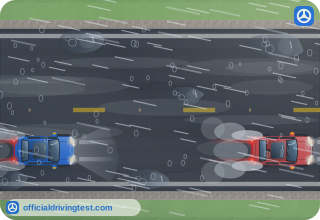
How does a wet road affect the distance you need to stop?
- You need about the same distance as on dry pavement
- You need a shorter distance because tires grip better
- You need a longer distance to stop
- You need a longer distance only on curves
Show answer
Correct answer: You need a longer distance to stop
Wet pavements are far more slippery, so it takes a longer distance to stop.
Source: District of Columbia Driver Manual (Updated January 2024), page 24
-
What are most rear-end collisions caused by?
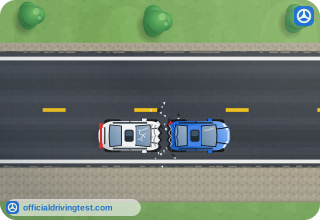
- Following too closely
- Driving too slowly
- Sudden lane changes
- Driving in bad weather
Show answer
Correct answer: Following too closely
The manual states that most rear-end collisions are caused by following too closely.
Source: District of Columbia Driver Manual (Updated January 2024), page 24
-
Which vehicles stop often and need more following distance than usual?
- Buses and post office vans
- Passenger cars and pickup trucks
- Ambulances and fire trucks
- Motorcycles and mopeds
Show answer
Correct answer: Buses and post office vans
The manual says to allow more following distance behind vehicles that stop often, such as buses and post office vans.
Source: District of Columbia Driver Manual (Updated January 2024), page 24