Washington, D.C.: Sharing the road — Part 4 Practice Test
Questions in this part include: “What are streetcars?” · “How are bicycle lanes indicated?”
Independent educational site · not affiliated with any government agency or DMV
Ready? Test yourself
Answer to start, or tap Start below:
What are streetcars?
- Instant feedback with an explanation
- Every answer cites its source in the manual
- Your best score is saved on this device
- Keyboard: press 1 to 4 to answer and Enter for the next question
Questions are original and based on the official manual "District of Columbia Driver Manual" (Updated January 2024), District of Columbia Department of Motor Vehicles (DC DMV).
All 18 questions in this practice test
Take the test above first, then use this list to study. Tap “Show answer” to see the correct answer and explanation.
Show the questions and answersHide the questions
-
Why should you avoid using your horn as you approach a bicyclist?
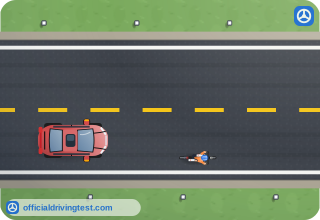
- Bicyclists cannot hear a horn
- The horn is allowed only for a motorcycle
- The horn signals that the bicyclist has the right-of-way
- Loud noises can startle the bicycle operator and cause a crash
Show answer
Correct answer: Loud noises can startle the bicycle operator and cause a crash
Bicyclists can usually hear an approaching vehicle, and a loud noise can startle the rider.
Source: District of Columbia Driver Manual (Updated January 2024), page 38
-
Why should you not follow a bicycle closely?
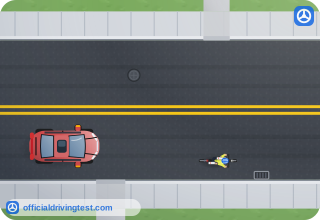
- Bicycles can stop and maneuver quickly, and bicyclists can swerve
- A bicycle always travels faster than a car on a street
- A bicycle can only travel in a straight line on the road
- A bicycle has no way to stop quickly
Show answer
Correct answer: Bicycles can stop and maneuver quickly, and bicyclists can swerve
A bicyclist can swerve or change speed quickly to avoid a road hazard.
Source: District of Columbia Driver Manual (Updated January 2024), page 38
-
After passing a bicyclist, when should you return to your lane?
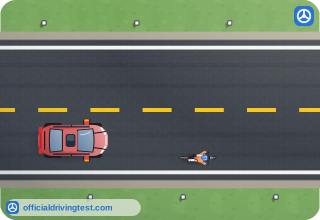
- As soon as your front bumper is past the bicyclist’s rear wheel
- When you can clearly see the bicyclist in your rear-view mirror
- After you sound your horn
- After the bicyclist signals
Show answer
Correct answer: When you can clearly see the bicyclist in your rear-view mirror
You return to your lane when the bicyclist is clearly in your rear-view mirror.
Source: District of Columbia Driver Manual (Updated January 2024), page 38
-
You are unable to pass a bicyclist safely. What should you do?
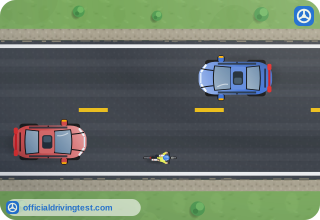
- Sound your horn to warn the rider, then pass on the left side
- Pass at once, before any other traffic arrives behind you
- Pass on the right at a high speed to clear the rider quickly
- Reduce your speed, follow the bicycle and wait for a safe chance to pass
Show answer
Correct answer: Reduce your speed, follow the bicycle and wait for a safe chance to pass
If you cannot pass safely, slow down and follow until you can.
Source: District of Columbia Driver Manual (Updated January 2024), page 38
-
What is the best way to avoid having vision blocks around a bus?
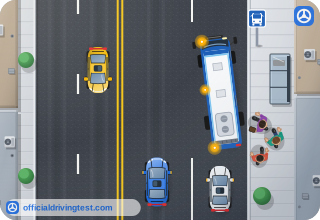
- Drive closely behind the bus so the driver can see you
- Leave a greater following distance between you and the bus
- Stay beside the bus
- Pass the bus on the right
Show answer
Correct answer: Leave a greater following distance between you and the bus
A larger gap lets you see around the bus and lets the driver see you.
Source: District of Columbia Driver Manual (Updated January 2024), page 39
-
Why is following a bus or other large vehicle too closely hazardous?
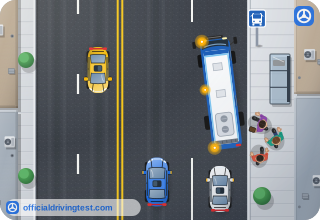
- The bus may drive in reverse at any moment
- The bus uses its horn to warn you
- You may be ticketed for passing too slowly
- You cannot see what is happening in front of it
Show answer
Correct answer: You cannot see what is happening in front of it
Following too closely hides the road ahead and may place you where the driver cannot see you.
Source: District of Columbia Driver Manual (Updated January 2024), page 39
-
What should you give buses when they are entering and exiting traffic?
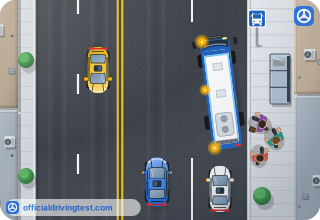
- The right-of-way
- A flash of your headlights
- A short following distance
- A signal with your horn
Show answer
Correct answer: The right-of-way
The manual says to always give buses the right-of-way when they are entering and exiting traffic.
Source: District of Columbia Driver Manual (Updated January 2024), page 39
-
Apart from turning, which of these may travel in a bus lane?
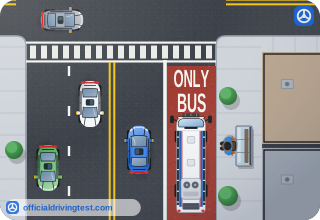
- A delivery truck
- A passenger car
- A motorcycle
- A school bus
Show answer
Correct answer: A school bus
A transit bus, tour bus, charter bus or school bus may use a bus lane; so may bicycles, paratransit and emergency vehicles.
Source: District of Columbia Driver Manual (Updated January 2024), page 39
-
What happens to unauthorized vehicles driving in bus lanes?
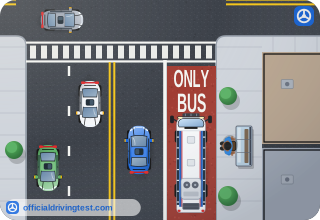
- They are allowed if traffic is heavy
- They are subject to ticketing and fines
- They are towed at once
- They get a warning only
Show answer
Correct answer: They are subject to ticketing and fines
Unauthorized vehicles in Bus Lanes can be ticketed and fined.
Source: District of Columbia Driver Manual (Updated January 2024), page 39
-
What are streetcars?
- Buses that run on a fixed schedule along a set route
- Passenger vehicles that operate on fixed rails on public streets
- Trucks that run only on public streets at night
- Cars that run on their own dedicated roadways, without rails
Show answer
Correct answer: Passenger vehicles that operate on fixed rails on public streets
Streetcars run on fixed rails on public streets, in mixed traffic or a separate right of way.
Source: District of Columbia Driver Manual (Updated January 2024), page 40
-
You are passing a stopped streetcar traveling in the same direction. On which side should you pass?
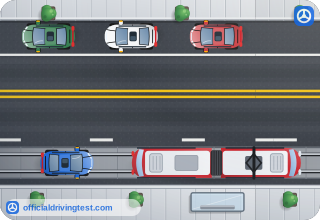
- On the right side of the streetcar
- On either side
- Do not pass it
- On the left side of the streetcar
Show answer
Correct answer: On the left side of the streetcar
When passing a stopped streetcar traveling in the same direction, use extreme caution, wait until it is safe and pass on the left side.
Source: District of Columbia Driver Manual (Updated January 2024), page 40
-
Why use extra caution when passing a stopped streetcar?
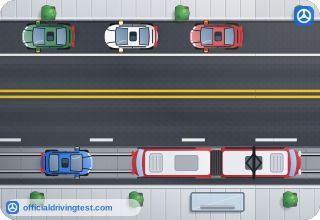
- Passengers may be entering or exiting
- The streetcar may reverse
- Streetcars have no brakes
- Streetcars must be passed at speed
Show answer
Correct answer: Passengers may be entering or exiting
Stopped streetcars may be loading or unloading passengers.
Source: District of Columbia Driver Manual (Updated January 2024), page 40
-
When passing a cyclist, what minimum clearance must you allow?
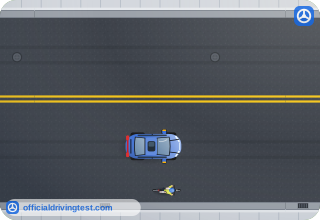
- One foot
- Two feet
- Five feet
- Three feet
Show answer
Correct answer: Three feet
You must leave at least three feet of clearance when passing a cyclist.
Source: District of Columbia Driver Manual (Updated January 2024), page 41
-
What should you not use when passing a cyclist?
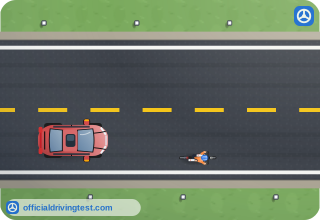
- Your horn
- Your turn signal
- Your low beams
- Your rear-view mirror
Show answer
Correct answer: Your horn
The manual says not to use your horn when passing a cyclist.
Source: District of Columbia Driver Manual (Updated January 2024), page 41
-
What do sharrows remind drivers to do?
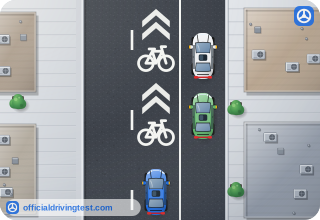
- Yield to buses
- Expect bicyclists on the road
- Stay out of the lane
- Slow to the advisory speed
Show answer
Correct answer: Expect bicyclists on the road
Sharrows clarify where bicyclists are encouraged to ride in the lane and remind drivers to expect bicyclists.
Source: District of Columbia Driver Manual (Updated January 2024), page 58
-
How are bicycle lanes indicated?
- A solid yellow line and a diamond shape in the lane ahead
- A broken yellow line along the curb of the street
- Double solid white lines and a bicycle sign mounted overhead
- A solid or dashed white line and a bicyclist symbol
Show answer
Correct answer: A solid or dashed white line and a bicyclist symbol
Bicycle lanes are marked with a solid or dashed white line and a bicyclist symbol.
Source: District of Columbia Driver Manual (Updated January 2024), page 58
-
When should drivers drive in a bicycle lane?
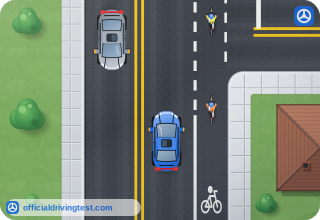
- Whenever the road ahead is crowded
- Whenever they need to pass a slower car
- Whenever no bicyclists are visible
- Only when necessary to turn left or right
Show answer
Correct answer: Only when necessary to turn left or right
A bicycle lane is for the preferential use of bicyclists; drivers should not drive in it except when necessary to turn.
Source: District of Columbia Driver Manual (Updated January 2024), page 58
-
Before turning across a bicycle lane, what should you do?
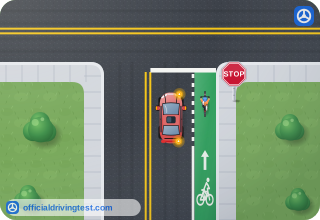
- Sound your horn and then turn right away across the lane
- Check your mirrors for bicyclists behind you and yield to bicycles
- Speed up to turn ahead of any bicyclist who is behind you
- Turn quickly so you are out of the lane first
Show answer
Correct answer: Check your mirrors for bicyclists behind you and yield to bicycles
Before turning, check mirrors for bicyclists behind you and yield to bicycles in the lane.
Source: District of Columbia Driver Manual (Updated January 2024), page 58