Washington, D.C.: Sharing the road — Part 2 Practice Test
Questions in this part include: “On multi-lane highways, which lane do tractor-trailers generally stay in?”
Independent educational site · not affiliated with any government agency or DMV
Ready? Test yourself
Answer to start, or tap Start below:
On multi-lane highways, which lane do tractor-trailers generally stay in?
- Instant feedback with an explanation
- Every answer cites its source in the manual
- Your best score is saved on this device
- Keyboard: press 1 to 4 to answer and Enter for the next question
Questions are original and based on the official manual "District of Columbia Driver Manual" (Updated January 2024), District of Columbia Department of Motor Vehicles (DC DMV).
All 18 questions in this practice test
Take the test above first, then use this list to study. Tap “Show answer” to see the correct answer and explanation.
Show the questions and answersHide the questions
-
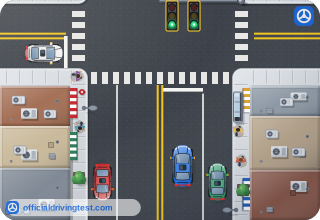
Defensive drivers should not assume what about every driver at a stop sign or red traffic light?
- That cyclists ride on the right
- That pedestrians use crosswalks
- That signs are hard to see
- That every driver will stop
Show answer
Correct answer: That every driver will stop
The manual says some drivers deliberately run stop signs and traffic lights.
Source: District of Columbia Driver Manual (Updated January 2024), page 29
-
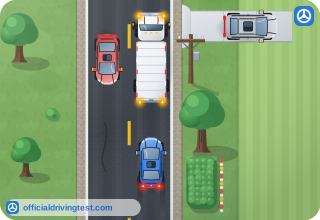
What should you constantly be thinking of as you drive defensively?
- A shortcut
- An escape route
- The next exit
- A parking space
Show answer
Correct answer: An escape route
The manual says to constantly think of an escape route so you have a plan of action if a sudden emergency arises.
Source: District of Columbia Driver Manual (Updated January 2024), page 29
-
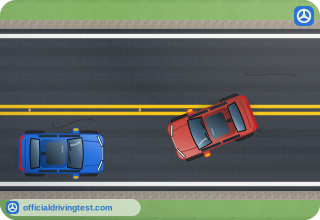
If an approaching vehicle starts to pass and may not have room to get back into the proper lane, what should you do?
- Speed up to move out of its way
- Move toward the center line
- Slow down and check the shoulder and nearby area
- Stay in the center of your lane at the same speed
Show answer
Correct answer: Slow down and check the shoulder and nearby area
The manual says to slow down and check the shoulder and nearby area so you know where you can go if necessary.
Source: District of Columbia Driver Manual (Updated January 2024), page 29
-
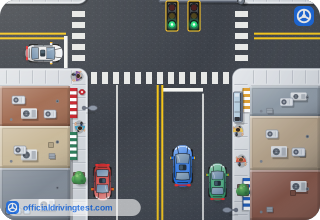
How far ahead does the manual say you should look?
- As far ahead as you can
- Only as far as the car ahead
- About one block ahead
- Only to the next intersection
Show answer
Correct answer: As far ahead as you can
Looking as far ahead as you can lets you see trouble developing in front of the vehicle ahead.
Source: District of Columbia Driver Manual (Updated January 2024), page 29
-
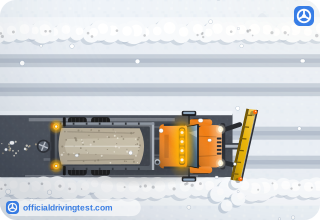
If you notice flashing red or yellow lights on a vehicle ahead, you should look for:
- A place to pass the vehicle
- Objects or people on the road
- A speed limit sign
- An exit to turn onto
Show answer
Correct answer: Objects or people on the road
The manual says to look for objects or people on the road when you see flashing red or yellow lights on a vehicle ahead.
Source: District of Columbia Driver Manual (Updated January 2024), page 29
-
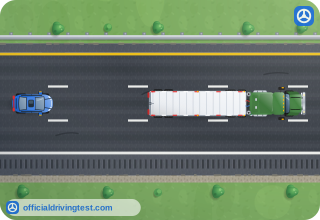
How does a large truck compare with a car in stopping and turning?
- It stops in a much shorter distance than a car does
- It has a much tighter turning radius than a car does
- It needs more distance to stop and a wider turning radius
- It accelerates faster than a car
Show answer
Correct answer: It needs more distance to stop and a wider turning radius
Trucks are not designed to be as maneuverable as cars.
Source: District of Columbia Driver Manual (Updated January 2024), page 36
-
On multi-lane highways, which lane do tractor-trailers generally stay in?
- The left lane
- The center lane
- The right lane
- The shoulder
Show answer
Correct answer: The center lane
Tractor-trailers stay in the center lane to help the flow of traffic on and off the highway.
Source: District of Columbia Driver Manual (Updated January 2024), page 36
-
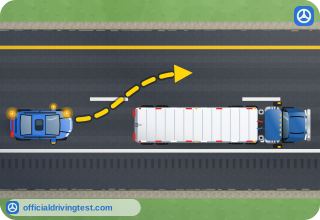
Before you move into the passing lane to pass a truck, what must be true?
- The truck is going below the speed limit and has signaled you
- The truck driver has sounded the horn to invite you
- You are at least one mile from an intersection
- It is clear to your front and rear, and you are in a legal passing zone
Show answer
Correct answer: It is clear to your front and rear, and you are in a legal passing zone
You must check front and rear and pass only in a legal passing zone.
Source: District of Columbia Driver Manual (Updated January 2024), page 36
-
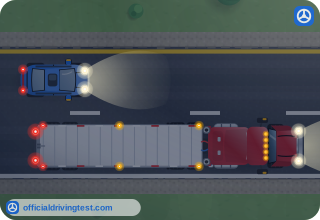
How can you let a truck driver know you are passing, especially at night?
- By blinking your headlights
- By sounding your horn
- By turning on your high beams and keeping them on
- By flashing your brake lights
Show answer
Correct answer: By blinking your headlights
Blinking your headlights tells the truck driver you are passing.
Source: District of Columbia Driver Manual (Updated January 2024), page 36
-
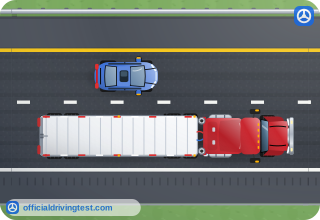
On a level highway, how much longer does it take to pass a truck than a car?
- About one minute longer
- Only one second longer
- Only three to five seconds longer
- About ten to fifteen seconds longer
Show answer
Correct answer: Only three to five seconds longer
On a level highway, passing a truck takes only three to five seconds longer than passing a car.
Source: District of Columbia Driver Manual (Updated January 2024), page 36
-
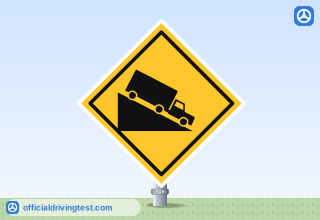
Why might you need to increase your speed when passing a truck on a downgrade?
- The truck will stop and wait for the car to pass
- The truck’s momentum will cause it to go faster
- The truck will move to the shoulder
- The truck driver will brake
Show answer
Correct answer: The truck’s momentum will cause it to go faster
On a downgrade, a truck's momentum makes it go faster.
Source: District of Columbia Driver Manual (Updated January 2024), page 36
-
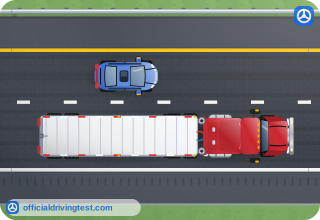
After you pass a truck, when should you move back in front of it?
- As soon as your car’s rear bumper is past the truck’s cab
- As soon as you have passed the truck’s rear bumper
- When your speed is above the truck’s
- When you can see the front of the truck in your rear-view mirror
Show answer
Correct answer: When you can see the front of the truck in your rear-view mirror
Move back only when you can see the front of the truck in your rear-view mirror.
Source: District of Columbia Driver Manual (Updated January 2024), page 36
-
What should you do after you pass a truck?
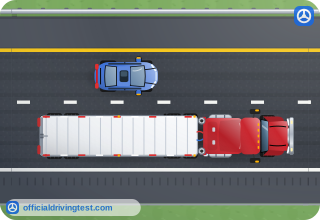
- Maintain your speed
- Slow down right away
- Stop at the next exit
- Move to the shoulder
Show answer
Correct answer: Maintain your speed
A quick lane change in front of a truck followed by slowing can leave the truck driver no time to react.
Source: District of Columbia Driver Manual (Updated January 2024), page 36
-
How far in front of the cab does a truck’s blind spot extend?
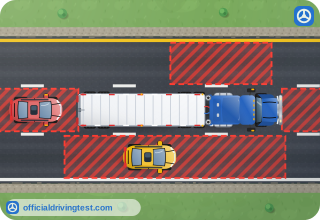
- Up to 5 feet
- Up to 50 feet
- Up to 20 feet
- Up to 200 feet
Show answer
Correct answer: Up to 20 feet
Truck blind spots extend up to 20 feet in front of the cab.
Source: District of Columbia Driver Manual (Updated January 2024), page 36
-
When you follow a truck at night, what should you always do?
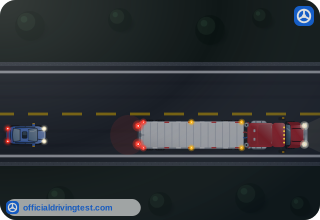
- Use your high beams
- Turn off your headlights
- Turn on your flashers
- Dim your headlights
Show answer
Correct answer: Dim your headlights
Bright lights from a vehicle behind will blind the truck driver when they reflect off the truck's large side mirrors.
Source: District of Columbia Driver Manual (Updated January 2024), page 37
-
If you are stopped behind a truck on an upgrade, what should you leave in front of you?
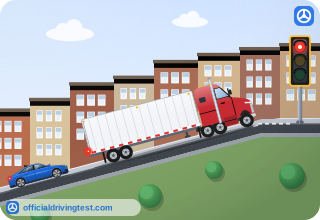
- Space, in case the truck drifts back slightly
- A car length of space on each side of the car
- No space, to stop it
- Enough space to pass it
Show answer
Correct answer: Space, in case the truck drifts back slightly
A truck may drift back slightly when it starts to move.
Source: District of Columbia Driver Manual (Updated January 2024), page 37
-
What does the manual say if you cannot see a truck’s mirrors?
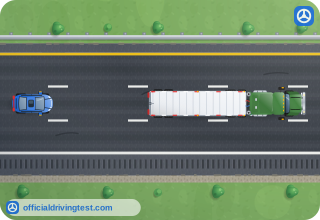
- The truck is about to turn
- The truck driver can see you in the mirror
- The truck driver cannot see you
- The truck is exceeding the limit
Show answer
Correct answer: The truck driver cannot see you
If you cannot see the truck's mirrors, you are in a blind spot.
Source: District of Columbia Driver Manual (Updated January 2024), page 37
-
What should you do about the unseen area directly behind a truck or bus (the rear no-zone)?
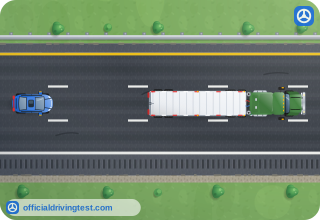
- Follow within one car length
- Avoid tailgating
- Pull up to the bumper at night
- Blink your headlights
Show answer
Correct answer: Avoid tailgating
Trucks and buses have huge no-zones directly behind them, so you should avoid tailgating.
Source: District of Columbia Driver Manual (Updated January 2024), page 37