Washington, D.C.: Sharing the road — Part 3 Practice Test
Bicyclists, large trucks and their No-Zones, school vehicles, motorcycles, buses, bus lanes and streetcars. — Part 3
Independent educational site · not affiliated with any government agency or DMV
Ready? Test yourself
- Instant feedback with an explanation
- Every answer cites its source in the manual
- Your best score is saved on this device
- Keyboard: press 1 to 4 to answer and Enter for the next question
Questions are original and based on the official manual "District of Columbia Driver Manual" (Updated January 2024), District of Columbia Department of Motor Vehicles (DC DMV).
All 18 questions in this practice test
Take the test above first, then use this list to study. Tap “Show answer” to see the correct answer and explanation.
Show the questions and answersHide the questions
-
What is a front no-zone danger when you pass a truck or bus?
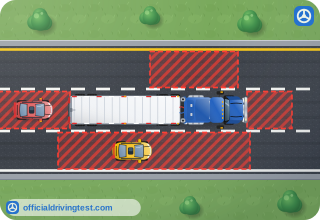
- Passing it in a legal passing zone on the left
- Staying behind the truck
- Keeping a steady speed
- Cutting in front too soon after passing it
Show answer
Correct answer: Cutting in front too soon after passing it
Cutting in front of a truck or bus too soon after passing it takes away the driver’s room to stop; look for its entire front in your rear-view mirror before you pull in front.
Source: District of Columbia Driver Manual (Updated January 2024), page 37
-
What should you never do around a truck that is backing up?
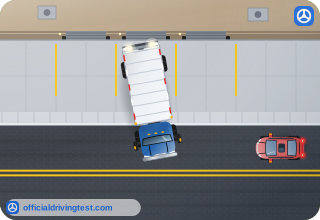
- Stop in front of it
- Wait beside it
- Cross behind it
- Pass it on the left
Show answer
Correct answer: Cross behind it
Truck drivers do not have a rear-view mirror and may not see you cutting in behind them.
Source: District of Columbia Driver Manual (Updated January 2024), page 37
-
When a truck makes a right or left turn, when should you pass?
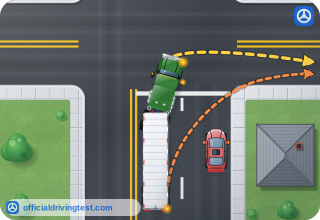
- Right after the truck driver signals
- During the turn
- Before the turn begins
- Not until the turning action is complete
Show answer
Correct answer: Not until the turning action is complete
Trucks make wide turns and sometimes use space from other lanes.
Source: District of Columbia Driver Manual (Updated January 2024), page 37
-
What can splash and spray from a truck’s wheels and trailer do in rain or snow?
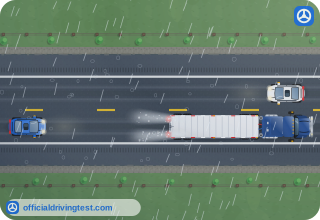
- Reduce visibility to nearly zero
- Help you see the road more clearly
- Improve your tire grip
- Wash your windshield
Show answer
Correct answer: Reduce visibility to nearly zero
In rain or snow, following or passing a heavy truck can create visibility problems.
Source: District of Columbia Driver Manual (Updated January 2024), page 37
-
Why should you pay close attention to truck turn signals?
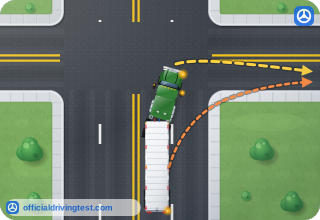
- Trucks signal when they plan to stop in the lane
- A truck's signals show when it is changing to a lower gear
- Trucks turn only after other drivers have signaled to pass
- Truck drivers cannot see cars squeezed in between them and the curb
Show answer
Correct answer: Truck drivers cannot see cars squeezed in between them and the curb
The manual says truck drivers cannot see cars squeezed in between them and the curb.
Source: District of Columbia Driver Manual (Updated January 2024), page 37
-
Whenever you drive in wet weather, what should you make sure of?
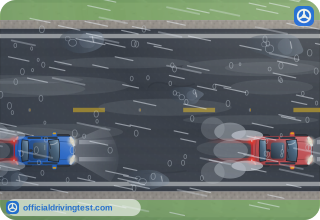
- Your wipers work, the washer reservoir has fluid and your headlights are on
- Your rear window defroster is on and your radio is turned off now
- Your tires are inflated above the recommended pressure for dry roads
- Your high beams are on and the wipers are off
Show answer
Correct answer: Your wipers work, the washer reservoir has fluid and your headlights are on
These checks help you see and be seen in the rain or snow.
Source: District of Columbia Driver Manual (Updated January 2024), page 37
-
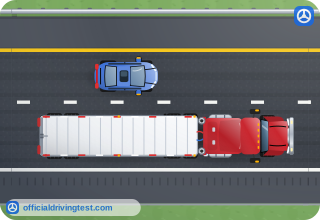
Why should you not linger alongside a truck while passing?
- It makes the truck driver slow down to let you pass
- It forces the truck driver to change lanes
- It lets the trucker see you in the mirrors
- It makes it impossible for the trucker to take evasive action
Show answer
Correct answer: It makes it impossible for the trucker to take evasive action
If you linger beside any vehicle while passing, the driver cannot dodge an obstacle in the road ahead.
Source: District of Columbia Driver Manual (Updated January 2024), page 37
-
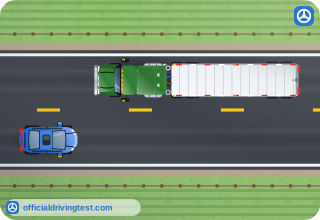
Why does a tractor-trailer often appear to travel at a slower speed than it really is?
- Because of its large size
- Because trucks may not go faster than 25 mph
- Because of its bright lights
- Because it keeps to the right lane
Show answer
Correct answer: Because of its large size
Its size can mislead drivers about how close it is and how quickly it is approaching.
Source: District of Columbia Driver Manual (Updated January 2024), page 38
-
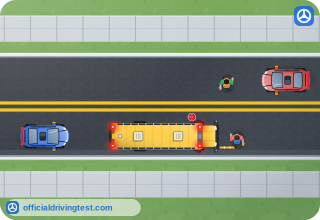
How far must vehicles stop from the front or rear of a school vehicle that is stopping or stopped on the roadway with its alternating flashing red lights operating?
- At least 5 feet
- At least 10 feet
- At least 20 feet
- At least 50 feet
Show answer
Correct answer: At least 20 feet
All vehicles must stop at least 20 feet from the front or rear of the school vehicle.
Source: District of Columbia Driver Manual (Updated January 2024), page 38
-
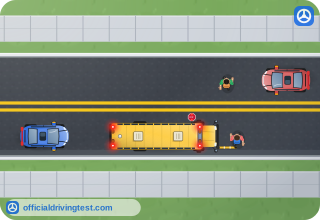
How long must you stay stopped for a school vehicle with alternating flashing red lights?
- Until the school vehicle begins to move away from the stop
- Until the alternating flashing red lights have been turned off
- For at least one minute
- Until the children are out of sight
Show answer
Correct answer: Until the alternating flashing red lights have been turned off
No one can proceed until the alternating flashing red lights have been turned off.
Source: District of Columbia Driver Manual (Updated January 2024), page 38
-
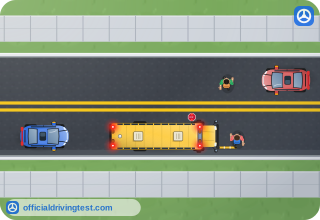
When are drivers of other vehicles not required to stop for a school vehicle’s alternating flashing red lights?
- When they are on a road that has four or more traffic lanes
- When the school vehicle has stopped at an intersection
- When no children can be seen anywhere near the school vehicle
- When they are on a divided highway and the school vehicle is across it
Show answer
Correct answer: When they are on a divided highway and the school vehicle is across it
The stop requirement does not apply on a divided highway when the school vehicle is on the other side.
Source: District of Columbia Driver Manual (Updated January 2024), page 38
-
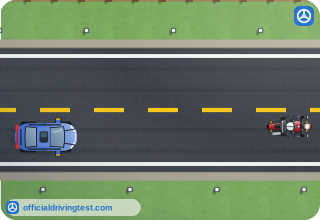
How much of its lane is a motorcycle entitled to use?
- The entire lane
- Half of the lane
- The left third of the lane
- The right half of the lane
Show answer
Correct answer: The entire lane
A motorcycle is entitled to use the entire lane, and its rider may move from side to side within it.
Source: District of Columbia Driver Manual (Updated January 2024), page 38
-
What does the manual say about passing a motorcycle within the same lane?
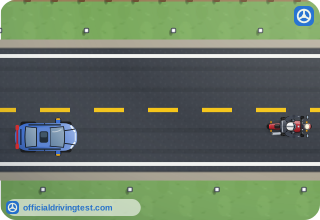
- It is allowed if you leave three feet of room beside the motorcycle
- It is allowed on a straight road
- It is against the law to overtake or pass a motorcycle within the same lane
- It is allowed if you signal first
Show answer
Correct answer: It is against the law to overtake or pass a motorcycle within the same lane
A motorcycle is entitled to the entire lane, so you must not pass it within that lane.
Source: District of Columbia Driver Manual (Updated January 2024), page 38
-
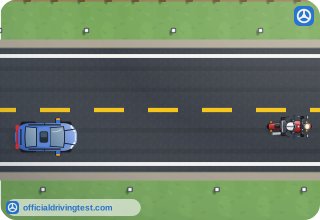
Why should you maintain a safe following distance behind a motorcycle?
- A motorcycle cannot be seen in the mirror
- A motorcycle can stop more quickly than a car
- A motorcycle is not allowed to brake suddenly
- A motorcycle always has to stay in the right lane
Show answer
Correct answer: A motorcycle can stop more quickly than a car
Motorcycles stop more quickly than cars, so tailgating one is dangerous.
Source: District of Columbia Driver Manual (Updated January 2024), page 38
-
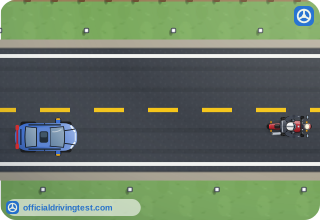
When should you be especially alert for motorcycles?
- Only on interstate highways and other limited access highways
- Only at night
- Only when it is raining
- When turning at intersections or pulling out from a side road or driveway
Show answer
Correct answer: When turning at intersections or pulling out from a side road or driveway
The size of a motorcycle makes it very difficult to see, especially at intersections and when pulling out.
Source: District of Columbia Driver Manual (Updated January 2024), page 38
-
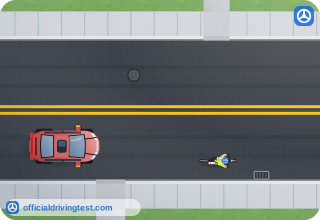
How are bicycles treated in the District of Columbia?
- As vehicles, with rights and duties like those of a motor vehicle
- As pedestrians, with the same rights as any person on foot
- As traffic that must stay off the roadway
- As vehicles that never have to yield
Show answer
Correct answer: As vehicles, with rights and duties like those of a motor vehicle
Bicycles are treated as vehicles in the District of Columbia, and bicyclists have rights and duties like those of a motor vehicle.
Source: District of Columbia Driver Manual (Updated January 2024), page 38
-
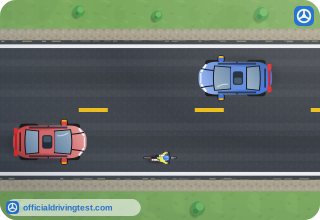
Where must motorists yield the right-of-way to bicyclists?
- Only in marked bike lanes
- Only at stop signs
- At intersections, when passing and when turning
- Only on streets with a speed limit under 25 mph
Show answer
Correct answer: At intersections, when passing and when turning
Motorists must yield to bicyclists at intersections when passing and when turning.
Source: District of Columbia Driver Manual (Updated January 2024), page 38
-
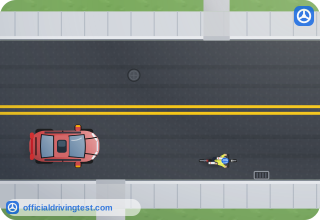
How do bicycle operators signal their intentions, since most bicycles have no turn signals?
- With horns and flashing lights
- With hand and arm signals
- With headlights
- With brake lights
Show answer
Correct answer: With hand and arm signals
Most bicycles do not have turn signals, so riders use hand and arm signals.
Source: District of Columbia Driver Manual (Updated January 2024), page 38