Washington, D.C.: Right-of-way, turning and passing — Part 4 Practice Test
Questions in this part include: “In the District of Columbia, what is the rule on making a left turn at a red light?” · “In a turnabout, how close to the left curb or edge of the street should you stop after the first forward move?”
Independent educational site · not affiliated with any government agency or DMV
Ready? Test yourself
Answer to start, or tap Start below:
In the District of Columbia, what is the rule on making a left turn at a red light?
- Instant feedback with an explanation
- Every answer cites its source in the manual
- Your best score is saved on this device
- Keyboard: press 1 to 4 to answer and Enter for the next question
Questions are original and based on the official manual "District of Columbia Driver Manual" (Updated January 2024), District of Columbia Department of Motor Vehicles (DC DMV).
All 16 questions in this practice test
Take the test above first, then use this list to study. Tap “Show answer” to see the correct answer and explanation.
Show the questions and answersHide the questions
-
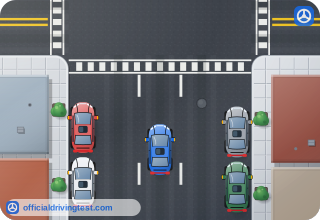
To make a left turn, which lane should you get into well ahead of the turn?
- The right lane on your side of the road
- The center of the intersection
- The shoulder
- The left lane on your side of the highway
Show answer
Correct answer: The left lane on your side of the highway
You get into the left lane on your side of the highway well ahead of a left turn.
Source: District of Columbia Driver Manual (Updated January 2024), page 42
-
When you turn left, whom must you yield to besides pedestrians in crosswalks?
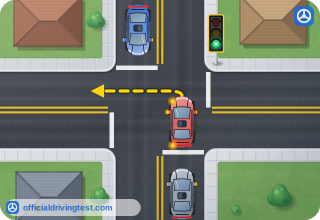
- Oncoming traffic, including bicycles
- Only oncoming motor vehicles, not bicycles
- Only vehicles turning right
- Traffic stopped behind you
Show answer
Correct answer: Oncoming traffic, including bicycles
Before a left turn you yield to oncoming traffic, bicycles included.
Source: District of Columbia Driver Manual (Updated January 2024), page 42
-
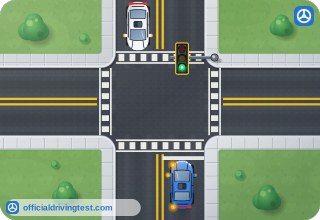
While you wait for oncoming traffic to clear before a left turn, what must you not do?
- Signal your turn
- Stay in the left lane
- Block the intersection
- Yield to pedestrians
Show answer
Correct answer: Block the intersection
You must not block the intersection while waiting for oncoming traffic to clear.
Source: District of Columbia Driver Manual (Updated January 2024), page 42
-
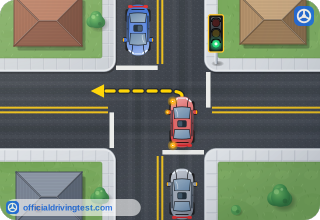
Which is a mistake to avoid when making a left turn?
- Getting into the left lane on your side well ahead of the turn
- Turning so wide that you end up in the right lane going your way
- Signaling your intention for at least 100 feet before the turn
- Yielding to oncoming traffic, including bicycles, before turning
Show answer
Correct answer: Turning so wide that you end up in the right lane going your way
You should not cut the corner or turn so wide that you end up in the right lane going your way.
Source: District of Columbia Driver Manual (Updated January 2024), page 42
-
In the District of Columbia, what is the rule on making a left turn at a red light?
- Allowed after a full stop
- Allowed when no traffic is coming
- Allowed after yielding to pedestrians
- It is illegal
Show answer
Correct answer: It is illegal
A left turn on red is illegal in the District of Columbia.
Source: District of Columbia Driver Manual (Updated January 2024), page 42
-
At a stop sign with no stop line, where must you stop?
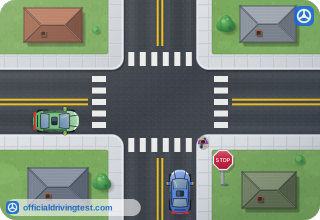
- Before entering the crosswalk
- In the middle of the crosswalk
- Just past the crosswalk
- At the far side of the intersection
Show answer
Correct answer: Before entering the crosswalk
If there is no stop line you must stop before entering the crosswalk.
Source: District of Columbia Driver Manual (Updated January 2024), page 44
-
At a yield sign, when should you come to a full stop?
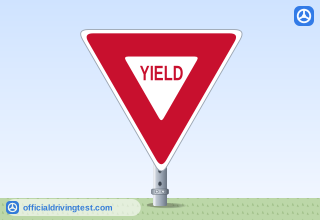
- Every time you reach a yield sign, no matter how clear the road is
- Only when the vehicle behind you is following too closely
- Only when a police officer is directing traffic at the sign
- When vehicles or pedestrians keep you from using the roadway beyond the sign
Show answer
Correct answer: When vehicles or pedestrians keep you from using the roadway beyond the sign
At a yield sign you stop fully only if vehicles or pedestrians keep you from using the road beyond it, then go when the way is clear.
Source: District of Columbia Driver Manual (Updated January 2024), page 44
-
You are emerging from an alley, driveway, private road, or parking structure and must drive over a sidewalk onto a street. What must you do?
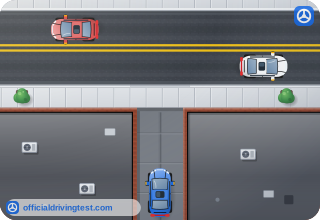
- Stop and yield to pedestrians, bicyclists, and other vehicles before entering the sidewalk
- Slow down and sound your horn, then enter the sidewalk ahead of any approaching traffic
- Stop only when a pedestrian is already on the sidewalk, then continue into the street
- Drive across the sidewalk first and stop at the edge of the street to yield to vehicles
Show answer
Correct answer: Stop and yield to pedestrians, bicyclists, and other vehicles before entering the sidewalk
You must stop and yield to pedestrians, bicyclists, and other vehicles before you enter the sidewalk or crosswalk.
Source: District of Columbia Driver Manual (Updated January 2024), page 44
-
What should you do before entering an intersection when the roadway beyond it is blocked with traffic?
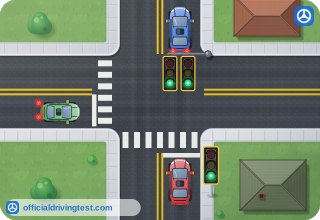
- Enter the intersection and wait in it until traffic ahead moves
- Pull into the crosswalk to wait for the road ahead to clear
- Stop and proceed through the intersection once it is no longer blocked
- Drive around the stopped traffic using the shoulder or sidewalk
Show answer
Correct answer: Stop and proceed through the intersection once it is no longer blocked
If the road beyond an intersection is blocked, you stop and enter only when it is clear: don't block the box or the crosswalk.
Source: District of Columbia Driver Manual (Updated January 2024), page 44
-
To make a turnabout, where do you start?
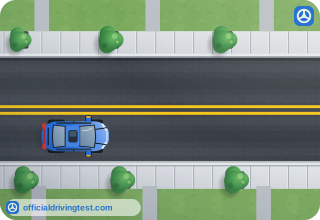
- From the center of the road
- From the extreme left side of the road
- From the extreme right side of the road
- From the middle of the nearest lane
Show answer
Correct answer: From the extreme right side of the road
A turnabout starts from the extreme right side of the road.
Source: District of Columbia Driver Manual (Updated January 2024), page 46
-
At the start of a turnabout, which way do you turn the steering wheel as you proceed forward slowly?
- To the right
- To the left
- Straight ahead
- Back and forth
Show answer
Correct answer: To the left
You move forward slowly while turning the steering wheel to the left.
Source: District of Columbia Driver Manual (Updated January 2024), page 46
-
In a turnabout, which way do you turn the steering wheel as you proceed backward slowly?
- To the left
- Straight ahead
- Back and forth
- To the right
Show answer
Correct answer: To the right
You back up slowly while turning the steering wheel to the right.
Source: District of Columbia Driver Manual (Updated January 2024), page 46
-
In a turnabout, how close to the left curb or edge of the street should you stop after the first forward move?
- Within several inches
- About three feet away
- At least six feet away
- Wherever the lane ends
Show answer
Correct answer: Within several inches
You stop within several inches of the left curb or street edge.
Source: District of Columbia Driver Manual (Updated January 2024), page 46
-
You cannot make a U-turn on a curve or hill where your vehicle cannot be seen at least how far away by another driver?
- 500 feet
- 100 feet
- 200 feet
- 300 feet
Show answer
Correct answer: 500 feet
A U-turn is not allowed on a curve or hill where other drivers cannot see your vehicle from at least 500 feet away.
Source: District of Columbia Driver Manual (Updated January 2024), page 47
-
Where are U-turns prohibited in the District of Columbia?
- At intersections controlled by stop signs
- On any two-lane street
- At intersections controlled by traffic lights
- At the end of a dead-end street
Show answer
Correct answer: At intersections controlled by traffic lights
U-turns are prohibited at intersections controlled by traffic lights and on an adjacent crosswalk.
Source: District of Columbia Driver Manual (Updated January 2024), page 47
-
At a 4-way stop, who goes first?
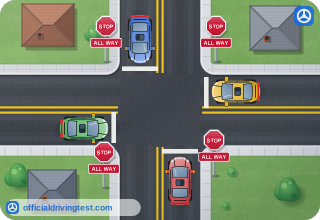
- The driver on the right
- The driver of the largest vehicle
- The first driver to stop
- The driver going straight ahead
Show answer
Correct answer: The first driver to stop
The first driver to stop is the first driver to go; other drivers wait their turn.
Source: District of Columbia Driver Manual (Updated January 2024), page 53