Washington, D.C.: Right-of-way, turning and passing
Who yields at intersections, turns and U-turns, turnabouts, and when and where you may pass. Split into 4 shorter tests so you're not stuck in one long quiz.
Independent educational site · not affiliated with any government agency or DMV
Choose a part
Right-of-way, turning and passing — Part 1
Questions in this part include: “When should you make up your mind about a turn?”
Right-of-way, turning and passing — Part 2
Questions in this part include: “What does the manual say about putting right-of-way laws ahead of safety?”
Right-of-way, turning and passing — Part 3
Who yields at intersections, turns and U-turns, turnabouts, and when and where you may pass. — Part 3
Right-of-way, turning and passing — Part 4
Questions in this part include: “In the District of Columbia, what is the rule on making a left turn at a red light?”
Questions are original and based on the official manual "District of Columbia Driver Manual" (Updated January 2024), District of Columbia Department of Motor Vehicles (DC DMV).
All 64 Right-of-way, turning and passing questions with answers
Choose a part above to take a practice test, or study every question and answer here.
Show the questions and answersHide the questions
1Part 116 questions
-
When should you make up your mind about a turn?
- Well in advance of reaching the turning point
- Just as you reach the point where you turn
- Once you can see the intersection ahead of you
- After you slow down for the corner ahead
Show answer
Correct answer: Well in advance of reaching the turning point
Last-minute decisions often cause crashes, so decide well in advance.
Source: District of Columbia Driver Manual (Updated January 2024), page 22
-
How does the speed of traffic affect when you should move into the proper lane for a turn?
- The faster traffic flows, the later you should get in the proper lane
- Traffic speed makes no difference to when you move over
- The faster traffic flows, the sooner you should get in the proper lane
- You should wait until you reach the turn to move over
Show answer
Correct answer: The faster traffic flows, the sooner you should get in the proper lane
The manual says to move into the proper lane well before the turn, and the faster traffic flows the sooner you should do so.
Source: District of Columbia Driver Manual (Updated January 2024), page 22
-
You should slow down gradually to a reasonable turning speed. What is the only exception?
- Leaving the interstate or another limited access highway
- Turning onto a wet road during a heavy rainfall
- Turning near a school while children are present
- Making a right turn from the far right-hand lane
Show answer
Correct answer: Leaving the interstate or another limited access highway
The manual names leaving the interstate or other limited access highway as the only exception to slowing down gradually for a turn.
Source: District of Columbia Driver Manual (Updated January 2024), page 23
-
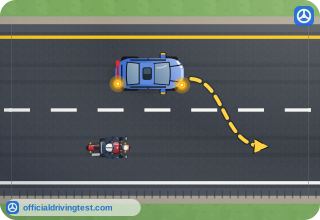
Before changing lanes, what should you do?
- Look only at the road ahead
- Look only in your rearview mirror
- Look behind you and to both sides
- Look only over your left shoulder
Show answer
Correct answer: Look behind you and to both sides
Safe turning includes looking behind you and to both sides and signaling before changing lanes.
Source: District of Columbia Driver Manual (Updated January 2024), page 22
-
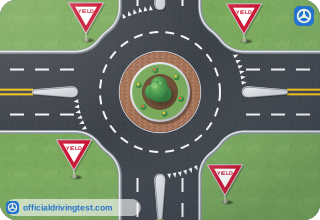
In which direction must drivers travel after entering a roundabout?
- Clockwise
- Counterclockwise
- Whichever way is shorter
- Toward the nearest exit
Show answer
Correct answer: Counterclockwise
Drivers must go counterclockwise around the center island once they have entered the roundabout.
Source: District of Columbia Driver Manual (Updated January 2024), page 31
-
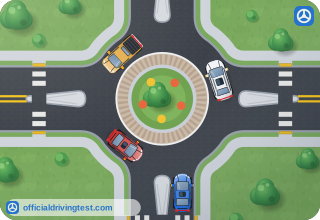
What should you do when approaching a roundabout?
- Speed up to merge ahead of the other traffic at the entry point
- Stop completely, even if the way is clear and no one is near
- Move into the left lane and keep your speed through the entry
- Slow down and use your turn signals to indicate where you want to go
Show answer
Correct answer: Slow down and use your turn signals to indicate where you want to go
You slow down and signal your intended direction as you approach.
Source: District of Columbia Driver Manual (Updated January 2024), page 31
-
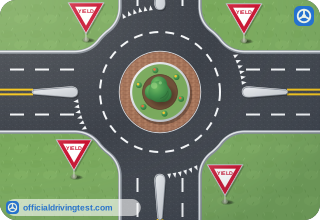
You plan to turn right at a roundabout. Where should you be as you enter it?
- To the right
- To the left
- In the center of the roadway
- Behind a large vehicle
Show answer
Correct answer: To the right
For a right turn, stay to the right as you enter the roundabout.
Source: District of Columbia Driver Manual (Updated January 2024), page 31
-
You plan to turn left at a roundabout. Where should you be as you enter it?
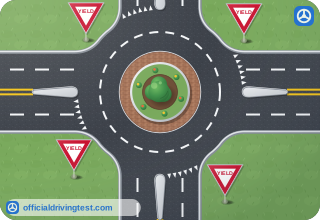
- To the right
- On the shoulder
- To the left
- In either lane, whichever is open
Show answer
Correct answer: To the left
For a left turn, stay to the left as you enter the roundabout.
Source: District of Columbia Driver Manual (Updated January 2024), page 31
-
At a dual lane roundabout, which lane may you use if you plan to go straight?
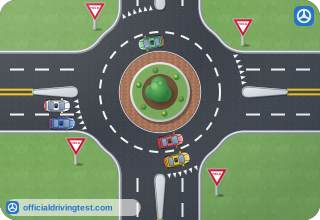
- Only the right lane
- Either lane
- Only the left lane
- Only the lane next to the island
Show answer
Correct answer: Either lane
The manual says you may stay in either lane when going straight at a dual lane circular intersection.
Source: District of Columbia Driver Manual (Updated January 2024), page 31
-
When you arrive at a roundabout, to whom must you yield the right-of-way besides motorcycles, pedestrians and bicyclists?
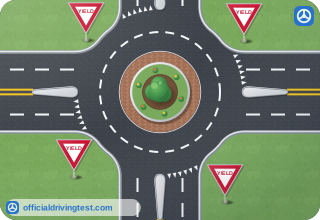
- Only vehicles entering from your left
- Vehicles waiting behind you
- Parked vehicles near the exit
- Any vehicles already in the roundabout
Show answer
Correct answer: Any vehicles already in the roundabout
Traffic already circling has priority, so you wait until the way is clear before entering.
Source: District of Columbia Driver Manual (Updated January 2024), page 31
-
Which turn signal do you use while inside a roundabout to let drivers know you are about to exit?
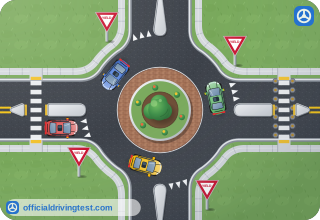
- The right turn signal
- The left turn signal
- The hazard flashers
- No signal is needed
Show answer
Correct answer: The right turn signal
While in the roundabout, you stay in your lane until ready to exit and use your right turn signal to show your plan.
Source: District of Columbia Driver Manual (Updated January 2024), page 31
-
What does the manual say about large vehicles, such as trucks and buses, at a roundabout?
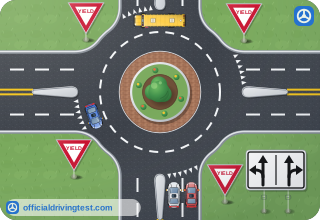
- Pass them on the right inside the roundabout
- Stay close behind them to save time
- Do not overtake them, and give them plenty of room
- Move ahead of them before they enter
Show answer
Correct answer: Do not overtake them, and give them plenty of room
Large vehicles may swing wide and can hide other vehicles, so you should not overtake them.
Source: District of Columbia Driver Manual (Updated January 2024), page 31
-
At a roundabout, what may large vehicles need to use to get around?
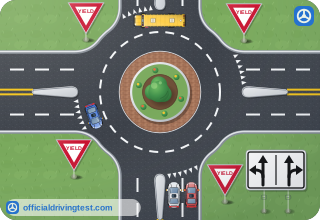
- Only the lane they entered in, with the right turn signal on
- The full width of the roadway, including mountable aprons
- Only the shoulder of the approach road and the right lane
- The sidewalk beside the exit, if there are no pedestrians
Show answer
Correct answer: The full width of the roadway, including mountable aprons
The manual warns that large vehicles may need the full roadway width, including mountable aprons.
Source: District of Columbia Driver Manual (Updated January 2024), page 31
-
What should you do before you change lanes or take an exit inside a roundabout?
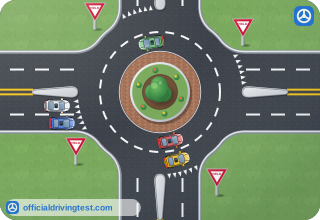
- Rely on your mirrors alone, because blind spots are not a concern
- Sound your horn, then move over before other drivers react
- Speed up to get ahead of the vehicles that are next to you
- Check for vehicles beside or behind you, and glance over your shoulder
Show answer
Correct answer: Check for vehicles beside or behind you, and glance over your shoulder
Vehicles may be in blind spots your mirrors cannot show, so a quick look over your shoulder is needed.
Source: District of Columbia Driver Manual (Updated January 2024), page 31
-
What does the right-of-way mean?
- The right of a driver to go first at any intersection at any time
- The right of one vehicle or pedestrian to proceed lawfully ahead of another
- The right of a driver to stop in any lane of a highway
- The right of a vehicle to travel faster than other traffic
Show answer
Correct answer: The right of one vehicle or pedestrian to proceed lawfully ahead of another
The right-of-way is the right to proceed lawfully ahead of another vehicle or pedestrian.
Source: District of Columbia Driver Manual (Updated January 2024), page 34
-
What should you do if you have the right-of-way and others yield it to you?
- Wait for a second signal
- Stop and let them go first
- Honk your horn first
- Proceed immediately
Show answer
Correct answer: Proceed immediately
When others yield to you, you proceed immediately.
Source: District of Columbia Driver Manual (Updated January 2024), page 34
2Part 216 questions
-
What does the manual say about putting right-of-way laws ahead of safety?
- You should never put these laws ahead of safety
- Laws always come before safety
- You may put them first when in a hurry
- You may put them first on a divided road
Show answer
Correct answer: You should never put these laws ahead of safety
Right-of-way laws are important, but safety always comes first.
Source: District of Columbia Driver Manual (Updated January 2024), page 34
-
You enter an intersection after another vehicle. What must you do?
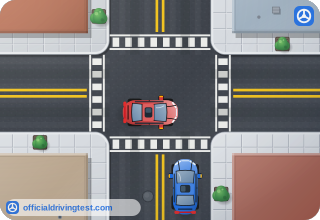
- Proceed first
- Sound your horn and proceed
- Yield the right-of-way
- Stop and wave the other driver on
Show answer
Correct answer: Yield the right-of-way
A driver who enters the intersection after another vehicle must yield.
Source: District of Columbia Driver Manual (Updated January 2024), page 35
-
You are about to turn left at an intersection or into an alley, private road or driveway. Who must you yield to?
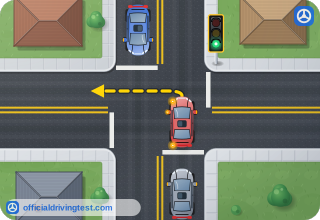
- Only vehicles that are coming toward you from the front
- Other pedestrians and vehicles, until it is safe to turn
- Only pedestrians in a marked crosswalk
- No one, if your light is green
Show answer
Correct answer: Other pedestrians and vehicles, until it is safe to turn
A left turner yields to pedestrians and vehicles until the turn can be made safely.
Source: District of Columbia Driver Manual (Updated January 2024), page 35
-
You are entering a public street or highway from a private road or driveway. What must you do?
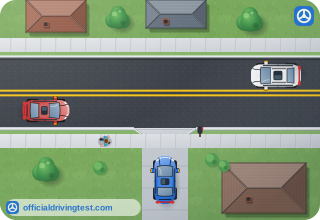
- Slow down and yield only to vehicles, not pedestrians
- Proceed if no vehicle is within 50 feet
- Sound your horn and proceed
- Stop and yield to all approaching vehicles and pedestrians
Show answer
Correct answer: Stop and yield to all approaching vehicles and pedestrians
Entering from a private road or driveway, you must first stop and give way to all vehicles and pedestrians.
Source: District of Columbia Driver Manual (Updated January 2024), page 35
-
When a traffic light turns green for you, what must you still do?
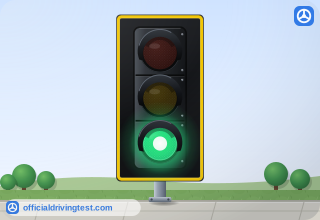
- Yield to pedestrians and vehicles in the intersection
- Speed up to clear the intersection before it changes
- Sound your horn at slow vehicles
- Yield only to vehicles from the right
Show answer
Correct answer: Yield to pedestrians and vehicles in the intersection
A green light does not remove the duty to yield to pedestrians and vehicles still in the intersection.
Source: District of Columbia Driver Manual (Updated January 2024), page 35
-
When you turn right, what must you not do around bicycle traffic?
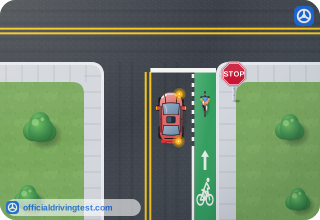
- Merge safely with the bicycle traffic beside you
- Slow down before turning
- Make a right turn across the path of bicycle traffic
- Signal before turning
Show answer
Correct answer: Make a right turn across the path of bicycle traffic
The manual says not to make right turns across the path of bicycle traffic, but to merge safely with bicycle traffic when turning.
Source: District of Columbia Driver Manual (Updated January 2024), page 38
-
District law makes it illegal for a driver to do which of these at an intersection?
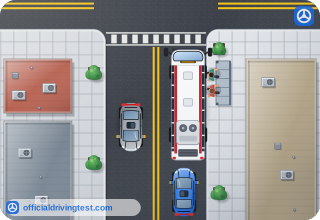
- Pass a stopped bus on the left when the road is clear
- Make a left turn behind a stopped bus at the intersection
- Turn right in front of a bus stopped for passengers
- Stop behind a bus that has stopped to let passengers off
Show answer
Correct answer: Turn right in front of a bus stopped for passengers
A vehicle must stay or merge behind the bus instead of turning right in front of it.
Source: District of Columbia Driver Manual (Updated January 2024), page 39
-
You want to make a right turn across a bus lane, and no sign is posted that allows it. Within what distance of an intersection may you turn?
- 40 feet
- 100 feet
- 10 feet
- 200 feet
Show answer
Correct answer: 40 feet
Without a posted sign, you may make the turn within 40 feet of an intersection.
Source: District of Columbia Driver Manual (Updated January 2024), page 39
-
What should you do before turning across a bus lane?
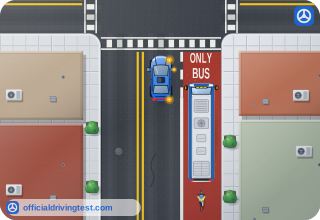
- Sound your horn to warn the buses and bicyclists behind
- Stop in the bus lane and wait until it is clear of buses
- Check your mirrors for buses and bicyclists, and yield to them
- Speed up to cross before the buses and bicyclists arrive
Show answer
Correct answer: Check your mirrors for buses and bicyclists, and yield to them
You must yield to bicycles and buses in the lane before you turn.
Source: District of Columbia Driver Manual (Updated January 2024), page 39
-
On a two-lane or other narrow highway, how much of the paved or improved portion of the road must you grant the approaching vehicle?
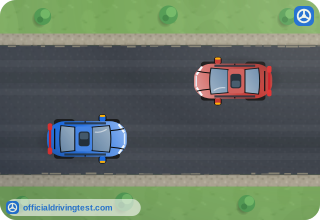
- One-half
- One-third
- One-quarter
- The entire road
Show answer
Correct answer: One-half
You must give an approaching vehicle one-half of the paved or improved part of a two-lane or narrow road.
Source: District of Columbia Driver Manual (Updated January 2024), page 41
-
Besides overtaking and passing another vehicle or cyclist, when may you leave the right side of the road?
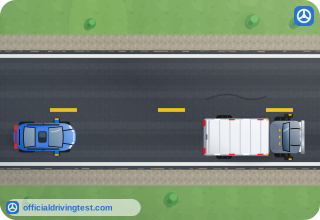
- To make a right turn
- When traffic is light
- To make a left turn
- To slow down
Show answer
Correct answer: To make a left turn
You should keep to the right except to overtake and pass or to make a left turn.
Source: District of Columbia Driver Manual (Updated January 2024), page 41
-
When you overtake a vehicle on a two-lane highway, on which side should you pass?
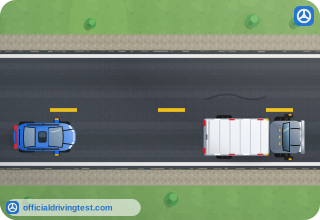
- On the right
- On the shoulder
- Whichever side has more room
- On the left
Show answer
Correct answer: On the left
On a two-lane highway you overtake and pass on the left.
Source: District of Columbia Driver Manual (Updated January 2024), page 41
-
On a two-lane highway, within how many feet of an intersection must you not pass?
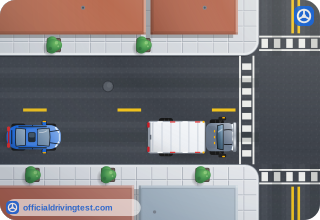
- 100 feet
- 25 feet
- 50 feet
- 200 feet
Show answer
Correct answer: 100 feet
You must not pass when crossing or within 100 feet of an intersection.
Source: District of Columbia Driver Manual (Updated January 2024), page 41
-
On a two-lane highway, within how many feet of a railroad crossing must you not pass?
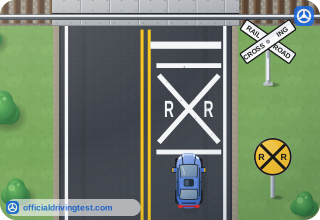
- 25 feet
- 75 feet
- 100 feet
- 200 feet
Show answer
Correct answer: 100 feet
Passing is not allowed when crossing or within 100 feet of a railroad crossing.
Source: District of Columbia Driver Manual (Updated January 2024), page 41
-
On a two-lane highway, you must not pass when you approach within 100 feet of a bridge, viaduct, or tunnel and what condition applies?
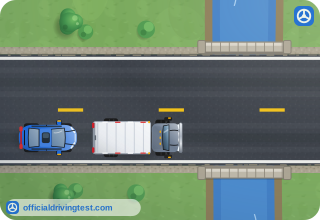
- The bridge is wet
- Your view is obstructed
- It is dark
- Another vehicle is behind you
Show answer
Correct answer: Your view is obstructed
Within 100 feet of a bridge, viaduct, or tunnel you must not pass if your view is obstructed.
Source: District of Columbia Driver Manual (Updated January 2024), page 41
-
On a two-lane highway, you must not pass when passing would do what?
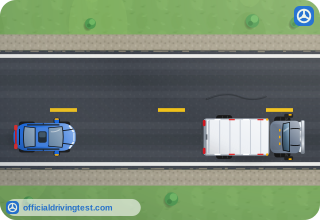
- Take you past more than one vehicle
- Require you to signal more than 100 feet ahead
- Interfere with the safe operation of oncoming vehicles
- Put you ahead of a slower vehicle
Show answer
Correct answer: Interfere with the safe operation of oncoming vehicles
You must not pass if doing so would interfere with the safe operation of oncoming vehicles.
Source: District of Columbia Driver Manual (Updated January 2024), page 41
3Part 316 questions
-
On a two-lane highway, you must not pass when approaching the top of a hill or on a curve and what applies?
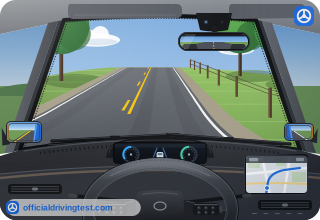
- The road surface is dry
- There is not sufficient clear view ahead
- A vehicle is behind you
- You are driving below the speed limit
Show answer
Correct answer: There is not sufficient clear view ahead
Near a hill top or on a curve you must not pass when you cannot see far enough ahead.
Source: District of Columbia Driver Manual (Updated January 2024), page 41
-
Which of these is a place where you must not drive in order to pass another vehicle?
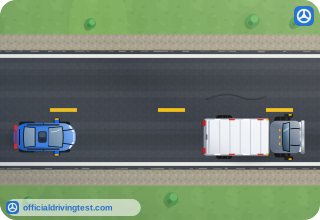
- In the left lane after a no-passing zone ends, when it is safe
- In the left lane of a two-lane highway with a clear view ahead
- In the opposite lane, with time to return before oncoming traffic
- On the shoulder of the highway, to the right or the left
Show answer
Correct answer: On the shoulder of the highway, to the right or the left
You must not pass on the shoulder of the highway, on either the right or the left.
Source: District of Columbia Driver Manual (Updated January 2024), page 41
-
What must you not do while another vehicle is passing you?
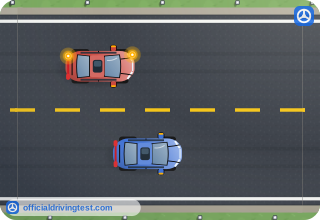
- Increase your speed
- Move to the right to give way
- Stay on the traveled portion of the road
- Keep your turn signal off
Show answer
Correct answer: Increase your speed
When being passed you must not increase your speed.
Source: District of Columbia Driver Manual (Updated January 2024), page 41
-
If you are driving the vehicle being overtaken, which way should you give way?
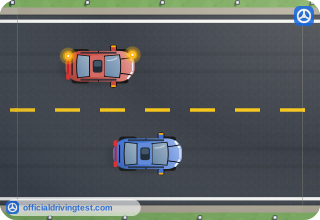
- To the left
- Toward the center line
- To the right
- You should not move over
Show answer
Correct answer: To the right
The driver being overtaken gives way to the right in favor of the overtaking vehicle.
Source: District of Columbia Driver Manual (Updated January 2024), page 41
-
What does the end of a no-passing zone mean?
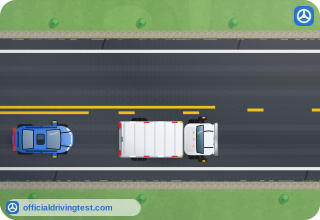
- It is always safe to pass, with or without oncoming traffic
- It is lawful to pass, but only when it is safe to do so
- You must pass the vehicle ahead as soon as the zone ends
- You may pass on the shoulder if it is clear of vehicles
Show answer
Correct answer: It is lawful to pass, but only when it is safe to do so
The end of a no-passing zone only means passing is lawful when it is safe.
Source: District of Columbia Driver Manual (Updated January 2024), page 41
-
Before you cross the center line to pass on a two-lane highway, what must you be certain of?
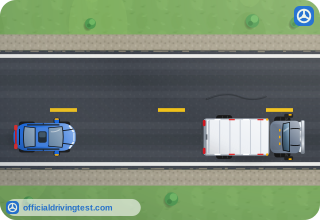
- The vehicle ahead is traveling below the posted speed limit and will not speed up
- Oncoming traffic will move to the shoulder to give you extra room to pass
- There is a solid white line on the right side of the road ahead of you
- There is time to pass and return to the right lane before meeting oncoming traffic
Show answer
Correct answer: There is time to pass and return to the right lane before meeting oncoming traffic
Before crossing the center line you must be sure you can finish the pass before oncoming traffic or a no-passing zone.
Source: District of Columbia Driver Manual (Updated January 2024), page 41
-
While you are passing on a two-lane highway, it appears you will not have time to finish before meeting oncoming traffic. What should you do?
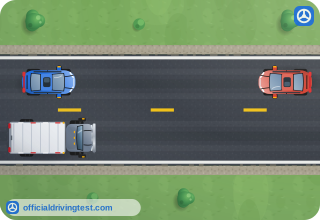
- Slow down and return to the lane behind the vehicle you were passing
- Speed up to finish the pass before the oncoming vehicle arrives
- Stay in the opposite lane and flash your headlights at the driver ahead
- Move onto the shoulder and finish passing the vehicle on the right
Show answer
Correct answer: Slow down and return to the lane behind the vehicle you were passing
If you cannot finish the pass in time, you slow down and drop back into the lane behind the vehicle.
Source: District of Columbia Driver Manual (Updated January 2024), page 41
-
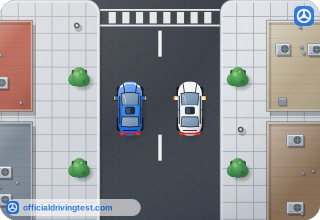
When passing a vehicle, when should you return to the right lane?
- As soon as your front bumper is even with the back bumper of the passed vehicle
- When you see both headlights of the passed vehicle in your rear-view mirror
- As soon as the passed vehicle is no longer visible in your side mirror
- When you have driven past the next intersection or driveway ahead of you
Show answer
Correct answer: When you see both headlights of the passed vehicle in your rear-view mirror
You return to the right lane once both headlights of the passed vehicle appear in your rear-view mirror.
Source: District of Columbia Driver Manual (Updated January 2024), page 41
-
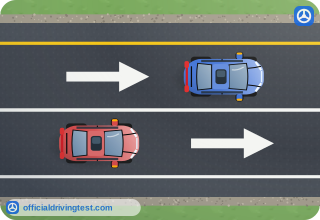
On a road with marked lanes, which of these must you not do?
- Stay in one lane
- Drive partly in one lane and partly in another
- Signal before changing lanes
- Move to the right lane when driving slowly
Show answer
Correct answer: Drive partly in one lane and partly in another
You must not drive partly in one lane and partly in another.
Source: District of Columbia Driver Manual (Updated January 2024), page 42
-
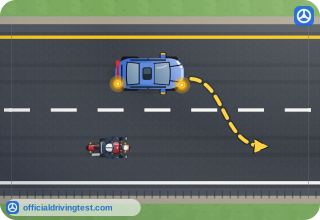
You must not move from one lane to another unless what is true?
- No vehicle is directly behind you
- The lane ahead is moving faster
- You are driving below the speed limit
- You can do so safely
Show answer
Correct answer: You can do so safely
A lane change is allowed only when you can make it safely.
Source: District of Columbia Driver Manual (Updated January 2024), page 42
-
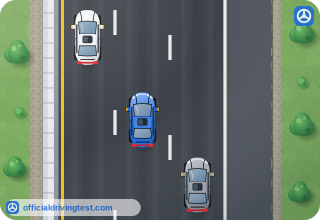
You are driving more slowly than the traffic flow on a highway with two or more lanes in your direction. Which lane should you use?
- The left lane
- The center lane
- The right lane
- Any lane with a gap
Show answer
Correct answer: The right lane
A slower driver should move to and stay in the right lane.
Source: District of Columbia Driver Manual (Updated January 2024), page 42
-
You see a vehicle stopped on the shoulder. What should you do?
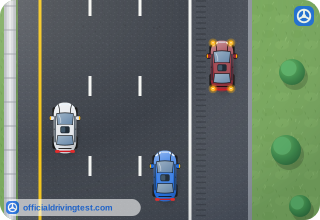
- Keep your speed and stay close to the right edge of your lane, away from the center line
- Slow down and move to the left part of your lane or the next lane, if available
- Stop behind the vehicle until it has moved away from the shoulder and rejoined traffic
- Sound your horn to warn the driver and speed up to pass it quickly
Show answer
Correct answer: Slow down and move to the left part of your lane or the next lane, if available
Near a vehicle stopped on the shoulder you slow down and move to the left part of your lane or into the next lane if possible.
Source: District of Columbia Driver Manual (Updated January 2024), page 42
-
To make a right turn, which lane should you get into well ahead of the turn?
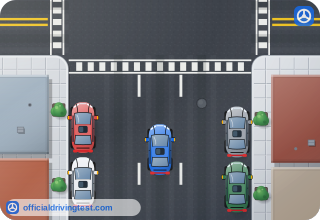
- The center lane of the highway
- The left lane on your side of the road
- Any open lane
- The lane furthermost to the right
Show answer
Correct answer: The lane furthermost to the right
For a right turn you move into the lane furthermost to the right, well before the turn.
Source: District of Columbia Driver Manual (Updated January 2024), page 42
-
When you prepare to turn right, which road users traveling between you and the side of the road should you yield to?
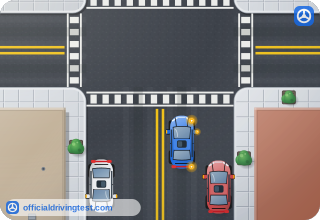
- Bicyclists
- Parked vehicles
- Vehicles in the oncoming lane
- Vehicles turning left behind you
Show answer
Correct answer: Bicyclists
A right-turning driver yields to bicyclists traveling between the vehicle and the side of the road.
Source: District of Columbia Driver Manual (Updated January 2024), page 42
-
When you make a right turn, into which lane should you turn?
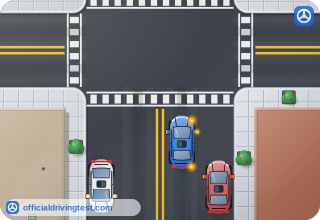
- Any lane going your way
- The center lane
- The right lane going your way
- The left lane going your way
Show answer
Correct answer: The right lane going your way
A right turn is made into the right lane going your way.
Source: District of Columbia Driver Manual (Updated January 2024), page 42
-
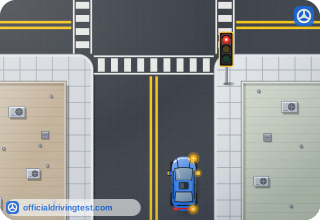
Where must you make a complete stop before a legal right turn on red?
- Past the crosswalk
- Before the crosswalk
- In the middle of the intersection
- At the far corner
Show answer
Correct answer: Before the crosswalk
For a legal right turn on red you must stop completely before the crosswalk.
Source: District of Columbia Driver Manual (Updated January 2024), page 42
4Part 416 questions
-
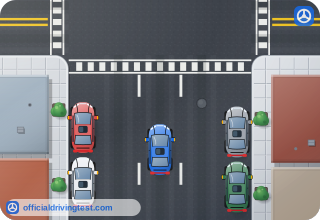
To make a left turn, which lane should you get into well ahead of the turn?
- The right lane on your side of the road
- The center of the intersection
- The shoulder
- The left lane on your side of the highway
Show answer
Correct answer: The left lane on your side of the highway
You get into the left lane on your side of the highway well ahead of a left turn.
Source: District of Columbia Driver Manual (Updated January 2024), page 42
-
When you turn left, whom must you yield to besides pedestrians in crosswalks?
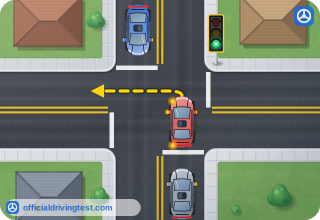
- Oncoming traffic, including bicycles
- Only oncoming motor vehicles, not bicycles
- Only vehicles turning right
- Traffic stopped behind you
Show answer
Correct answer: Oncoming traffic, including bicycles
Before a left turn you yield to oncoming traffic, bicycles included.
Source: District of Columbia Driver Manual (Updated January 2024), page 42
-
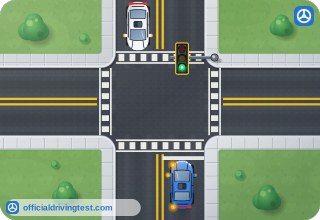
While you wait for oncoming traffic to clear before a left turn, what must you not do?
- Signal your turn
- Stay in the left lane
- Block the intersection
- Yield to pedestrians
Show answer
Correct answer: Block the intersection
You must not block the intersection while waiting for oncoming traffic to clear.
Source: District of Columbia Driver Manual (Updated January 2024), page 42
-
Which is a mistake to avoid when making a left turn?
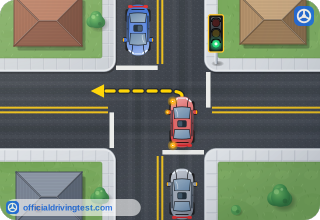
- Getting into the left lane on your side well ahead of the turn
- Turning so wide that you end up in the right lane going your way
- Signaling your intention for at least 100 feet before the turn
- Yielding to oncoming traffic, including bicycles, before turning
Show answer
Correct answer: Turning so wide that you end up in the right lane going your way
You should not cut the corner or turn so wide that you end up in the right lane going your way.
Source: District of Columbia Driver Manual (Updated January 2024), page 42
-
In the District of Columbia, what is the rule on making a left turn at a red light?
- Allowed after a full stop
- Allowed when no traffic is coming
- Allowed after yielding to pedestrians
- It is illegal
Show answer
Correct answer: It is illegal
A left turn on red is illegal in the District of Columbia.
Source: District of Columbia Driver Manual (Updated January 2024), page 42
-
At a stop sign with no stop line, where must you stop?
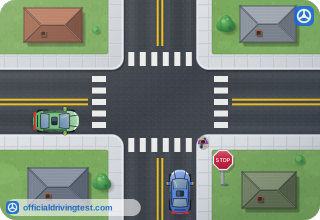
- Before entering the crosswalk
- In the middle of the crosswalk
- Just past the crosswalk
- At the far side of the intersection
Show answer
Correct answer: Before entering the crosswalk
If there is no stop line you must stop before entering the crosswalk.
Source: District of Columbia Driver Manual (Updated January 2024), page 44
-
At a yield sign, when should you come to a full stop?
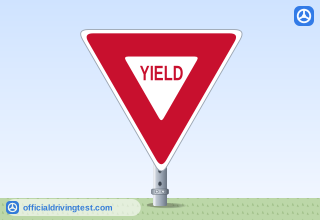
- Every time you reach a yield sign, no matter how clear the road is
- Only when the vehicle behind you is following too closely
- Only when a police officer is directing traffic at the sign
- When vehicles or pedestrians keep you from using the roadway beyond the sign
Show answer
Correct answer: When vehicles or pedestrians keep you from using the roadway beyond the sign
At a yield sign you stop fully only if vehicles or pedestrians keep you from using the road beyond it, then go when the way is clear.
Source: District of Columbia Driver Manual (Updated January 2024), page 44
-
You are emerging from an alley, driveway, private road, or parking structure and must drive over a sidewalk onto a street. What must you do?
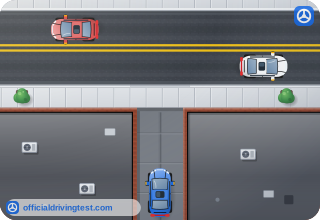
- Stop and yield to pedestrians, bicyclists, and other vehicles before entering the sidewalk
- Slow down and sound your horn, then enter the sidewalk ahead of any approaching traffic
- Stop only when a pedestrian is already on the sidewalk, then continue into the street
- Drive across the sidewalk first and stop at the edge of the street to yield to vehicles
Show answer
Correct answer: Stop and yield to pedestrians, bicyclists, and other vehicles before entering the sidewalk
You must stop and yield to pedestrians, bicyclists, and other vehicles before you enter the sidewalk or crosswalk.
Source: District of Columbia Driver Manual (Updated January 2024), page 44
-
What should you do before entering an intersection when the roadway beyond it is blocked with traffic?
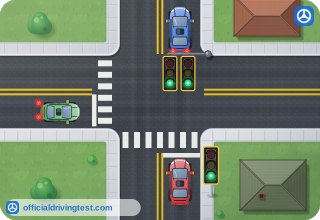
- Enter the intersection and wait in it until traffic ahead moves
- Pull into the crosswalk to wait for the road ahead to clear
- Stop and proceed through the intersection once it is no longer blocked
- Drive around the stopped traffic using the shoulder or sidewalk
Show answer
Correct answer: Stop and proceed through the intersection once it is no longer blocked
If the road beyond an intersection is blocked, you stop and enter only when it is clear: don't block the box or the crosswalk.
Source: District of Columbia Driver Manual (Updated January 2024), page 44
-
To make a turnabout, where do you start?
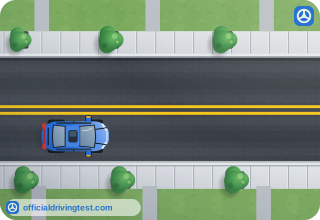
- From the center of the road
- From the extreme left side of the road
- From the extreme right side of the road
- From the middle of the nearest lane
Show answer
Correct answer: From the extreme right side of the road
A turnabout starts from the extreme right side of the road.
Source: District of Columbia Driver Manual (Updated January 2024), page 46
-
At the start of a turnabout, which way do you turn the steering wheel as you proceed forward slowly?
- To the right
- To the left
- Straight ahead
- Back and forth
Show answer
Correct answer: To the left
You move forward slowly while turning the steering wheel to the left.
Source: District of Columbia Driver Manual (Updated January 2024), page 46
-
In a turnabout, which way do you turn the steering wheel as you proceed backward slowly?
- To the left
- Straight ahead
- Back and forth
- To the right
Show answer
Correct answer: To the right
You back up slowly while turning the steering wheel to the right.
Source: District of Columbia Driver Manual (Updated January 2024), page 46
-
In a turnabout, how close to the left curb or edge of the street should you stop after the first forward move?
- Within several inches
- About three feet away
- At least six feet away
- Wherever the lane ends
Show answer
Correct answer: Within several inches
You stop within several inches of the left curb or street edge.
Source: District of Columbia Driver Manual (Updated January 2024), page 46
-
You cannot make a U-turn on a curve or hill where your vehicle cannot be seen at least how far away by another driver?
- 500 feet
- 100 feet
- 200 feet
- 300 feet
Show answer
Correct answer: 500 feet
A U-turn is not allowed on a curve or hill where other drivers cannot see your vehicle from at least 500 feet away.
Source: District of Columbia Driver Manual (Updated January 2024), page 47
-
Where are U-turns prohibited in the District of Columbia?
- At intersections controlled by stop signs
- On any two-lane street
- At intersections controlled by traffic lights
- At the end of a dead-end street
Show answer
Correct answer: At intersections controlled by traffic lights
U-turns are prohibited at intersections controlled by traffic lights and on an adjacent crosswalk.
Source: District of Columbia Driver Manual (Updated January 2024), page 47
-
At a 4-way stop, who goes first?
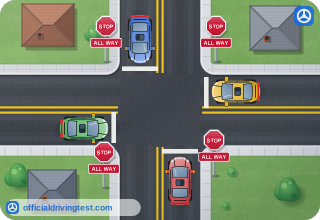
- The driver on the right
- The driver of the largest vehicle
- The first driver to stop
- The driver going straight ahead
Show answer
Correct answer: The first driver to stop
The first driver to stop is the first driver to go; other drivers wait their turn.
Source: District of Columbia Driver Manual (Updated January 2024), page 53