Washington, D.C.: Right-of-way, turning and passing — Part 2 Practice Test
Questions in this part include: “What does the manual say about putting right-of-way laws ahead of safety?”
Independent educational site · not affiliated with any government agency or DMV
Ready? Test yourself
Answer to start, or tap Start below:
What does the manual say about putting right-of-way laws ahead of safety?
- Instant feedback with an explanation
- Every answer cites its source in the manual
- Your best score is saved on this device
- Keyboard: press 1 to 4 to answer and Enter for the next question
Questions are original and based on the official manual "District of Columbia Driver Manual" (Updated January 2024), District of Columbia Department of Motor Vehicles (DC DMV).
All 16 questions in this practice test
Take the test above first, then use this list to study. Tap “Show answer” to see the correct answer and explanation.
Show the questions and answersHide the questions
-
What does the manual say about putting right-of-way laws ahead of safety?
- You should never put these laws ahead of safety
- Laws always come before safety
- You may put them first when in a hurry
- You may put them first on a divided road
Show answer
Correct answer: You should never put these laws ahead of safety
Right-of-way laws are important, but safety always comes first.
Source: District of Columbia Driver Manual (Updated January 2024), page 34
-
You enter an intersection after another vehicle. What must you do?
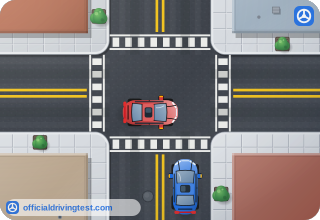
- Proceed first
- Sound your horn and proceed
- Yield the right-of-way
- Stop and wave the other driver on
Show answer
Correct answer: Yield the right-of-way
A driver who enters the intersection after another vehicle must yield.
Source: District of Columbia Driver Manual (Updated January 2024), page 35
-
You are about to turn left at an intersection or into an alley, private road or driveway. Who must you yield to?
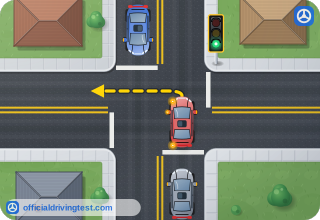
- Only vehicles that are coming toward you from the front
- Other pedestrians and vehicles, until it is safe to turn
- Only pedestrians in a marked crosswalk
- No one, if your light is green
Show answer
Correct answer: Other pedestrians and vehicles, until it is safe to turn
A left turner yields to pedestrians and vehicles until the turn can be made safely.
Source: District of Columbia Driver Manual (Updated January 2024), page 35
-
You are entering a public street or highway from a private road or driveway. What must you do?
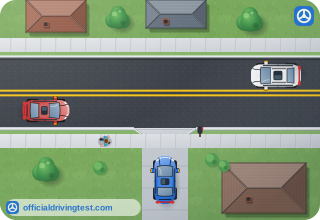
- Slow down and yield only to vehicles, not pedestrians
- Proceed if no vehicle is within 50 feet
- Sound your horn and proceed
- Stop and yield to all approaching vehicles and pedestrians
Show answer
Correct answer: Stop and yield to all approaching vehicles and pedestrians
Entering from a private road or driveway, you must first stop and give way to all vehicles and pedestrians.
Source: District of Columbia Driver Manual (Updated January 2024), page 35
-
When a traffic light turns green for you, what must you still do?
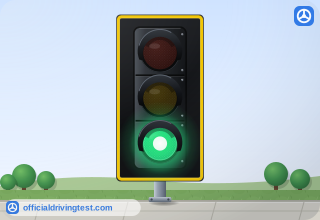
- Yield to pedestrians and vehicles in the intersection
- Speed up to clear the intersection before it changes
- Sound your horn at slow vehicles
- Yield only to vehicles from the right
Show answer
Correct answer: Yield to pedestrians and vehicles in the intersection
A green light does not remove the duty to yield to pedestrians and vehicles still in the intersection.
Source: District of Columbia Driver Manual (Updated January 2024), page 35
-
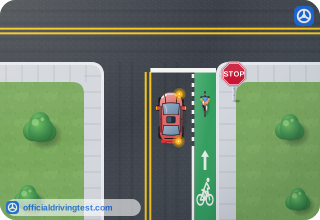
When you turn right, what must you not do around bicycle traffic?
- Merge safely with the bicycle traffic beside you
- Slow down before turning
- Make a right turn across the path of bicycle traffic
- Signal before turning
Show answer
Correct answer: Make a right turn across the path of bicycle traffic
The manual says not to make right turns across the path of bicycle traffic, but to merge safely with bicycle traffic when turning.
Source: District of Columbia Driver Manual (Updated January 2024), page 38
-
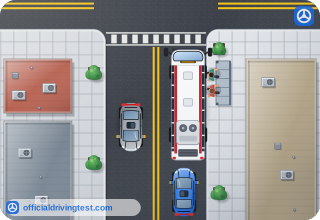
District law makes it illegal for a driver to do which of these at an intersection?
- Pass a stopped bus on the left when the road is clear
- Make a left turn behind a stopped bus at the intersection
- Turn right in front of a bus stopped for passengers
- Stop behind a bus that has stopped to let passengers off
Show answer
Correct answer: Turn right in front of a bus stopped for passengers
A vehicle must stay or merge behind the bus instead of turning right in front of it.
Source: District of Columbia Driver Manual (Updated January 2024), page 39
-
You want to make a right turn across a bus lane, and no sign is posted that allows it. Within what distance of an intersection may you turn?
- 40 feet
- 100 feet
- 10 feet
- 200 feet
Show answer
Correct answer: 40 feet
Without a posted sign, you may make the turn within 40 feet of an intersection.
Source: District of Columbia Driver Manual (Updated January 2024), page 39
-
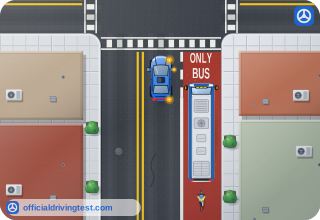
What should you do before turning across a bus lane?
- Sound your horn to warn the buses and bicyclists behind
- Stop in the bus lane and wait until it is clear of buses
- Check your mirrors for buses and bicyclists, and yield to them
- Speed up to cross before the buses and bicyclists arrive
Show answer
Correct answer: Check your mirrors for buses and bicyclists, and yield to them
You must yield to bicycles and buses in the lane before you turn.
Source: District of Columbia Driver Manual (Updated January 2024), page 39
-
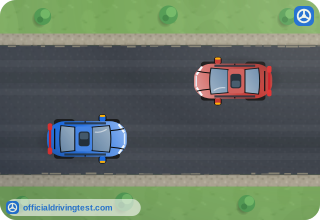
On a two-lane or other narrow highway, how much of the paved or improved portion of the road must you grant the approaching vehicle?
- One-half
- One-third
- One-quarter
- The entire road
Show answer
Correct answer: One-half
You must give an approaching vehicle one-half of the paved or improved part of a two-lane or narrow road.
Source: District of Columbia Driver Manual (Updated January 2024), page 41
-
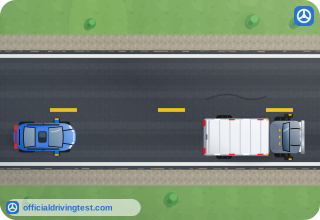
Besides overtaking and passing another vehicle or cyclist, when may you leave the right side of the road?
- To make a right turn
- When traffic is light
- To make a left turn
- To slow down
Show answer
Correct answer: To make a left turn
You should keep to the right except to overtake and pass or to make a left turn.
Source: District of Columbia Driver Manual (Updated January 2024), page 41
-
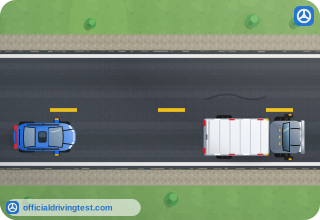
When you overtake a vehicle on a two-lane highway, on which side should you pass?
- On the right
- On the shoulder
- Whichever side has more room
- On the left
Show answer
Correct answer: On the left
On a two-lane highway you overtake and pass on the left.
Source: District of Columbia Driver Manual (Updated January 2024), page 41
-
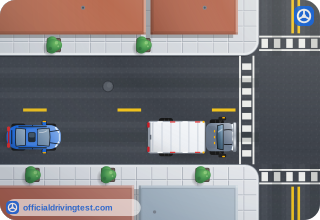
On a two-lane highway, within how many feet of an intersection must you not pass?
- 100 feet
- 25 feet
- 50 feet
- 200 feet
Show answer
Correct answer: 100 feet
You must not pass when crossing or within 100 feet of an intersection.
Source: District of Columbia Driver Manual (Updated January 2024), page 41
-
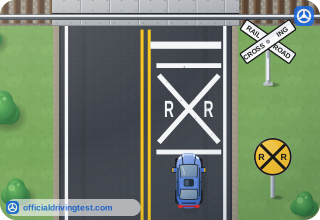
On a two-lane highway, within how many feet of a railroad crossing must you not pass?
- 25 feet
- 75 feet
- 100 feet
- 200 feet
Show answer
Correct answer: 100 feet
Passing is not allowed when crossing or within 100 feet of a railroad crossing.
Source: District of Columbia Driver Manual (Updated January 2024), page 41
-
On a two-lane highway, you must not pass when you approach within 100 feet of a bridge, viaduct, or tunnel and what condition applies?
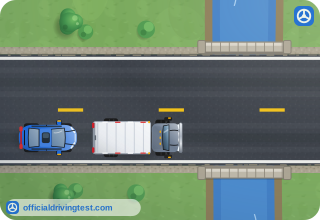
- The bridge is wet
- Your view is obstructed
- It is dark
- Another vehicle is behind you
Show answer
Correct answer: Your view is obstructed
Within 100 feet of a bridge, viaduct, or tunnel you must not pass if your view is obstructed.
Source: District of Columbia Driver Manual (Updated January 2024), page 41
-
On a two-lane highway, you must not pass when passing would do what?
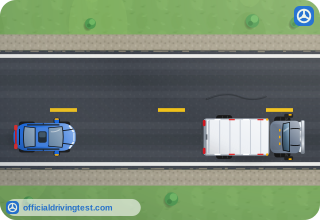
- Take you past more than one vehicle
- Require you to signal more than 100 feet ahead
- Interfere with the safe operation of oncoming vehicles
- Put you ahead of a slower vehicle
Show answer
Correct answer: Interfere with the safe operation of oncoming vehicles
You must not pass if doing so would interfere with the safe operation of oncoming vehicles.
Source: District of Columbia Driver Manual (Updated January 2024), page 41