Washington, D.C.: Right-of-way, turning and passing — Part 1 Practice Test
Questions in this part include: “When should you make up your mind about a turn?” · “You should slow down gradually to a reasonable turning speed. What is the only exception?”
Independent educational site · not affiliated with any government agency or DMV
Ready? Test yourself
Answer to start, or tap Start below:
When should you make up your mind about a turn?
- Instant feedback with an explanation
- Every answer cites its source in the manual
- Your best score is saved on this device
- Keyboard: press 1 to 4 to answer and Enter for the next question
Questions are original and based on the official manual "District of Columbia Driver Manual" (Updated January 2024), District of Columbia Department of Motor Vehicles (DC DMV).
All 16 questions in this practice test
Take the test above first, then use this list to study. Tap “Show answer” to see the correct answer and explanation.
Show the questions and answersHide the questions
-
When should you make up your mind about a turn?
- Well in advance of reaching the turning point
- Just as you reach the point where you turn
- Once you can see the intersection ahead of you
- After you slow down for the corner ahead
Show answer
Correct answer: Well in advance of reaching the turning point
Last-minute decisions often cause crashes, so decide well in advance.
Source: District of Columbia Driver Manual (Updated January 2024), page 22
-
How does the speed of traffic affect when you should move into the proper lane for a turn?
- The faster traffic flows, the later you should get in the proper lane
- Traffic speed makes no difference to when you move over
- The faster traffic flows, the sooner you should get in the proper lane
- You should wait until you reach the turn to move over
Show answer
Correct answer: The faster traffic flows, the sooner you should get in the proper lane
The manual says to move into the proper lane well before the turn, and the faster traffic flows the sooner you should do so.
Source: District of Columbia Driver Manual (Updated January 2024), page 22
-
You should slow down gradually to a reasonable turning speed. What is the only exception?
- Leaving the interstate or another limited access highway
- Turning onto a wet road during a heavy rainfall
- Turning near a school while children are present
- Making a right turn from the far right-hand lane
Show answer
Correct answer: Leaving the interstate or another limited access highway
The manual names leaving the interstate or other limited access highway as the only exception to slowing down gradually for a turn.
Source: District of Columbia Driver Manual (Updated January 2024), page 23
-
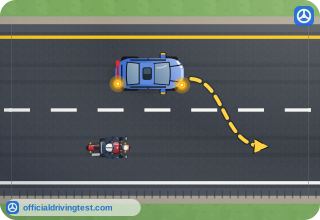
Before changing lanes, what should you do?
- Look only at the road ahead
- Look only in your rearview mirror
- Look behind you and to both sides
- Look only over your left shoulder
Show answer
Correct answer: Look behind you and to both sides
Safe turning includes looking behind you and to both sides and signaling before changing lanes.
Source: District of Columbia Driver Manual (Updated January 2024), page 22
-
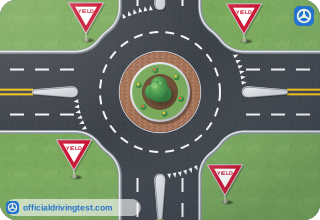
In which direction must drivers travel after entering a roundabout?
- Clockwise
- Counterclockwise
- Whichever way is shorter
- Toward the nearest exit
Show answer
Correct answer: Counterclockwise
Drivers must go counterclockwise around the center island once they have entered the roundabout.
Source: District of Columbia Driver Manual (Updated January 2024), page 31
-
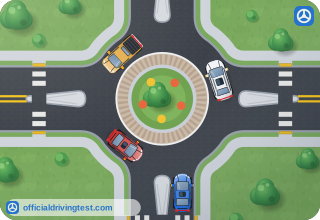
What should you do when approaching a roundabout?
- Speed up to merge ahead of the other traffic at the entry point
- Stop completely, even if the way is clear and no one is near
- Move into the left lane and keep your speed through the entry
- Slow down and use your turn signals to indicate where you want to go
Show answer
Correct answer: Slow down and use your turn signals to indicate where you want to go
You slow down and signal your intended direction as you approach.
Source: District of Columbia Driver Manual (Updated January 2024), page 31
-
You plan to turn right at a roundabout. Where should you be as you enter it?
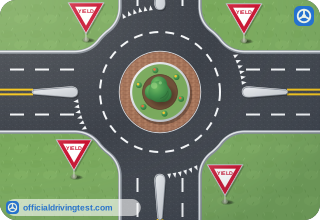
- To the right
- To the left
- In the center of the roadway
- Behind a large vehicle
Show answer
Correct answer: To the right
For a right turn, stay to the right as you enter the roundabout.
Source: District of Columbia Driver Manual (Updated January 2024), page 31
-
You plan to turn left at a roundabout. Where should you be as you enter it?
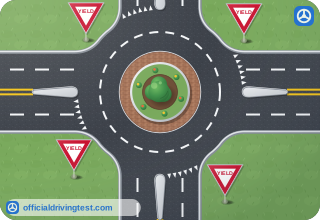
- To the right
- On the shoulder
- To the left
- In either lane, whichever is open
Show answer
Correct answer: To the left
For a left turn, stay to the left as you enter the roundabout.
Source: District of Columbia Driver Manual (Updated January 2024), page 31
-
At a dual lane roundabout, which lane may you use if you plan to go straight?
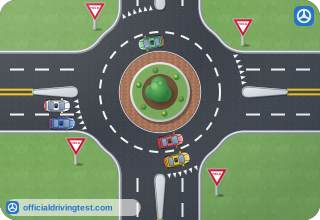
- Only the right lane
- Either lane
- Only the left lane
- Only the lane next to the island
Show answer
Correct answer: Either lane
The manual says you may stay in either lane when going straight at a dual lane circular intersection.
Source: District of Columbia Driver Manual (Updated January 2024), page 31
-
When you arrive at a roundabout, to whom must you yield the right-of-way besides motorcycles, pedestrians and bicyclists?
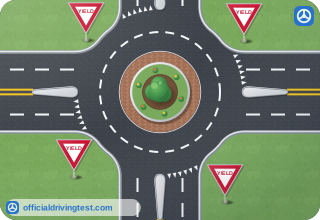
- Only vehicles entering from your left
- Vehicles waiting behind you
- Parked vehicles near the exit
- Any vehicles already in the roundabout
Show answer
Correct answer: Any vehicles already in the roundabout
Traffic already circling has priority, so you wait until the way is clear before entering.
Source: District of Columbia Driver Manual (Updated January 2024), page 31
-
Which turn signal do you use while inside a roundabout to let drivers know you are about to exit?
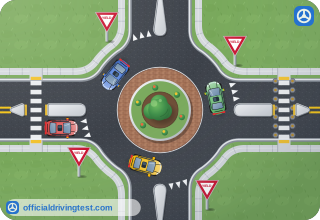
- The right turn signal
- The left turn signal
- The hazard flashers
- No signal is needed
Show answer
Correct answer: The right turn signal
While in the roundabout, you stay in your lane until ready to exit and use your right turn signal to show your plan.
Source: District of Columbia Driver Manual (Updated January 2024), page 31
-
What does the manual say about large vehicles, such as trucks and buses, at a roundabout?
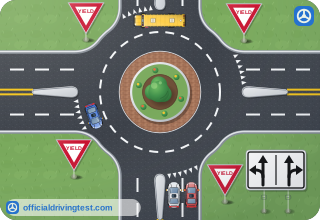
- Pass them on the right inside the roundabout
- Stay close behind them to save time
- Do not overtake them, and give them plenty of room
- Move ahead of them before they enter
Show answer
Correct answer: Do not overtake them, and give them plenty of room
Large vehicles may swing wide and can hide other vehicles, so you should not overtake them.
Source: District of Columbia Driver Manual (Updated January 2024), page 31
-
At a roundabout, what may large vehicles need to use to get around?
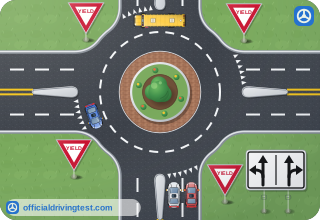
- Only the lane they entered in, with the right turn signal on
- The full width of the roadway, including mountable aprons
- Only the shoulder of the approach road and the right lane
- The sidewalk beside the exit, if there are no pedestrians
Show answer
Correct answer: The full width of the roadway, including mountable aprons
The manual warns that large vehicles may need the full roadway width, including mountable aprons.
Source: District of Columbia Driver Manual (Updated January 2024), page 31
-
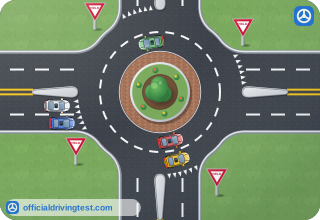
What should you do before you change lanes or take an exit inside a roundabout?
- Rely on your mirrors alone, because blind spots are not a concern
- Sound your horn, then move over before other drivers react
- Speed up to get ahead of the vehicles that are next to you
- Check for vehicles beside or behind you, and glance over your shoulder
Show answer
Correct answer: Check for vehicles beside or behind you, and glance over your shoulder
Vehicles may be in blind spots your mirrors cannot show, so a quick look over your shoulder is needed.
Source: District of Columbia Driver Manual (Updated January 2024), page 31
-
What does the right-of-way mean?
- The right of a driver to go first at any intersection at any time
- The right of one vehicle or pedestrian to proceed lawfully ahead of another
- The right of a driver to stop in any lane of a highway
- The right of a vehicle to travel faster than other traffic
Show answer
Correct answer: The right of one vehicle or pedestrian to proceed lawfully ahead of another
The right-of-way is the right to proceed lawfully ahead of another vehicle or pedestrian.
Source: District of Columbia Driver Manual (Updated January 2024), page 34
-
What should you do if you have the right-of-way and others yield it to you?
- Wait for a second signal
- Stop and let them go first
- Honk your horn first
- Proceed immediately
Show answer
Correct answer: Proceed immediately
When others yield to you, you proceed immediately.
Source: District of Columbia Driver Manual (Updated January 2024), page 34