Washington, D.C.: Right-of-way, turning and passing — Part 3 Practice Test
Who yields at intersections, turns and U-turns, turnabouts, and when and where you may pass. — Part 3
Independent educational site · not affiliated with any government agency or DMV
Ready? Test yourself
- Instant feedback with an explanation
- Every answer cites its source in the manual
- Your best score is saved on this device
- Keyboard: press 1 to 4 to answer and Enter for the next question
Questions are original and based on the official manual "District of Columbia Driver Manual" (Updated January 2024), District of Columbia Department of Motor Vehicles (DC DMV).
All 16 questions in this practice test
Take the test above first, then use this list to study. Tap “Show answer” to see the correct answer and explanation.
Show the questions and answersHide the questions
-
On a two-lane highway, you must not pass when approaching the top of a hill or on a curve and what applies?
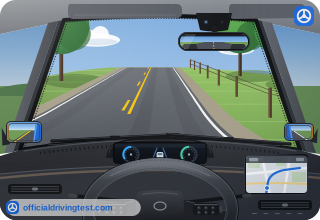
- The road surface is dry
- There is not sufficient clear view ahead
- A vehicle is behind you
- You are driving below the speed limit
Show answer
Correct answer: There is not sufficient clear view ahead
Near a hill top or on a curve you must not pass when you cannot see far enough ahead.
Source: District of Columbia Driver Manual (Updated January 2024), page 41
-
Which of these is a place where you must not drive in order to pass another vehicle?
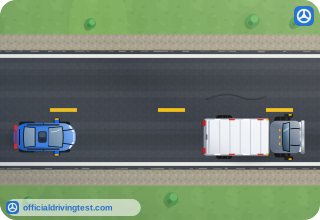
- In the left lane after a no-passing zone ends, when it is safe
- In the left lane of a two-lane highway with a clear view ahead
- In the opposite lane, with time to return before oncoming traffic
- On the shoulder of the highway, to the right or the left
Show answer
Correct answer: On the shoulder of the highway, to the right or the left
You must not pass on the shoulder of the highway, on either the right or the left.
Source: District of Columbia Driver Manual (Updated January 2024), page 41
-
What must you not do while another vehicle is passing you?
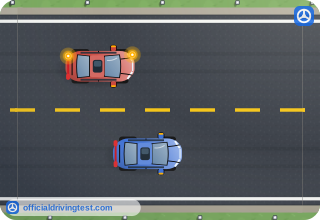
- Increase your speed
- Move to the right to give way
- Stay on the traveled portion of the road
- Keep your turn signal off
Show answer
Correct answer: Increase your speed
When being passed you must not increase your speed.
Source: District of Columbia Driver Manual (Updated January 2024), page 41
-
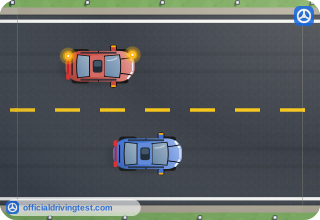
If you are driving the vehicle being overtaken, which way should you give way?
- To the left
- Toward the center line
- To the right
- You should not move over
Show answer
Correct answer: To the right
The driver being overtaken gives way to the right in favor of the overtaking vehicle.
Source: District of Columbia Driver Manual (Updated January 2024), page 41
-
What does the end of a no-passing zone mean?
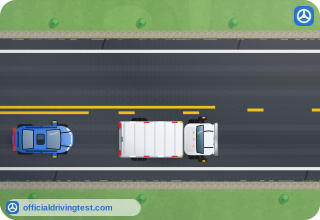
- It is always safe to pass, with or without oncoming traffic
- It is lawful to pass, but only when it is safe to do so
- You must pass the vehicle ahead as soon as the zone ends
- You may pass on the shoulder if it is clear of vehicles
Show answer
Correct answer: It is lawful to pass, but only when it is safe to do so
The end of a no-passing zone only means passing is lawful when it is safe.
Source: District of Columbia Driver Manual (Updated January 2024), page 41
-
Before you cross the center line to pass on a two-lane highway, what must you be certain of?
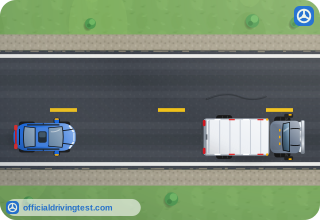
- The vehicle ahead is traveling below the posted speed limit and will not speed up
- Oncoming traffic will move to the shoulder to give you extra room to pass
- There is a solid white line on the right side of the road ahead of you
- There is time to pass and return to the right lane before meeting oncoming traffic
Show answer
Correct answer: There is time to pass and return to the right lane before meeting oncoming traffic
Before crossing the center line you must be sure you can finish the pass before oncoming traffic or a no-passing zone.
Source: District of Columbia Driver Manual (Updated January 2024), page 41
-
While you are passing on a two-lane highway, it appears you will not have time to finish before meeting oncoming traffic. What should you do?
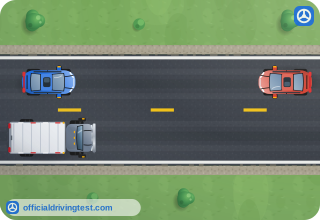
- Slow down and return to the lane behind the vehicle you were passing
- Speed up to finish the pass before the oncoming vehicle arrives
- Stay in the opposite lane and flash your headlights at the driver ahead
- Move onto the shoulder and finish passing the vehicle on the right
Show answer
Correct answer: Slow down and return to the lane behind the vehicle you were passing
If you cannot finish the pass in time, you slow down and drop back into the lane behind the vehicle.
Source: District of Columbia Driver Manual (Updated January 2024), page 41
-
When passing a vehicle, when should you return to the right lane?
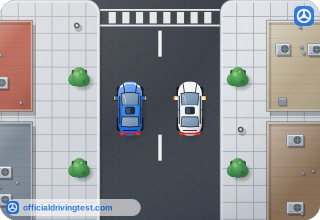
- As soon as your front bumper is even with the back bumper of the passed vehicle
- When you see both headlights of the passed vehicle in your rear-view mirror
- As soon as the passed vehicle is no longer visible in your side mirror
- When you have driven past the next intersection or driveway ahead of you
Show answer
Correct answer: When you see both headlights of the passed vehicle in your rear-view mirror
You return to the right lane once both headlights of the passed vehicle appear in your rear-view mirror.
Source: District of Columbia Driver Manual (Updated January 2024), page 41
-
On a road with marked lanes, which of these must you not do?
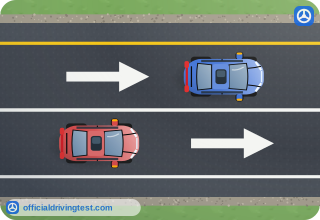
- Stay in one lane
- Drive partly in one lane and partly in another
- Signal before changing lanes
- Move to the right lane when driving slowly
Show answer
Correct answer: Drive partly in one lane and partly in another
You must not drive partly in one lane and partly in another.
Source: District of Columbia Driver Manual (Updated January 2024), page 42
-
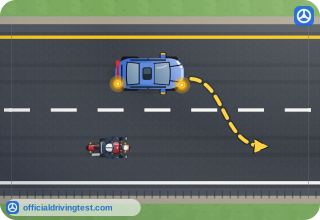
You must not move from one lane to another unless what is true?
- No vehicle is directly behind you
- The lane ahead is moving faster
- You are driving below the speed limit
- You can do so safely
Show answer
Correct answer: You can do so safely
A lane change is allowed only when you can make it safely.
Source: District of Columbia Driver Manual (Updated January 2024), page 42
-
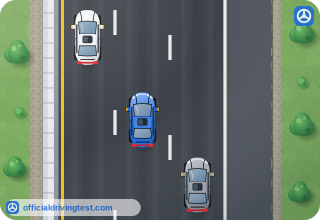
You are driving more slowly than the traffic flow on a highway with two or more lanes in your direction. Which lane should you use?
- The left lane
- The center lane
- The right lane
- Any lane with a gap
Show answer
Correct answer: The right lane
A slower driver should move to and stay in the right lane.
Source: District of Columbia Driver Manual (Updated January 2024), page 42
-
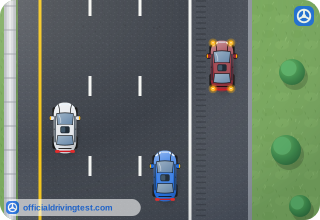
You see a vehicle stopped on the shoulder. What should you do?
- Keep your speed and stay close to the right edge of your lane, away from the center line
- Slow down and move to the left part of your lane or the next lane, if available
- Stop behind the vehicle until it has moved away from the shoulder and rejoined traffic
- Sound your horn to warn the driver and speed up to pass it quickly
Show answer
Correct answer: Slow down and move to the left part of your lane or the next lane, if available
Near a vehicle stopped on the shoulder you slow down and move to the left part of your lane or into the next lane if possible.
Source: District of Columbia Driver Manual (Updated January 2024), page 42
-
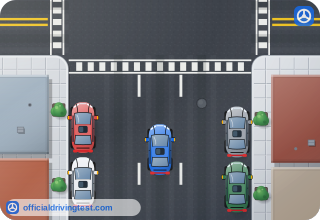
To make a right turn, which lane should you get into well ahead of the turn?
- The center lane of the highway
- The left lane on your side of the road
- Any open lane
- The lane furthermost to the right
Show answer
Correct answer: The lane furthermost to the right
For a right turn you move into the lane furthermost to the right, well before the turn.
Source: District of Columbia Driver Manual (Updated January 2024), page 42
-
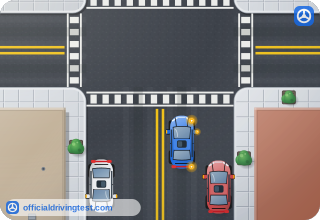
When you prepare to turn right, which road users traveling between you and the side of the road should you yield to?
- Bicyclists
- Parked vehicles
- Vehicles in the oncoming lane
- Vehicles turning left behind you
Show answer
Correct answer: Bicyclists
A right-turning driver yields to bicyclists traveling between the vehicle and the side of the road.
Source: District of Columbia Driver Manual (Updated January 2024), page 42
-
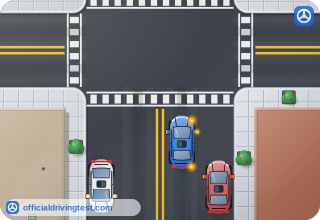
When you make a right turn, into which lane should you turn?
- Any lane going your way
- The center lane
- The right lane going your way
- The left lane going your way
Show answer
Correct answer: The right lane going your way
A right turn is made into the right lane going your way.
Source: District of Columbia Driver Manual (Updated January 2024), page 42
-
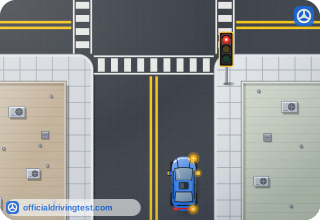
Where must you make a complete stop before a legal right turn on red?
- Past the crosswalk
- Before the crosswalk
- In the middle of the intersection
- At the far corner
Show answer
Correct answer: Before the crosswalk
For a legal right turn on red you must stop completely before the crosswalk.
Source: District of Columbia Driver Manual (Updated January 2024), page 42