Delaware: Sharing the road
Bicyclists, motorcycles, mopeds, school buses, large trucks and their No-Zones, and other road users. Split into 6 shorter tests so you're not stuck in one long quiz.
Independent educational site · not affiliated with any government agency or DMV
Choose a part
Sharing the road — Part 1
Questions in this part include: “According to the manual, which vehicle is a school bus?”
StartSharing the road — Part 2
Questions in this part include: “How do pedestrians benefit from a bike box?”
StartSharing the road — Part 3
Questions in this part include: “At night, how far away must the white headlight on a bicycle be visible?”
StartSharing the road — Part 4
Questions in this part include: “Which of these may cause a motorcyclist to change speed or direction?”
StartSharing the road — Part 5
Questions in this part include: “Compared with cars, how long do trucks take to stop, in general?”
StartSharing the road — Part 6
Questions in this part include: “Why should you watch for large trucks and small underpowered cars on steep grades?”
StartAll 118 Sharing the road questions with answers
Choose a part above to take a practice test, or study every question and answer here.
Show the questions and answersHide the questions
-
An electric-motor vehicle with fully operable pedals can still be a "bicycle" if its motor is rated at less than how many watts?
- 500 watts (0.67 hp)
- 750 watts (1 hp)
- 1,500 watts (2 hp)
- 2,000 watts (2.7 hp)
Show answer
Correct answer: 750 watts (1 hp)
The definition of bicycle includes a two- or three-wheeled vehicle with fully operable pedals and an electric motor of less than 750 watts (1 hp).
Source: Delaware Driver Manual (July 2026), page 11 · Open this page in the manual (Manual page 11)
-
To be a "bicycle" under the manual, a pedal vehicle with an electric motor must have a maximum speed, when powered solely by the motor with a 170-pound rider on a paved level surface, of less than what?
- 15 mph
- 25 mph
- 30 mph
- 20 mph
Show answer
Correct answer: 20 mph
The manual's bicycle definition sets the limit at less than 20 mph when powered solely by the motor with a 170-pound operator on a paved level surface.
Source: Delaware Driver Manual (July 2026), page 11 · Open this page in the manual (Manual page 11)
-
According to the manual, which vehicle is a school bus?
- Any motor vehicle that is used to carry children to and from school
- Any yellow motor vehicle that carries ten or more passengers
- Any bus that carries students and displays flashing lights
- A motor vehicle painted chrome yellow that displays the words "SCHOOL BUS"
Show answer
Correct answer: A motor vehicle painted chrome yellow that displays the words "SCHOOL BUS"
The manual defines a school bus as a motor vehicle painted national school bus chrome yellow with the words SCHOOL BUS displayed on it.
Source: Delaware Driver Manual (July 2026), page 13 · Open this page in the manual (Manual page 13)
-
Which of these is another name the manual gives for a two-way cycle track?
- Protected bike lane
- Bike box
- Shared roadway
- Painted shoulder
Show answer
Correct answer: Protected bike lane
The manual says a two-way cycle track is also known as protected bike lanes, separated bikeways and on-street bike paths.
Source: Delaware Driver Manual (July 2026), page 13 · Open this page in the manual (Manual page 13)
-
How much clearance does the law require motorists to leave at all times when passing a cyclist?
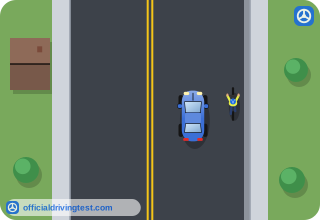
- A minimum of one foot
- A minimum of three feet
- A minimum of five feet
- A minimum of ten feet
Show answer
Correct answer: A minimum of three feet
The law requires a minimum of three feet of clearance at all times when passing a cyclist.
Source: Delaware Driver Manual (July 2026), page 81 · Open this page in the manual (Manual page 81)
-
On a multi-lane road, what does the law require motorists to do when passing a cyclist, whenever possible?
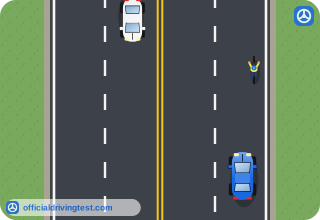
- Stay in the lane and slow down
- Sound the horn and pass quickly
- Pass on the right side of the cyclist
- Move to the adjacent lane
Show answer
Correct answer: Move to the adjacent lane
On multi-lane roads, motorists must move to the adjacent lane whenever possible when passing a cyclist.
Source: Delaware Driver Manual (July 2026), page 81 · Open this page in the manual (Manual page 81)
-
What lights do school buses have front and rear that are activated before the red lights?
- Two overhead steady yellow lights
- One overhead flashing white light
- Two overhead alternately flashing yellow lights
- Two overhead alternately flashing green lights
Show answer
Correct answer: Two overhead alternately flashing yellow lights
The manual says school buses have two overhead alternately flashing yellow lights both front and rear.
Source: Delaware Driver Manual (July 2026), page 89 · Open this page in the manual (Manual page 89)
-
How long before the overhead flashing red lights are the school bus yellow lights activated?
- Approximately 3 seconds
- Approximately 10 seconds
- Approximately 30 seconds
- Approximately 1 minute
Show answer
Correct answer: Approximately 10 seconds
The manual says the yellow lights are activated approximately 10 seconds before the overhead flashing red lights.
Source: Delaware Driver Manual (July 2026), page 89 · Open this page in the manual (Manual page 89)
-
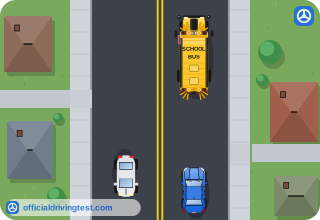
What should you do when approaching a school bus with its flashing yellow lights on?
- Speed up to pass before it stops
- Stop at once and wait for the red lights
- Ignore the lights until the stop arm extends
- Approach with caution and anticipate a stop
Show answer
Correct answer: Approach with caution and anticipate a stop
The manual says to approach a bus flashing yellow lights with caution and anticipate a stop.
Source: Delaware Driver Manual (July 2026), page 89 · Open this page in the manual (Manual page 89)
-
When may you proceed after a school bus has stopped with its red lights flashing and stop arm out?
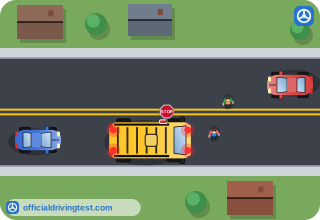
- Not until the red lights have stopped flashing and the stop arm has been retracted
- As soon as all of the children have crossed the road and are safely off it
- After waiting about 10 seconds for the bus to begin moving again
- As soon as the red lights stop flashing, even if the stop arm is out
Show answer
Correct answer: Not until the red lights have stopped flashing and the stop arm has been retracted
The manual says you must not proceed until the red lights have stopped flashing and the stop arm has been retracted.
Source: Delaware Driver Manual (July 2026), page 89 · Open this page in the manual (Manual page 89)
-
On a roadway with fewer than 4 lanes, who must stop for a school bus that has stopped with red lights flashing?
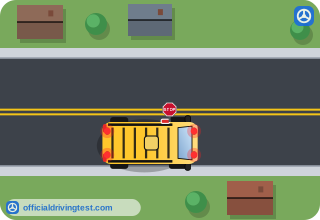
- Only traffic following the bus
- Only traffic approaching the bus
- Traffic in both directions
- Only traffic in the right lane
Show answer
Correct answer: Traffic in both directions
The picture on this page says that on roadways with less than 4 lanes, both directions must stop.
Source: Delaware Driver Manual (July 2026), page 89 · Open this page in the manual (Manual page 89)
-
Which school district is authorized by House Bill Number 202 to install stop arm cameras on its school buses as part of the School Bus Safety Pilot Program?
- The Appoquinimink School District
- The Red Clay Consolidated School District
- The Capital School District of Dover
- The Brandywine School District
Show answer
Correct answer: The Red Clay Consolidated School District
The manual says House Bill 202 authorizes the Red Clay Consolidated School District to install stop arm cameras.
Source: Delaware Driver Manual (July 2026), page 90 · Open this page in the manual (Manual page 90)
-
Who must obey traffic laws on the highway?
- All highway users, including drivers, pedestrians, and bicyclists
- Only drivers of motor vehicles, because pedestrians and bicyclists are not regulated
- Drivers and bicyclists, but not pedestrians
- Drivers and pedestrians, but not bicyclists
Show answer
Correct answer: All highway users, including drivers, pedestrians, and bicyclists
The manual says all highway users must obey traffic laws, including drivers, pedestrians, and bicyclists.
Source: Delaware Driver Manual (July 2026), page 94 · Open this page in the manual (Manual page 94)
-
On which Delaware roads do cyclists NOT have the right to ride?
- Limited access highways
- Roads with a double yellow center line
- Roads without a paved shoulder
- Roads with more than two lanes
Show answer
Correct answer: Limited access highways
Cyclists may use all Delaware roads except limited access highways.
Source: Delaware Driver Manual (July 2026), page 96 · Open this page in the manual (Manual page 96)
-
Under the Bicycle Friendly Delaware Act, what must a driver do when passing a bicycle if the travel lanes are too narrow for sharing?
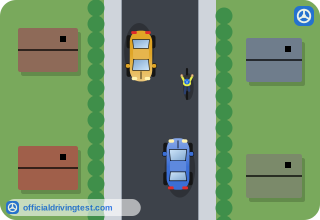
- Stay in the lane and honk to warn the cyclist
- Wait until the cyclist leaves the roadway
- Change lanes, even if there is a double yellow line
- Pass on the right side of the cyclist
Show answer
Correct answer: Change lanes, even if there is a double yellow line
The Act requires drivers to change lanes, including across a double yellow line, when the lanes are too narrow to share with the bicycle.
Source: Delaware Driver Manual (July 2026), page 96 · Open this page in the manual (Manual page 96)
-
How much room must motorists give a bicyclist when passing?
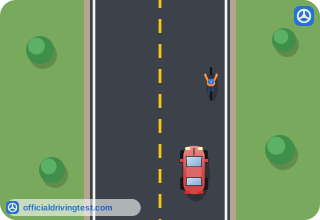
- At least one foot
- At least three feet
- At least five feet
- At least ten feet
Show answer
Correct answer: At least three feet
Motorists must give bicyclists at least three feet of room when passing.
Source: Delaware Driver Manual (July 2026), page 96 · Open this page in the manual (Manual page 96)
-
When are motorists allowed to honk their horn at a bicyclist?
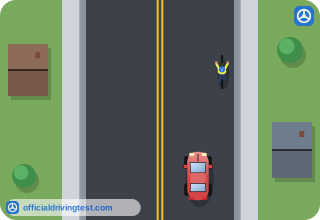
- When the cyclist is riding in the middle of the lane
- When the driver wants to pass the cyclist
- When the cyclist is riding on a double yellow line
- Only when there is an imminent danger
Show answer
Correct answer: Only when there is an imminent danger
Motorists are forbidden from honking at bicyclists unless there is an imminent danger.
Source: Delaware Driver Manual (July 2026), page 96 · Open this page in the manual (Manual page 96)
-
Under the Bicycle Friendly Delaware Act, where should bicyclists ride on the roadway?
- To the right of the roadway as their safety allows
- In the center of the travel lane at all times
- On the left side, facing traffic
- On the sidewalk whenever possible
Show answer
Correct answer: To the right of the roadway as their safety allows
The Act says bicyclists should ride to the right of the roadway as their safety allows.
Source: Delaware Driver Manual (July 2026), page 96 · Open this page in the manual (Manual page 96)
-
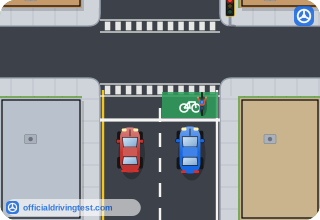
What is a bike box?
- A designated lane beside the curb where bicycles may park at intersections
- A locked storage area where bicycles are kept at the entrance to a parking lot
- A designated area at the head of a traffic lane that helps bicyclists turn and get ahead
- A sign posted at intersections to tell drivers that a bike route begins
Show answer
Correct answer: A designated area at the head of a traffic lane that helps bicyclists turn and get ahead
The manual defines a bike box as a designated area at the head of a traffic lane at intersections for bicyclists to turn safely and get ahead of traffic.
Source: Delaware Driver Manual (July 2026), page 96 · Open this page in the manual (Manual page 96)
-
Which is a stated benefit of a bike box at an intersection?
- It lets cyclists ignore the traffic signal at the intersection
- It helps prevent right-hook conflicts with turning vehicles
- It gives turning vehicles priority over bicyclists
- It removes the need for crosswalks at the intersection
Show answer
Correct answer: It helps prevent right-hook conflicts with turning vehicles
The manual lists prevention of right-hook conflicts with turning vehicles among the benefits of a bike box.
Source: Delaware Driver Manual (July 2026), page 96 · Open this page in the manual (Manual page 96)
-
How do pedestrians benefit from a bike box?
- It gives pedestrians a separate walk signal of their own
- It lets pedestrians walk in the bike lane
- It stops vehicles from turning right
- It reduces vehicle encroachment into the crosswalk
Show answer
Correct answer: It reduces vehicle encroachment into the crosswalk
The manual says a bike box reduces vehicle encroachment into the crosswalk, which helps pedestrians.
Source: Delaware Driver Manual (July 2026), page 96 · Open this page in the manual (Manual page 96)
-
What is a two-way cycle track?
- A physically separated track for two-way bicycle movement on one side of the road
- A painted bike lane on each side of the road, with one direction per side
- A shared lane marked with chevrons for both cyclists and cars
- A bike trail that crosses the road at a railroad crossing
Show answer
Correct answer: A physically separated track for two-way bicycle movement on one side of the road
A two-way cycle track is physically separated and carries bicycles in both directions on one side of the road.
Source: Delaware Driver Manual (July 2026), page 97 · Open this page in the manual (Manual page 97)
-
How may a two-way cycle track be set up at street level?
- With no barrier at all, only a painted bicycle symbol on the pavement surface
- With a traffic signal at every driveway along the street
- As a protected track with a parking lane or other barrier next to the travel lane
- Directly inside the motor vehicle travel lane with no separation
Show answer
Correct answer: As a protected track with a parking lane or other barrier next to the travel lane
A two-way cycle track may be a protected track with a parking lane or other barrier separating it from motor vehicles.
Source: Delaware Driver Manual (July 2026), page 97 · Open this page in the manual (Manual page 97)
-
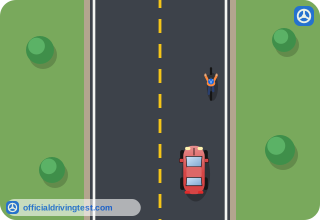
Why can driving at higher speeds close to a cyclist be dangerous?
- The cyclist may not be able to hear the engine of the vehicle
- The air pressure from the passing vehicle can cause the cyclist to crash
- Cyclists cannot see vehicles that pass them quickly from behind
- The vehicle may push the cyclist onto the sidewalk or shoulder
Show answer
Correct answer: The air pressure from the passing vehicle can cause the cyclist to crash
At higher speeds, especially with a truck or bus, the air pressure from passing too closely can make a cyclist crash.
Source: Delaware Driver Manual (July 2026), page 97 · Open this page in the manual (Manual page 97)
-
When you drive at slower speeds on local streets, how can you interact with bicycles?
- Only by stopping until the cyclist is out of sight
- Only by changing lanes each time you pass
- Only after the cyclist signals you to pass
- Safely and legally, much as you would with other vehicles
Show answer
Correct answer: Safely and legally, much as you would with other vehicles
At slower speeds on local streets, drivers can interact with bicycles much as they would with other vehicles.
Source: Delaware Driver Manual (July 2026), page 97 · Open this page in the manual (Manual page 97)
-
In which case does Delaware law permit you to pass a bicycle without changing lanes?
- When the travel lane is wide enough for both your vehicle and a bicycle
- When the cyclist is riding on the sidewalk or shoulder next to the road
- When no vehicle is approaching from behind you
- When you are driving a truck or bus and the road is clear
Show answer
Correct answer: When the travel lane is wide enough for both your vehicle and a bicycle
Only in the unusual case of a very wide travel lane may you pass a bicycle without changing lanes.
Source: Delaware Driver Manual (July 2026), page 97 · Open this page in the manual (Manual page 97)
-
If you pass a bicycle without changing lanes in a very wide lane, what speed action does the law require?
- Speed up to pass quickly
- Keep your speed exactly the same
- Slow down when passing
- Stop until the cyclist passes you
Show answer
Correct answer: Slow down when passing
The law requires you to slow down when passing a bicycle in a very wide lane and to keep at least three feet of clearance.
Source: Delaware Driver Manual (July 2026), page 97 · Open this page in the manual (Manual page 97)
-
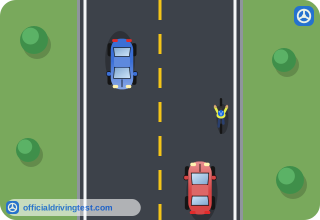
On a two-lane road, what should you do if you cannot pass a cyclist safely because of poor visibility or oncoming traffic?
- Pass anyway and move back slowly once you are ahead
- Follow at a safe distance and wait until it is safe
- Honk to make the cyclist pull off the road
- Pass on the shoulder at low speed
Show answer
Correct answer: Follow at a safe distance and wait until it is safe
The manual says to follow at a safe distance and wait until it is safe before passing.
Source: Delaware Driver Manual (July 2026), page 97 · Open this page in the manual (Manual page 97)
-
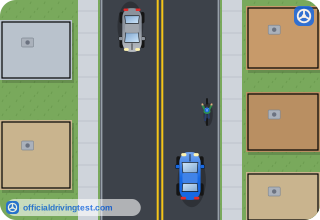
After you overtake a cyclist, what should you do before you pull back to the right?
- Pull back right away so you stay clear of any oncoming traffic
- Slow to a stop so the cyclist can move well ahead of you
- Flash your headlights to warn the cyclist you are returning
- Allow plenty of clearance; cyclists may be faster than you realize
Show answer
Correct answer: Allow plenty of clearance; cyclists may be faster than you realize
The manual says to allow plenty of clearance after overtaking a cyclist because the cyclist's speed may be greater than you realize.
Source: Delaware Driver Manual (July 2026), page 97 · Open this page in the manual (Manual page 97)
-
Why should you be especially careful to look for cyclists when you prepare to enter a roadway or make a turn?
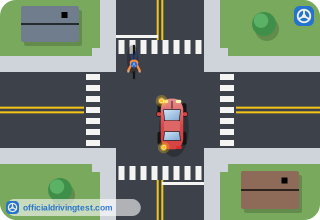
- Many car/cycle crashes happen because motorists do not see cyclists
- Cyclists always have the right-of-way when a driver turns left
- Cyclists never slow down when they reach intersections
- Bicycles are required to ride only in the left lane
Show answer
Correct answer: Many car/cycle crashes happen because motorists do not see cyclists
The manual says many car/cycle crashes happen because the motorist does not see the cyclist.
Source: Delaware Driver Manual (July 2026), page 97 · Open this page in the manual (Manual page 97)
-
What should you do if you are in doubt when you want to turn near a cyclist?
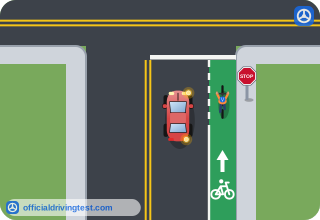
- Turn quickly in front of the cyclist
- Sound your horn and turn
- Wait
- Slow down slightly and turn
Show answer
Correct answer: Wait
The manual says not to pass a cyclist only to turn directly in front of them, and that when in doubt you should wait.
Source: Delaware Driver Manual (July 2026), page 97 · Open this page in the manual (Manual page 97)
-
What should you remember about bicycles at night?
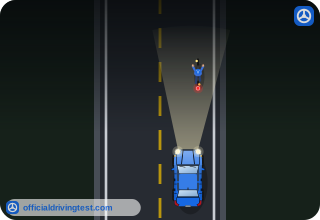
- Bicycles must always use the center of the lane
- Bicycles can be harder to see
- Bicycles are always lit by a bright light
- Bicycles are easier to see than in daylight
Show answer
Correct answer: Bicycles can be harder to see
The manual tells drivers to be aware that bicycles can be harder to see at night.
Source: Delaware Driver Manual (July 2026), page 97 · Open this page in the manual (Manual page 97)
-
Under the law, for what can the parent or guardian of a child cyclist be held responsible?
- Only if the child rides at night
- Only if the child rides on a highway
- Only if the child is younger than 8 years old
- If the child violates any traffic law while bicycling
Show answer
Correct answer: If the child violates any traffic law while bicycling
The parent or guardian can be held responsible if a child, while bicycling, violates any traffic law.
Source: Delaware Driver Manual (July 2026), page 98 · Open this page in the manual (Manual page 98)
-
What does the manual say an adult cyclist should do first, before venturing into traffic?
- Master control of the bicycle: riding straight, turning, stopping
- Ride only on the sidewalk until you feel fully confident
- Memorize the hand signals that drivers of cars use
- Install a taillight, a horn and a rear-view mirror
Show answer
Correct answer: Master control of the bicycle: riding straight, turning, stopping
The first critical rule is to control your bicycle before you venture into traffic.
Source: Delaware Driver Manual (July 2026), page 98 · Open this page in the manual (Manual page 98)
-
At intersections, what should an adult cyclist be prepared to do even when the cyclist thinks he or she has the right-of-way?
- Speed up to cross first
- Ride on the sidewalk
- Yield to motor vehicle traffic
- Signal the driver to stop
Show answer
Correct answer: Yield to motor vehicle traffic
The manual says most serious and fatal bicycle crashes occur at intersections, so cyclists should be prepared to yield.
Source: Delaware Driver Manual (July 2026), page 98 · Open this page in the manual (Manual page 98)
-
Which equipment does the manual say a cyclist must always have on the bicycle at night?
- A red headlight and a white rear-reflector
- A white headlight and a red rear-reflector
- A white taillight and a bicycle bell
- A blue flashing light and a mirror
Show answer
Correct answer: A white headlight and a red rear-reflector
At night a cyclist must always have the required white headlight and red rear-reflector.
Source: Delaware Driver Manual (July 2026), page 98 · Open this page in the manual (Manual page 98)
-
In addition to the required headlight and rear-reflector, what does the manual say is also helpful for a cyclist at night?
- A loud horn and a siren mounted on the bicycle
- A bicycle flag and a bell on the handle bars
- A second white headlight on the rear fender
- A red taillight and additional reflectors
Show answer
Correct answer: A red taillight and additional reflectors
The manual says a red taillight and additional reflectors are also helpful for being seen.
Source: Delaware Driver Manual (July 2026), page 98 · Open this page in the manual (Manual page 98)
-
Which way should a cyclist ride to be predictable to other road users?
- With motor vehicle traffic, not against it
- Against traffic so drivers can see the cyclist
- In the middle of the sidewalk
- Alongside parked cars only
Show answer
Correct answer: With motor vehicle traffic, not against it
Being predictable means riding with motor vehicle traffic, signaling clearly and early, and not swerving into traffic.
Source: Delaware Driver Manual (July 2026), page 98 · Open this page in the manual (Manual page 98)
-
How should cyclists communicate their intentions to other vehicles?
- Flash the headlight
- Ring a bell twice
- Use hand signals
- Wave at drivers after turning
Show answer
Correct answer: Use hand signals
The manual tells cyclists to use hand signals to communicate their intentions to other vehicles.
Source: Delaware Driver Manual (July 2026), page 98 · Open this page in the manual (Manual page 98)
-
Where should a cyclist ride in an unusually wide travel lane that is wide enough for a bicycle and a vehicle side by side?
- In the center of the lane so that vehicles cannot pass you
- On the right side of the lane, so vehicles can pass on the left
- On the left side of the lane, next to the center line
- Directly on the center line so drivers can see you easily
Show answer
Correct answer: On the right side of the lane, so vehicles can pass on the left
A cyclist should ride in the right side of such a lane (if safe) so motor vehicles can pass on the left without changing lanes.
Source: Delaware Driver Manual (July 2026), page 98 · Open this page in the manual (Manual page 98)
-
At night, how far away must the white headlight on a bicycle be visible?
- 100 feet
- 300 feet
- 600 feet
- 500 feet
Show answer
Correct answer: 500 feet
A cyclist must not ride at night unless the white headlight is visible for 500 feet.
Source: Delaware Driver Manual (July 2026), page 98 · Open this page in the manual (Manual page 98)
-
At night, how far away must the red rear reflector on a bicycle be visible?
- 600 feet
- 200 feet
- 300 feet
- 500 feet
Show answer
Correct answer: 600 feet
The required red rear reflector must be visible for 600 feet.
Source: Delaware Driver Manual (July 2026), page 98 · Open this page in the manual (Manual page 98)
-
For night riding, what is required in addition to the white headlight and the red rear reflector?
- Reflective material or a lighted lamp, visible from the front only
- A reflector on the rear wheel only, visible from behind
- Reflective material or a lighted lamp, visible from both sides
- A flag or lamp on the rear that is visible from behind only
Show answer
Correct answer: Reflective material or a lighted lamp, visible from both sides
Night riding also needs either reflective material visible from both sides for 600 feet or a lighted lamp visible from both sides for 500 feet.
Source: Delaware Driver Manual (July 2026), page 98 · Open this page in the manual (Manual page 98)
-
While riding a bicycle, where must you be seated?
- On the handle bars
- On or astride a permanent seat
- Standing on the pedals at all times
- Seated behind the rider ahead
Show answer
Correct answer: On or astride a permanent seat
Cyclists must be on or astride a permanent seat.
Source: Delaware Driver Manual (July 2026), page 98 · Open this page in the manual (Manual page 98)
-
When may a cyclist carry a passenger?
- Only on roads that have a marked bike lane or cycle track
- Only during daylight hours when the road is dry
- Only if the passenger wears a properly fitted helmet
- Only if the bicycle is designed for carrying a passenger
Show answer
Correct answer: Only if the bicycle is designed for carrying a passenger
You may not carry a passenger unless your bicycle is designed for carrying a passenger.
Source: Delaware Driver Manual (July 2026), page 98 · Open this page in the manual (Manual page 98)
-
What does the manual say a cyclist must not do while on the highway?
- Cling to any vehicle
- Ride in a bike lane
- Use hand signals
- Ride in the right side of the lane
Show answer
Correct answer: Cling to any vehicle
A cyclist must not cling to any vehicle upon the highway.
Source: Delaware Driver Manual (July 2026), page 98 · Open this page in the manual (Manual page 98)
-
How many hands must a cyclist keep on the handle bars?
- Both hands at all times
- Both hands except when signaling a stop
- At least one hand at all times
- No hands are required on a straight road
Show answer
Correct answer: At least one hand at all times
A cyclist must keep at least one hand on the handle bars at all times.
Source: Delaware Driver Manual (July 2026), page 98 · Open this page in the manual (Manual page 98)
-
What must a cyclist do when approaching a pedestrian on a sidewalk or in a crosswalk?
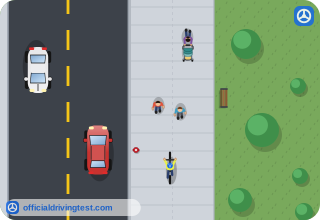
- Ride past quickly and avoid giving the pedestrian any signal
- Yield to the pedestrian and give an audible signal before overtaking
- Stop and wait until the pedestrian waves you through the area
- Use hand signals only, then pass on the left of the pedestrian
Show answer
Correct answer: Yield to the pedestrian and give an audible signal before overtaking
A cyclist must yield to pedestrians on a sidewalk and in a crosswalk and give an audible signal before overtaking.
Source: Delaware Driver Manual (July 2026), page 98 · Open this page in the manual (Manual page 98)
-
What kind of headset is a cyclist not allowed to wear?
- A headset covering one ear
- Any headset with a microphone
- A headset with a volume control
- A headset covering both ears
Show answer
Correct answer: A headset covering both ears
A cyclist must not wear a headset covering both ears.
Source: Delaware Driver Manual (July 2026), page 98 · Open this page in the manual (Manual page 98)
-
Who must wear a properly fitted and fastened bicycle helmet?
- All persons under the age of 18
- Only children under 12
- Only riders on roads with 3 or more lanes
- Only riders at night
Show answer
Correct answer: All persons under the age of 18
All persons under the age of 18 must wear a properly fitted and fastened bicycle helmet.
Source: Delaware Driver Manual (July 2026), page 99 · Open this page in the manual (Manual page 99)
-
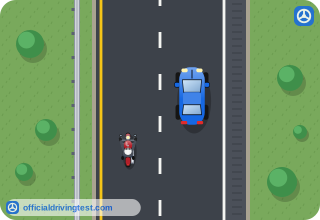
What should a driver check frequently to make sure a motorcycle is not present?
- Sound the horn
- Flash the high beams
- Check the blind spot
- Slow to ten miles per hour
Show answer
Correct answer: Check the blind spot
The manual says to remain alert and check your blind spot frequently for motorcycles.
Source: Delaware Driver Manual (July 2026), page 99 · Open this page in the manual (Manual page 99)
-
When do you need to be especially alert for motorcycles?
- Only when you are driving on limited access highways at night or in rain
- When turning at intersections and pulling out from a side road or driveway
- Only on roads that have a marked bike lane or a cycle track nearby
- Only when you are driving a truck or a bus on a local street
Show answer
Correct answer: When turning at intersections and pulling out from a side road or driveway
The manual says to be especially alert for motorcycles when turning at intersections and pulling out from a side road or driveway.
Source: Delaware Driver Manual (July 2026), page 99 · Open this page in the manual (Manual page 99)
-
What rights and responsibilities do motorcyclists have on public roadways?
- Fewer rights than car drivers
- More rights than other highway users
- Rights only on limited access highways
- The same as other highway users
Show answer
Correct answer: The same as other highway users
Motorcyclists have the same rights and responsibilities on public roadways as other highway users.
Source: Delaware Driver Manual (July 2026), page 99 · Open this page in the manual (Manual page 99)
-
Why is it so important to be aware of motorcycles?
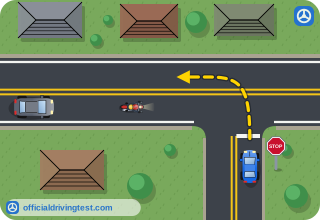
- Motorcycles are not easily identified in traffic
- Motorcycles are always the fastest vehicles
- Motorcycles have no right to use the lane
- Motorcycles make no noise
Show answer
Correct answer: Motorcycles are not easily identified in traffic
The manual says awareness is important primarily because motorcycles are not easily identified in traffic.
Source: Delaware Driver Manual (July 2026), page 99 · Open this page in the manual (Manual page 99)
-
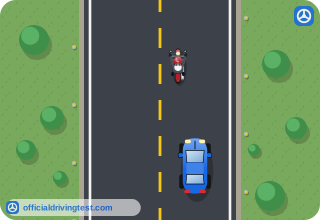
About how wide is a motorcycle compared with an automobile, according to the manual?
- About four feet, compared with an automobile that is eight feet wide
- About three feet, compared with an automobile that is six feet wide
- About two feet, compared with the five- to six-foot width of an automobile
- About one foot, compared with an automobile that is four feet wide
Show answer
Correct answer: About two feet, compared with the five- to six-foot width of an automobile
Motorcycles are only about two feet wide, compared with the five- to six-foot width of an automobile.
Source: Delaware Driver Manual (July 2026), page 99 · Open this page in the manual (Manual page 99)
-
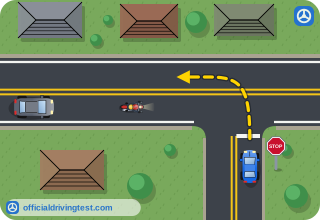
Even when a motorcycle is seen, what is difficult for some drivers?
- Hearing the motorcycle's engine
- Judging how far away the motorcyclist is
- Recognizing that it is a vehicle
- Knowing that it has the right-of-way
Show answer
Correct answer: Judging how far away the motorcyclist is
The manual says it is difficult for some drivers to judge how far away motorcyclists are.
Source: Delaware Driver Manual (July 2026), page 99 · Open this page in the manual (Manual page 99)
-
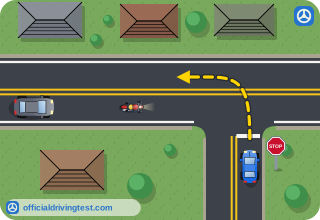
Even when a motorcycle is seen and its distance judged correctly, what can some drivers not tell?
- Whether it is a motorcycle or a moped
- Which lane it is using
- Whether it is about to stop
- How fast the motorcycle is going
Show answer
Correct answer: How fast the motorcycle is going
The manual says some drivers can't tell how fast motorcycles are going.
Source: Delaware Driver Manual (July 2026), page 99 · Open this page in the manual (Manual page 99)
-
When you plan a left turn in front of an oncoming motorcyclist, what does the manual say the correct behavior is?
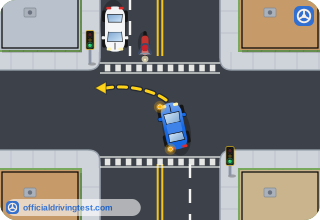
- Look and look again
- Turn quickly before the rider arrives
- Assume the rider will slow down for you
- Flash your headlights to warn the rider
Show answer
Correct answer: Look and look again
The manual says left turns in front of oncoming motorcycles cause many injury crashes, so drivers must look and look again.
Source: Delaware Driver Manual (July 2026), page 100 · Open this page in the manual (Manual page 100)
-
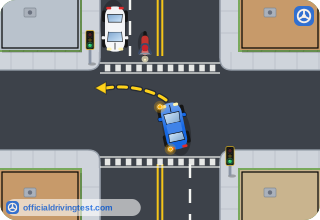
Which is one of the two parts of the problem of not seeing an oncoming motorcyclist before a left turn?
- Drivers may fail to hear the engine of the motorcycle
- Riders may fail to signal a turn in front of the driver
- Drivers may fail to judge the speed of the oncoming motorcycle
- Drivers may fail to notice the helmet of the motorcyclist
Show answer
Correct answer: Drivers may fail to judge the speed of the oncoming motorcycle
The manual says the problem is twofold: drivers may not pick the cyclist out of the traffic scene, or may not judge the oncoming motorcycle's speed.
Source: Delaware Driver Manual (July 2026), page 100 · Open this page in the manual (Manual page 100)
-
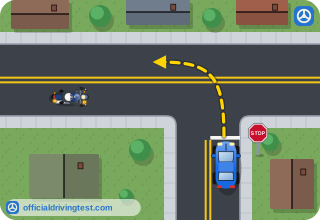
Before you turn in front of a motorcyclist whose turn signal is blinking, what should you be sure of?
- That the rider has seen your vehicle and will stop for you
- That the rider is turning and not continuing straight with a forgotten signal
- That the rider will cancel the signal automatically before the turn
- That the rider is traveling slower than the posted speed limit
Show answer
Correct answer: That the rider is turning and not continuing straight with a forgotten signal
Turn signals are not automatically self-canceling on most motorcycles, so a blinking signal may have been forgotten.
Source: Delaware Driver Manual (July 2026), page 100 · Open this page in the manual (Manual page 100)
-
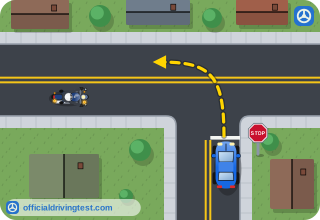
On most motorcycles, how do turn signals behave after a turn?
- They cancel automatically after ten seconds
- They cancel when the rider touches the brake
- They cancel when the speed drops below 40 mph
- They are not automatically self-canceling
Show answer
Correct answer: They are not automatically self-canceling
The manual states that turn signals are not automatically self-canceling on most motorcycles.
Source: Delaware Driver Manual (July 2026), page 100 · Open this page in the manual (Manual page 100)
-
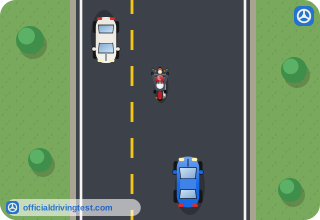
How much of a lane is a motorcycle entitled to use?
- Only the half of the lane nearest the shoulder
- Only the center third of the lane
- The same full lane width as all other vehicles
- Only the part of the lane the rider chooses to leave open
Show answer
Correct answer: The same full lane width as all other vehicles
The manual says motorcycles have the same full lane width as any other vehicle.
Source: Delaware Driver Manual (July 2026), page 100 · Open this page in the manual (Manual page 100)
-
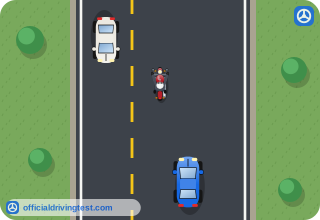
A motorcyclist is riding far to one side of a wide lane. What must you never do?
- Follow the motorcycle at a four second count
- Move into the same lane alongside the motorcycle
- Look and look again before a left turn
- Increase your following distance in the rain
Show answer
Correct answer: Move into the same lane alongside the motorcycle
The manual says sharing a lane alongside a motorcycle is illegal and extremely hazardous, even in a wide lane.
Source: Delaware Driver Manual (July 2026), page 100 · Open this page in the manual (Manual page 100)
-
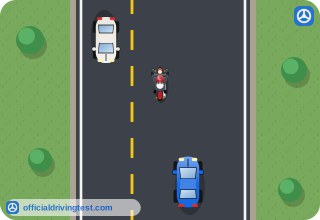
Why does a skilled motorcycle operator constantly change positions within a lane?
- To make room for cars to pass within the same lane
- To avoid being followed by vehicles behind the motorcycle
- To signal drivers that the rider is about to turn
- To see and be seen and to compensate for objects in or near the road
Show answer
Correct answer: To see and be seen and to compensate for objects in or near the road
Changing position within the lane helps a skilled rider see and be seen and deal with objects in or near the road.
Source: Delaware Driver Manual (July 2026), page 100 · Open this page in the manual (Manual page 100)
-
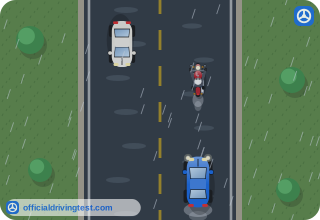
What does the manual say about rain, wind, dust and smog and a motorcyclist's vision?
- They affect the rider's vision less than a driver's vision
- They affect only riders who do not wear a face shield
- They affect the rider's vision more easily than yours
- They affect the rider only when traveling above 40 mph
Show answer
Correct answer: They affect the rider's vision more easily than yours
The manual says these conditions limit a rider's vision more easily than a driver's, even with a face shield or goggles.
Source: Delaware Driver Manual (July 2026), page 100 · Open this page in the manual (Manual page 100)
-
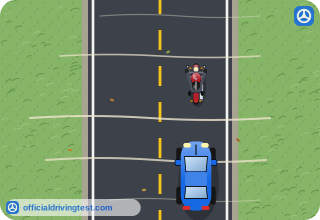
Which places should you watch for when cross winds could move a motorcycle out of its lane?
- Narrow residential streets with parked cars
- Wide open, long stretches of highways and bridges
- Short tunnels on mountain roads only
- Shaded roads lined with trees
Show answer
Correct answer: Wide open, long stretches of highways and bridges
The manual lists wide open, long stretches of highway and bridges as places where cross winds can move a motorcycle.
Source: Delaware Driver Manual (July 2026), page 100 · Open this page in the manual (Manual page 100)
-
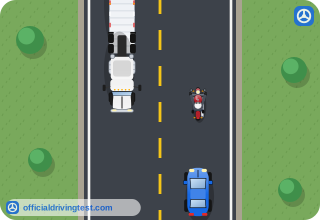
What can fast-moving large trucks create that may startle a motorcyclist?
- Loud horn blasts
- Bright reflections
- Sudden road noise
- Wind blasts
Show answer
Correct answer: Wind blasts
The manual says large trucks can create wind blasts that startle a rider and may move the rider out of the path of travel.
Source: Delaware Driver Manual (July 2026), page 100 · Open this page in the manual (Manual page 100)
-
Which of these may cause a motorcyclist to change speed or direction?
- Gravel, debris, pavement seams or manhole covers
- Dry pavement, bright paint, or wide shoulders
- Level roads, clear weather, or light traffic
- Painted crosswalks, road signs, or lane lines
Show answer
Correct answer: Gravel, debris, pavement seams or manhole covers
The manual says road surfaces and objects that do not bother other vehicles can make a motorcyclist change speed or direction.
Source: Delaware Driver Manual (July 2026), page 100 · Open this page in the manual (Manual page 100)
-
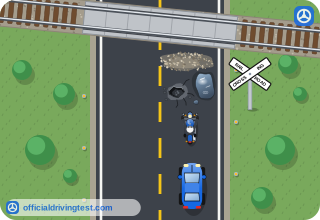
Why might a motorcyclist slow down or change direction at a railroad grade crossing?
- So the rider can stop on the tracks to look
- So the rider can avoid using the brakes
- So the tracks can be crossed head on
- So the rider can pass the vehicle ahead
Show answer
Correct answer: So the tracks can be crossed head on
Railroad crossings may be rough or angled, so a rider may slow or change direction to cross the tracks head on.
Source: Delaware Driver Manual (July 2026), page 100 · Open this page in the manual (Manual page 100)
-
What may a cyclist do to cushion the shock of a rough railroad crossing?
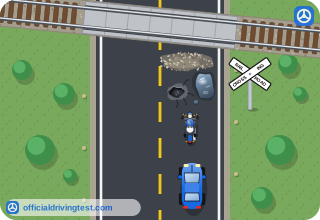
- Lean far to one side
- Rise up off the seat
- Take both hands off the handlebars
- Speed up before the tracks
Show answer
Correct answer: Rise up off the seat
The manual says a cyclist may rise up off the seat to cushion the shock of a rough crossing.
Source: Delaware Driver Manual (July 2026), page 100 · Open this page in the manual (Manual page 100)
-
What can metal or grated bridges cause a motorcycle's front tire to do?
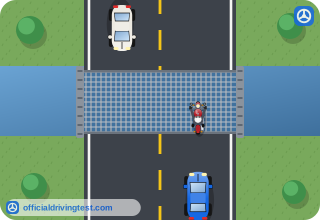
- Lose air pressure while crossing
- Stick firmly to the metal surface
- Make the rider lose engine power suddenly
- A wobbling sensation
Show answer
Correct answer: A wobbling sensation
The manual says grated bridges give a motorcycle's front tire a wobbling sensation greater than a car's, which may make an inexperienced rider change direction or slow down.
Source: Delaware Driver Manual (July 2026), page 100 · Open this page in the manual (Manual page 100)
-
What rights and duties does the rider of an animal or the driver of an animal-drawn vehicle have on the highway?
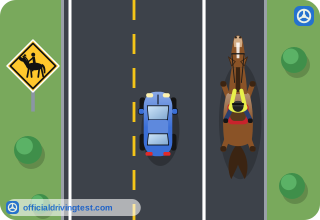
- Only the rights of a pedestrian crossing the road
- The right of way over all motor vehicles at all times
- All the rights and duties of a motor vehicle driver
- No rights, and only the duty to keep to the right shoulder
Show answer
Correct answer: All the rights and duties of a motor vehicle driver
Animal riders and animal-drawn vehicle drivers have the same rights and duties as motor vehicle drivers, except where a law cannot apply by its nature.
Source: Delaware Driver Manual (July 2026), page 102 · Open this page in the manual (Manual page 102)
-
As the driver of a farm tractor or other self-propelled road or construction equipment, what rights and duties do you have on the highway?
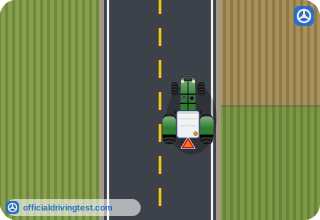
- Only the duty to stay on the shoulder
- All the rights and duties of any other motor vehicle
- The right to ignore speed limits on farm roads
- No duties, since the equipment is not a motor vehicle
Show answer
Correct answer: All the rights and duties of any other motor vehicle
Drivers of farm tractors and self-propelled equipment have all the rights and duties of any other motor vehicle on the highway.
Source: Delaware Driver Manual (July 2026), page 102 · Open this page in the manual (Manual page 102)
-
You see a triangular, fluorescent and reflective orange emblem on the back of a farm tractor ahead of you. What should you do?
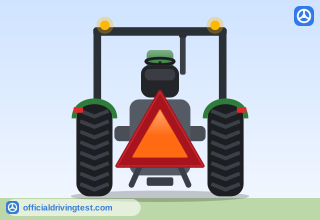
- Slow down immediately and proceed with caution
- Pass immediately on the right side of it
- Stop and wait until the vehicle leaves the road
- Honk to warn the driver to move over
Show answer
Correct answer: Slow down immediately and proceed with caution
The manual says to slow down immediately and proceed with caution when you see a Slow-Moving Vehicle emblem.
Source: Delaware Driver Manual (July 2026), page 102 · Open this page in the manual (Manual page 102)
-
What does the Slow-Moving Vehicle emblem on a farm tractor look like?
- A square yellow sign with a black border
- A round red sign with a white bar
- A triangular, fluorescent and reflective orange sign
- A diamond-shaped green sign with a white arrow
Show answer
Correct answer: A triangular, fluorescent and reflective orange sign
The manual describes the emblem as a triangular, fluorescent and reflective orange sign.
Source: Delaware Driver Manual (July 2026), page 102 · Open this page in the manual (Manual page 102)
-
What should you check before you move into the passing lane to pass a truck?
- That the truck driver has turned off his headlights
- That the lane is clear and the zone is a legal passing zone
- That the truck is traveling below 40 mph on a level road
- That another vehicle is passing the truck at the same time
Show answer
Correct answer: That the lane is clear and the zone is a legal passing zone
The manual says to check front and rear and pass only if the lane is clear and you are in a legal passing zone.
Source: Delaware Driver Manual (July 2026), page 102 · Open this page in the manual (Manual page 102)
-
How can you let a truck driver know you are passing, especially at night?
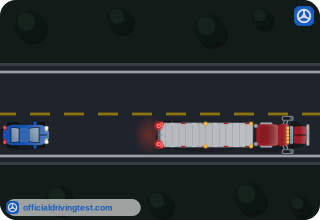
- By sounding your horn continuously
- By turning on your hazard lights
- By flashing your brake lights
- By blinking your headlights
Show answer
Correct answer: By blinking your headlights
The manual says to blink your headlights if needed to let the truck driver know you are passing.
Source: Delaware Driver Manual (July 2026), page 102 · Open this page in the manual (Manual page 102)
-
On a level highway, about how much longer does it take to pass a truck than a car?
- Three to five seconds
- One to two seconds
- Ten to fifteen seconds
- Thirty seconds
Show answer
Correct answer: Three to five seconds
The manual says it takes only three to five seconds longer to pass a truck than a car on a level highway.
Source: Delaware Driver Manual (July 2026), page 103 · Open this page in the manual (Manual page 103)
-
Why is it easier to pass a truck than a car on an upgrade?
- A truck stops on every upgrade
- A truck must use the right shoulder
- A truck often loses speed on an upgrade
- A truck driver cannot see you on an upgrade
Show answer
Correct answer: A truck often loses speed on an upgrade
The manual says a truck often loses speed on an upgrade, so it is easier to pass than a car.
Source: Delaware Driver Manual (July 2026), page 103 · Open this page in the manual (Manual page 103)
-
What may you need to do when passing a truck on a downgrade?
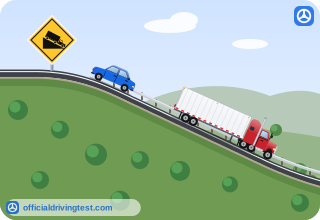
- Slow down and stay beside the truck
- Increase your speed
- Stop on the shoulder
- Pass on the right side
Show answer
Correct answer: Increase your speed
On a downgrade the truck's momentum makes it go faster, so you may need to increase your speed to pass.
Source: Delaware Driver Manual (July 2026), page 103 · Open this page in the manual (Manual page 103)
-
When you pass a truck, how should you complete the pass?
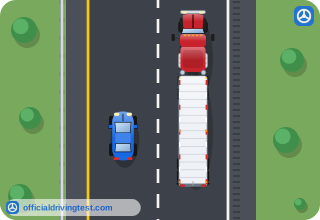
- Slowly, staying beside the truck for a while
- At the same speed as the truck for safety
- By pausing in the truck's blind spot
- As quickly as possible
Show answer
Correct answer: As quickly as possible
The manual says to complete the pass as quickly as possible and not stay alongside the other vehicle.
Source: Delaware Driver Manual (July 2026), page 103 · Open this page in the manual (Manual page 103)
-
After passing a truck, when should you move back into its lane?
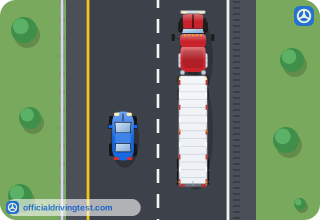
- When you see the front of the truck in your mirror
- As soon as your car is beside the truck’s cab
- As soon as your car's front bumper passes the cab
- When the truck driver sounds the horn
Show answer
Correct answer: When you see the front of the truck in your mirror
The manual says to move back only when you can see the front of the truck in your rear-view mirror.
Source: Delaware Driver Manual (July 2026), page 103 · Open this page in the manual (Manual page 103)
-
What does it mean if a truck driver blinks his lights after you pass?
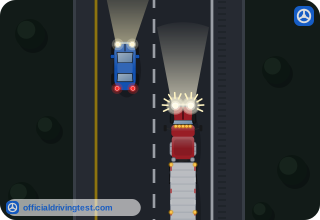
- The truck is about to stop
- You are driving too fast
- It is clear to pull back in
- You must pass again
Show answer
Correct answer: It is clear to pull back in
The manual says a blink of the truck driver's lights after you pass signals that it is clear to pull back in.
Source: Delaware Driver Manual (July 2026), page 103 · Open this page in the manual (Manual page 103)
-
How can you help the truck driver when a truck passes you?
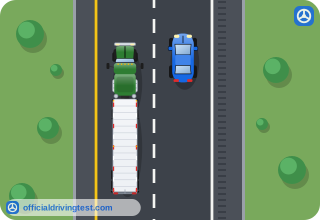
- Move to the center of your lane and speed up a little
- Brake hard and stop at the roadside
- Drive on the left edge of the lane and speed up
- Keep to the far side of your lane and slow slightly
Show answer
Correct answer: Keep to the far side of your lane and slow slightly
The manual says to keep to the far side of your lane and reduce speed slightly while a truck passes.
Source: Delaware Driver Manual (July 2026), page 103 · Open this page in the manual (Manual page 103)
-
While a truck is passing you, what should you not do?
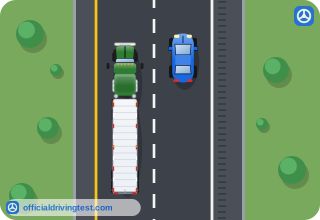
- Speed up
- Keep to the far side of your lane
- Reduce speed slightly
- Watch for the truck's signal after it passes
Show answer
Correct answer: Speed up
The manual says never to speed up while a truck is passing you.
Source: Delaware Driver Manual (July 2026), page 103 · Open this page in the manual (Manual page 103)
-
When you meet a truck coming from the opposite direction, what should you do?
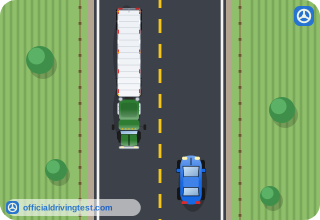
- Move to the center line to make room
- Slow down and stop in the lane
- Keep as far as possible to the side
- Flash your headlights repeatedly
Show answer
Correct answer: Keep as far as possible to the side
Keeping as far as possible to the side avoids a sideswipe crash and reduces wind turbulence between the vehicles.
Source: Delaware Driver Manual (July 2026), page 103 · Open this page in the manual (Manual page 103)
-
What does the wind turbulence between you and a truck coming from the opposite direction do to the two vehicles?
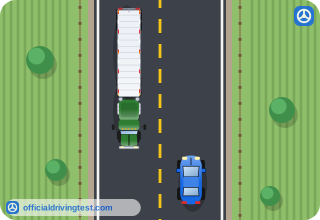
- It sucks the vehicles together
- It pushes the vehicles apart
- It pushes both vehicles to the right
- It has no effect on the vehicles
Show answer
Correct answer: It pushes the vehicles apart
The manual says turbulence between meeting vehicles pushes them apart and does not suck them together.
Source: Delaware Driver Manual (July 2026), page 103 · Open this page in the manual (Manual page 103)
-
Compared with cars, how long do trucks take to stop, in general?
- Slightly less, because of their weight
- The same, because of their brakes
- Much less, because of their tires
- Slightly longer, because of their size
Show answer
Correct answer: Slightly longer, because of their size
The manual says trucks in general take slightly longer than cars to stop because of their size.
Source: Delaware Driver Manual (July 2026), page 103 · Open this page in the manual (Manual page 103)
-
What does the manual call the blind spots around a truck?
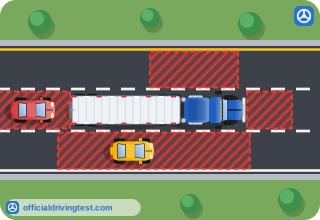
- The No-Zone
- The Safe-Zone
- The Slow-Zone
- The Pass-Zone
Show answer
Correct answer: The No-Zone
The manual says a truck's blind spots are also called the No-Zone, the danger areas where crashes are more likely.
Source: Delaware Driver Manual (July 2026), page 103 · Open this page in the manual (Manual page 103)
-
What should you never do when a truck is in the process of backing up?
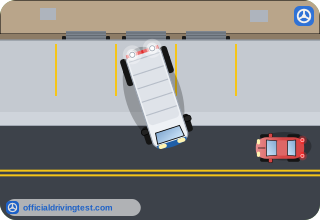
- Wait behind the truck at a distance
- Pass close behind the truck
- Pass in front of the truck
- Stop at a safe distance on the roadside
Show answer
Correct answer: Pass close behind the truck
The manual says never to pass close behind a truck that is backing up.
Source: Delaware Driver Manual (July 2026), page 103 · Open this page in the manual (Manual page 103)
-
How wide are most trailers, according to the manual?
- 6.5 feet
- 10 feet
- 12 feet
- 8.5 feet
Show answer
Correct answer: 8.5 feet
The manual says most trailers are 8.5 feet wide and can completely hide objects that come between them and a loading area.
Source: Delaware Driver Manual (July 2026), page 103 · Open this page in the manual (Manual page 103)
-
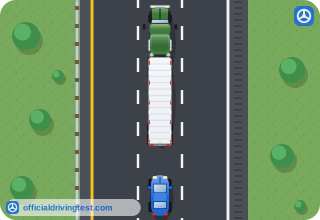
Why should you avoid tailgating a truck?
- The truck's brake lights are hard to see
- The truck's exhaust blocks your car's windows
- The truck driver cannot see your car directly behind the truck
- The truck driver may speed up to keep you off the road
Show answer
Correct answer: The truck driver cannot see your car directly behind the truck
Trucks have deep blindspots directly behind them, so a driver following too closely cannot be seen and greatly increases the chance of a rear-end collision.
Source: Delaware Driver Manual (July 2026), page 103 · Open this page in the manual (Manual page 103)
-
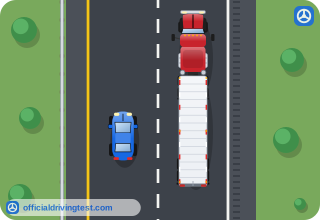
What can happen if you drive in a truck's side blindspots for any length of time?
- The truck driver will see you in his mirrors but not slow down
- The truck driver can't see you, risking a serious crash
- The truck driver will move over to let you pass
- The truck's wind turbulence will pull your car sideways
Show answer
Correct answer: The truck driver can't see you, risking a serious crash
Trucks have much larger blindspots on both sides than passenger vehicles, and a lane change could cause a serious crash.
Source: Delaware Driver Manual (July 2026), page 104 · Open this page in the manual (Manual page 104)
-
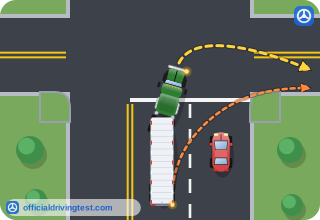
Why do truck drivers sometimes swing wide to the left before a right turn?
- To avoid the vehicles on the right shoulder
- To pass the vehicles ahead on the left
- To signal other drivers to pass on the right
- To safely negotiate the right turn
Show answer
Correct answer: To safely negotiate the right turn
The manual says truck drivers sometimes need to swing wide to the left to safely negotiate a right turn.
Source: Delaware Driver Manual (July 2026), page 104 · Open this page in the manual (Manual page 104)
-
What increases the possibility of a crash when a truck is making a right turn?
- Cutting in between the truck and the curb or shoulder
- Staying behind the truck at a safe following distance
- Slowing down well before the intersection
- Waiting for the truck on the left side
Show answer
Correct answer: Cutting in between the truck and the curb or shoulder
The manual says cutting in between a truck and the curb or shoulder on its right increases the chance of a crash, since the driver cannot see cars directly behind.
Source: Delaware Driver Manual (July 2026), page 104 · Open this page in the manual (Manual page 104)
-
Which road users are harder to see than cars and trucks?
- School buses and large delivery trucks
- Motorcycles, bicycles, and pedestrians
- Taxis and delivery vans
- Police cars and ambulances
Show answer
Correct answer: Motorcycles, bicycles, and pedestrians
The manual names motorcycles, bicycles, and pedestrians as harder to see than cars and trucks.
Source: Delaware Driver Manual (July 2026), page 118 · Open this page in the manual (Manual page 118)
-
When should you be especially alert for motorcycles, bicycles, and pedestrians?
- When driving on a freeway with no ramps
- When you are following a truck on the highway
- When you are stopped at a railroad crossing
- When entering the roadway from the curb or driveway
Show answer
Correct answer: When entering the roadway from the curb or driveway
The manual says to be especially alert when you are entering the roadway from the curb or driveway.
Source: Delaware Driver Manual (July 2026), page 119 · Open this page in the manual (Manual page 119)
-
How can you help make Delaware’s roadways safer when you see aggressive driving?
- Follow the driver until a police officer stops them
- Flash your lights to warn the driver to stop
- Drive beside the driver to keep the speed down
- Get the tag number and report it (call 911)
Show answer
Correct answer: Get the tag number and report it (call 911)
The manual says you can help by reporting aggressive driving with your cellular phone: get the tag number and report it, call 911.
Source: Delaware Driver Manual (July 2026), page 115 · Open this page in the manual (Manual page 115)
-
How should you treat an aggressive driver?
- Challenge them to keep a safe distance
- Avoid eye contact with them
- Stay close behind them to get their tag number
- Speed up to show them they are wrong
Show answer
Correct answer: Avoid eye contact with them
The manual lists remaining calm, avoiding eye contact, not challenging them, and staying away from erratic drivers.
Source: Delaware Driver Manual (July 2026), page 115 · Open this page in the manual (Manual page 115)
-
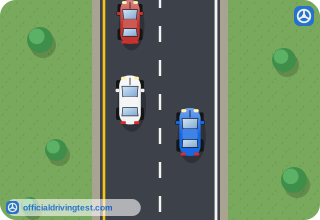
If you find yourself driving on the side and slightly to the rear of another vehicle, what should you do?
- Stay where you are and tap your horn
- Speed up or drop back so the other driver sees you
- Move closer to the other vehicle and stay there
- Flash your high beams at the other driver
Show answer
Correct answer: Speed up or drop back so the other driver sees you
That position is in the other driver's blind spot, so you should either speed up or drop back.
Source: Delaware Driver Manual (July 2026), page 121 · Open this page in the manual (Manual page 121)
-
When passing another vehicle, how should you move through the other driver's blind spot?
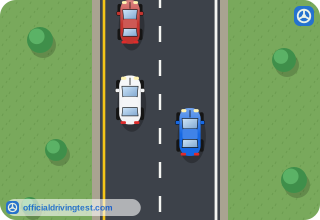
- Slowly, to stay in control
- Staying there until the other driver notices you
- At the same speed as the vehicle you are passing
- As quickly as you can
Show answer
Correct answer: As quickly as you can
The longer you stay in the blind spot, the longer you are in danger of the other driver turning into you.
Source: Delaware Driver Manual (July 2026), page 121 · Open this page in the manual (Manual page 121)
-
Why should you never stay alongside a large vehicle such as a truck or bus?
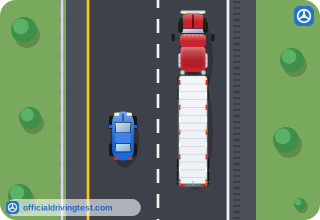
- Their blind spots are large and drivers cannot easily see you
- They always stop without any warning at all to you
- Their mirrors show every vehicle beside them clearly
- Their exhaust can damage smaller vehicles nearby
Show answer
Correct answer: Their blind spots are large and drivers cannot easily see you
Large vehicles have large blind spots, so their drivers have a hard time seeing you alongside.
Source: Delaware Driver Manual (July 2026), page 121 · Open this page in the manual (Manual page 121)
-
Why should you watch for large trucks and small underpowered cars on steep grades?
- They can lose speed on long or steep hills
- They have the right-of-way on all steep hills
- They are not allowed to use the right lane
- They must stop at the top of every steep hill
Show answer
Correct answer: They can lose speed on long or steep hills
The manual says large trucks and small underpowered cars can lose speed on long or steep hills.
Source: Delaware Driver Manual (July 2026), page 125 · Open this page in the manual (Manual page 125)
-
Why should you watch for large trucks and small underpowered cars when they are entering traffic?
- They always enter traffic faster than other vehicles
- They are required to stop before entering traffic
- It takes them longer to get up to speed
- They can only enter traffic from the left lane
Show answer
Correct answer: It takes them longer to get up to speed
The manual says it takes longer for these vehicles to get up to speed when they enter traffic.
Source: Delaware Driver Manual (July 2026), page 125 · Open this page in the manual (Manual page 125)
-
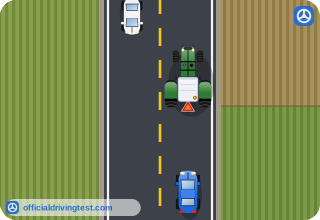
About how fast do farm tractors, animal-drawn vehicles and roadway maintenance vehicles usually go?
- 35 mph or less
- 25 mph or less
- 45 mph or less
- 15 mph or less
Show answer
Correct answer: 25 mph or less
The manual says these vehicles usually go 25 mph or less.
Source: Delaware Driver Manual (July 2026), page 125 · Open this page in the manual (Manual page 125)
-
What should a farm tractor have on the back to show that it is a slow-moving vehicle?
- A red flashing light shaped like a diamond
- A yellow octagon with the word SLOW
- A white square with a black border
- A slow-moving vehicle decal, an orange triangle
Show answer
Correct answer: A slow-moving vehicle decal, an orange triangle
The manual says these vehicles should have a slow-moving vehicle decal, an orange triangle, on the back.
Source: Delaware Driver Manual (July 2026), page 125 · Open this page in the manual (Manual page 125)
-
Why do you need extra distance when following motorcycles?
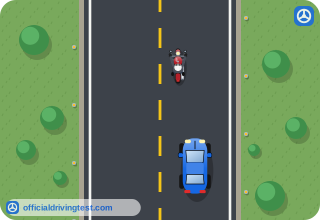
- If the motorcycle falls over, you need room to avoid hitting the rider
- Motorcycles are required to ride on the shoulder of the road
- Motorcycles are not permitted to use turn signals or brake lights
- Motorcycles are required to drive well below the speed limit
Show answer
Correct answer: If the motorcycle falls over, you need room to avoid hitting the rider
The manual says to leave extra distance so you can avoid hitting the rider if the motorcycle falls over.
Source: Delaware Driver Manual (July 2026), page 128 · Open this page in the manual (Manual page 128)
-
On which surfaces is the chance of a motorcycle falling greatest?
- Dry asphalt roads, smooth concrete highways and new pavement
- Newly paved roads, well-lit city streets and wide shoulders
- Wet or icy roads, gravel roads, and metal surfaces such as bridges
- Straight rural roads, dry shoulders and freshly marked lanes
Show answer
Correct answer: Wet or icy roads, gravel roads, and metal surfaces such as bridges
The manual says the chances of a fall are greatest on wet or icy roads, gravel roads, or on metal surfaces such as bridges, gratings, or streetcar or railroad tracks.
Source: Delaware Driver Manual (July 2026), page 128 · Open this page in the manual (Manual page 128)
-
Which drivers may not be able to see you when you are directly behind them?
- Drivers of two-door coupes, compact sedans and small hatchbacks
- Drivers of trucks, buses, vans or vehicles pulling campers or trailers
- Drivers of motorcycles, mopeds and other two-wheeled vehicles
- Drivers of taxis, delivery cars and rental sedans only
Show answer
Correct answer: Drivers of trucks, buses, vans or vehicles pulling campers or trailers
The manual says the drivers of trucks, buses, vans or vehicles pulling campers or trailers may not see you directly behind them.
Source: Delaware Driver Manual (July 2026), page 128 · Open this page in the manual (Manual page 128)
-
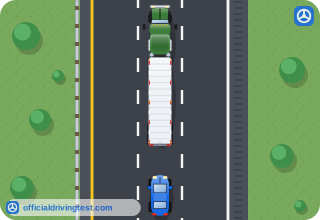
What is the benefit of falling back when following a large vehicle?
- You can follow it more closely
- You can pass it with less warning
- You can use its headlights to see
- More room to see ahead and to be seen
Show answer
Correct answer: More room to see ahead and to be seen
The manual says large vehicles block your view of the road ahead, and falling back gives you more room to see ahead and to be seen.
Source: Delaware Driver Manual (July 2026), page 128 · Open this page in the manual (Manual page 128)
-
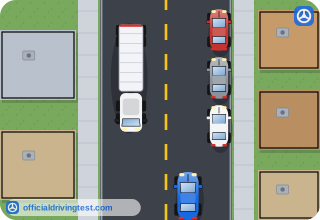
You steer between an oncoming tractor-trailer and parked vehicles. Where should you leave a little more space?
- On the side of the parked vehicles
- On the side that the truck will pass
- Equal on both sides, never more on one
- On the far right edge of the road
Show answer
Correct answer: On the side that the truck will pass
If the oncoming vehicle is a tractor-trailer, leave a little more room on the side the truck will pass.
Source: Delaware Driver Manual (July 2026), page 130 · Open this page in the manual (Manual page 130)
-
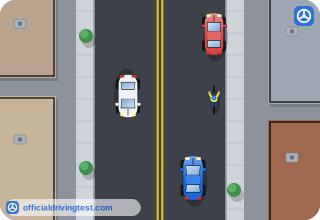
You are overtaking a bicycle and a vehicle is approaching from the opposite direction. What should you do?
- Speed up to pass the bicycle before the vehicle arrives
- Pass the bicycle at once and move back in quickly
- Stop and wait for the bicycle to leave the road
- Slow down and let the oncoming vehicle pass first
Show answer
Correct answer: Slow down and let the oncoming vehicle pass first
Taking hazards one at a time, you slow down and let the vehicle pass first so you can give extra room to the bicycle.
Source: Delaware Driver Manual (July 2026), page 130 · Open this page in the manual (Manual page 130)
-
How should you handle two hazards of similar danger, such as oncoming vehicles and parked vehicles?
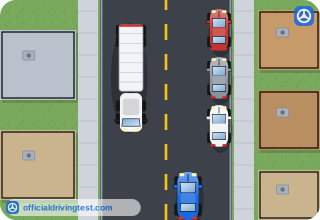
- Steer a middle course between them
- Drive close to the parked vehicles
- Drive close to the oncoming traffic
- Stop until both have cleared
Show answer
Correct answer: Steer a middle course between them
The manual says to split the difference between two hazards by steering a middle course between them.
Source: Delaware Driver Manual (July 2026), page 130 · Open this page in the manual (Manual page 130)
-
Which of these is listed among those who could have trouble seeing you?
- Construction workers
- Drivers whose windows are steamed up
- Drivers who slow down for no reason
- Children not paying attention
Show answer
Correct answer: Drivers whose windows are steamed up
Drivers whose windows are covered with snow or ice or are steamed up are listed as people who cannot see you well.
Source: Delaware Driver Manual (July 2026), page 132 · Open this page in the manual (Manual page 132)
-
Which of these is listed among people who may be distracted?
- Pedestrians with umbrellas in front of their faces
- Drivers looking for street signs or house numbers
- Drivers who slow down for what seems like no reason
- Delivery persons
Show answer
Correct answer: Delivery persons
Delivery persons, construction workers, and children or drivers not paying attention are listed as possibly distracted.
Source: Delaware Driver Manual (July 2026), page 132 · Open this page in the manual (Manual page 132)
-
Which of these is listed among people who may be confused?
- Drivers looking for street signs or house numbers
- Construction workers
- Delivery persons
- Drivers whose windows are covered with snow or ice
Show answer
Correct answer: Drivers looking for street signs or house numbers
Tourists, drivers who slow down for no reason, and drivers looking for street signs or house numbers are listed as possibly confused.
Source: Delaware Driver Manual (July 2026), page 132 · Open this page in the manual (Manual page 132)
-
If another driver passes you without enough room, what should you do?
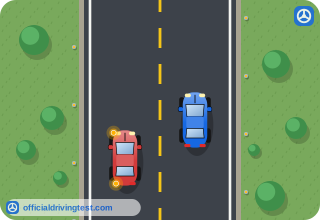
- Speed up to keep them from returning to the lane
- Honk your horn and hold your position
- Slow down and let them return to the drive lane safely
- Move to the shoulder and stop
Show answer
Correct answer: Slow down and let them return to the drive lane safely
Do not make another driver's mistake worse: slow down and let them return to the drive lane safely.
Source: Delaware Driver Manual (July 2026), page 132 · Open this page in the manual (Manual page 132)
-
If another driver needs to suddenly change lanes, what should you do?
- Speed up to stay ahead of them
- Slow down and let them merge
- Hold your speed and position
- Sound your horn as a warning
Show answer
Correct answer: Slow down and let them merge
Slowing down and letting them merge keeps traffic moving smoothly and safely and helps you avoid a crash.
Source: Delaware Driver Manual (July 2026), page 132 · Open this page in the manual (Manual page 132)