Delaware: Sharing the road — Part 6 Practice Test
Questions in this part include: “Why should you watch for large trucks and small underpowered cars on steep grades?” · “Which drivers may not be able to see you when you are directly behind them?”
Independent educational site · not affiliated with any government agency or DMV
Ready? Test yourself
- Instant feedback with an explanation
- Every answer cites its source in the manual
- Your best score is saved on this device
Questions are original and based on the official manual "Delaware Driver Manual" (July 2026), Delaware Division of Motor Vehicles (DMV).
All 19 questions in this practice test
Take the test above first, then use this list to study. Tap “Show answer” to see the correct answer and explanation.
Show the questions and answersHide the questions
-
If you find yourself driving on the side and slightly to the rear of another vehicle, what should you do?
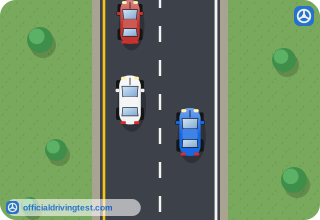
- Stay where you are and tap your horn
- Speed up or drop back so the other driver sees you
- Move closer to the other vehicle and stay there
- Flash your high beams at the other driver
Show answer
Correct answer: Speed up or drop back so the other driver sees you
That position is in the other driver's blind spot, so you should either speed up or drop back.
Source: Delaware Driver Manual (July 2026), page 121 · Open this page in the manual (Manual page 121)
-
When passing another vehicle, how should you move through the other driver's blind spot?
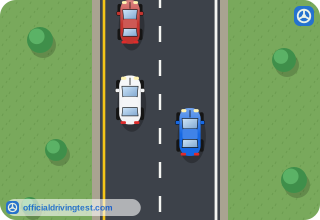
- Slowly, to stay in control
- Staying there until the other driver notices you
- At the same speed as the vehicle you are passing
- As quickly as you can
Show answer
Correct answer: As quickly as you can
The longer you stay in the blind spot, the longer you are in danger of the other driver turning into you.
Source: Delaware Driver Manual (July 2026), page 121 · Open this page in the manual (Manual page 121)
-
Why should you never stay alongside a large vehicle such as a truck or bus?
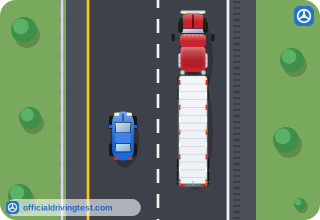
- Their blind spots are large and drivers cannot easily see you
- They always stop without any warning at all to you
- Their mirrors show every vehicle beside them clearly
- Their exhaust can damage smaller vehicles nearby
Show answer
Correct answer: Their blind spots are large and drivers cannot easily see you
Large vehicles have large blind spots, so their drivers have a hard time seeing you alongside.
Source: Delaware Driver Manual (July 2026), page 121 · Open this page in the manual (Manual page 121)
-
Why should you watch for large trucks and small underpowered cars on steep grades?
- They can lose speed on long or steep hills
- They have the right-of-way on all steep hills
- They are not allowed to use the right lane
- They must stop at the top of every steep hill
Show answer
Correct answer: They can lose speed on long or steep hills
The manual says large trucks and small underpowered cars can lose speed on long or steep hills.
Source: Delaware Driver Manual (July 2026), page 125 · Open this page in the manual (Manual page 125)
-
Why should you watch for large trucks and small underpowered cars when they are entering traffic?
- They always enter traffic faster than other vehicles
- They are required to stop before entering traffic
- It takes them longer to get up to speed
- They can only enter traffic from the left lane
Show answer
Correct answer: It takes them longer to get up to speed
The manual says it takes longer for these vehicles to get up to speed when they enter traffic.
Source: Delaware Driver Manual (July 2026), page 125 · Open this page in the manual (Manual page 125)
-
About how fast do farm tractors, animal-drawn vehicles and roadway maintenance vehicles usually go?
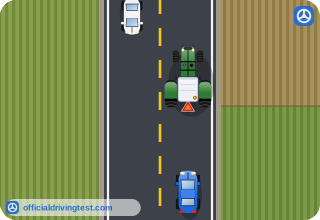
- 35 mph or less
- 25 mph or less
- 45 mph or less
- 15 mph or less
Show answer
Correct answer: 25 mph or less
The manual says these vehicles usually go 25 mph or less.
Source: Delaware Driver Manual (July 2026), page 125 · Open this page in the manual (Manual page 125)
-
What should a farm tractor have on the back to show that it is a slow-moving vehicle?
- A red flashing light shaped like a diamond
- A yellow octagon with the word SLOW
- A white square with a black border
- A slow-moving vehicle decal, an orange triangle
Show answer
Correct answer: A slow-moving vehicle decal, an orange triangle
The manual says these vehicles should have a slow-moving vehicle decal, an orange triangle, on the back.
Source: Delaware Driver Manual (July 2026), page 125 · Open this page in the manual (Manual page 125)
-
Why do you need extra distance when following motorcycles?
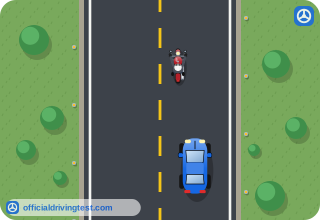
- If the motorcycle falls over, you need room to avoid hitting the rider
- Motorcycles are required to ride on the shoulder of the road
- Motorcycles are not permitted to use turn signals or brake lights
- Motorcycles are required to drive well below the speed limit
Show answer
Correct answer: If the motorcycle falls over, you need room to avoid hitting the rider
The manual says to leave extra distance so you can avoid hitting the rider if the motorcycle falls over.
Source: Delaware Driver Manual (July 2026), page 128 · Open this page in the manual (Manual page 128)
-
On which surfaces is the chance of a motorcycle falling greatest?
- Dry asphalt roads, smooth concrete highways and new pavement
- Newly paved roads, well-lit city streets and wide shoulders
- Wet or icy roads, gravel roads, and metal surfaces such as bridges
- Straight rural roads, dry shoulders and freshly marked lanes
Show answer
Correct answer: Wet or icy roads, gravel roads, and metal surfaces such as bridges
The manual says the chances of a fall are greatest on wet or icy roads, gravel roads, or on metal surfaces such as bridges, gratings, or streetcar or railroad tracks.
Source: Delaware Driver Manual (July 2026), page 128 · Open this page in the manual (Manual page 128)
-
Which drivers may not be able to see you when you are directly behind them?
- Drivers of two-door coupes, compact sedans and small hatchbacks
- Drivers of trucks, buses, vans or vehicles pulling campers or trailers
- Drivers of motorcycles, mopeds and other two-wheeled vehicles
- Drivers of taxis, delivery cars and rental sedans only
Show answer
Correct answer: Drivers of trucks, buses, vans or vehicles pulling campers or trailers
The manual says the drivers of trucks, buses, vans or vehicles pulling campers or trailers may not see you directly behind them.
Source: Delaware Driver Manual (July 2026), page 128 · Open this page in the manual (Manual page 128)
-
What is the benefit of falling back when following a large vehicle?
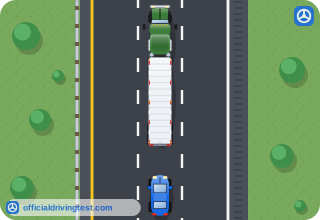
- You can follow it more closely
- You can pass it with less warning
- You can use its headlights to see
- More room to see ahead and to be seen
Show answer
Correct answer: More room to see ahead and to be seen
The manual says large vehicles block your view of the road ahead, and falling back gives you more room to see ahead and to be seen.
Source: Delaware Driver Manual (July 2026), page 128 · Open this page in the manual (Manual page 128)
-
You steer between an oncoming tractor-trailer and parked vehicles. Where should you leave a little more space?
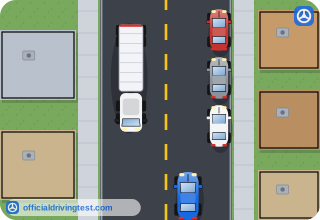
- On the side of the parked vehicles
- On the side that the truck will pass
- Equal on both sides, never more on one
- On the far right edge of the road
Show answer
Correct answer: On the side that the truck will pass
If the oncoming vehicle is a tractor-trailer, leave a little more room on the side the truck will pass.
Source: Delaware Driver Manual (July 2026), page 130 · Open this page in the manual (Manual page 130)
-
You are overtaking a bicycle and a vehicle is approaching from the opposite direction. What should you do?
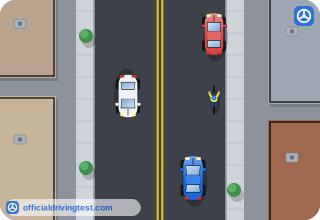
- Speed up to pass the bicycle before the vehicle arrives
- Pass the bicycle at once and move back in quickly
- Stop and wait for the bicycle to leave the road
- Slow down and let the oncoming vehicle pass first
Show answer
Correct answer: Slow down and let the oncoming vehicle pass first
Taking hazards one at a time, you slow down and let the vehicle pass first so you can give extra room to the bicycle.
Source: Delaware Driver Manual (July 2026), page 130 · Open this page in the manual (Manual page 130)
-
How should you handle two hazards of similar danger, such as oncoming vehicles and parked vehicles?
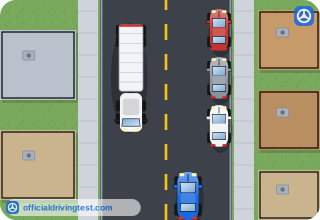
- Steer a middle course between them
- Drive close to the parked vehicles
- Drive close to the oncoming traffic
- Stop until both have cleared
Show answer
Correct answer: Steer a middle course between them
The manual says to split the difference between two hazards by steering a middle course between them.
Source: Delaware Driver Manual (July 2026), page 130 · Open this page in the manual (Manual page 130)
-
Which of these is listed among those who could have trouble seeing you?
- Construction workers
- Drivers whose windows are steamed up
- Drivers who slow down for no reason
- Children not paying attention
Show answer
Correct answer: Drivers whose windows are steamed up
Drivers whose windows are covered with snow or ice or are steamed up are listed as people who cannot see you well.
Source: Delaware Driver Manual (July 2026), page 132 · Open this page in the manual (Manual page 132)
-
Which of these is listed among people who may be distracted?
- Pedestrians with umbrellas in front of their faces
- Drivers looking for street signs or house numbers
- Drivers who slow down for what seems like no reason
- Delivery persons
Show answer
Correct answer: Delivery persons
Delivery persons, construction workers, and children or drivers not paying attention are listed as possibly distracted.
Source: Delaware Driver Manual (July 2026), page 132 · Open this page in the manual (Manual page 132)
-
Which of these is listed among people who may be confused?
- Drivers looking for street signs or house numbers
- Construction workers
- Delivery persons
- Drivers whose windows are covered with snow or ice
Show answer
Correct answer: Drivers looking for street signs or house numbers
Tourists, drivers who slow down for no reason, and drivers looking for street signs or house numbers are listed as possibly confused.
Source: Delaware Driver Manual (July 2026), page 132 · Open this page in the manual (Manual page 132)
-
If another driver passes you without enough room, what should you do?
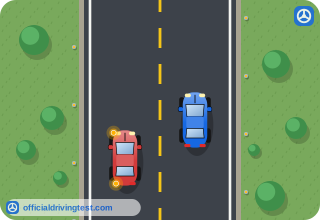
- Speed up to keep them from returning to the lane
- Honk your horn and hold your position
- Slow down and let them return to the drive lane safely
- Move to the shoulder and stop
Show answer
Correct answer: Slow down and let them return to the drive lane safely
Do not make another driver's mistake worse: slow down and let them return to the drive lane safely.
Source: Delaware Driver Manual (July 2026), page 132 · Open this page in the manual (Manual page 132)
-
If another driver needs to suddenly change lanes, what should you do?
- Speed up to stay ahead of them
- Slow down and let them merge
- Hold your speed and position
- Sound your horn as a warning
Show answer
Correct answer: Slow down and let them merge
Slowing down and letting them merge keeps traffic moving smoothly and safely and helps you avoid a crash.
Source: Delaware Driver Manual (July 2026), page 132 · Open this page in the manual (Manual page 132)