Delaware: Sharing the road — Part 1 Practice Test
Questions in this part include: “According to the manual, which vehicle is a school bus?” · “Who must obey traffic laws on the highway?”
Independent educational site · not affiliated with any government agency or DMV
Ready? Test yourself
- Instant feedback with an explanation
- Every answer cites its source in the manual
- Your best score is saved on this device
Questions are original and based on the official manual "Delaware Driver Manual" (July 2026), Delaware Division of Motor Vehicles (DMV).
All 20 questions in this practice test
Take the test above first, then use this list to study. Tap “Show answer” to see the correct answer and explanation.
Show the questions and answersHide the questions
-
An electric-motor vehicle with fully operable pedals can still be a "bicycle" if its motor is rated at less than how many watts?
- 500 watts (0.67 hp)
- 750 watts (1 hp)
- 1,500 watts (2 hp)
- 2,000 watts (2.7 hp)
Show answer
Correct answer: 750 watts (1 hp)
The definition of bicycle includes a two- or three-wheeled vehicle with fully operable pedals and an electric motor of less than 750 watts (1 hp).
Source: Delaware Driver Manual (July 2026), page 11 · Open this page in the manual (Manual page 11)
-
To be a "bicycle" under the manual, a pedal vehicle with an electric motor must have a maximum speed, when powered solely by the motor with a 170-pound rider on a paved level surface, of less than what?
- 15 mph
- 25 mph
- 30 mph
- 20 mph
Show answer
Correct answer: 20 mph
The manual's bicycle definition sets the limit at less than 20 mph when powered solely by the motor with a 170-pound operator on a paved level surface.
Source: Delaware Driver Manual (July 2026), page 11 · Open this page in the manual (Manual page 11)
-
According to the manual, which vehicle is a school bus?
- Any motor vehicle that is used to carry children to and from school
- Any yellow motor vehicle that carries ten or more passengers
- Any bus that carries students and displays flashing lights
- A motor vehicle painted chrome yellow that displays the words "SCHOOL BUS"
Show answer
Correct answer: A motor vehicle painted chrome yellow that displays the words "SCHOOL BUS"
The manual defines a school bus as a motor vehicle painted national school bus chrome yellow with the words SCHOOL BUS displayed on it.
Source: Delaware Driver Manual (July 2026), page 13 · Open this page in the manual (Manual page 13)
-
Which of these is another name the manual gives for a two-way cycle track?
- Protected bike lane
- Bike box
- Shared roadway
- Painted shoulder
Show answer
Correct answer: Protected bike lane
The manual says a two-way cycle track is also known as protected bike lanes, separated bikeways and on-street bike paths.
Source: Delaware Driver Manual (July 2026), page 13 · Open this page in the manual (Manual page 13)
-
How much clearance does the law require motorists to leave at all times when passing a cyclist?
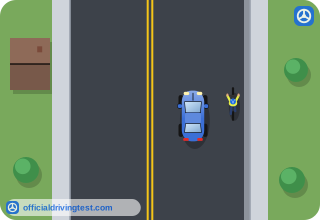
- A minimum of one foot
- A minimum of three feet
- A minimum of five feet
- A minimum of ten feet
Show answer
Correct answer: A minimum of three feet
The law requires a minimum of three feet of clearance at all times when passing a cyclist.
Source: Delaware Driver Manual (July 2026), page 81 · Open this page in the manual (Manual page 81)
-
On a multi-lane road, what does the law require motorists to do when passing a cyclist, whenever possible?
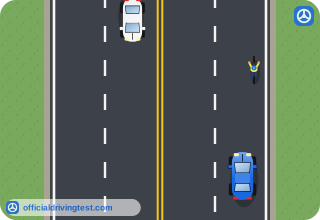
- Stay in the lane and slow down
- Sound the horn and pass quickly
- Pass on the right side of the cyclist
- Move to the adjacent lane
Show answer
Correct answer: Move to the adjacent lane
On multi-lane roads, motorists must move to the adjacent lane whenever possible when passing a cyclist.
Source: Delaware Driver Manual (July 2026), page 81 · Open this page in the manual (Manual page 81)
-
What lights do school buses have front and rear that are activated before the red lights?
- Two overhead steady yellow lights
- One overhead flashing white light
- Two overhead alternately flashing yellow lights
- Two overhead alternately flashing green lights
Show answer
Correct answer: Two overhead alternately flashing yellow lights
The manual says school buses have two overhead alternately flashing yellow lights both front and rear.
Source: Delaware Driver Manual (July 2026), page 89 · Open this page in the manual (Manual page 89)
-
How long before the overhead flashing red lights are the school bus yellow lights activated?
- Approximately 3 seconds
- Approximately 10 seconds
- Approximately 30 seconds
- Approximately 1 minute
Show answer
Correct answer: Approximately 10 seconds
The manual says the yellow lights are activated approximately 10 seconds before the overhead flashing red lights.
Source: Delaware Driver Manual (July 2026), page 89 · Open this page in the manual (Manual page 89)
-
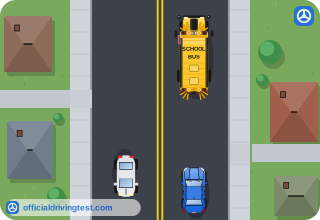
What should you do when approaching a school bus with its flashing yellow lights on?
- Speed up to pass before it stops
- Stop at once and wait for the red lights
- Ignore the lights until the stop arm extends
- Approach with caution and anticipate a stop
Show answer
Correct answer: Approach with caution and anticipate a stop
The manual says to approach a bus flashing yellow lights with caution and anticipate a stop.
Source: Delaware Driver Manual (July 2026), page 89 · Open this page in the manual (Manual page 89)
-
When may you proceed after a school bus has stopped with its red lights flashing and stop arm out?
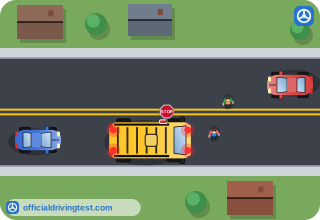
- Not until the red lights have stopped flashing and the stop arm has been retracted
- As soon as all of the children have crossed the road and are safely off it
- After waiting about 10 seconds for the bus to begin moving again
- As soon as the red lights stop flashing, even if the stop arm is out
Show answer
Correct answer: Not until the red lights have stopped flashing and the stop arm has been retracted
The manual says you must not proceed until the red lights have stopped flashing and the stop arm has been retracted.
Source: Delaware Driver Manual (July 2026), page 89 · Open this page in the manual (Manual page 89)
-
On a roadway with fewer than 4 lanes, who must stop for a school bus that has stopped with red lights flashing?
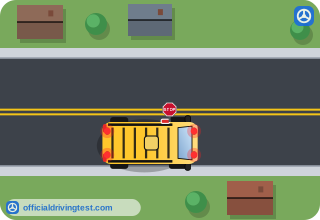
- Only traffic following the bus
- Only traffic approaching the bus
- Traffic in both directions
- Only traffic in the right lane
Show answer
Correct answer: Traffic in both directions
The picture on this page says that on roadways with less than 4 lanes, both directions must stop.
Source: Delaware Driver Manual (July 2026), page 89 · Open this page in the manual (Manual page 89)
-
Which school district is authorized by House Bill Number 202 to install stop arm cameras on its school buses as part of the School Bus Safety Pilot Program?
- The Appoquinimink School District
- The Red Clay Consolidated School District
- The Capital School District of Dover
- The Brandywine School District
Show answer
Correct answer: The Red Clay Consolidated School District
The manual says House Bill 202 authorizes the Red Clay Consolidated School District to install stop arm cameras.
Source: Delaware Driver Manual (July 2026), page 90 · Open this page in the manual (Manual page 90)
-
Who must obey traffic laws on the highway?
- All highway users, including drivers, pedestrians, and bicyclists
- Only drivers of motor vehicles, because pedestrians and bicyclists are not regulated
- Drivers and bicyclists, but not pedestrians
- Drivers and pedestrians, but not bicyclists
Show answer
Correct answer: All highway users, including drivers, pedestrians, and bicyclists
The manual says all highway users must obey traffic laws, including drivers, pedestrians, and bicyclists.
Source: Delaware Driver Manual (July 2026), page 94 · Open this page in the manual (Manual page 94)
-
On which Delaware roads do cyclists NOT have the right to ride?
- Limited access highways
- Roads with a double yellow center line
- Roads without a paved shoulder
- Roads with more than two lanes
Show answer
Correct answer: Limited access highways
Cyclists may use all Delaware roads except limited access highways.
Source: Delaware Driver Manual (July 2026), page 96 · Open this page in the manual (Manual page 96)
-
Under the Bicycle Friendly Delaware Act, what must a driver do when passing a bicycle if the travel lanes are too narrow for sharing?
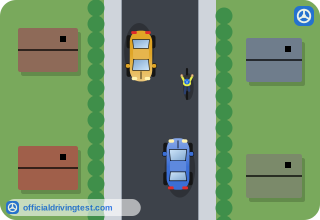
- Stay in the lane and honk to warn the cyclist
- Wait until the cyclist leaves the roadway
- Change lanes, even if there is a double yellow line
- Pass on the right side of the cyclist
Show answer
Correct answer: Change lanes, even if there is a double yellow line
The Act requires drivers to change lanes, including across a double yellow line, when the lanes are too narrow to share with the bicycle.
Source: Delaware Driver Manual (July 2026), page 96 · Open this page in the manual (Manual page 96)
-
How much room must motorists give a bicyclist when passing?
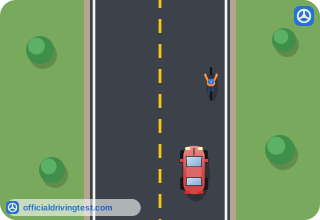
- At least one foot
- At least three feet
- At least five feet
- At least ten feet
Show answer
Correct answer: At least three feet
Motorists must give bicyclists at least three feet of room when passing.
Source: Delaware Driver Manual (July 2026), page 96 · Open this page in the manual (Manual page 96)
-
When are motorists allowed to honk their horn at a bicyclist?
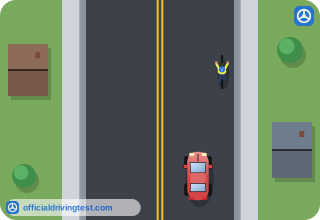
- When the cyclist is riding in the middle of the lane
- When the driver wants to pass the cyclist
- When the cyclist is riding on a double yellow line
- Only when there is an imminent danger
Show answer
Correct answer: Only when there is an imminent danger
Motorists are forbidden from honking at bicyclists unless there is an imminent danger.
Source: Delaware Driver Manual (July 2026), page 96 · Open this page in the manual (Manual page 96)
-
Under the Bicycle Friendly Delaware Act, where should bicyclists ride on the roadway?
- To the right of the roadway as their safety allows
- In the center of the travel lane at all times
- On the left side, facing traffic
- On the sidewalk whenever possible
Show answer
Correct answer: To the right of the roadway as their safety allows
The Act says bicyclists should ride to the right of the roadway as their safety allows.
Source: Delaware Driver Manual (July 2026), page 96 · Open this page in the manual (Manual page 96)
-
What is a bike box?
- A designated lane beside the curb where bicycles may park at intersections
- A locked storage area where bicycles are kept at the entrance to a parking lot
- A designated area at the head of a traffic lane that helps bicyclists turn and get ahead
- A sign posted at intersections to tell drivers that a bike route begins
Show answer
Correct answer: A designated area at the head of a traffic lane that helps bicyclists turn and get ahead
The manual defines a bike box as a designated area at the head of a traffic lane at intersections for bicyclists to turn safely and get ahead of traffic.
Source: Delaware Driver Manual (July 2026), page 96 · Open this page in the manual (Manual page 96)
-
Which is a stated benefit of a bike box at an intersection?
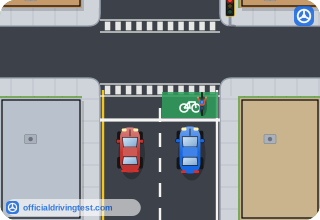
- It lets cyclists ignore the traffic signal at the intersection
- It helps prevent right-hook conflicts with turning vehicles
- It gives turning vehicles priority over bicyclists
- It removes the need for crosswalks at the intersection
Show answer
Correct answer: It helps prevent right-hook conflicts with turning vehicles
The manual lists prevention of right-hook conflicts with turning vehicles among the benefits of a bike box.
Source: Delaware Driver Manual (July 2026), page 96 · Open this page in the manual (Manual page 96)