Delaware: Sharing the road — Part 4 Practice Test
Questions in this part include: “Which of these may cause a motorcyclist to change speed or direction?” · “What should you check before you move into the passing lane to pass a truck?”
Independent educational site · not affiliated with any government agency or DMV
Ready? Test yourself
- Instant feedback with an explanation
- Every answer cites its source in the manual
- Your best score is saved on this device
Questions are original and based on the official manual "Delaware Driver Manual" (July 2026), Delaware Division of Motor Vehicles (DMV).
All 20 questions in this practice test
Take the test above first, then use this list to study. Tap “Show answer” to see the correct answer and explanation.
Show the questions and answersHide the questions
-
On most motorcycles, how do turn signals behave after a turn?
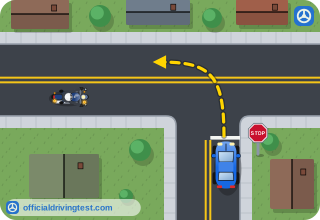
- They cancel automatically after ten seconds
- They cancel when the rider touches the brake
- They cancel when the speed drops below 40 mph
- They are not automatically self-canceling
Show answer
Correct answer: They are not automatically self-canceling
The manual states that turn signals are not automatically self-canceling on most motorcycles.
Source: Delaware Driver Manual (July 2026), page 100 · Open this page in the manual (Manual page 100)
-
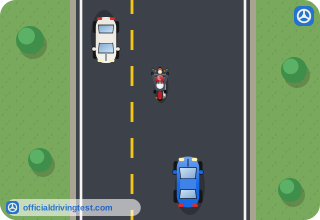
How much of a lane is a motorcycle entitled to use?
- Only the half of the lane nearest the shoulder
- Only the center third of the lane
- The same full lane width as all other vehicles
- Only the part of the lane the rider chooses to leave open
Show answer
Correct answer: The same full lane width as all other vehicles
The manual says motorcycles have the same full lane width as any other vehicle.
Source: Delaware Driver Manual (July 2026), page 100 · Open this page in the manual (Manual page 100)
-
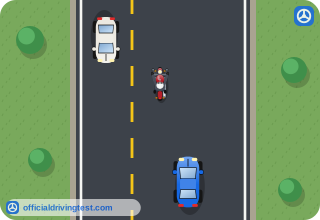
A motorcyclist is riding far to one side of a wide lane. What must you never do?
- Follow the motorcycle at a four second count
- Move into the same lane alongside the motorcycle
- Look and look again before a left turn
- Increase your following distance in the rain
Show answer
Correct answer: Move into the same lane alongside the motorcycle
The manual says sharing a lane alongside a motorcycle is illegal and extremely hazardous, even in a wide lane.
Source: Delaware Driver Manual (July 2026), page 100 · Open this page in the manual (Manual page 100)
-
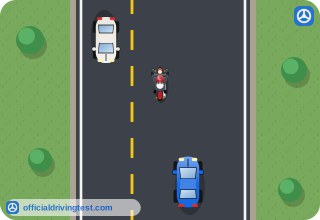
Why does a skilled motorcycle operator constantly change positions within a lane?
- To make room for cars to pass within the same lane
- To avoid being followed by vehicles behind the motorcycle
- To signal drivers that the rider is about to turn
- To see and be seen and to compensate for objects in or near the road
Show answer
Correct answer: To see and be seen and to compensate for objects in or near the road
Changing position within the lane helps a skilled rider see and be seen and deal with objects in or near the road.
Source: Delaware Driver Manual (July 2026), page 100 · Open this page in the manual (Manual page 100)
-
What does the manual say about rain, wind, dust and smog and a motorcyclist's vision?
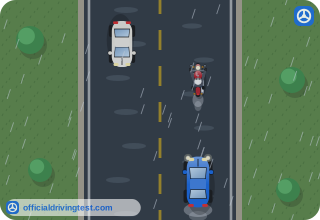
- They affect the rider's vision less than a driver's vision
- They affect only riders who do not wear a face shield
- They affect the rider's vision more easily than yours
- They affect the rider only when traveling above 40 mph
Show answer
Correct answer: They affect the rider's vision more easily than yours
The manual says these conditions limit a rider's vision more easily than a driver's, even with a face shield or goggles.
Source: Delaware Driver Manual (July 2026), page 100 · Open this page in the manual (Manual page 100)
-
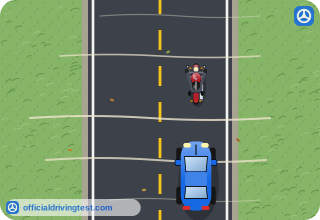
Which places should you watch for when cross winds could move a motorcycle out of its lane?
- Narrow residential streets with parked cars
- Wide open, long stretches of highways and bridges
- Short tunnels on mountain roads only
- Shaded roads lined with trees
Show answer
Correct answer: Wide open, long stretches of highways and bridges
The manual lists wide open, long stretches of highway and bridges as places where cross winds can move a motorcycle.
Source: Delaware Driver Manual (July 2026), page 100 · Open this page in the manual (Manual page 100)
-
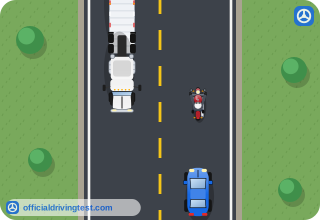
What can fast-moving large trucks create that may startle a motorcyclist?
- Loud horn blasts
- Bright reflections
- Sudden road noise
- Wind blasts
Show answer
Correct answer: Wind blasts
The manual says large trucks can create wind blasts that startle a rider and may move the rider out of the path of travel.
Source: Delaware Driver Manual (July 2026), page 100 · Open this page in the manual (Manual page 100)
-
Which of these may cause a motorcyclist to change speed or direction?
- Gravel, debris, pavement seams or manhole covers
- Dry pavement, bright paint, or wide shoulders
- Level roads, clear weather, or light traffic
- Painted crosswalks, road signs, or lane lines
Show answer
Correct answer: Gravel, debris, pavement seams or manhole covers
The manual says road surfaces and objects that do not bother other vehicles can make a motorcyclist change speed or direction.
Source: Delaware Driver Manual (July 2026), page 100 · Open this page in the manual (Manual page 100)
-
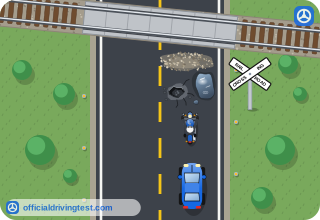
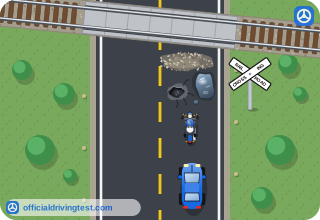
Why might a motorcyclist slow down or change direction at a railroad grade crossing?
- So the rider can stop on the tracks to look
- So the rider can avoid using the brakes
- So the tracks can be crossed head on
- So the rider can pass the vehicle ahead
Show answer
Correct answer: So the tracks can be crossed head on
Railroad crossings may be rough or angled, so a rider may slow or change direction to cross the tracks head on.
Source: Delaware Driver Manual (July 2026), page 100 · Open this page in the manual (Manual page 100)
-
What may a cyclist do to cushion the shock of a rough railroad crossing?
- Lean far to one side
- Rise up off the seat
- Take both hands off the handlebars
- Speed up before the tracks
Show answer
Correct answer: Rise up off the seat
The manual says a cyclist may rise up off the seat to cushion the shock of a rough crossing.
Source: Delaware Driver Manual (July 2026), page 100 · Open this page in the manual (Manual page 100)
-
What can metal or grated bridges cause a motorcycle's front tire to do?
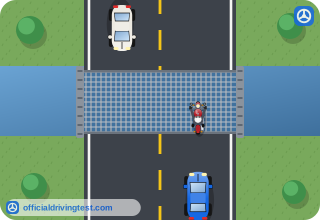
- Lose air pressure while crossing
- Stick firmly to the metal surface
- Make the rider lose engine power suddenly
- A wobbling sensation
Show answer
Correct answer: A wobbling sensation
The manual says grated bridges give a motorcycle's front tire a wobbling sensation greater than a car's, which may make an inexperienced rider change direction or slow down.
Source: Delaware Driver Manual (July 2026), page 100 · Open this page in the manual (Manual page 100)
-
What rights and duties does the rider of an animal or the driver of an animal-drawn vehicle have on the highway?
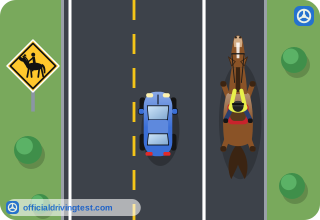
- Only the rights of a pedestrian crossing the road
- The right of way over all motor vehicles at all times
- All the rights and duties of a motor vehicle driver
- No rights, and only the duty to keep to the right shoulder
Show answer
Correct answer: All the rights and duties of a motor vehicle driver
Animal riders and animal-drawn vehicle drivers have the same rights and duties as motor vehicle drivers, except where a law cannot apply by its nature.
Source: Delaware Driver Manual (July 2026), page 102 · Open this page in the manual (Manual page 102)
-
As the driver of a farm tractor or other self-propelled road or construction equipment, what rights and duties do you have on the highway?
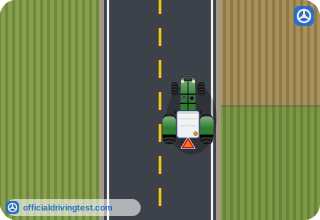
- Only the duty to stay on the shoulder
- All the rights and duties of any other motor vehicle
- The right to ignore speed limits on farm roads
- No duties, since the equipment is not a motor vehicle
Show answer
Correct answer: All the rights and duties of any other motor vehicle
Drivers of farm tractors and self-propelled equipment have all the rights and duties of any other motor vehicle on the highway.
Source: Delaware Driver Manual (July 2026), page 102 · Open this page in the manual (Manual page 102)
-
You see a triangular, fluorescent and reflective orange emblem on the back of a farm tractor ahead of you. What should you do?
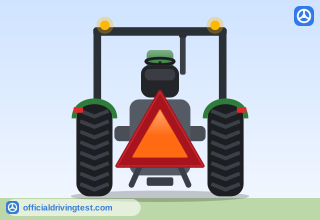
- Slow down immediately and proceed with caution
- Pass immediately on the right side of it
- Stop and wait until the vehicle leaves the road
- Honk to warn the driver to move over
Show answer
Correct answer: Slow down immediately and proceed with caution
The manual says to slow down immediately and proceed with caution when you see a Slow-Moving Vehicle emblem.
Source: Delaware Driver Manual (July 2026), page 102 · Open this page in the manual (Manual page 102)
-
What does the Slow-Moving Vehicle emblem on a farm tractor look like?
- A square yellow sign with a black border
- A round red sign with a white bar
- A triangular, fluorescent and reflective orange sign
- A diamond-shaped green sign with a white arrow
Show answer
Correct answer: A triangular, fluorescent and reflective orange sign
The manual describes the emblem as a triangular, fluorescent and reflective orange sign.
Source: Delaware Driver Manual (July 2026), page 102 · Open this page in the manual (Manual page 102)
-
What should you check before you move into the passing lane to pass a truck?
- That the truck driver has turned off his headlights
- That the lane is clear and the zone is a legal passing zone
- That the truck is traveling below 40 mph on a level road
- That another vehicle is passing the truck at the same time
Show answer
Correct answer: That the lane is clear and the zone is a legal passing zone
The manual says to check front and rear and pass only if the lane is clear and you are in a legal passing zone.
Source: Delaware Driver Manual (July 2026), page 102 · Open this page in the manual (Manual page 102)
-
How can you let a truck driver know you are passing, especially at night?
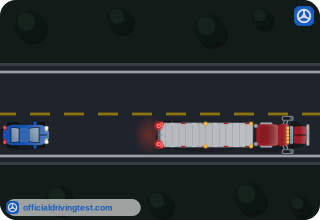
- By sounding your horn continuously
- By turning on your hazard lights
- By flashing your brake lights
- By blinking your headlights
Show answer
Correct answer: By blinking your headlights
The manual says to blink your headlights if needed to let the truck driver know you are passing.
Source: Delaware Driver Manual (July 2026), page 102 · Open this page in the manual (Manual page 102)
-
On a level highway, about how much longer does it take to pass a truck than a car?
- Three to five seconds
- One to two seconds
- Ten to fifteen seconds
- Thirty seconds
Show answer
Correct answer: Three to five seconds
The manual says it takes only three to five seconds longer to pass a truck than a car on a level highway.
Source: Delaware Driver Manual (July 2026), page 103 · Open this page in the manual (Manual page 103)
-
Why is it easier to pass a truck than a car on an upgrade?
- A truck stops on every upgrade
- A truck must use the right shoulder
- A truck often loses speed on an upgrade
- A truck driver cannot see you on an upgrade
Show answer
Correct answer: A truck often loses speed on an upgrade
The manual says a truck often loses speed on an upgrade, so it is easier to pass than a car.
Source: Delaware Driver Manual (July 2026), page 103 · Open this page in the manual (Manual page 103)
-
What may you need to do when passing a truck on a downgrade?
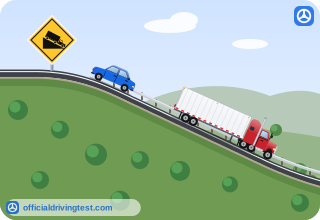
- Slow down and stay beside the truck
- Increase your speed
- Stop on the shoulder
- Pass on the right side
Show answer
Correct answer: Increase your speed
On a downgrade the truck's momentum makes it go faster, so you may need to increase your speed to pass.
Source: Delaware Driver Manual (July 2026), page 103 · Open this page in the manual (Manual page 103)