Delaware: Sharing the road — Part 2 Practice Test
Questions in this part include: “How do pedestrians benefit from a bike box?” · “If you pass a bicycle without changing lanes in a very wide lane, what speed action does the law require?”
Independent educational site · not affiliated with any government agency or DMV
Ready? Test yourself
- Instant feedback with an explanation
- Every answer cites its source in the manual
- Your best score is saved on this device
Questions are original and based on the official manual "Delaware Driver Manual" (July 2026), Delaware Division of Motor Vehicles (DMV).
All 20 questions in this practice test
Take the test above first, then use this list to study. Tap “Show answer” to see the correct answer and explanation.
Show the questions and answersHide the questions
-
How do pedestrians benefit from a bike box?
- It gives pedestrians a separate walk signal of their own
- It lets pedestrians walk in the bike lane
- It stops vehicles from turning right
- It reduces vehicle encroachment into the crosswalk
Show answer
Correct answer: It reduces vehicle encroachment into the crosswalk
The manual says a bike box reduces vehicle encroachment into the crosswalk, which helps pedestrians.
Source: Delaware Driver Manual (July 2026), page 96 · Open this page in the manual (Manual page 96)
-
What is a two-way cycle track?
- A physically separated track for two-way bicycle movement on one side of the road
- A painted bike lane on each side of the road, with one direction per side
- A shared lane marked with chevrons for both cyclists and cars
- A bike trail that crosses the road at a railroad crossing
Show answer
Correct answer: A physically separated track for two-way bicycle movement on one side of the road
A two-way cycle track is physically separated and carries bicycles in both directions on one side of the road.
Source: Delaware Driver Manual (July 2026), page 97 · Open this page in the manual (Manual page 97)
-
How may a two-way cycle track be set up at street level?
- With no barrier at all, only a painted bicycle symbol on the pavement surface
- With a traffic signal at every driveway along the street
- As a protected track with a parking lane or other barrier next to the travel lane
- Directly inside the motor vehicle travel lane with no separation
Show answer
Correct answer: As a protected track with a parking lane or other barrier next to the travel lane
A two-way cycle track may be a protected track with a parking lane or other barrier separating it from motor vehicles.
Source: Delaware Driver Manual (July 2026), page 97 · Open this page in the manual (Manual page 97)
-
Why can driving at higher speeds close to a cyclist be dangerous?
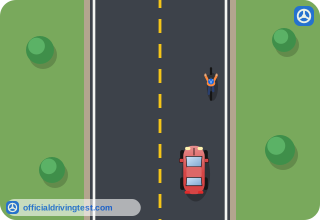
- The cyclist may not be able to hear the engine of the vehicle
- The air pressure from the passing vehicle can cause the cyclist to crash
- Cyclists cannot see vehicles that pass them quickly from behind
- The vehicle may push the cyclist onto the sidewalk or shoulder
Show answer
Correct answer: The air pressure from the passing vehicle can cause the cyclist to crash
At higher speeds, especially with a truck or bus, the air pressure from passing too closely can make a cyclist crash.
Source: Delaware Driver Manual (July 2026), page 97 · Open this page in the manual (Manual page 97)
-
When you drive at slower speeds on local streets, how can you interact with bicycles?
- Only by stopping until the cyclist is out of sight
- Only by changing lanes each time you pass
- Only after the cyclist signals you to pass
- Safely and legally, much as you would with other vehicles
Show answer
Correct answer: Safely and legally, much as you would with other vehicles
At slower speeds on local streets, drivers can interact with bicycles much as they would with other vehicles.
Source: Delaware Driver Manual (July 2026), page 97 · Open this page in the manual (Manual page 97)
-
In which case does Delaware law permit you to pass a bicycle without changing lanes?
- When the travel lane is wide enough for both your vehicle and a bicycle
- When the cyclist is riding on the sidewalk or shoulder next to the road
- When no vehicle is approaching from behind you
- When you are driving a truck or bus and the road is clear
Show answer
Correct answer: When the travel lane is wide enough for both your vehicle and a bicycle
Only in the unusual case of a very wide travel lane may you pass a bicycle without changing lanes.
Source: Delaware Driver Manual (July 2026), page 97 · Open this page in the manual (Manual page 97)
-
If you pass a bicycle without changing lanes in a very wide lane, what speed action does the law require?
- Speed up to pass quickly
- Keep your speed exactly the same
- Slow down when passing
- Stop until the cyclist passes you
Show answer
Correct answer: Slow down when passing
The law requires you to slow down when passing a bicycle in a very wide lane and to keep at least three feet of clearance.
Source: Delaware Driver Manual (July 2026), page 97 · Open this page in the manual (Manual page 97)
-
On a two-lane road, what should you do if you cannot pass a cyclist safely because of poor visibility or oncoming traffic?
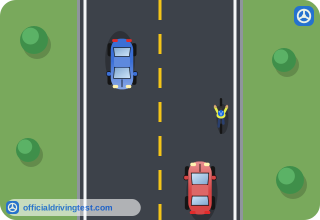
- Pass anyway and move back slowly once you are ahead
- Follow at a safe distance and wait until it is safe
- Honk to make the cyclist pull off the road
- Pass on the shoulder at low speed
Show answer
Correct answer: Follow at a safe distance and wait until it is safe
The manual says to follow at a safe distance and wait until it is safe before passing.
Source: Delaware Driver Manual (July 2026), page 97 · Open this page in the manual (Manual page 97)
-
After you overtake a cyclist, what should you do before you pull back to the right?
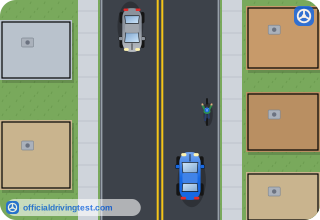
- Pull back right away so you stay clear of any oncoming traffic
- Slow to a stop so the cyclist can move well ahead of you
- Flash your headlights to warn the cyclist you are returning
- Allow plenty of clearance; cyclists may be faster than you realize
Show answer
Correct answer: Allow plenty of clearance; cyclists may be faster than you realize
The manual says to allow plenty of clearance after overtaking a cyclist because the cyclist's speed may be greater than you realize.
Source: Delaware Driver Manual (July 2026), page 97 · Open this page in the manual (Manual page 97)
-
Why should you be especially careful to look for cyclists when you prepare to enter a roadway or make a turn?
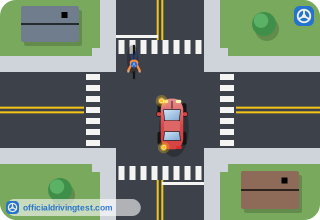
- Many car/cycle crashes happen because motorists do not see cyclists
- Cyclists always have the right-of-way when a driver turns left
- Cyclists never slow down when they reach intersections
- Bicycles are required to ride only in the left lane
Show answer
Correct answer: Many car/cycle crashes happen because motorists do not see cyclists
The manual says many car/cycle crashes happen because the motorist does not see the cyclist.
Source: Delaware Driver Manual (July 2026), page 97 · Open this page in the manual (Manual page 97)
-
What should you do if you are in doubt when you want to turn near a cyclist?
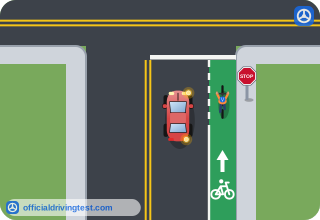
- Turn quickly in front of the cyclist
- Sound your horn and turn
- Wait
- Slow down slightly and turn
Show answer
Correct answer: Wait
The manual says not to pass a cyclist only to turn directly in front of them, and that when in doubt you should wait.
Source: Delaware Driver Manual (July 2026), page 97 · Open this page in the manual (Manual page 97)
-
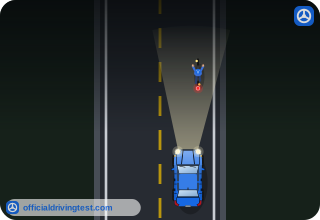
What should you remember about bicycles at night?
- Bicycles must always use the center of the lane
- Bicycles can be harder to see
- Bicycles are always lit by a bright light
- Bicycles are easier to see than in daylight
Show answer
Correct answer: Bicycles can be harder to see
The manual tells drivers to be aware that bicycles can be harder to see at night.
Source: Delaware Driver Manual (July 2026), page 97 · Open this page in the manual (Manual page 97)
-
Under the law, for what can the parent or guardian of a child cyclist be held responsible?
- Only if the child rides at night
- Only if the child rides on a highway
- Only if the child is younger than 8 years old
- If the child violates any traffic law while bicycling
Show answer
Correct answer: If the child violates any traffic law while bicycling
The parent or guardian can be held responsible if a child, while bicycling, violates any traffic law.
Source: Delaware Driver Manual (July 2026), page 98 · Open this page in the manual (Manual page 98)
-
What does the manual say an adult cyclist should do first, before venturing into traffic?
- Master control of the bicycle: riding straight, turning, stopping
- Ride only on the sidewalk until you feel fully confident
- Memorize the hand signals that drivers of cars use
- Install a taillight, a horn and a rear-view mirror
Show answer
Correct answer: Master control of the bicycle: riding straight, turning, stopping
The first critical rule is to control your bicycle before you venture into traffic.
Source: Delaware Driver Manual (July 2026), page 98 · Open this page in the manual (Manual page 98)
-
At intersections, what should an adult cyclist be prepared to do even when the cyclist thinks he or she has the right-of-way?
- Speed up to cross first
- Ride on the sidewalk
- Yield to motor vehicle traffic
- Signal the driver to stop
Show answer
Correct answer: Yield to motor vehicle traffic
The manual says most serious and fatal bicycle crashes occur at intersections, so cyclists should be prepared to yield.
Source: Delaware Driver Manual (July 2026), page 98 · Open this page in the manual (Manual page 98)
-
Which equipment does the manual say a cyclist must always have on the bicycle at night?
- A red headlight and a white rear-reflector
- A white headlight and a red rear-reflector
- A white taillight and a bicycle bell
- A blue flashing light and a mirror
Show answer
Correct answer: A white headlight and a red rear-reflector
At night a cyclist must always have the required white headlight and red rear-reflector.
Source: Delaware Driver Manual (July 2026), page 98 · Open this page in the manual (Manual page 98)
-
In addition to the required headlight and rear-reflector, what does the manual say is also helpful for a cyclist at night?
- A loud horn and a siren mounted on the bicycle
- A bicycle flag and a bell on the handle bars
- A second white headlight on the rear fender
- A red taillight and additional reflectors
Show answer
Correct answer: A red taillight and additional reflectors
The manual says a red taillight and additional reflectors are also helpful for being seen.
Source: Delaware Driver Manual (July 2026), page 98 · Open this page in the manual (Manual page 98)
-
Which way should a cyclist ride to be predictable to other road users?
- With motor vehicle traffic, not against it
- Against traffic so drivers can see the cyclist
- In the middle of the sidewalk
- Alongside parked cars only
Show answer
Correct answer: With motor vehicle traffic, not against it
Being predictable means riding with motor vehicle traffic, signaling clearly and early, and not swerving into traffic.
Source: Delaware Driver Manual (July 2026), page 98 · Open this page in the manual (Manual page 98)
-
How should cyclists communicate their intentions to other vehicles?
- Flash the headlight
- Ring a bell twice
- Use hand signals
- Wave at drivers after turning
Show answer
Correct answer: Use hand signals
The manual tells cyclists to use hand signals to communicate their intentions to other vehicles.
Source: Delaware Driver Manual (July 2026), page 98 · Open this page in the manual (Manual page 98)
-
Where should a cyclist ride in an unusually wide travel lane that is wide enough for a bicycle and a vehicle side by side?
- In the center of the lane so that vehicles cannot pass you
- On the right side of the lane, so vehicles can pass on the left
- On the left side of the lane, next to the center line
- Directly on the center line so drivers can see you easily
Show answer
Correct answer: On the right side of the lane, so vehicles can pass on the left
A cyclist should ride in the right side of such a lane (if safe) so motor vehicles can pass on the left without changing lanes.
Source: Delaware Driver Manual (July 2026), page 98 · Open this page in the manual (Manual page 98)