Delaware: Sharing the road — Part 5 Practice Test
Questions in this part include: “Compared with cars, how long do trucks take to stop, in general?” · “Which road users are harder to see than cars and trucks?”
Independent educational site · not affiliated with any government agency or DMV
Ready? Test yourself
- Instant feedback with an explanation
- Every answer cites its source in the manual
- Your best score is saved on this device
Questions are original and based on the official manual "Delaware Driver Manual" (July 2026), Delaware Division of Motor Vehicles (DMV).
All 19 questions in this practice test
Take the test above first, then use this list to study. Tap “Show answer” to see the correct answer and explanation.
Show the questions and answersHide the questions
-
When you pass a truck, how should you complete the pass?
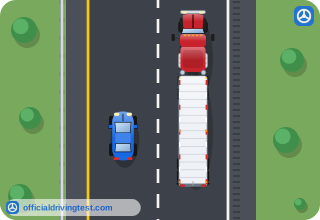
- Slowly, staying beside the truck for a while
- At the same speed as the truck for safety
- By pausing in the truck's blind spot
- As quickly as possible
Show answer
Correct answer: As quickly as possible
The manual says to complete the pass as quickly as possible and not stay alongside the other vehicle.
Source: Delaware Driver Manual (July 2026), page 103 · Open this page in the manual (Manual page 103)
-
After passing a truck, when should you move back into its lane?
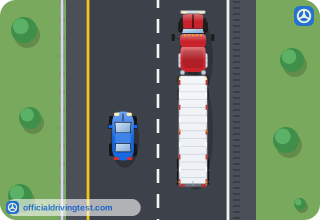
- When you see the front of the truck in your mirror
- As soon as your car is beside the truck’s cab
- As soon as your car's front bumper passes the cab
- When the truck driver sounds the horn
Show answer
Correct answer: When you see the front of the truck in your mirror
The manual says to move back only when you can see the front of the truck in your rear-view mirror.
Source: Delaware Driver Manual (July 2026), page 103 · Open this page in the manual (Manual page 103)
-
What does it mean if a truck driver blinks his lights after you pass?
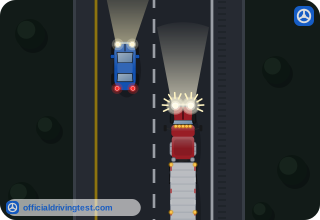
- The truck is about to stop
- You are driving too fast
- It is clear to pull back in
- You must pass again
Show answer
Correct answer: It is clear to pull back in
The manual says a blink of the truck driver's lights after you pass signals that it is clear to pull back in.
Source: Delaware Driver Manual (July 2026), page 103 · Open this page in the manual (Manual page 103)
-
How can you help the truck driver when a truck passes you?
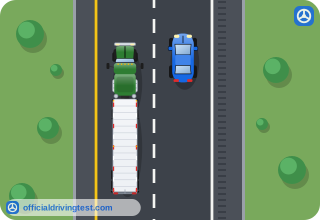
- Move to the center of your lane and speed up a little
- Brake hard and stop at the roadside
- Drive on the left edge of the lane and speed up
- Keep to the far side of your lane and slow slightly
Show answer
Correct answer: Keep to the far side of your lane and slow slightly
The manual says to keep to the far side of your lane and reduce speed slightly while a truck passes.
Source: Delaware Driver Manual (July 2026), page 103 · Open this page in the manual (Manual page 103)
-
While a truck is passing you, what should you not do?
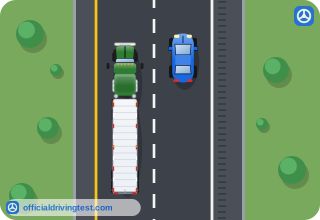
- Speed up
- Keep to the far side of your lane
- Reduce speed slightly
- Watch for the truck's signal after it passes
Show answer
Correct answer: Speed up
The manual says never to speed up while a truck is passing you.
Source: Delaware Driver Manual (July 2026), page 103 · Open this page in the manual (Manual page 103)
-
When you meet a truck coming from the opposite direction, what should you do?
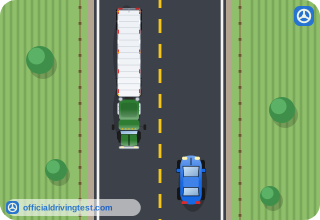
- Move to the center line to make room
- Slow down and stop in the lane
- Keep as far as possible to the side
- Flash your headlights repeatedly
Show answer
Correct answer: Keep as far as possible to the side
Keeping as far as possible to the side avoids a sideswipe crash and reduces wind turbulence between the vehicles.
Source: Delaware Driver Manual (July 2026), page 103 · Open this page in the manual (Manual page 103)
-
What does the wind turbulence between you and a truck coming from the opposite direction do to the two vehicles?
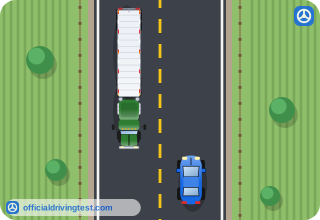
- It sucks the vehicles together
- It pushes the vehicles apart
- It pushes both vehicles to the right
- It has no effect on the vehicles
Show answer
Correct answer: It pushes the vehicles apart
The manual says turbulence between meeting vehicles pushes them apart and does not suck them together.
Source: Delaware Driver Manual (July 2026), page 103 · Open this page in the manual (Manual page 103)
-
Compared with cars, how long do trucks take to stop, in general?
- Slightly less, because of their weight
- The same, because of their brakes
- Much less, because of their tires
- Slightly longer, because of their size
Show answer
Correct answer: Slightly longer, because of their size
The manual says trucks in general take slightly longer than cars to stop because of their size.
Source: Delaware Driver Manual (July 2026), page 103 · Open this page in the manual (Manual page 103)
-
What does the manual call the blind spots around a truck?
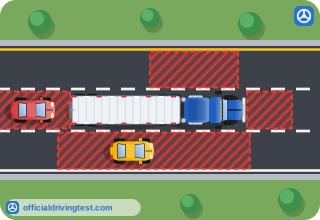
- The No-Zone
- The Safe-Zone
- The Slow-Zone
- The Pass-Zone
Show answer
Correct answer: The No-Zone
The manual says a truck's blind spots are also called the No-Zone, the danger areas where crashes are more likely.
Source: Delaware Driver Manual (July 2026), page 103 · Open this page in the manual (Manual page 103)
-
What should you never do when a truck is in the process of backing up?
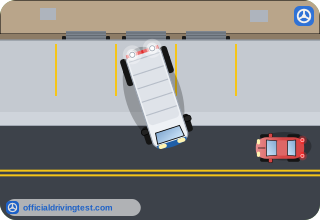
- Wait behind the truck at a distance
- Pass close behind the truck
- Pass in front of the truck
- Stop at a safe distance on the roadside
Show answer
Correct answer: Pass close behind the truck
The manual says never to pass close behind a truck that is backing up.
Source: Delaware Driver Manual (July 2026), page 103 · Open this page in the manual (Manual page 103)
-
How wide are most trailers, according to the manual?
- 6.5 feet
- 10 feet
- 12 feet
- 8.5 feet
Show answer
Correct answer: 8.5 feet
The manual says most trailers are 8.5 feet wide and can completely hide objects that come between them and a loading area.
Source: Delaware Driver Manual (July 2026), page 103 · Open this page in the manual (Manual page 103)
-
Why should you avoid tailgating a truck?
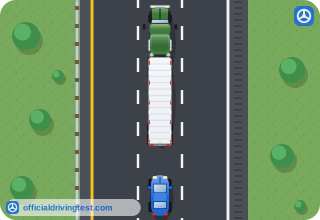
- The truck's brake lights are hard to see
- The truck's exhaust blocks your car's windows
- The truck driver cannot see your car directly behind the truck
- The truck driver may speed up to keep you off the road
Show answer
Correct answer: The truck driver cannot see your car directly behind the truck
Trucks have deep blindspots directly behind them, so a driver following too closely cannot be seen and greatly increases the chance of a rear-end collision.
Source: Delaware Driver Manual (July 2026), page 103 · Open this page in the manual (Manual page 103)
-
What can happen if you drive in a truck's side blindspots for any length of time?
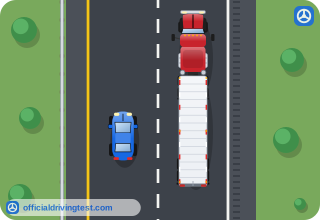
- The truck driver will see you in his mirrors but not slow down
- The truck driver can't see you, risking a serious crash
- The truck driver will move over to let you pass
- The truck's wind turbulence will pull your car sideways
Show answer
Correct answer: The truck driver can't see you, risking a serious crash
Trucks have much larger blindspots on both sides than passenger vehicles, and a lane change could cause a serious crash.
Source: Delaware Driver Manual (July 2026), page 104 · Open this page in the manual (Manual page 104)
-
Why do truck drivers sometimes swing wide to the left before a right turn?
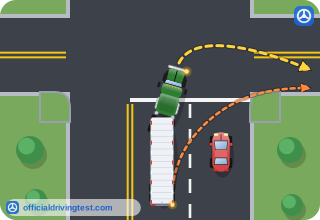
- To avoid the vehicles on the right shoulder
- To pass the vehicles ahead on the left
- To signal other drivers to pass on the right
- To safely negotiate the right turn
Show answer
Correct answer: To safely negotiate the right turn
The manual says truck drivers sometimes need to swing wide to the left to safely negotiate a right turn.
Source: Delaware Driver Manual (July 2026), page 104 · Open this page in the manual (Manual page 104)
-
What increases the possibility of a crash when a truck is making a right turn?
- Cutting in between the truck and the curb or shoulder
- Staying behind the truck at a safe following distance
- Slowing down well before the intersection
- Waiting for the truck on the left side
Show answer
Correct answer: Cutting in between the truck and the curb or shoulder
The manual says cutting in between a truck and the curb or shoulder on its right increases the chance of a crash, since the driver cannot see cars directly behind.
Source: Delaware Driver Manual (July 2026), page 104 · Open this page in the manual (Manual page 104)
-
Which road users are harder to see than cars and trucks?
- School buses and large delivery trucks
- Motorcycles, bicycles, and pedestrians
- Taxis and delivery vans
- Police cars and ambulances
Show answer
Correct answer: Motorcycles, bicycles, and pedestrians
The manual names motorcycles, bicycles, and pedestrians as harder to see than cars and trucks.
Source: Delaware Driver Manual (July 2026), page 118 · Open this page in the manual (Manual page 118)
-
When should you be especially alert for motorcycles, bicycles, and pedestrians?
- When driving on a freeway with no ramps
- When you are following a truck on the highway
- When you are stopped at a railroad crossing
- When entering the roadway from the curb or driveway
Show answer
Correct answer: When entering the roadway from the curb or driveway
The manual says to be especially alert when you are entering the roadway from the curb or driveway.
Source: Delaware Driver Manual (July 2026), page 119 · Open this page in the manual (Manual page 119)
-
How can you help make Delaware’s roadways safer when you see aggressive driving?
- Follow the driver until a police officer stops them
- Flash your lights to warn the driver to stop
- Drive beside the driver to keep the speed down
- Get the tag number and report it (call 911)
Show answer
Correct answer: Get the tag number and report it (call 911)
The manual says you can help by reporting aggressive driving with your cellular phone: get the tag number and report it, call 911.
Source: Delaware Driver Manual (July 2026), page 115 · Open this page in the manual (Manual page 115)
-
How should you treat an aggressive driver?
- Challenge them to keep a safe distance
- Avoid eye contact with them
- Stay close behind them to get their tag number
- Speed up to show them they are wrong
Show answer
Correct answer: Avoid eye contact with them
The manual lists remaining calm, avoiding eye contact, not challenging them, and staying away from erratic drivers.
Source: Delaware Driver Manual (July 2026), page 115 · Open this page in the manual (Manual page 115)