General Knowledge: Driving emergencies, ABS and skids
Steering and stopping in an emergency, brake and tire failures, antilock brakes, and skid control and recovery. Split into 6 shorter tests so you're not stuck in one long quiz.
Independent educational site · not affiliated with any government agency or DMV
Choose a part
Driving emergencies, ABS and skids — Part 1
Questions in this part include: “Which situation is called a vehicle emergency, as opposed to a traffic emergency?”
Driving emergencies, ABS and skids — Part 2
Questions in this part include: “You must return to the pavement before you can stop. How should you do it?”
Driving emergencies, ABS and skids — Part 3
Questions in this part include: “You have stopped on an uphill escape route. How do you keep the vehicle from rolling backward?”
Driving emergencies, ABS and skids — Part 4
Questions in this part include: “What is the main benefit of ABS during hard braking?”
Driving emergencies, ABS and skids — Part 5
Questions in this part include: “Only the tractor, only the trailer, or only one axle has ABS. How should you brake?”
Driving emergencies, ABS and skids — Part 6
Questions in this part include: “Which device can cause a skid if you use it on a slippery road?”
Questions are written in our own words from the CDL manual; they are not the real test's questions. With your state chosen, every answer gives its page in your state's CDL manual. Without a state, answers cite the CDL manual, national model as printed by New Jersey (July 2017).
All 107 Driving emergencies, ABS and skids questions with answers
Choose a part above to take a practice test, or study every question and answer here.
Show the questions and answersHide the questions
1Part 118 questions
-
Which situation is called a vehicle emergency, as opposed to a traffic emergency?
- Two vehicles are about to hit each other
- Heavy rain makes the road surface slippery
- A tire, a brake or another key part fails
Show answer
Correct answer: A tire, a brake or another key part fails
A vehicle emergency is a failure of the vehicle itself, such as tires or brakes. A traffic emergency is when two vehicles are about to collide.
Source: CDL manual, national model as printed by New Jersey, Sections 1 to 3 (July 2017)
-
There is not enough room to stop before an obstacle. Which action can usually get you clear of it faster?
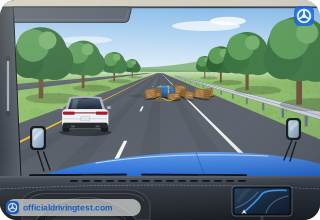
- Steering around it
- Stopping short of it with a hard brake
- Shifting to a lower gear to slow down
Show answer
Correct answer: Steering around it
A vehicle can almost always swerve around an obstacle faster than it can stop. Steering is often the safer choice when there is no room to stop.
Source: CDL manual, national model as printed by New Jersey, Sections 1 to 3 (July 2017)
-
Which vehicles may flip over when the driver swerves to miss an obstacle?
- Empty straight trucks with a short wheelbase
- Buses that carry only a light passenger load
- Top-heavy vehicles and multi-trailer tractors
Show answer
Correct answer: Top-heavy vehicles and multi-trailer tractors
Turning away from an obstacle is quick, but top-heavy vehicles and tractors with more than one trailer can roll over in the turn.
Source: CDL manual, national model as printed by New Jersey, Sections 1 to 3 (July 2017)
-
How can you be sure both of your hands are on the steering wheel when an emergency comes?
- Keep both hands on the wheel at all times
- Move them to the wheel as soon as you see danger
- Rest one hand on the gearshift and one on the wheel
Show answer
Correct answer: Keep both hands on the wheel at all times
A quick, safe turn needs a firm two-handed grip, and an emergency gives no time to reposition your hands. Keeping both hands on the wheel all the time solves this.
Source: CDL manual, national model as printed by New Jersey, Sections 1 to 3 (July 2017)
-
Why should you avoid braking while you make a quick emergency turn?
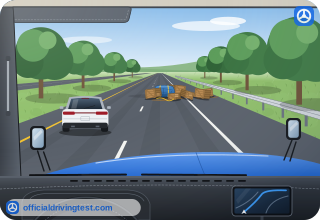
- The wheels can lock easily and the vehicle may skid
- The brakes will overheat during the turn
- The turn will become much wider than needed
Show answer
Correct answer: The wheels can lock easily and the vehicle may skid
Wheels lock very easily while turning. A vehicle with locked wheels can skid out of control.
Source: CDL manual, national model as printed by New Jersey, Sections 1 to 3 (July 2017)
-
In an emergency turn, what happens to the risk of a skid or rollover as you turn the wheel more sharply?
- The risk stays about the same
- The risk gets greater
- The risk gets smaller
Show answer
Correct answer: The risk gets greater
A sharper turn raises the chance of a skid or rollover. Turn only as much as needed to clear what is in your way.
Source: CDL manual, national model as printed by New Jersey, Sections 1 to 3 (July 2017)
-
After an emergency turn around an obstacle, what does counter-steering mean?
- Turning the wheel back the other way past the hazard
- Pumping the brake pedal to slow the vehicle down quickly
- Holding the wheel still until the vehicle comes to a stop
Show answer
Correct answer: Turning the wheel back the other way past the hazard
Counter-steering is turning the wheel back the other way after you pass the hazard. Emergency steering and counter-steering are two parts of one action.
Source: CDL manual, national model as printed by New Jersey, Sections 1 to 3 (July 2017)
-
Why must you be ready to counter-steer before you make an emergency turn?
- Otherwise the brakes will lock during the turn
- Otherwise you cannot do it quickly enough afterward
- Otherwise the trailer will swing into the next lane
Show answer
Correct answer: Otherwise you cannot do it quickly enough afterward
If you are not prepared in advance, the counter-steer will come too late. Plan the emergency turn and the turn back as one action.
Source: CDL manual, national model as printed by New Jersey, Sections 1 to 3 (July 2017)
-
A driver coming toward you has wandered into your lane. Which way is usually best to steer?
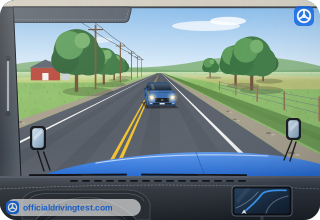
- To your left
- Straight ahead while braking hard
- To your right
Show answer
Correct answer: To your right
Steering right is best. A driver who notices the mistake will naturally move back into the proper lane.
Source: CDL manual, national model as printed by New Jersey, Sections 1 to 3 (July 2017)
-
When something blocks your path, how will you know which lane is free to steer into?
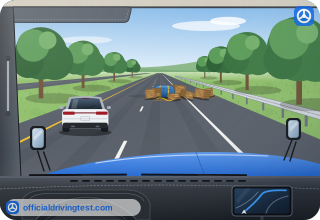
- By flashing your lights at the traffic next to you
- By slowing down until the other vehicles pass you
- By having checked your mirrors regularly as you drove
Show answer
Correct answer: By having checked your mirrors regularly as you drove
A driver who uses the mirrors all the time already knows which lane is empty and safe to use.
Source: CDL manual, national model as printed by New Jersey, Sections 1 to 3 (July 2017)
-
Your path is blocked and the shoulder is clear. Why may going right be the better choice?
- Traffic is more likely to be passing on your right side
- The shoulder is always wider than a traffic lane here
- Few drive on the shoulder but someone may pass left
Show answer
Correct answer: Few drive on the shoulder but someone may pass left
Few vehicles are on the shoulder, while another driver may be passing on your left. Your mirrors tell you which is the case.
Source: CDL manual, national model as printed by New Jersey, Sections 1 to 3 (July 2017)
-
You are blocked on both sides. What is the benefit of moving to the right?
- Your trailer will follow the tractor more closely
- You will be able to brake harder in the turn
- You will not push anyone into oncoming traffic
Show answer
Correct answer: You will not push anyone into oncoming traffic
A move to the right does not force another vehicle into an opposing lane, which could cause a head-on collision.
Source: CDL manual, national model as printed by New Jersey, Sections 1 to 3 (July 2017)
-
Compared with hitting another vehicle, how risky can it be to drive off the road in an emergency?
- Always more dangerous than a collision
- It may be less risky than a collision
- Just as risky as a collision in every case
Show answer
Correct answer: It may be less risky than a collision
In some emergencies, leaving the road is the safer choice compared with a collision with another vehicle.
Source: CDL manual, national model as printed by New Jersey, Sections 1 to 3 (July 2017)
-
What is true of most road shoulders when a large vehicle must leave the pavement?
- They are too soft to carry a large vehicle safely
- They carry only light cars and pickup trucks safely
- They are strong enough, so they make an escape route
Show answer
Correct answer: They are strong enough, so they make an escape route
Most shoulders can support the weight of a large vehicle, so they are usually an available escape route.
Source: CDL manual, national model as printed by New Jersey, Sections 1 to 3 (July 2017)
-
When you leave the road in an emergency, until what speed should you avoid braking if possible?
- About 10 mph
- About 20 mph
- About 30 mph
Show answer
Correct answer: About 20 mph
Hold off braking until you are down to about 20 mph, then press the pedal very softly so the vehicle does not skid on a loose surface.
Source: CDL manual, national model as printed by New Jersey, Sections 1 to 3 (July 2017)
-
Once your speed is down while you are off the pavement, how should you brake?
- Firmly, to stop before you reach any obstacle
- Very gently, to avoid a skid on the loose surface
- With quick pumps, to keep the wheels turning fast
Show answer
Correct answer: Very gently, to avoid a skid on the loose surface
On a loose surface hard braking can cause a skid, so brake very gently after the speed has dropped.
Source: CDL manual, national model as printed by New Jersey, Sections 1 to 3 (July 2017)
-
Which practice helps you keep control while you drive partly off the pavement?
- Put all the wheels on the loose edge of the road
- Steer back and forth between the pavement and the shoulder
- Keep one set of wheels on the paved part if you can
Show answer
Correct answer: Keep one set of wheels on the paved part if you can
Keeping one set of wheels on the pavement, when possible, helps maintain control of the vehicle.
Source: CDL manual, national model as printed by New Jersey, Sections 1 to 3 (July 2017)
-
The shoulder is clear after you leave the road. When should you pull back onto the pavement?
- As soon as your speed falls below 20 mph
- After you stop, signaling and checking mirrors
- Right away, at the first gap in traffic ahead
Show answer
Correct answer: After you stop, signaling and checking mirrors
Stay on the clear shoulder until the vehicle has stopped. Then signal and check your mirrors before you rejoin the road.
Source: CDL manual, national model as printed by New Jersey, Sections 1 to 3 (July 2017)
2Part 218 questions
-
You must return to the pavement before you can stop. How should you do it?
- Edge back onto the road a little at a time
- Brake hard first, then turn back slowly
- Turn sharply and hold the wheel tightly to return
Show answer
Correct answer: Turn sharply and hold the wheel tightly to return
A gradual return can make the tires grab suddenly and cause a loss of control. A firm, sharp turn back onto the road is safer.
Source: CDL manual, national model as printed by New Jersey, Sections 1 to 3 (July 2017)
-
When returning to the pavement, when should you counter-steer?
- After the vehicle has fully stopped
- When both front tires are back on pavement
- When the rear tires touch the pavement
Show answer
Correct answer: When both front tires are back on pavement
Counter-steer as soon as both front tires are on the pavement. The two turns should be done as one steer-counter-steer move.
Source: CDL manual, national model as printed by New Jersey, Sections 1 to 3 (July 2017)
-
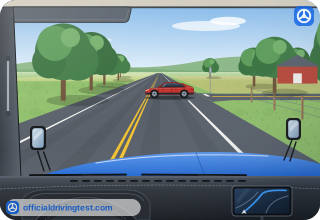
Someone suddenly pulls out in front of you. When is braking a good response?
- When there is enough room to stop and you brake right
- Whenever you are not able to steer
- Only when the road is dry and the trailer is empty
Show answer
Correct answer: When there is enough room to stop and you brake right
Braking works when there is enough room to stop and the brakes are used the right way.
Source: CDL manual, national model as printed by New Jersey, Sections 1 to 3 (July 2017)
-
What two things should your emergency braking let you do?
- Stop in the shortest distance and keep steering still
- Slow the trailer first and then the tractor
- Hold a straight line and still be able to turn
Show answer
Correct answer: Hold a straight line and still be able to turn
Brake so the vehicle stays straight and you can still steer away if that becomes necessary.
Source: CDL manual, national model as printed by New Jersey, Sections 1 to 3 (July 2017)
-
With the controlled braking method, how hard do you press the brakes?
- As hard as you can, but short of wheel lockup
- Lightly, so the vehicle slows down a little at a time
- All the way down so the wheels lock briefly
Show answer
Correct answer: As hard as you can, but short of wheel lockup
Controlled braking means the hardest braking possible short of wheel lockup, with only very small steering movements.
Source: CDL manual, national model as printed by New Jersey, Sections 1 to 3 (July 2017)
-
How should you move the steering wheel while using controlled braking?
- With large, quick turns to dodge the hazard
- By holding the wheel perfectly still all the time
- With very small movements only
Show answer
Correct answer: With very small movements only
Steering moves must stay very small during controlled braking. A larger steering move means the brakes should be released first.
Source: CDL manual, national model as printed by New Jersey, Sections 1 to 3 (July 2017)
-
While using controlled braking, the wheels lock. What should you do?
- Hold the pedal down until the vehicle stops fully
- Release the brakes, then re-apply as soon as you can
- Pump the pedal lightly while steering sharply
Show answer
Correct answer: Release the brakes, then re-apply as soon as you can
Release the brakes when the wheels lock or when a larger steering move is needed, then re-apply them as soon as possible.
Source: CDL manual, national model as printed by New Jersey, Sections 1 to 3 (July 2017)
-
In the stab braking method, what do you do when the wheels lock up?
- Release, then press fully again once wheels roll
- Keep the pedal down until the vehicle stops
- Ease off the pedal a little and keep it there
Show answer
Correct answer: Release, then press fully again once wheels roll
With stab braking you press the brakes fully, let go when the wheels lock, and press fully again as soon as the wheels start rolling.
Source: CDL manual, national model as printed by New Jersey, Sections 1 to 3 (July 2017)
-
After you release the brakes in stab braking, how long can it take for the wheels to start rolling?
- Up to one second
- Up to five seconds
- Less than a tenth of a second
Show answer
Correct answer: Up to one second
It can take up to one second. If you press the brakes again before the wheels roll, the vehicle will not straighten out.
Source: CDL manual, national model as printed by New Jersey, Sections 1 to 3 (July 2017)
-
In stab braking, what happens if you press the brakes again before the wheels start rolling?
- The vehicle will not straighten out
- The vehicle stops in a shorter distance
- The wheels start rolling sooner than before
Show answer
Correct answer: The vehicle will not straighten out
The wheels must be rolling again before you re-apply the brakes. Pressing too soon keeps the vehicle from straightening out.
Source: CDL manual, national model as printed by New Jersey, Sections 1 to 3 (July 2017)
-
Why is pushing the brake pedal down as hard as you can a poor way to stop in an emergency?
- The wheels stay locked, so the vehicle skids
- The brake lines may burst from the pressure
- The engine will stall and power steering is lost
Show answer
Correct answer: The wheels stay locked, so the vehicle skids
Stamping on the pedal keeps the wheels locked and causes a skid. A skidding vehicle cannot be controlled.
Source: CDL manual, national model as printed by New Jersey, Sections 1 to 3 (July 2017)
-
What are the two usual causes of hydraulic brake failure?
- Worn tires and loose wheel nuts on the axles
- Low air pressure and a stuck governor valve
- Loss of hydraulic pressure and fade on long hills
Show answer
Correct answer: Loss of hydraulic pressure and fade on long hills
Most hydraulic brake failures come from losing hydraulic pressure or from brake fade on long hills.
Source: CDL manual, national model as printed by New Jersey, Sections 1 to 3 (July 2017)
-
What will you notice at the brake pedal when a hydraulic system cannot build up pressure?
- The pedal feels spongy or goes to the floor
- The pedal becomes very hard and will not move
- The pedal vibrates and pulses under your foot
Show answer
Correct answer: The pedal feels spongy or goes to the floor
When pressure cannot build, the pedal feels spongy or sinks all the way to the floor.
Source: CDL manual, national model as printed by New Jersey, Sections 1 to 3 (July 2017)
-
Your hydraulic brakes have lost pressure. How does downshifting help?
- It rebuilds pressure in the brake lines
- A lower gear helps slow the vehicle
- It releases any brakes that have locked
Show answer
Correct answer: A lower gear helps slow the vehicle
A lower gear adds engine braking, which helps slow the vehicle when the brakes are not working.
Source: CDL manual, national model as printed by New Jersey, Sections 1 to 3 (July 2017)
-
After a loss of hydraulic pressure, what may build enough pressure to stop the vehicle?
- Holding the pedal steadily at the floor
- Pumping the brake pedal
- Shifting the transmission into neutral
Show answer
Correct answer: Pumping the brake pedal
Pumping the pedal can sometimes create enough hydraulic pressure to stop the vehicle.
Source: CDL manual, national model as printed by New Jersey, Sections 1 to 3 (July 2017)
-
Why can the parking brake help slow a vehicle whose hydraulic brakes have failed?
- It works from its own system, apart from hydraulics
- It is connected to the same fluid lines as the pedal
- It uses engine vacuum to build up its pressure
Show answer
Correct answer: It works from its own system, apart from hydraulics
The parking or emergency brake is a separate system from the hydraulic brakes, so it can still slow the vehicle.
Source: CDL manual, national model as printed by New Jersey, Sections 1 to 3 (July 2017)
-
When you use the parking brake to slow a vehicle with failed hydraulic brakes, what must you do at the same time?
- Turn off the engine and coast to a stop slowly
- Press the release button or pull the lever
- Shift into the highest gear and release the clutch
Show answer
Correct answer: Press the release button or pull the lever
Using the release button or lever lets you adjust the brake pressure so the wheels do not lock up.
Source: CDL manual, national model as printed by New Jersey, Sections 1 to 3 (July 2017)
-
While looking for an escape route after brake loss, which kind of path helps slow and stop the vehicle?
- One that turns uphill
- One that runs along a downhill slope
- One that stays level on the highway
Show answer
Correct answer: One that turns uphill
Turning uphill uses the slope to slow and stop the vehicle.
Source: CDL manual, national model as printed by New Jersey, Sections 1 to 3 (July 2017)
3Part 318 questions
-
You have stopped on an uphill escape route. How do you keep the vehicle from rolling backward?
- Put it in low gear and apply the parking brake
- Leave the transmission in neutral and wait
- Shift to the highest gear and turn off the engine
Show answer
Correct answer: Put it in low gear and apply the parking brake
After stopping, use low gear and the parking brake so the vehicle does not roll back.
Source: CDL manual, national model as printed by New Jersey, Sections 1 to 3 (July 2017)
-
What will almost always prevent brake failure on a long downgrade?
- Riding the brake lightly all the way down
- Staying in a high gear to save the engine
- Going slow enough and braking the right way
Show answer
Correct answer: Going slow enough and braking the right way
A slow enough speed together with proper braking almost always prevents brake failure on long downgrades.
Source: CDL manual, national model as printed by New Jersey, Sections 1 to 3 (July 2017)
-
Where is an escape ramp usually found on a long downgrade?
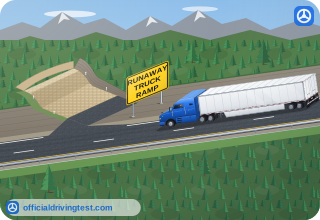
- A few miles down from the top
- Right at the bottom of the hill
- Exactly halfway along the grade
Show answer
Correct answer: A few miles down from the top
Escape ramps are usually placed a few miles below the top of the grade, and signs tell you about them.
Source: CDL manual, national model as printed by New Jersey, Sections 1 to 3 (July 2017)
-
What do some escape ramps use to bring a runaway vehicle to a stop?
- Water-filled barriers across the lane
- Soft gravel that resists the vehicle motion
- A smooth paved surface that is level
Show answer
Correct answer: Soft gravel that resists the vehicle motion
Some ramps have soft gravel that resists the vehicle's motion. Others turn uphill and use soft gravel to hold the vehicle in place.
Source: CDL manual, national model as printed by New Jersey, Sections 1 to 3 (July 2017)
-
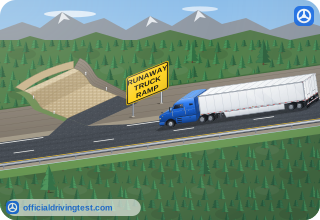
You lose your brakes going downhill and an escape ramp is available. What may happen if you skip it?
- Your chance of a serious crash may be much greater
- You may find a safer stretch of road farther down
- The engine will slow the vehicle enough to stop it
Show answer
Correct answer: Your chance of a serious crash may be much greater
A driver who loses brakes on a downgrade should use an available escape ramp. Skipping it may raise the chance of a serious crash.
Source: CDL manual, national model as printed by New Jersey, Sections 1 to 3 (July 2017)
-
With no escape ramp available and your brakes gone, when should you move to an escape route?
- Once you reach the bottom of the hill
- Only after trying the brakes several more times
- As soon as you know the brakes do not work
Show answer
Correct answer: As soon as you know the brakes do not work
Act at once. Every moment of delay lets the vehicle pick up speed and makes it harder to stop.
Source: CDL manual, national model as printed by New Jersey, Sections 1 to 3 (July 2017)
-
You hear a loud bang while driving and are not sure where it came from. What is the safest thing to assume?
- That a tire on a nearby vehicle has blown
- That the sound was an engine or exhaust noise
- That your own vehicle has had a tire blowout
Show answer
Correct answer: That your own vehicle has had a tire blowout
A blowout can take a few seconds to affect your vehicle, so the sound may seem to come from elsewhere. Treat any bang as your own tire failing.
Source: CDL manual, national model as printed by New Jersey, Sections 1 to 3 (July 2017)
-
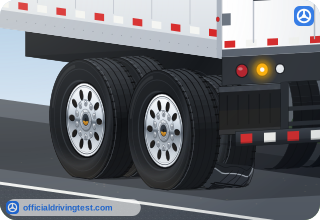
A rear tire goes flat. What may be the only warning you get?
- The steering suddenly feels heavy
- A pull toward the side of the road
- The vehicle thumps or vibrates heavily
Show answer
Correct answer: The vehicle thumps or vibrates heavily
Heavy thumping or vibration can be the only clue to a flat rear tire. Heavy steering points to a front tire instead.
Source: CDL manual, national model as printed by New Jersey, Sections 1 to 3 (July 2017)
-
Your steering suddenly feels heavy. Which tire has most likely failed?
- A rear tire on the trailer
- A tire on the drive axle
- A front tire
Show answer
Correct answer: A front tire
Heavy steering usually means one of the front tires has failed.
Source: CDL manual, national model as printed by New Jersey, Sections 1 to 3 (July 2017)
-
Why does a failed rear tire often not make a vehicle fishtail?
- The steering axle keeps the rear in line
- The trailer weight holds the rear in line
- Dual rear tires usually prevent the sliding
Show answer
Correct answer: Dual rear tires usually prevent the sliding
Failure of a rear tire can make the vehicle fishtail, but dual rear tires usually prevent this.
Source: CDL manual, national model as printed by New Jersey, Sections 1 to 3 (July 2017)
-
How can you stop a failing front tire from twisting the steering wheel out of your hand?
- Steer lightly with one hand on the wheel
- Keep both hands firmly on the wheel at all times
- Brake hard before the wheel starts to turn
Show answer
Correct answer: Keep both hands firmly on the wheel at all times
A front tire failure can jerk the wheel. Holding it firmly with both hands all the time is the only prevention.
Source: CDL manual, national model as printed by New Jersey, Sections 1 to 3 (July 2017)
-
A tire fails and nothing is in your path. What should you do about the brakes at first?
- Brake firmly to stop as fast as possible
- Pump the brake pedal several times quickly
- Keep off the pedal while the vehicle slows
Show answer
Correct answer: Keep off the pedal while the vehicle slows
Braking right after a tire failure could make you lose control. Let the vehicle slow down first unless you are about to hit something.
Source: CDL manual, national model as printed by New Jersey, Sections 1 to 3 (July 2017)
-
After a blown tire has slowed the vehicle, how should you bring it to a stop?
- Steer sharply to the shoulder and brake hard
- Ease on the brake lightly, leave the road, stop
- Stop in your lane and turn on the hazard flashers
Show answer
Correct answer: Ease on the brake lightly, leave the road, stop
Once speed has dropped, use very gentle braking while moving off the road to stop.
Source: CDL manual, national model as printed by New Jersey, Sections 1 to 3 (July 2017)
-
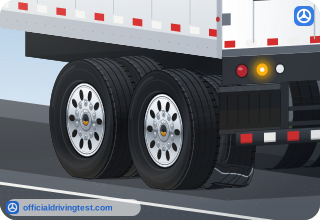
After stopping from a suspected tire failure, the vehicle seems to handle normally. What should you do?
- Check only the tire you think failed
- Continue driving and check at the next stop
- Get out and check all of the tires
Show answer
Correct answer: Get out and check all of the tires
Some failures, such as one tire of a dual pair, may not be noticed from the cab, so check every tire even if the vehicle handles normally.
Source: CDL manual, national model as printed by New Jersey, Sections 1 to 3 (July 2017)
-
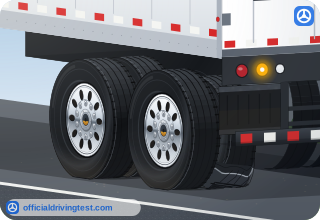
How might you learn that one tire of a dual pair has failed?
- By getting out and looking at it
- By a loud bang every time
- By a warning lamp on the dash
Show answer
Correct answer: By getting out and looking at it
A failed tire in a dual pair may give no clear sign from the cab, so you may have to look at it.
Source: CDL manual, national model as printed by New Jersey, Sections 1 to 3 (July 2017)
-
What does a computerized antilock braking system (ABS) do?
- Stops the vehicle in a shorter distance always
- Holds the brakes on when parked on a hill
- Keeps wheels from locking during hard braking
Show answer
Correct answer: Keeps wheels from locking during hard braking
ABS is a computer-controlled system that prevents wheel lockup when you brake hard.
Source: CDL manual, national model as printed by New Jersey, Sections 1 to 3 (July 2017)
-
How does ABS relate to your normal brakes?
- It adds on without changing braking power
- It replaces the normal brakes
- It makes the normal brakes stronger
Show answer
Correct answer: It adds on without changing braking power
ABS is an add-on. Your normal braking power is neither reduced nor increased by it.
Source: CDL manual, national model as printed by New Jersey, Sections 1 to 3 (July 2017)
-
When does ABS become active?
- Only when wheels are about to lock up
- Whenever the brake pedal is pressed
- Whenever the vehicle goes over a set speed
Show answer
Correct answer: Only when wheels are about to lock up
Normal braking works as usual. ABS steps in only when a wheel is close to locking.
Source: CDL manual, national model as printed by New Jersey, Sections 1 to 3 (July 2017)
4Part 418 questions
-
What is the main benefit of ABS during hard braking?
- It always shortens the stopping distance
- It helps you keep the vehicle under control
- It lets you follow other vehicles closer
Show answer
Correct answer: It helps you keep the vehicle under control
ABS may not shorten the stop, but it helps you stay in control while braking hard.
Source: CDL manual, national model as printed by New Jersey, Sections 1 to 3 (July 2017)
-
When sensors detect that a wheel may lock, what does the ABS electronic control unit do?
- It raises the brake pressure
- It turns off the brakes for that axle
- It lowers the brake pressure
Show answer
Correct answer: It lowers the brake pressure
The control unit reduces brake pressure so the wheel keeps turning.
Source: CDL manual, national model as printed by New Jersey, Sections 1 to 3 (July 2017)
-
How does ABS adjust brake pressure while you brake hard?
- It keeps pressure low so lockup can never start
- It gives the most braking possible without wheel lockup
- It gives full pressure until a wheel locks, then releases
Show answer
Correct answer: It gives the most braking possible without wheel lockup
ABS varies the pressure so braking is as strong as it can be while the wheels keep from locking.
Source: CDL manual, national model as printed by New Jersey, Sections 1 to 3 (July 2017)
-
How does the speed of ABS compare with a driver's reaction to wheel lockup?
- About the same speed as a trained driver
- Far faster than the driver can respond
- Much slower, so the driver must help it
Show answer
Correct answer: Far faster than the driver can respond
ABS reacts to a possible lockup much more quickly than any driver could.
Source: CDL manual, national model as printed by New Jersey, Sections 1 to 3 (July 2017)
-
Truck tractors with air brakes must have ABS if they were built on or after which date?
- March 1, 1998
- March 1, 1997
- March 1, 1999
Show answer
Correct answer: March 1, 1997
Air-braked truck tractors built on or after March 1, 1997 are required to have ABS.
Source: CDL manual, national model as printed by New Jersey, Sections 1 to 3 (July 2017)
-
Air-braked trucks, buses, trailers and converter dollies must have ABS if built on or after which date?
- March 1, 1998
- March 1, 1997
- March 1, 1999
Show answer
Correct answer: March 1, 1998
Other air brake vehicles, including trailers and converter dollies, need ABS if built on or after March 1, 1998.
Source: CDL manual, national model as printed by New Jersey, Sections 1 to 3 (July 2017)
-
A hydraulically braked truck rated 10,000 lbs or more must have ABS if built on or after which date?
- March 1, 1998
- March 1, 1999
- March 1, 1997
Show answer
Correct answer: March 1, 1999
Hydraulic-brake trucks and buses of 10,000 lbs or more need ABS when built on or after March 1, 1999.
Source: CDL manual, national model as printed by New Jersey, Sections 1 to 3 (July 2017)
-
A commercial vehicle was built before the dates that made ABS mandatory. Can it have ABS?
- No, ABS cannot be added to older vehicles
- Only if it has hydraulic brakes
- Yes, many were fitted with it voluntarily
Show answer
Correct answer: Yes, many were fitted with it voluntarily
Many older commercial vehicles were voluntarily equipped with ABS even though it was not yet required.
Source: CDL manual, national model as printed by New Jersey, Sections 1 to 3 (July 2017)
-
What color is the ABS malfunction lamp on a tractor, truck or bus, and where is it?
- Red, on the left side of the cab
- Yellow, on the left rear corner
- Yellow, on the instrument panel
Show answer
Correct answer: Yellow, on the instrument panel
Tractors, trucks and buses show a yellow ABS warning lamp on the instrument panel.
Source: CDL manual, national model as printed by New Jersey, Sections 1 to 3 (July 2017)
-
Where do you look for the ABS malfunction lamp on a trailer?
- On the right side, near the landing gear
- Inside the tractor cab, on the panel
- On the left side, at a front or rear corner
Show answer
Correct answer: On the left side, at a front or rear corner
A trailer carries its yellow ABS lamp on the left side, at either the front or rear corner.
Source: CDL manual, national model as printed by New Jersey, Sections 1 to 3 (July 2017)
-
On which side of a converter dolly must its ABS lamp be?
- On the right side
- Underneath, at the center
- On the left side
Show answer
Correct answer: On the left side
Dollies made on or after March 1, 1998 must have the ABS lamp on their left side.
Source: CDL manual, national model as printed by New Jersey, Sections 1 to 3 (July 2017)
-
What should the ABS lamp do at start-up on a newer vehicle that is working normally?
- Stay lit until you pass five mph
- Flash until the brakes are applied
- Light briefly, then go out quickly
Show answer
Correct answer: Light briefly, then go out quickly
On newer vehicles the lamp lights at start-up as a bulb check and soon goes out.
Source: CDL manual, national model as printed by New Jersey, Sections 1 to 3 (July 2017)
-
On an older ABS system, how long might the malfunction lamp normally stay on?
- Until the engine has run for a minute
- Until you are driving over five mph
- Until you are driving over 25 mph
Show answer
Correct answer: Until you are driving over five mph
Newer systems turn the lamp off quickly after start-up. On older systems it can stay lit until the vehicle passes five mph.
Source: CDL manual, national model as printed by New Jersey, Sections 1 to 3 (July 2017)
-
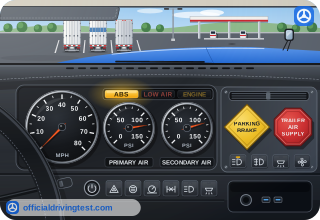
The ABS lamp stays lit after the start-up bulb check. What may this mean?
- The ABS is working at full strength
- The brakes are cold and need warming up
- You may have lost ABS control
Show answer
Correct answer: You may have lost ABS control
A lamp that stays on after the bulb check, or comes on while driving, can mean the ABS has stopped working.
Source: CDL manual, national model as printed by New Jersey, Sections 1 to 3 (July 2017)
-
An older towed unit has no obvious ABS lamp. How can you tell whether it has ABS?
- Check the tire size on the sidewall
- Count the number of axles under it
- Look under it for the ECU and wires
Show answer
Correct answer: Look under it for the ECU and wires
On older towed units it can be hard to tell. Looking underneath for the control unit and sensor wires from the brakes shows if ABS is fitted.
Source: CDL manual, national model as printed by New Jersey, Sections 1 to 3 (July 2017)
-
On a vehicle without ABS, what happens if the steering wheels lock up during hard braking?
- You lose steering control
- The vehicle spins around
- The trailer jackknifes
Show answer
Correct answer: You lose steering control
Locked front wheels slide instead of steering, so you can no longer steer.
Source: CDL manual, national model as printed by New Jersey, Sections 1 to 3 (July 2017)
-
On a vehicle without ABS, what may happen when wheels other than the steering wheels lock?
- You lose steering control only
- You may skid, jackknife, or spin
- The brakes release by themselves
Show answer
Correct answer: You may skid, jackknife, or spin
Locked non-steering wheels can lead to a skid, a jackknife or a spin.
Source: CDL manual, national model as printed by New Jersey, Sections 1 to 3 (July 2017)
-
With working ABS, what can you do that is hard without it when braking hard for an obstacle?
- Steer around the obstacle while braking
- Stop in a shorter distance every time
- Drive faster in wet conditions
Show answer
Correct answer: Steer around the obstacle while braking
ABS keeps the wheels rolling, so you can still steer past an obstacle while braking, and over-braking skids are avoided.
Source: CDL manual, national model as printed by New Jersey, Sections 1 to 3 (July 2017)
5Part 518 questions
-
Only the tractor, only the trailer, or only one axle has ABS. How should you brake?
- Brake lightly, since ABS is incomplete
- Brake in short, hard stabs
- Brake normally
Show answer
Correct answer: Brake normally
Even partial ABS gives more control, so you brake in your usual way.
Source: CDL manual, national model as printed by New Jersey, Sections 1 to 3 (July 2017)
-
What benefit do you get when only the tractor has ABS?
- The trailer can no longer swing out
- Steering control is kept; less jackknife risk
- Stopping distance is always much shorter
Show answer
Correct answer: Steering control is kept; less jackknife risk
ABS on the tractor helps you keep steering control and lowers the chance of a jackknife.
Source: CDL manual, national model as printed by New Jersey, Sections 1 to 3 (July 2017)
-
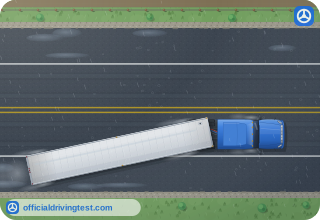
Only the tractor has ABS and the trailer begins to swing out. What should you do if it is safe?
- Brake harder to straighten the trailer
- Turn the wheel sharply the other way
- Let up on the brakes
Show answer
Correct answer: Let up on the brakes
The trailer has no ABS and can still swing out. Easing off the brakes, if safe, helps you keep control.
Source: CDL manual, national model as printed by New Jersey, Sections 1 to 3 (July 2017)
-
What benefit do you get when only the trailer has ABS?
- The trailer has less tendency to swing wide
- The tractor is less likely to jackknife
- The tractor always keeps steering control
Show answer
Correct answer: The trailer has less tendency to swing wide
ABS on the trailer makes it less likely to swing out.
Source: CDL manual, national model as printed by New Jersey, Sections 1 to 3 (July 2017)
-
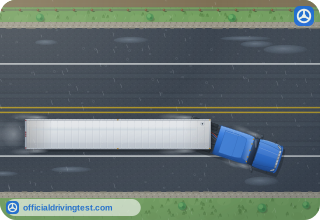
Only the trailer has ABS and the tractor starts to jackknife. What should you do if it is safe?
- Apply the brakes fully down
- Speed up to pull the trailer straight
- Let up on the brakes until control returns
Show answer
Correct answer: Let up on the brakes until control returns
With ABS only on the trailer, the tractor can still lose steering or jackknife. If safe, ease off the brakes until you regain control.
Source: CDL manual, national model as printed by New Jersey, Sections 1 to 3 (July 2017)
-
How much braking force should you use in a vehicle with ABS in a normal stop?
- Full force every time, for the ABS
- Only what is needed to stop safely
- Very light force, letting ABS do the work
Show answer
Correct answer: Only what is needed to stop safely
Brake the way you always have, using just the force needed to stop safely while staying in control.
Source: CDL manual, national model as printed by New Jersey, Sections 1 to 3 (July 2017)
-
While slowing a tractor-trailer with ABS, what should you keep doing?
- Watch the rig and back off if it is safe
- Hold the brake pedal at full pressure
- Pump the pedal quickly to help the ABS
Show answer
Correct answer: Watch the rig and back off if it is safe
Keep watching the whole combination and ease off the brakes when it is safe, to stay in control.
Source: CDL manual, national model as printed by New Jersey, Sections 1 to 3 (July 2017)
-
When may you fully apply the brakes in an emergency stop with ABS?
- When any single axle has working ABS
- When all axles have working ABS
- Only when the vehicle is completely empty
Show answer
Correct answer: When all axles have working ABS
The one exception to brake-as-usual: with working ABS on every axle, an emergency stop allows full brake application.
Source: CDL manual, national model as printed by New Jersey, Sections 1 to 3 (July 2017)
-
What color is the lamp that warns of an ABS problem?
- Red
- Blue
- Yellow
Show answer
Correct answer: Yellow
ABS vehicles use a yellow malfunction lamp to show that the system has a problem.
Source: CDL manual, national model as printed by New Jersey, Sections 1 to 3 (July 2017)
-
Your ABS stops working while you drive. What is the right approach?
- Drive normally and have it serviced soon
- Pump the pedal hard at every stop
- Park the vehicle since it has no brakes
Show answer
Correct answer: Drive normally and have it serviced soon
The normal brakes still work when ABS fails, so you drive and brake as usual and get the ABS repaired soon.
Source: CDL manual, national model as printed by New Jersey, Sections 1 to 3 (July 2017)
-
How should ABS change the way you choose speed and following distance?
- It lets you follow somewhat closer
- It does not change them at all
- It lets you drive a bit faster
Show answer
Correct answer: It does not change them at all
ABS gives no reason to speed up, tailgate or drive with less care.
Source: CDL manual, national model as printed by New Jersey, Sections 1 to 3 (July 2017)
-
Which kind of skid can ABS NOT prevent?
- A skid from locking wheels in hard braking
- A skid from spinning the drive wheels
- A jackknife started by over braking
Show answer
Correct answer: A skid from spinning the drive wheels
ABS stops brake-caused skids, but it cannot stop skids from spinning the drive wheels or from entering a turn too fast.
Source: CDL manual, national model as printed by New Jersey, Sections 1 to 3 (July 2017)
-
What does ABS reliably give you when you brake hard?
- A much shorter stopping distance
- More braking power than normal brakes
- Better control of the vehicle
Show answer
Correct answer: Better control of the vehicle
ABS helps you keep control, but it does not always make the stopping distance shorter.
Source: CDL manual, national model as printed by New Jersey, Sections 1 to 3 (July 2017)
-
A vehicle has worn, poorly kept brakes and ABS. What can you expect from the ABS?
- It will not make up for the weak brakes
- It will make up for the weak brakes
- It will warn you before the brakes fade
Show answer
Correct answer: It will not make up for the weak brakes
ABS cannot make up for bad brakes or poor brake upkeep, so the brakes must still be kept in good shape.
Source: CDL manual, national model as printed by New Jersey, Sections 1 to 3 (July 2017)
-
Which is the best safety feature a vehicle can have?
- Antilock brakes
- Air brakes on every axle
- A safe driver
Show answer
Correct answer: A safe driver
No equipment beats a safe driver, ABS included.
Source: CDL manual, national model as printed by New Jersey, Sections 1 to 3 (July 2017)
-
What is the right attitude toward ABS while on the road?
- Count on it to cover for hard braking
- Drive so you never have to depend on it
- Brake later, since the stop will be shorter
Show answer
Correct answer: Drive so you never have to depend on it
Drive so you never need ABS; if you do need it, it could help prevent a serious crash.
Source: CDL manual, national model as printed by New Jersey, Sections 1 to 3 (July 2017)
-
When does a skid happen?
- Only when the brakes lock the wheels
- The tires stop gripping the pavement
- Only when the drive wheels spin
Show answer
Correct answer: The tires stop gripping the pavement
A skid is the loss of tire grip on the road, and it can come from over-braking, over-steering, over-acceleration or too much speed.
Source: CDL manual, national model as printed by New Jersey, Sections 1 to 3 (July 2017)
-
Which cause of skids is hard braking that locks up the wheels?
- Over-acceleration
- Driving too fast
- Over-braking
Show answer
Correct answer: Over-braking
Over-braking locks the wheels, and locked wheels slide instead of gripping.
Source: CDL manual, national model as printed by New Jersey, Sections 1 to 3 (July 2017)
6Part 617 questions
-
Which device can cause a skid if you use it on a slippery road?
- The cruise control
- The speed retarder
- The parking brake valve
Show answer
Correct answer: The speed retarder
A speed retarder acts like braking, so on a slippery road it can make the tires lose their grip.
Source: CDL manual, national model as printed by New Jersey, Sections 1 to 3 (July 2017)
-
Which skid cause means the steering turn is tighter than the vehicle is able to follow?
- Over-acceleration
- Over-steering
- Driving too fast
Show answer
Correct answer: Over-steering
Over-steering means the turn is tighter than the vehicle can follow, so the tires lose grip.
Source: CDL manual, national model as printed by New Jersey, Sections 1 to 3 (July 2017)
-
Giving the drive wheels so much power that they spin is which cause of skids?
- Over-acceleration
- Over-braking
- Over-steering
Show answer
Correct answer: Over-acceleration
Over-acceleration sends too much power to the drive wheels, so they spin and lose grip.
Source: CDL manual, national model as printed by New Jersey, Sections 1 to 3 (July 2017)
-
What lies behind most serious skids?
- Turning the wheel too slowly in a curve
- Driving too fast for the road conditions
- Tires inflated a little too high
Show answer
Correct answer: Driving too fast for the road conditions
Excess speed for the conditions is behind most serious skids. Drivers who match speed to conditions avoid over-braking and over-steering caused by too much speed.
Source: CDL manual, national model as printed by New Jersey, Sections 1 to 3 (July 2017)
-
Which skid is by far the most common?
- The rear wheels losing traction
- The front wheels sliding in a curve
- The trailer wheels dragging evenly
Show answer
Correct answer: The rear wheels losing traction
The most common skid is the drive-wheel skid, where the rear wheels lose traction from too much braking or acceleration.
Source: CDL manual, national model as printed by New Jersey, Sections 1 to 3 (July 2017)
-
On what kind of road surface do acceleration skids usually happen?
- Gravel roads
- Freshly oiled asphalt
- Ice or snow
Show answer
Correct answer: Ice or snow
Acceleration skids usually happen on ice or snow, where the drive wheels spin easily.
Source: CDL manual, national model as printed by New Jersey, Sections 1 to 3 (July 2017)
-
Your drive wheels spin from too much power. What stops the skid?
- Press the brake pedal firmly
- Shift into a lower gear
- Ease off the accelerator
Show answer
Correct answer: Ease off the accelerator
Taking your foot off the accelerator usually ends an acceleration skid. On a very slippery road, push the clutch in too.
Source: CDL manual, national model as printed by New Jersey, Sections 1 to 3 (July 2017)
-
Why push the clutch in during an acceleration skid on a very slippery road?
- The engine could keep the wheels from regaining grip
- The clutch adds braking force to the rear wheels
- The engine would stall and lock the steering
Show answer
Correct answer: The engine could keep the wheels from regaining grip
With the engine still connected, the wheels cannot spin freely, so they may not get their grip back.
Source: CDL manual, national model as printed by New Jersey, Sections 1 to 3 (July 2017)
-
In a rear wheel braking skid, which way do the rear wheels usually slide?
- Straight ahead
- Backward, dragging straight behind
- Sideways
Show answer
Correct answer: Sideways
Locked wheels grip less than rolling wheels, so the rear of the vehicle slides sideways.
Source: CDL manual, national model as printed by New Jersey, Sections 1 to 3 (July 2017)
-
In a rear wheel braking skid, which vehicle typically spins out instead of jackknifing?
- A tractor pulling a trailer
- A bus or straight truck
- A combination with a long trailer
Show answer
Correct answer: A bus or straight truck
A bus or straight truck spins out when its rear wheels lock, while a trailer can push a towing vehicle into a jackknife.
Source: CDL manual, national model as printed by New Jersey, Sections 1 to 3 (July 2017)
-
What can a drive-wheel skid do to a vehicle that is towing a trailer?
- Let the trailer push the tractor sideways
- Make the trailer lift off its wheels
- Lock the trailer's brakes while the tractor rolls
Show answer
Correct answer: Let the trailer push the tractor sideways
The trailer can shove the towing vehicle sideways and cause a sudden jackknife.
Source: CDL manual, national model as printed by New Jersey, Sections 1 to 3 (July 2017)
-
Your rear wheels lock and begin to skid. What is the first correction?
- Release the brakes
- Brake a little harder
- Turn the wheel sharply
Show answer
Correct answer: Release the brakes
Letting off the brakes lets the rear wheels roll again, which keeps them from sliding.
Source: CDL manual, national model as printed by New Jersey, Sections 1 to 3 (July 2017)
-
Why must you steer back the other way quickly as the vehicle straightens out of a skid?
- The front tires need to cool down after the skid
- It tends to keep turning and may skid the other way
- The trailer brakes stay applied until you steer back
Show answer
Correct answer: It tends to keep turning and may skid the other way
A vehicle returning to course tends to keep turning. Without a quick counter-steer it can skid the other way.
Source: CDL manual, national model as printed by New Jersey, Sections 1 to 3 (July 2017)
-
Where is the best place to practice skid recovery?
- On a quiet stretch of country road
- On an empty highway entrance ramp
- On a big driving range or a skid pad
Show answer
Correct answer: On a big driving range or a skid pad
Staying off the brake, steering quickly, pushing in the clutch and counter-steering take much practice, best done on a driving range or skid pad.
Source: CDL manual, national model as printed by New Jersey, Sections 1 to 3 (July 2017)
-
Besides excess speed, which cargo problem can lead to a front-wheel skid?
- Too much weight on the front axle
- Cargo loaded very high on the trailer
- Too little weight on the front axle
Show answer
Correct answer: Too little weight on the front axle
Cargo loaded so that too little weight rests on the front axle can cause a front-wheel skid, as can worn front tread.
Source: CDL manual, national model as printed by New Jersey, Sections 1 to 3 (July 2017)
-
What happens to the vehicle in a front-wheel skid?
- The front end keeps going straight
- The rear end swings around the front
- The vehicle turns more sharply than you steer
Show answer
Correct answer: The front end keeps going straight
When the front tires skid, the vehicle keeps heading straight ahead, however far you turn the wheel.
Source: CDL manual, national model as printed by New Jersey, Sections 1 to 3 (July 2017)
-
What is the only way to end a front-wheel skid?
- Steer harder in the skid direction
- Accelerate gently out of it
- Let the vehicle slow down
Show answer
Correct answer: Let the vehicle slow down
Stop turning and braking so hard, and slow down as quickly as you can without skidding.
Source: CDL manual, national model as printed by New Jersey, Sections 1 to 3 (July 2017)