General Knowledge: Driving emergencies, ABS and skids — Part 4
Questions in this part include: “What is the main benefit of ABS during hard braking?” · “Where do you look for the ABS malfunction lamp on a trailer?”
Independent educational site · not affiliated with any government agency or DMV
Ready? Test yourself
Answer to start, or tap Start below:
What is the main benefit of ABS during hard braking?
- Instant feedback with an explanation
- Every answer cites its source in the manual
- Your best score is saved on this device
- Keyboard: press 1 to 3 to answer and Enter for the next question
Questions are written in our own words from the CDL manual; they are not the real test's questions. With your state chosen, every answer gives its page in your state's CDL manual. Without a state, answers cite the CDL manual, national model as printed by New Jersey (July 2017).
All 18 questions in this practice test
Take the test above first, then use this list to study. Tap “Show answer” to see the correct answer and explanation.
Show the questions and answersHide the questions
-
What is the main benefit of ABS during hard braking?
- It always shortens the stopping distance
- It helps you keep the vehicle under control
- It lets you follow other vehicles closer
Show answer
Correct answer: It helps you keep the vehicle under control
ABS may not shorten the stop, but it helps you stay in control while braking hard.
Source: CDL manual, national model as printed by New Jersey, Sections 1 to 3 (July 2017)
-
When sensors detect that a wheel may lock, what does the ABS electronic control unit do?
- It raises the brake pressure
- It turns off the brakes for that axle
- It lowers the brake pressure
Show answer
Correct answer: It lowers the brake pressure
The control unit reduces brake pressure so the wheel keeps turning.
Source: CDL manual, national model as printed by New Jersey, Sections 1 to 3 (July 2017)
-
How does ABS adjust brake pressure while you brake hard?
- It keeps pressure low so lockup can never start
- It gives the most braking possible without wheel lockup
- It gives full pressure until a wheel locks, then releases
Show answer
Correct answer: It gives the most braking possible without wheel lockup
ABS varies the pressure so braking is as strong as it can be while the wheels keep from locking.
Source: CDL manual, national model as printed by New Jersey, Sections 1 to 3 (July 2017)
-
How does the speed of ABS compare with a driver's reaction to wheel lockup?
- About the same speed as a trained driver
- Far faster than the driver can respond
- Much slower, so the driver must help it
Show answer
Correct answer: Far faster than the driver can respond
ABS reacts to a possible lockup much more quickly than any driver could.
Source: CDL manual, national model as printed by New Jersey, Sections 1 to 3 (July 2017)
-
Truck tractors with air brakes must have ABS if they were built on or after which date?
- March 1, 1998
- March 1, 1997
- March 1, 1999
Show answer
Correct answer: March 1, 1997
Air-braked truck tractors built on or after March 1, 1997 are required to have ABS.
Source: CDL manual, national model as printed by New Jersey, Sections 1 to 3 (July 2017)
-
Air-braked trucks, buses, trailers and converter dollies must have ABS if built on or after which date?
- March 1, 1998
- March 1, 1997
- March 1, 1999
Show answer
Correct answer: March 1, 1998
Other air brake vehicles, including trailers and converter dollies, need ABS if built on or after March 1, 1998.
Source: CDL manual, national model as printed by New Jersey, Sections 1 to 3 (July 2017)
-
A hydraulically braked truck rated 10,000 lbs or more must have ABS if built on or after which date?
- March 1, 1998
- March 1, 1999
- March 1, 1997
Show answer
Correct answer: March 1, 1999
Hydraulic-brake trucks and buses of 10,000 lbs or more need ABS when built on or after March 1, 1999.
Source: CDL manual, national model as printed by New Jersey, Sections 1 to 3 (July 2017)
-
A commercial vehicle was built before the dates that made ABS mandatory. Can it have ABS?
- No, ABS cannot be added to older vehicles
- Only if it has hydraulic brakes
- Yes, many were fitted with it voluntarily
Show answer
Correct answer: Yes, many were fitted with it voluntarily
Many older commercial vehicles were voluntarily equipped with ABS even though it was not yet required.
Source: CDL manual, national model as printed by New Jersey, Sections 1 to 3 (July 2017)
-
What color is the ABS malfunction lamp on a tractor, truck or bus, and where is it?
- Red, on the left side of the cab
- Yellow, on the left rear corner
- Yellow, on the instrument panel
Show answer
Correct answer: Yellow, on the instrument panel
Tractors, trucks and buses show a yellow ABS warning lamp on the instrument panel.
Source: CDL manual, national model as printed by New Jersey, Sections 1 to 3 (July 2017)
-
Where do you look for the ABS malfunction lamp on a trailer?
- On the right side, near the landing gear
- Inside the tractor cab, on the panel
- On the left side, at a front or rear corner
Show answer
Correct answer: On the left side, at a front or rear corner
A trailer carries its yellow ABS lamp on the left side, at either the front or rear corner.
Source: CDL manual, national model as printed by New Jersey, Sections 1 to 3 (July 2017)
-
On which side of a converter dolly must its ABS lamp be?
- On the right side
- Underneath, at the center
- On the left side
Show answer
Correct answer: On the left side
Dollies made on or after March 1, 1998 must have the ABS lamp on their left side.
Source: CDL manual, national model as printed by New Jersey, Sections 1 to 3 (July 2017)
-
What should the ABS lamp do at start-up on a newer vehicle that is working normally?
- Stay lit until you pass five mph
- Flash until the brakes are applied
- Light briefly, then go out quickly
Show answer
Correct answer: Light briefly, then go out quickly
On newer vehicles the lamp lights at start-up as a bulb check and soon goes out.
Source: CDL manual, national model as printed by New Jersey, Sections 1 to 3 (July 2017)
-
On an older ABS system, how long might the malfunction lamp normally stay on?
- Until the engine has run for a minute
- Until you are driving over five mph
- Until you are driving over 25 mph
Show answer
Correct answer: Until you are driving over five mph
Newer systems turn the lamp off quickly after start-up. On older systems it can stay lit until the vehicle passes five mph.
Source: CDL manual, national model as printed by New Jersey, Sections 1 to 3 (July 2017)
-
The ABS lamp stays lit after the start-up bulb check. What may this mean?
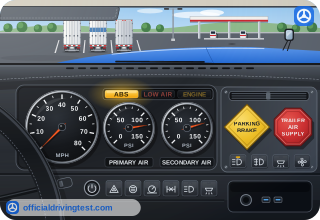
- The ABS is working at full strength
- The brakes are cold and need warming up
- You may have lost ABS control
Show answer
Correct answer: You may have lost ABS control
A lamp that stays on after the bulb check, or comes on while driving, can mean the ABS has stopped working.
Source: CDL manual, national model as printed by New Jersey, Sections 1 to 3 (July 2017)
-
An older towed unit has no obvious ABS lamp. How can you tell whether it has ABS?
- Check the tire size on the sidewall
- Count the number of axles under it
- Look under it for the ECU and wires
Show answer
Correct answer: Look under it for the ECU and wires
On older towed units it can be hard to tell. Looking underneath for the control unit and sensor wires from the brakes shows if ABS is fitted.
Source: CDL manual, national model as printed by New Jersey, Sections 1 to 3 (July 2017)
-
On a vehicle without ABS, what happens if the steering wheels lock up during hard braking?
- You lose steering control
- The vehicle spins around
- The trailer jackknifes
Show answer
Correct answer: You lose steering control
Locked front wheels slide instead of steering, so you can no longer steer.
Source: CDL manual, national model as printed by New Jersey, Sections 1 to 3 (July 2017)
-
On a vehicle without ABS, what may happen when wheels other than the steering wheels lock?
- You lose steering control only
- You may skid, jackknife, or spin
- The brakes release by themselves
Show answer
Correct answer: You may skid, jackknife, or spin
Locked non-steering wheels can lead to a skid, a jackknife or a spin.
Source: CDL manual, national model as printed by New Jersey, Sections 1 to 3 (July 2017)
-
With working ABS, what can you do that is hard without it when braking hard for an obstacle?
- Steer around the obstacle while braking
- Stop in a shorter distance every time
- Drive faster in wet conditions
Show answer
Correct answer: Steer around the obstacle while braking
ABS keeps the wheels rolling, so you can still steer past an obstacle while braking, and over-braking skids are avoided.
Source: CDL manual, national model as printed by New Jersey, Sections 1 to 3 (July 2017)