General Knowledge: 30 Hardest Questions
Questions that need a second thought, picked for close numbers, exceptions and easy-to-confuse rules. Take your time.
Independent educational site · not affiliated with any government agency or DMV
Ready? Test yourself
Answer to start, or tap Start below:
What is the smallest tread depth a front tire may have in each major groove?
- Instant feedback with an explanation
- Every answer cites its source in the manual
- Your best score is saved on this device
- Keyboard: press 1 to 3 to answer and Enter for the next question
Questions are written in our own words from the CDL manual; they are not the real test's questions. With your state chosen, every answer gives its page in your state's CDL manual. Without a state, answers cite the CDL manual, national model as printed by New Jersey (July 2017).
All 30 questions in this practice test
Take the test above first, then use this list to study. Tap “Show answer” to see the correct answer and explanation.
Show the questions and answersHide the questions
-
What is the smallest tread depth a front tire may have in each major groove?
- 2/32 inch
- 4/32 inch
- 6/32 inch
Show answer
Correct answer: 4/32 inch
Front tires need at least 4/32 inch of tread in every major groove. Other tires need at least 2/32 inch.
Source: CDL manual, national model as printed by New Jersey, Sections 1 to 3 (July 2017)
-
A car ahead brakes hard near a freeway exit. When does this hazard become an emergency?
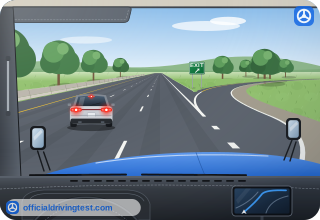
- When that driver cuts in front of you
- As soon as its brake lights come on
- When you first slow down to prepare
Show answer
Correct answer: When that driver cuts in front of you
The braking car is a hazard because it might do something sudden. It becomes an emergency only when the driver actually cuts in front of you.
Source: CDL manual, national model as printed by New Jersey, Sections 1 to 3 (July 2017)
-
A truck with a high center of gravity takes a curve at the posted limit. What is the risk?
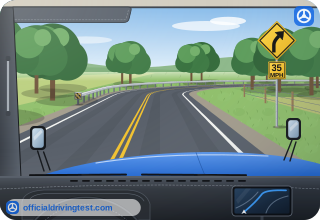
- Its brakes may overheat
- Its engine may stall
- It may roll over
Show answer
Correct answer: It may roll over
Tall-centered trucks may tip over even when they stay within the limit shown for the curve.
Source: CDL manual, national model as printed by New Jersey, Sections 1 to 3 (July 2017)
-
A combination has a GCWR of 26,001 pounds or more. To count as a Class A combination, the towed vehicle needs a GVWR of what weight?
- More than 6,000 pounds
- More than 26,000 pounds
- More than 10,000 pounds
Show answer
Correct answer: More than 10,000 pounds
A combination with a GCWR of 26,001 pounds or more is in Class A when the towed unit's GVWR is over 10,000 pounds.
Source: CDL manual, national model as printed by New Jersey, Sections 1 to 3 (July 2017)
-
The tire pressure rises in very hot weather. What should you do about it?
- Let air out until it reads normal
- Leave the air in the tires
- Add more air to balance it
Show answer
Correct answer: Leave the air in the tires
Heat raises tire pressure, but air you release would leave the tires underinflated once they cool.
Source: CDL manual, national model as printed by New Jersey, Sections 1 to 3 (July 2017)
-
You are making a left turn and there are two left-turn lanes. Which lane should a large vehicle use?
- The lane with less traffic
- The left-hand turning lane
- The right-hand turning lane
Show answer
Correct answer: The right-hand turning lane
Starting in the inside lane may force you to swing right, and drivers on your left can be seen more easily.
Source: CDL manual, national model as printed by New Jersey, Sections 1 to 3 (July 2017)
-
You commit three or more serious traffic violations in a CMV within three years. What is the minimum time you lose your CDL?
- 90 days
- 120 days
- 180 days
Show answer
Correct answer: 120 days
Three or more serious violations in a three-year period cost you the CDL for at least 120 days.
Source: CDL manual, national model as printed by New Jersey, Sections 1 to 3 (July 2017)
-
About how far ahead can you see with high beams at night?
- About 150 to 250 feet
- About 350 to 500 feet
- About 600 to 800 feet
Show answer
Correct answer: About 350 to 500 feet
High beams reach about 350 to 500 feet, which is farther than low beams but still limited.
Source: CDL manual, national model as printed by New Jersey, Sections 1 to 3 (July 2017)
-
On a vehicle that uses progressive shifting, how does the shift rpm change as you move up through the gears?
- It becomes lower in each higher gear
- It becomes higher in each higher gear
- It stays the same in every gear
Show answer
Correct answer: It becomes higher in each higher gear
With this style of shifting, the rpm for each shift rises the higher you go through the gears.
Source: CDL manual, national model as printed by New Jersey, Sections 1 to 3 (July 2017)
-
By federal rules, the combined working load limit of the tie-downs must be at least what part of the cargo's weight?
- Half of the weight of the cargo
- The full weight of the cargo
- Twice the weight of the cargo
Show answer
Correct answer: Half of the weight of the cargo
The securement system's aggregate working load limit must reach at least one-half of the weight of the cargo it holds.
Source: CDL manual, national model as printed by New Jersey, Sections 1 to 3 (July 2017)
-
What does an A:B:C extinguisher handle that a B:C type does not?
- Wood, paper and cloth fires
- Electrical equipment fires
- Burning gasoline
Show answer
Correct answer: Wood, paper and cloth fires
The A:B:C type covers electrical fires and burning liquids like the B:C type, and also wood, paper and cloth.
Source: CDL manual, national model as printed by New Jersey, Sections 1 to 3 (July 2017)
-
You drive a load between two cities in the same state. The load started its trip in another state. What kind of commerce is this?
- Intrastate commerce, because both stops are in one state
- Excepted commerce, because the distance is short
- Interstate commerce, because the trip began in another state
Show answer
Correct answer: Interstate commerce, because the trip began in another state
A trip that started in, or ends in, another state or country is interstate commerce, even for a leg that stays inside one state.
Source: CDL manual, national model as printed by New Jersey, Sections 1 to 3 (July 2017)
-
You must return to the pavement before you can stop. How should you do it?
- Edge back onto the road a little at a time
- Brake hard first, then turn back slowly
- Turn sharply and hold the wheel tightly to return
Show answer
Correct answer: Turn sharply and hold the wheel tightly to return
A gradual return can make the tires grab suddenly and cause a loss of control. A firm, sharp turn back onto the road is safer.
Source: CDL manual, national model as printed by New Jersey, Sections 1 to 3 (July 2017)
-
You stop on a divided highway. Where do you place your three warning devices?
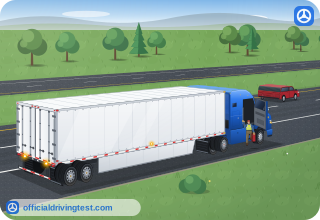
- At 10, 50 and 100 feet toward the approaching traffic
- At 10, 100 and 200 feet toward the approaching traffic
- At 100, 200 and 300 feet behind the vehicle only on the shoulder
Show answer
Correct answer: At 10, 100 and 200 feet toward the approaching traffic
On a one-way or divided highway, place them 10, 100 and 200 feet back toward the approaching traffic.
Source: CDL manual, national model as printed by New Jersey, Sections 1 to 3 (July 2017)
-
Which action counts as using a hand-held mobile phone under the federal rule?
- Pressing a single button to answer
- Dialing by pressing more than one button
- Hearing a call through an earpiece
Show answer
Correct answer: Dialing by pressing more than one button
Dialing by pressing more than a single button counts as hand-held use, as does holding the phone for a voice call.
Source: CDL manual, national model as printed by New Jersey, Sections 1 to 3 (July 2017)
-
No stop line is painted. How far from the nearest rail must a vehicle that has to stop at a crossing stop?
- At least 15 feet but not over 50 feet
- At least 5 feet but not over 15 feet
- At least 50 feet but not over 100 feet
Show answer
Correct answer: At least 15 feet but not over 50 feet
With no painted line, a vehicle that has to stop waits at least 15 feet and no more than 50 feet back from the closest rail.
Source: CDL manual, national model as printed by New Jersey, Sections 1 to 3 (July 2017)
-
A driver with a hazardous materials endorsement is convicted of a disqualifying crime. How soon must the endorsement be surrendered to the issuing state?
- Within 24 hours
- Within two business days
- Within 30 days
Show answer
Correct answer: Within 24 hours
The driver must notify the issuing state and surrender the endorsement within 24 hours of the conviction or indictment.
Source: CDL manual, national model as printed by New Jersey, Sections 1 to 3 (July 2017)
-
In a rear wheel braking skid, which vehicle typically spins out instead of jackknifing?
- A tractor pulling a trailer
- A bus or straight truck
- A combination with a long trailer
Show answer
Correct answer: A bus or straight truck
A bus or straight truck spins out when its rear wheels lock, while a trailer can push a towing vehicle into a jackknife.
Source: CDL manual, national model as printed by New Jersey, Sections 1 to 3 (July 2017)
-
After the first cargo securement check, how often must a truck driver check the cargo again?
- Every 200 miles or four hours, whichever is first
- Every 150 miles or three hours, whichever is first
- Every 300 miles or five hours, whichever is first
Show answer
Correct answer: Every 150 miles or three hours, whichever is first
Once the first check is done, check the cargo again after 150 miles of driving or three hours, whichever passes first.
Source: CDL manual, national model as printed by New Jersey, Sections 1 to 3 (July 2017)
-
Cargo is loaded too far toward the rear of the vehicle. What problem can this cause at the front?
- The steering axle is too light to steer the vehicle safely
- The steering axle gets too heavy and the steering wheel turns hard
- The front brakes lock up each time the driver slows down
Show answer
Correct answer: The steering axle is too light to steer the vehicle safely
Loading too far to the rear takes weight off the front axle. With too little weight on it, the truck cannot be steered safely.
Source: CDL manual, national model as printed by New Jersey, Sections 1 to 3 (July 2017)
-
If you go from 20 mph to 60 mph, how much greater are the impact and the braking distance?
- 3 times greater
- 9 times greater
- 12 times greater
Show answer
Correct answer: 9 times greater
Three times the speed gives 9 times the impact and 9 times the braking distance.
Source: CDL manual, national model as printed by New Jersey, Sections 1 to 3 (July 2017)
-
You commit a third railroad-highway grade crossing violation within three years. What is the minimum time you lose your CDL?
- 120 days
- One year
- 60 days
Show answer
Correct answer: One year
A third crossing violation in a three-year period costs you the CDL for at least one year.
Source: CDL manual, national model as printed by New Jersey, Sections 1 to 3 (July 2017)
-
When may you fully apply the brakes in an emergency stop with ABS?
- When any single axle has working ABS
- When all axles have working ABS
- Only when the vehicle is completely empty
Show answer
Correct answer: When all axles have working ABS
The one exception to brake-as-usual: with working ABS on every axle, an emergency stop allows full brake application.
Source: CDL manual, national model as printed by New Jersey, Sections 1 to 3 (July 2017)
-
A tank endorsement is required when the vehicle carries tanks that total 1,000 gallons or more and each tank holds more than what amount?
- More than 1,000 gallons
- More than 199 gallons
- More than 119 gallons
Show answer
Correct answer: More than 119 gallons
The tank endorsement applies when each tank is rated for more than 119 gallons and the tanks together are rated for 1,000 gallons or more.
Source: CDL manual, national model as printed by New Jersey, Sections 1 to 3 (July 2017)
-
After you release the brakes in stab braking, how long can it take for the wheels to start rolling?
- Up to one second
- Up to five seconds
- Less than a tenth of a second
Show answer
Correct answer: Up to one second
It can take up to one second. If you press the brakes again before the wheels roll, the vehicle will not straighten out.
Source: CDL manual, national model as printed by New Jersey, Sections 1 to 3 (July 2017)
-
When using the BAC chart, how much time lowers the BAC by .01%?
- 20 minutes of drinking
- 60 minutes of drinking
- 40 minutes of drinking
Show answer
Correct answer: 40 minutes of drinking
Each 40 minutes of drinking time lowers the chart figure by .01%.
Source: CDL manual, national model as printed by New Jersey, Sections 1 to 3 (July 2017)
-
How many seconds should you leave behind the vehicle ahead when driving a 60-foot rig faster than 40 mph?
- 7 seconds
- 6 seconds
- 8 seconds
Show answer
Correct answer: 7 seconds
Over 40 mph you add 1 second to the one-second-per-10-feet rule, so a 60-foot rig needs 7 seconds.
Source: CDL manual, national model as printed by New Jersey, Sections 1 to 3 (July 2017)
-
In the Large Truck Crash Causation Study, what share of large-truck crashes happened when the driver was externally distracted?
- 18 percent
- 28 percent
- 8 percent
Show answer
Correct answer: 8 percent
The study found that 8 percent of large-truck crashes happened when the CMV driver was distracted by something outside the vehicle.
Source: CDL manual, national model as printed by New Jersey, Sections 1 to 3 (July 2017)
-
Your safe speed on a downgrade is 40 mph and you have just braked from 40 mph. At what speed do you release the brakes?
- About 35 mph
- About 30 mph
- About 38 mph
Show answer
Correct answer: About 35 mph
Brake until the speed has dropped about 5 mph under your safe speed, which is 35 mph here, then release and let speed build back to 40.
Source: CDL manual, national model as printed by New Jersey, Sections 1 to 3 (July 2017)
-
Air-braked trucks, buses, trailers and converter dollies must have ABS if built on or after which date?
- March 1, 1998
- March 1, 1997
- March 1, 1999
Show answer
Correct answer: March 1, 1998
Other air brake vehicles, including trailers and converter dollies, need ABS if built on or after March 1, 1998.
Source: CDL manual, national model as printed by New Jersey, Sections 1 to 3 (July 2017)