General Knowledge: Accident procedures and fires — Part 1
Questions in this part include: “Which set lists the three basic steps to take at any accident?” · “When may you move a severely injured person?”
Independent educational site · not affiliated with any government agency or DMV
Ready? Test yourself
Answer to start, or tap Start below:
Which set lists the three basic steps to take at any accident?
- Instant feedback with an explanation
- Every answer cites its source in the manual
- Your best score is saved on this device
- Keyboard: press 1 to 3 to answer and Enter for the next question
Questions are written in our own words from the CDL manual; they are not the real test's questions. With your state chosen, every answer gives its page in your state's CDL manual. Without a state, answers cite the CDL manual, national model as printed by New Jersey (July 2017).
All 22 questions in this practice test
Take the test above first, then use this list to study. Tap “Show answer” to see the correct answer and explanation.
Show the questions and answersHide the questions
-
Which set lists the three basic steps to take at any accident?
- Protect the area, notify authorities, care for the injured
- Find the cause, call your company, move the injured
- Clear the road, take photos, notify your insurer
Show answer
Correct answer: Protect the area, notify authorities, care for the injured
The three basic steps at any accident are to protect the area, notify the authorities and care for the injured.
Source: CDL manual, national model as printed by New Jersey, Sections 1 to 3 (July 2017)
-
What should you do first when you arrive at an accident scene?
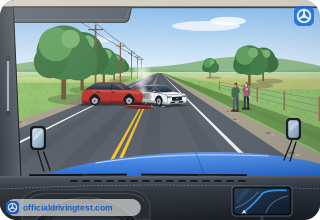
- Keep another accident from happening at the spot
- Help the injured people out of their vehicles
- Find out who caused the accident
Show answer
Correct answer: Keep another accident from happening at the spot
The first priority is to stop a second crash from happening at the same place.
Source: CDL manual, national model as printed by New Jersey, Sections 1 to 3 (July 2017)
-
Your own vehicle is in an accident and can still be driven. What should you try to do with it?
- Pull it over to the roadside
- Leave it where it stopped so police can see it
- Back it up to give other traffic more room
Show answer
Correct answer: Pull it over to the roadside
Moving your vehicle to the side helps prevent another accident and lets traffic keep moving.
Source: CDL manual, national model as printed by New Jersey, Sections 1 to 3 (July 2017)
-
You stop to help at an accident you were not part of. Where should you park?
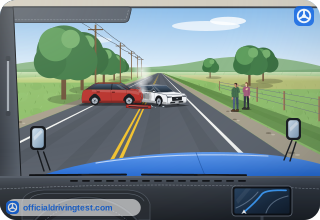
- Right beside the crashed vehicles, to light up the scene
- Away from the accident, so emergency vehicles have room
- In the lane next to the accident, to block traffic
Show answer
Correct answer: Away from the accident, so emergency vehicles have room
The area right around the accident must stay open for emergency vehicles.
Source: CDL manual, national model as printed by New Jersey, Sections 1 to 3 (July 2017)
-
Which lights should you turn on to help protect an accident area?
- Your high beams
- Your cab marker lights only
- Your flashers
Show answer
Correct answer: Your flashers
Turning on your flashers warns approaching drivers that there is a problem ahead.
Source: CDL manual, national model as printed by New Jersey, Sections 1 to 3 (July 2017)
-
When you set out reflective triangles at an accident, what must you make sure of?
- They are placed right up against the crashed vehicle
- They are set out before you turn on your flashers
- Approaching drivers can see them early enough to stop
Show answer
Correct answer: Approaching drivers can see them early enough to stop
Triangles only protect the scene if approaching drivers see them early enough to avoid the accident.
Source: CDL manual, national model as printed by New Jersey, Sections 1 to 3 (July 2017)
-
You have a cell phone or CB radio at an accident. When should you call for help?
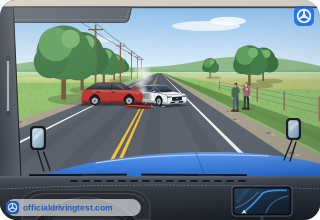
- Before you get out of your vehicle
- After you have checked all the injured people
- Once emergency vehicles are already in sight
Show answer
Correct answer: Before you get out of your vehicle
With a phone or CB, you call for help first, before leaving your vehicle.
Source: CDL manual, national model as printed by New Jersey, Sections 1 to 3 (July 2017)
-
You have no cell phone or CB at an accident. When should you phone the police, or send someone to do it?
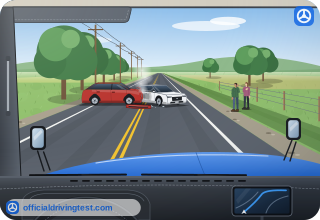
- Immediately, before doing anything else at the scene
- Once the scene has been made safe for others
- After all the injured have been taken away
Show answer
Correct answer: Once the scene has been made safe for others
With no phone or CB, make the scene safe first. After that, call the police yourself or ask someone else to call.
Source: CDL manual, national model as printed by New Jersey, Sections 1 to 3 (July 2017)
-
What should you try to determine so you can tell the police?
- Exactly where you are
- Which driver was at fault in the accident
- The names of the other drivers' insurers
Show answer
Correct answer: Exactly where you are
Rescuers need the exact location to reach the scene quickly.
Source: CDL manual, national model as printed by New Jersey, Sections 1 to 3 (July 2017)
-
A qualified person is already helping the injured at an accident. What should you do?
- Take over the care of the injured yourself
- Move the injured people away from the road
- Stay out of the way unless you are asked to help
Show answer
Correct answer: Stay out of the way unless you are asked to help
When a qualified person is helping, you should not interfere unless you are asked to assist.
Source: CDL manual, national model as printed by New Jersey, Sections 1 to 3 (July 2017)
-
No qualified person is at the accident to help the injured. What should you do?
- Leave the injured alone until police arrive
- Give the injured whatever help you can
- Only set out triangles and wait
Show answer
Correct answer: Give the injured whatever help you can
When nobody qualified is helping, you give the injured the best help you are able to.
Source: CDL manual, national model as printed by New Jersey, Sections 1 to 3 (July 2017)
-
When may you move a severely injured person?
- Whenever the person asks to sit up now
- Only if fire or traffic makes it necessary
- As soon as emergency vehicles are called
Show answer
Correct answer: Only if fire or traffic makes it necessary
A severely injured person should stay still unless fire or passing traffic makes moving unavoidable.
Source: CDL manual, national model as printed by New Jersey, Sections 1 to 3 (July 2017)
-
How do you stop heavy bleeding from an injured person?
- Apply direct pressure to the wound
- Wrap the whole limb tightly and leave it
- Wash the wound with clean water
Show answer
Correct answer: Apply direct pressure to the wound
Direct pressure on the wound is the way to stop heavy bleeding.
Source: CDL manual, national model as printed by New Jersey, Sections 1 to 3 (July 2017)
-
What simple step helps an injured person while you wait for help?
- Give the person something to drink
- Walk the person around
- Keep the person warm
Show answer
Correct answer: Keep the person warm
Keeping an injured person warm is one of the simple steps to take when giving assistance.
Source: CDL manual, national model as printed by New Jersey, Sections 1 to 3 (July 2017)
-
Which two things can start a fire after an accident?
- Spilled fuel and a cold engine
- Broken glass and loose cargo straps
- Spilled fuel and improper use of flares
Show answer
Correct answer: Spilled fuel and improper use of flares
After an accident, spilled fuel and flares used the wrong way are fire hazards.
Source: CDL manual, national model as printed by New Jersey, Sections 1 to 3 (July 2017)
-
Which tire problem can cause a vehicle fire?
- Tires with deep tread
- Tires of different brands
- Duals that touch each other
Show answer
Correct answer: Duals that touch each other
Under-inflated tires and dual tires that touch are both causes of vehicle fires.
Source: CDL manual, national model as printed by New Jersey, Sections 1 to 3 (July 2017)
-
What in the electrical system can cause a vehicle fire?
- Short circuits from damaged wire insulation
- Headlights left on while parked for hours
- A fully charged battery in a cold engine
Show answer
Correct answer: Short circuits from damaged wire insulation
Damaged wire insulation and loose connections can cause short circuits, which can start fires.
Source: CDL manual, national model as printed by New Jersey, Sections 1 to 3 (July 2017)
-
During your vehicle inspection, what must you confirm about the fire extinguisher?
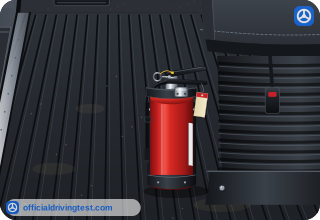
- That it holds water only
- That it is charged
- That its label shows this year's date
Show answer
Correct answer: That it is charged
As part of fire prevention, make sure the extinguisher is charged and ready to use.
Source: CDL manual, national model as printed by New Jersey, Sections 1 to 3 (July 2017)
-
At every stop during a trip, what should you look for on the tires, wheels and truck body?
- Signs of wear on the paint
- Signs of heat
- Signs of loose license plates
Show answer
Correct answer: Signs of heat
Checking for heat at each stop can reveal a fire danger before it grows.
Source: CDL manual, national model as printed by New Jersey, Sections 1 to 3 (July 2017)
-
Which activities call for correct safety procedures to prevent a fire?
- Fueling, using the brakes and handling flares
- Adjusting the seat, using the horn and wipers
- Setting the radio, dimming lights and shifting gears
Show answer
Correct answer: Fueling, using the brakes and handling flares
Fueling, braking and handling flares can all start a fire, so each must be done by the safe procedure.
Source: CDL manual, national model as printed by New Jersey, Sections 1 to 3 (July 2017)
-
While driving, how can you spot a possible fire starting?
- Listen for engine noise and watch only the road ahead
- Check the load once a trip and the gauges at each fuel stop
- Watch gauges for overheating and use mirrors to look for smoke
Show answer
Correct answer: Watch gauges for overheating and use mirrors to look for smoke
Check gauges often for overheating and use the mirrors to see smoke coming from the tires or the vehicle.
Source: CDL manual, national model as printed by New Jersey, Sections 1 to 3 (July 2017)
-
How much care does fire prevention call for when you handle anything flammable?
- Only special care when the cargo is placarded
- No extra care if the container is sealed
- Normal caution
Show answer
Correct answer: Normal caution
Handle flammable items with normal caution.
Source: CDL manual, national model as printed by New Jersey, Sections 1 to 3 (July 2017)